




 Request Quote



How to Choose a UBC Shredder for Baled Aluminum Cans
Loose aluminum cans are easy to underestimate because each can is light and relatively soft. Baled UBC is different. The shredder has to deal with a compacted mass that can be dense, spring back when opened, hold moisture, and still contain wire, straps, steel cans, plastic, glass, dirt, or other aluminum items. For equipment selection, the condition of the bale matters more than the behavior of an individual can.
For a buyer, the practical question is not “Which UBC shredder has the biggest motor?” It is: What machine can accept the agreed bale envelope, open or reduce it to the required condition, avoid unnecessary fines and aluminum loss, and feed the downstream separation system at a stable rate? The public UBC aluminum can recycling line follows the same feed-first logic: clean loose cans, mixed dry containers and dense UBC bales are different projects, and shredding is added only when the feed and output justify it.
This guide stays narrowly on shredder selection for baled UBC. It shows how to translate the baled-UBC duty into a purchasing specification, how to compare suppliers on the same basis, and how to prove the selected machine during a representative factory acceptance test.
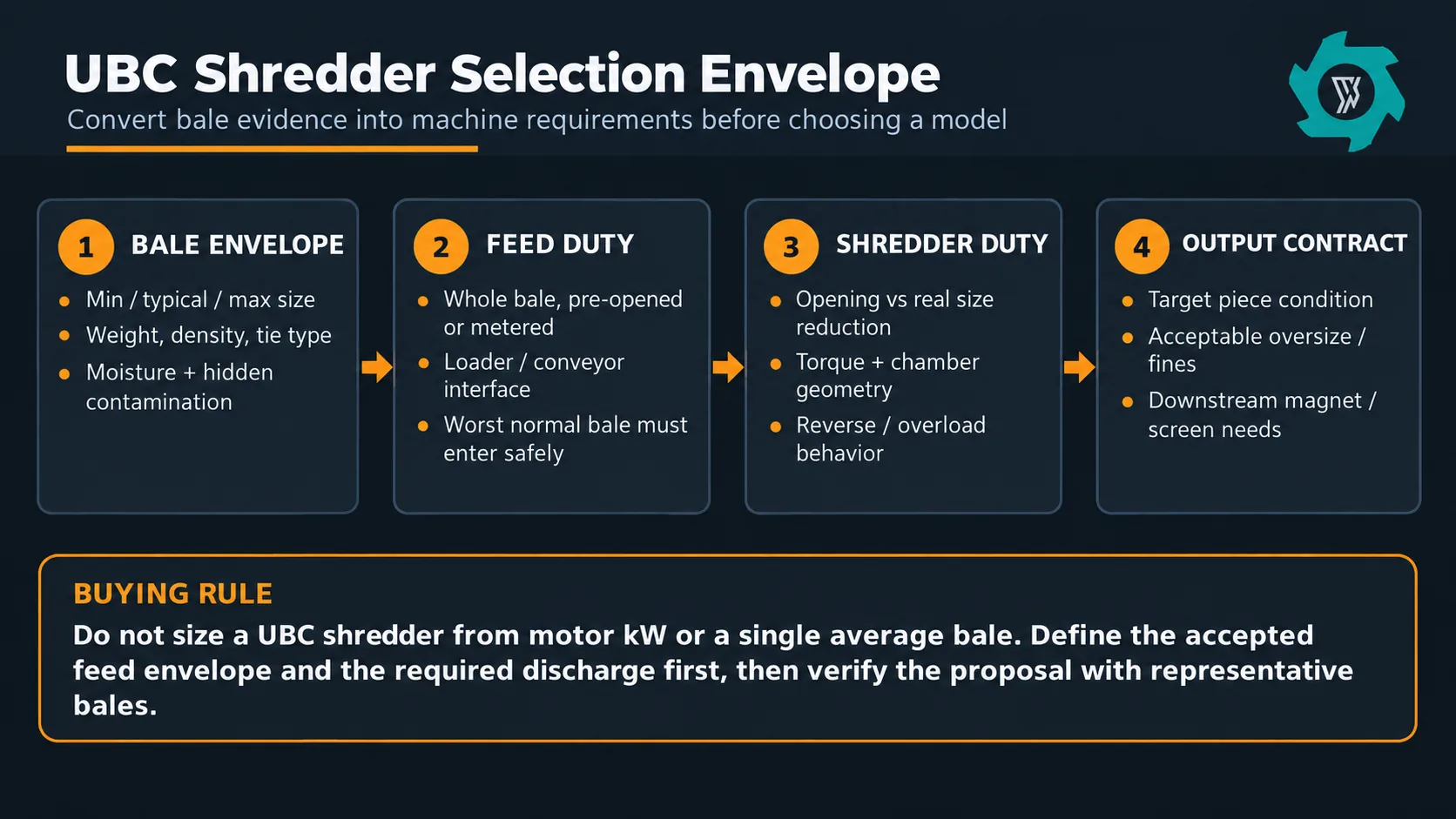
1. First Decide What the Shredder Must Actually Accomplish
“Shred baled cans” is not a complete duty statement. At least three different jobs can sit behind that phrase. A plant may only need to destroy bale coherence so magnets and operators can see trapped contamination. It may need real size reduction so the material flows through a screen or another separation stage. Or it may need a controlled shredded product because the downstream buyer has a specific commercial form in mind.
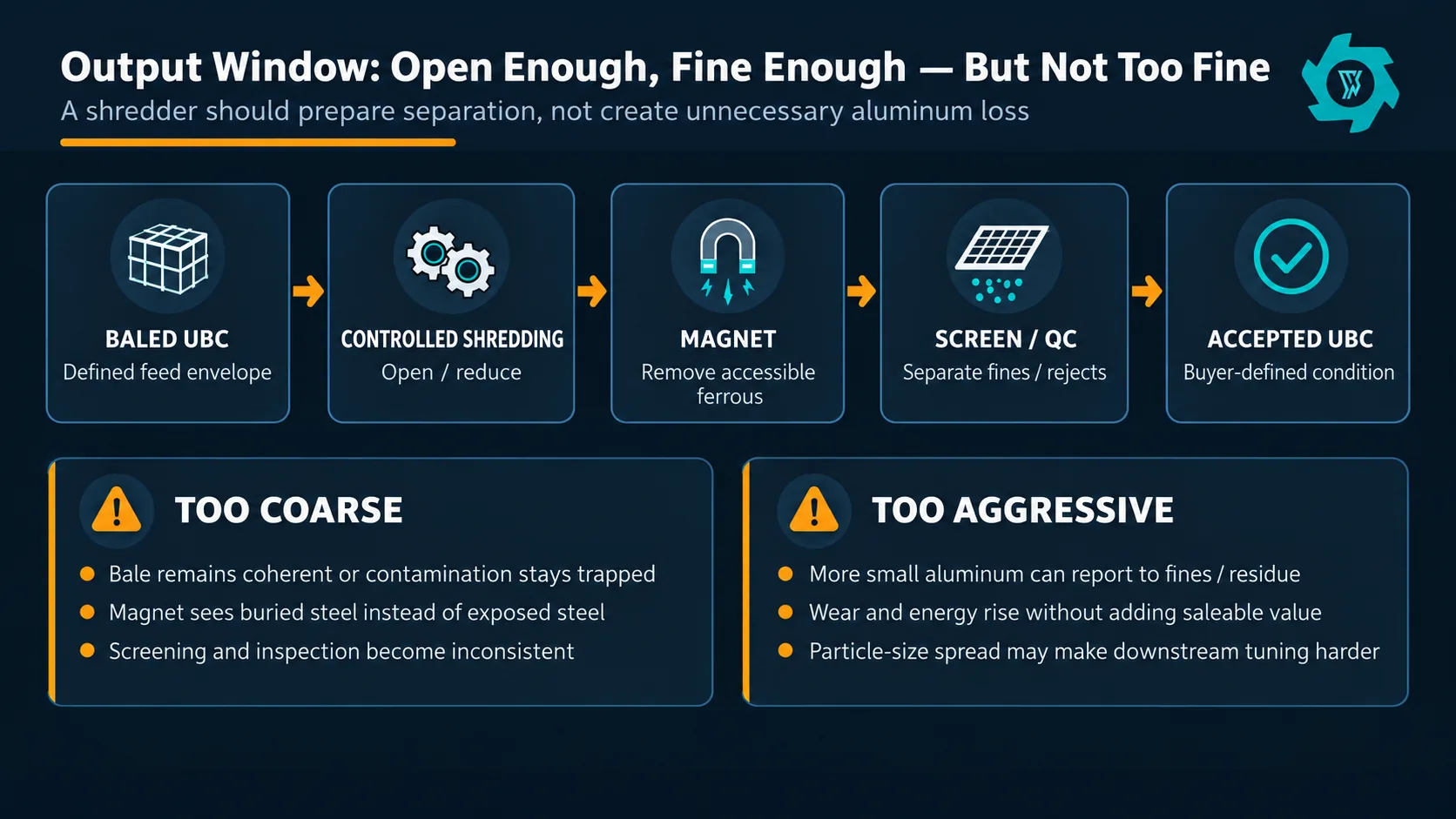
Those jobs lead to different machine settings and sometimes different machine types. If the main need is simply bale opening, aggressive cutting can be counterproductive. It can create smaller aluminum fragments, increase wear, enlarge the fines stream and make downstream housekeeping harder. If the downstream process requires a narrower particle range, however, a machine that only tears a few cracks through the bale may leave large coherent clumps and fail to expose the contaminants that the next stage is supposed to remove.
A useful procurement statement therefore describes the before-and-after condition. For example: “Accept Taldon-form bales within the approved dimensional and density envelope; release bale coherence; expose ferrous and non-metal contamination; produce a controlled loose or reduced UBC stream suitable for magnetic separation and screening; keep fines within the agreed test limit.”
2. Build a Feed Envelope Instead of Sending One Average Bale
The shredder should be selected against the range of bales the plant expects to accept. ReMA/ISRI’s Taldon description gives a useful commercial reference for baled UBC: it defines bale density, dimensional ranges and permitted tying arrangements, and it also requires magnetically separated UBC free from listed foreign substances.[1] The purpose of using that reference in equipment selection is not to assume every incoming bale is perfect. It is to understand the declared form and then document where the plant’s real receiving envelope is tighter, wider or simply different.
Your RFQ should state minimum, typical and maximum bale dimensions; bale mass; estimated density; whether cans are flattened; tie material and number; visible deformation; moisture condition; and the normal contamination range. If the plant receives material from several MRFs or traders, identify how much those variables change by source. A shredder that works smoothly on a light unflattened bale may behave very differently when the same outside dimensions contain flattened cans at a higher density.
The separate UBC bale specifications guide is the right place to go deeper into bale density, dimensions, moisture and contamination. For the shredder RFQ, the key is to convert those measurements into an accepted-feed envelope and a list of hard exclusions.
| Feed field | Why the shredder supplier needs it | What to write in the RFQ |
|---|---|---|
| Bale dimensions | Sets hopper opening, chamber width, loading method and risk of bridging at the inlet. | Minimum, typical and maximum L × W × H; deformation allowance. |
| Bale mass and density | Changes the initial bite load and the amount of material entering per loading cycle. | Range, not one average; note flattened/unflattened condition. |
| Ties | Steel straps or wire can create wrapping, entanglement and downstream ferrous load. | Material, number, location, whether removed before the machine. |
| Moisture / residual liquid | Changes paid mass, friction, housekeeping and behavior of dirt or fines. | As-received condition and any receiving limit. |
| Contamination | Controls wear, safety, separation duty and product quality. | Ferrous, plastics, glass, dirt/fines, other rejects, non-UBC aluminum. |
| Abnormal items | Defines what the machine must reject rather than “handle.” | Pressurized containers, batteries, hard steel, unknown sealed packages, hazardous material. |
3. Feed Opening and Chamber Geometry Matter More Than Catalog Model Names
Once the feed envelope is written, compare the physical path into the cutters. The hopper should accept the approved bale without encouraging operators to push or manually reposition material near the danger zone. The loading method also changes the practical infeed height and upstream buffer.
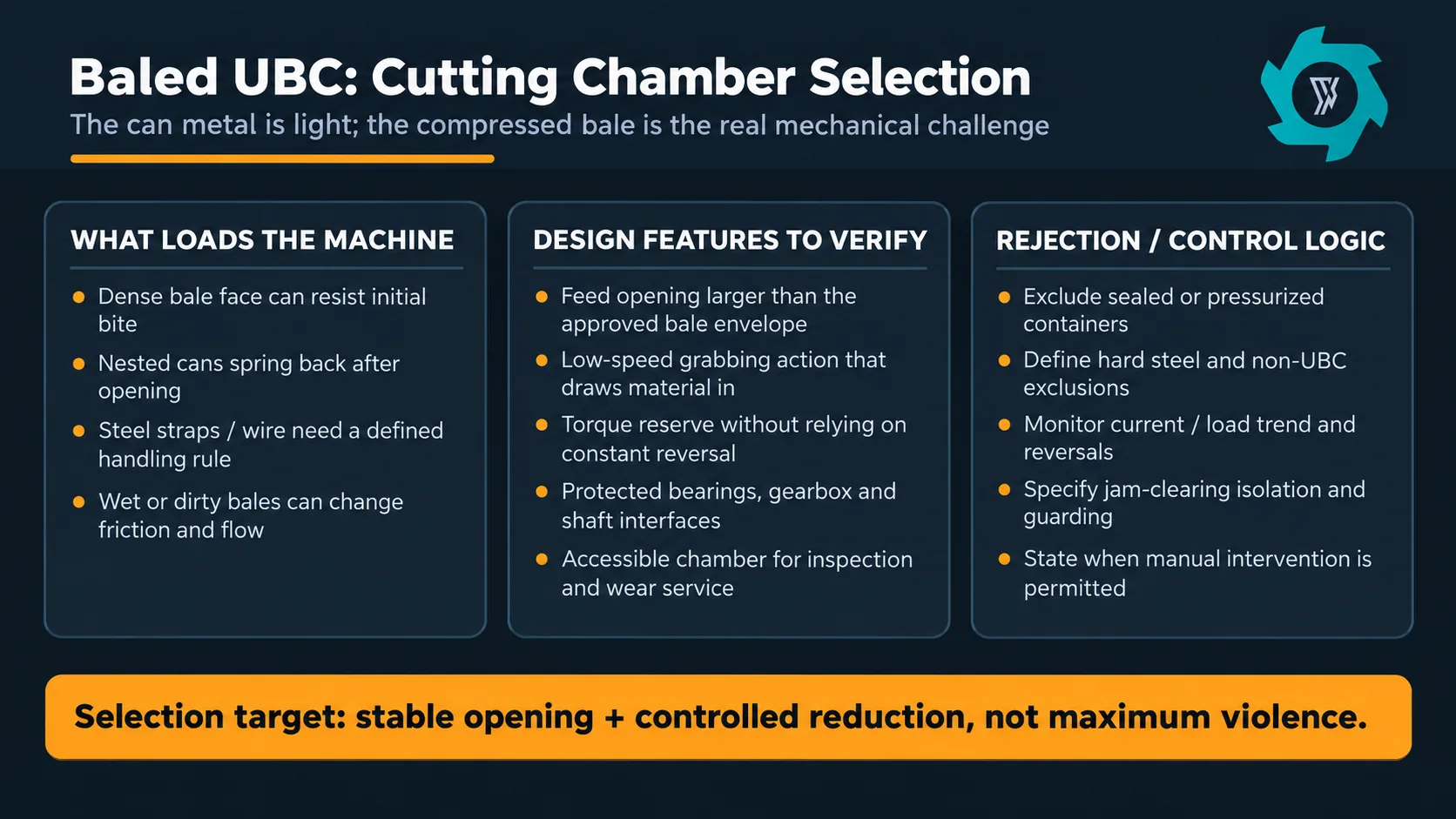
A dense bale presents a resistant face to the cutters. Initial grabbing action matters because the machine must pull material into the cutting zone instead of letting the bale ride or rotate above it. Ask for cutter/shaft layout, rotation logic and a test using comparable bales; loose-can footage does not prove whole-bale feeding.
Chamber width should also be checked against the maximum approved bale orientation. If the proposal assumes every bale will be presented on one face, put that in the operating method and plant layout. A chamber that is nominally wide enough can still be a poor match when bent wires, bulging sides or a loader’s approach angle create real-world interference.
4. Compare Torque, Speed and Control as a System
Motor power alone cannot tell you how the shredder will behave. Two machines with similar installed kilowatts can have different shaft speeds, reduction ratios, cutter geometry, shaft diameter, effective torque and control logic. For baled UBC, low-speed high-torque action is often attractive because it can grab and tear a compressed block without depending on high rotor speed. But even that description is incomplete unless the supplier explains how the machine responds when the bale momentarily loads the chamber harder than normal.
Ask what the controller monitors, what triggers a reversal, how many reversals are allowed before an alarm or stop, and whether the machine can continue feeding after a normal short-duration load spike. Frequent reversing may protect hardware, but it can also be evidence that the proposed machine is spending too much time recovering from the feed. A FAT should therefore log reversals and interventions.
Gearbox and shaft protection deserve the same attention. A UBC line is not supposed to ingest heavy steel, yet real bales may contain straps, cans from the wrong stream or occasional hard objects. The quotation should state the approved hard-object limit and the protection philosophy. Do not treat an overload device as permission to process undefined contamination.
For general metal-shredder design terms, the broader metal shredder selection guide provides background. This UBC guide narrows those variables to the specific bale-opening and aluminum-loss problem.
5. Decide the Output Window from the Next Machine Backward
A UBC shredder should not be asked to produce the smallest possible pieces. It should produce the least aggressive reduction that reliably enables the next operation. If the next step is magnetic separation, the bale must be open enough that straps, steel cans and other accessible ferrous pieces are no longer buried in compacted aluminum. If a screen follows, the discharge should be loose enough to present the screen with a usable particle-size distribution.
If the project intends to sell shredded UBC under the Talcred commercial description, ReMA/ISRI defines a density range of 12–17 lb/ft³ (193–273 kg/m³) and states that material should contain no more than 5% fines smaller than 4 mesh (6.35 mm), along with contamination requirements.[2] That does not mean every project should aim for Talcred. It means that when Talcred is the target, fines are no longer a vague housekeeping issue; they are part of the product definition.
Even when no named scrap specification applies, the buyer should still define the accepted output. Useful fields include maximum coherent lump size, expected piece-size band, oversize handling, fines definition, maximum recirculation and the required downstream feed condition. The UBC scrap specification comparison is useful when the commercial output form itself needs to be resolved before the machine is purchased.
6. Control Fines by Measuring Aluminum Loss, Not Only Appearance
Fine generation matters because small aluminum can disappear into the wrong stream. A clean-looking accepted product can still be an expensive result if a noticeable fraction of aluminum reports to screen undersize, light rejects or housekeeping dust.
For an acceptance test, define the fines fraction before the run. Weigh it separately. Then inspect or sample that fraction for aluminum content using the method agreed by the buyer and supplier. Do the same for other reject streams. The goal is not to invent one universal recovery guarantee; it is to stop the test from celebrating product purity while ignoring metal lost in rejects.
EPA’s secondary-aluminum process description treats scrap pretreatment as a group of operations that can include sorting, crushing, screening, shredding and classifying, depending on the scrap and the downstream need.[3] The same document notes that mechanical cleaning operations such as crushing, shredding and screening generate metallic and nonmetallic particulate.[3] That makes fines control both a yield issue and an installed-system issue.
7. Match the Shredder to Magnetic Separation and Screening
A shredder does not remove steel simply because it exposes it. The downstream magnet still needs the ferrous item to be accessible and presented in a material layer that allows capture. Decide whether bale ties and other accessible ferrous items are removed before shredding, cut and recovered after bale opening, or handled by another defined procedure.
The next separation stage should determine how uniformly the shredder has to discharge. A belt magnet, screen or quality-control conveyor works better with controlled material presentation than with intermittent avalanches. If the shredder empties a whole bale in a short surge and then waits for the next load, the project may need a discharge conveyor or buffer sized to smooth the flow.
Where the project also contains a non-metal fraction and an eddy current separator is being considered, remember that an ECS has a different job from a magnet. The detailed magnetic vs eddy current separator guide explains that sequence. For a UBC shredder purchase, the practical point is to give the shredder supplier the downstream equipment list and the required feed condition.
8. Specify Capacity on a Defined Time and Product Basis
UBC shredder capacity is often distorted by undefined time. A short burst while a bale collapses through the chamber can produce an impressive instantaneous rate. It does not tell the buyer how many accepted tons the machine will prepare in a shift. Use at least two time measures during testing: elapsed test time and net running time. Then record the events that explain the difference.
Log loading gaps, feed starvation, reversals, alarms, manual clearing and downstream holds. For a connected line, state whether the reported rate is shredder discharge, accepted output after separation or another measurement point.
Capacity should also be tied to the output window. A machine should not “pass” a 5 t/h requirement by generating more oversize than the downstream line can accept or by producing excessive fines that are excluded from the saleable product. The buyer can avoid that argument by defining accepted output, oversize/return and fines before the test begins.
9. Do Not Ignore Wear Just Because Aluminum Is Soft
Aluminum is soft compared with steel, but dirt, glass, straps and hidden ferrous pieces can dominate wear. Discuss cutter life against the approved contamination envelope.
Ask how cutters are indexed or replaced, how bearings are protected, which clearances need checks, and what access or lifting points routine service requires. Normalize the commissioning spares, first-year wear set and cutter lead time across bids.
10. Define Guarding, Isolation and Jam-Clearing Before Purchase
Whole-bale loading creates obvious hazards around the hopper, cutters, conveyors and any manual intervention point. Machine guarding needs to keep operators away from the actual sources of injury, including cutting areas, pinch points, rotating components, and material that may be thrown from the machine.[4] Maintenance work brings a different risk because stored or connected energy may still be present after the machine stops. Where an energy-isolating device is capable of being locked out, OSHA requires lockout unless the employer can demonstrate that a tagout system provides full employee protection equivalent to lockout.[5]
For the RFQ, ask the supplier to show the guarding boundary, access doors, interlocks, emergency-stop locations and the intended method for clearing a jam. Then have the site safety team review the installed arrangement against local requirements. A reversible drive, remote jog function or hydraulic opening feature can help maintenance, but none of them replaces verified energy isolation when a person enters a hazard zone.
11. Normalize Supplier Quotations with the Same Selection Sheet
UBC shredder quotes become comparable only when every supplier answers the same feed and performance questions. A simple normalization table can prevent a low-priced proposal from winning by silently assuming easier bales, shorter duty or a coarser product.
| RFQ section | Buyer provides | Supplier must return |
|---|---|---|
| Feed envelope | Bale size, mass, density, tie, moisture, contamination, exclusions. | Accepted range and any pre-opening or tie-removal assumptions. |
| Duty | Opening only, opening + reduction, target output condition. | Proposed chamber, cutter/shaft concept, speed and control philosophy. |
| Capacity | Sustained target, shift hours, downstream measurement point. | Capacity basis, test feed, net/elapsed-time assumptions and likely bottleneck. |
| Output | Oversize limit, fines definition, downstream separator needs. | Expected distribution and how adjustment is made. |
| Controls | Site electrical standard and automation boundary. | Motor/drive, PLC functions, reversal logic, alarms and interfaces. |
| Maintenance | Site access and lifting constraints. | Wear parts, service intervals, access space, lifting points and spares. |
| Safety | Site requirements and operator workflow. | Guarding, interlocks, E-stops and isolation provisions. |
| FAT | Representative bales and pass/fail criteria. | Test procedure, instruments, data sheet and deviation-closure process. |
If the project includes conveyors, magnetic separation, screening, dust extraction or final quality control, ask for a line-level proposal as well as the shredder data. Those connected stages should be normalized on the same feed, output, capacity and acceptance basis as the shredder.
12. Require a Representative UBC Shredder FAT
A factory acceptance test should answer the exact purchasing questions that remain uncertain after design review. For baled UBC, that normally means: Can the shredder accept the approved bales? Does it feed without unacceptable manual intervention? Does it sustain the agreed rate? Does the discharge meet the output window? How much aluminum reports to the fines and reject streams? What operating events occur under the defined feed?
The test material should represent normal production, including difficult-but-normal bales inside the agreed envelope. Photograph or identify the test bales before processing. Record dimensions, mass, condition and any pre-treatment. If ties are removed, say so. If the supplier cuts bales before loading even though the plant intends to feed whole bales, the test is not proving the purchased duty.
During the run, record elapsed time, net running time, current or load trend where available, automatic reversals, stops, alarms, operator interventions and manual clearing. After the run, weigh the outputs separately: accepted UBC, ferrous output, fines or dust, other rejects, oversize/return if present, and retained material. State any unexplained mass difference separately rather than burying it inside another category.
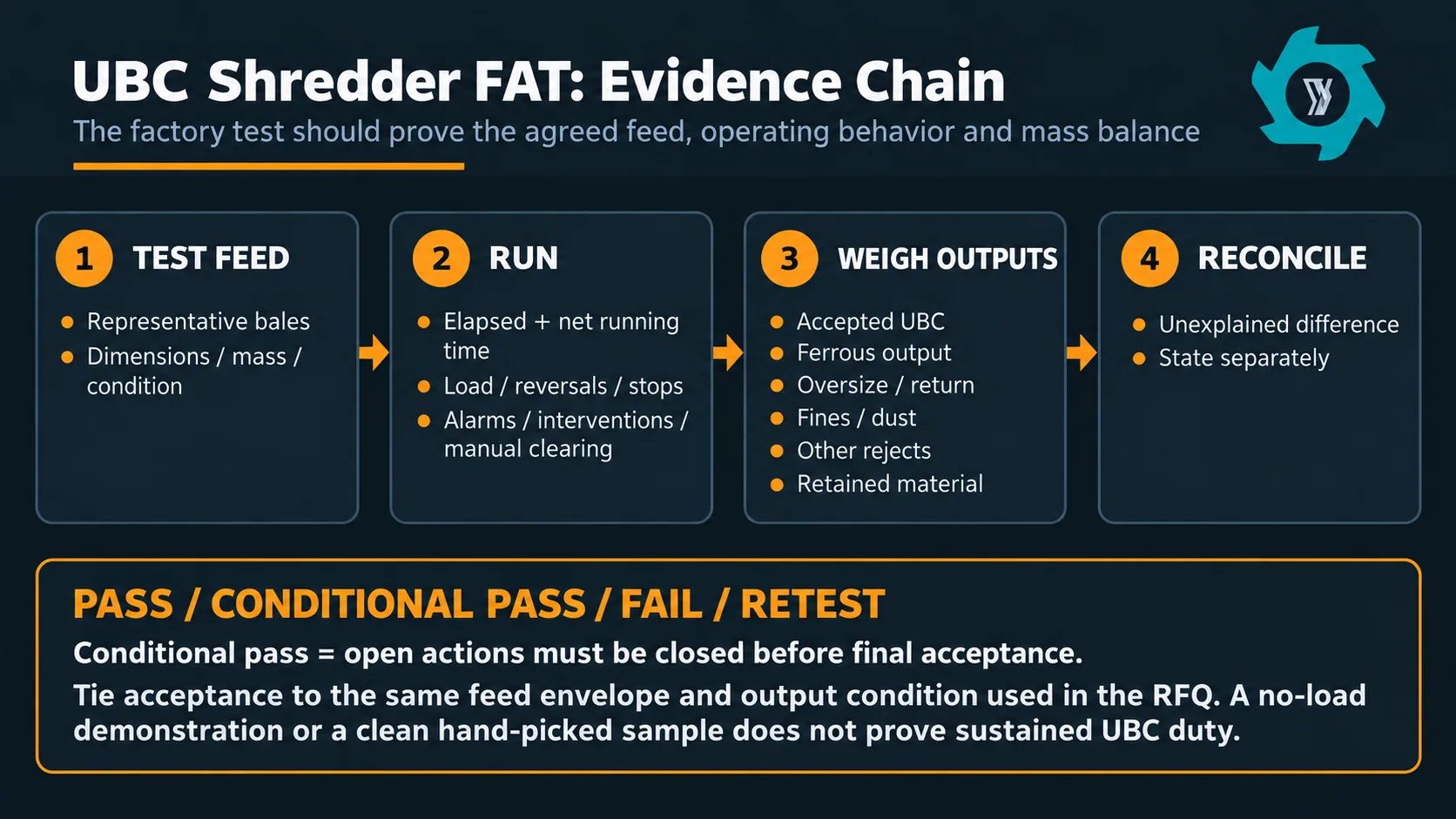
Then classify the result using pre-agreed outcomes such as pass, conditional pass with open actions, or fail/retest. A supplier demonstration can be impressive and still be commercially weak if no one can tell which bales were tested, what happened during the run or where the input mass went.
13. Common UBC Shredder Selection Mistakes
Buying from motor power. Installed kW is not a substitute for torque, speed, geometry and controls. Request the complete duty basis.
Testing loose cans for a whole-bale project. Loose-can footage does not prove initial bite, whole-bale feeding or peak load behavior.
Using the average bale only. The hardest normal bale often determines interruptions and real capacity. Include the approved maximum condition in the acceptance plan.
Choosing the smallest output by default. Extra reduction can increase fines, wear and aluminum loss without improving the buyer’s product.
Ignoring tie handling. Steel banding or wire must have a written removal or recovery strategy.
Reporting capacity without rejects. A high gross rate can hide oversize, fines or product loss. Report accepted output and material streams.
Leaving downstream equipment out of the discussion. The shredder discharge must suit the magnet, screen, conveyor and quality-control stages that actually determine saleable output.
14. A Practical Selection Sequence
Use this sequence: confirm that shredding is really required; write the feed envelope and exclusions; define the discharge and downstream equipment; compare chamber, grabbing action, torque/speed and controls against the worst normal bale; review fines, yield, wear and safety; normalize quotations; then prove the selected machine with a representative FAT and separately weighed mass balance. This keeps the model number from becoming the starting assumption.
FAQ
Do all baled UBC projects need a shredder?
A bale opener may be all that is needed when the only task is to loosen compacted cans. A shredder becomes relevant when the material also needs some size control, trapped contamination needs to be exposed, or the next separation stage works better with a steadier feed.
What information should I send before asking for a UBC shredder model?
Send representative bale photos and video, minimum and maximum bale dimensions, bale weight, estimated density, flattened or unflattened condition, strap or wire type, moisture condition, known contamination, target throughput, required output condition, downstream equipment, power supply and available layout space.
Should I choose the shredder by motor power?
No. Motor power is only one design input. Feeding geometry, shaft and cutter arrangement, speed, torque, chamber dimensions, overload control, bale density, duty cycle and the required discharge all affect performance. Compare the complete proposed duty, not motor kilowatts alone.
How small should shredded UBC be?
There is no universal best size. The target should be only as small as needed to open the bale, expose contaminants and feed the next process. If the buyer is targeting a shredded UBC specification such as Talcred, its density and fines requirements also become part of the product definition.
How should UBC shredder capacity be verified?
Use representative bales inside the agreed feed envelope and record input mass, elapsed and net running time, reversals, stops, interventions and all material outputs. Weigh accepted UBC, ferrous output, oversize or return material, fines or dust, other rejects, retained material and unexplained difference separately so capacity is not reported without a material balance.
What should be excluded from a baled UBC shredder feed?
The project should define exclusions before commissioning. Typical exclusions include sealed or pressurized containers, batteries, electronic devices, hazardous containers, large hard steel pieces, unknown packages and any material outside the confirmed bale and contamination envelope.
Send the Bale Envelope, Not Just “5 t/h UBC”
Share representative bale photos, dimensions, density range, ties, moisture, contamination, target throughput, required output and downstream equipment so the shredder can be selected for the real UBC preparation duty.
References
- ReMA: Taldon.
- ReMA: Talcred.
- EPA: secondary aluminum.
- OSHA: machine guarding.
- OSHA: lockout tagout.