Henan University Science and Technology Park (Western) ,Zhengzhou, Henan ,China(Mainland)
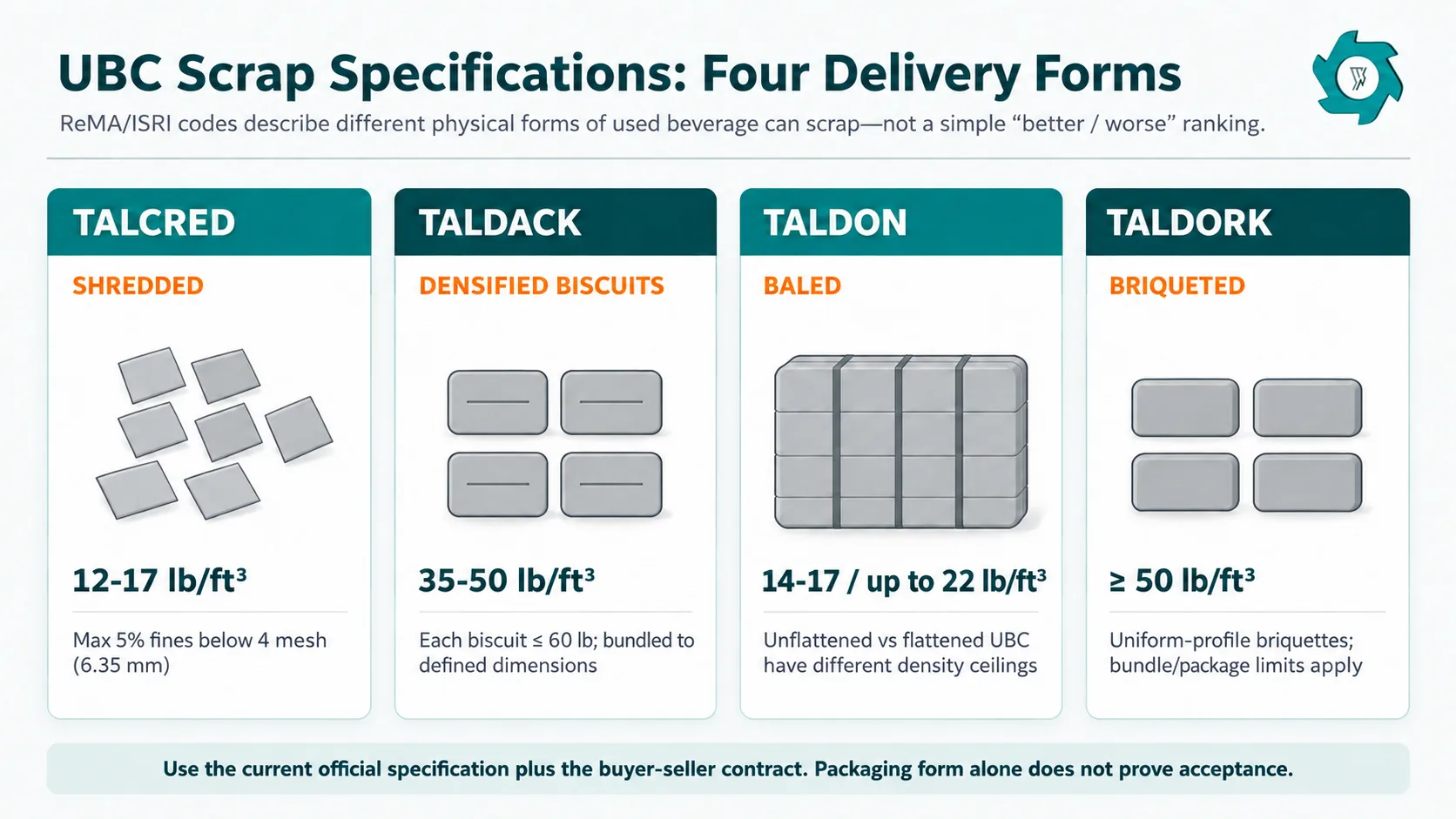
UBC scrap specifications are easy to misread because several code words describe the same underlying commodity while setting very different rules for physical form. Talcred is shredded UBC, Taldack is densified UBC in biscuits, Taldon is baled UBC, and Taldork is briqueted UBC. They are not four purity grades arranged from low to high. They are four commercial descriptions that tell a buyer how the cans have been prepared, how dense the material or package should be, and what additional dimensional or packaging conditions apply.[1]
For a recycler, that distinction changes more than the sales description. The required product form shapes several practical decisions, from how incoming material is handled to how it is prepared, checked, and specified in the purchase contract. It can also affect how easily contamination is found and how density is verified. Before choosing a baler, shredder, or briquetting system, the plant should first confirm what form the downstream buyer is actually willing to receive.
Use Talcred for shredded UBC that meets its density and fines requirements; Taldack for high-density biscuit-form UBC; Taldon for baled UBC within its density, bale-size and tying rules; and Taldork for briqueted UBC with a minimum briquette density and package limits. In all four cases, material identity and contamination controls remain essential. When a requirement is not defined by the trade specification—or when either party wants a variation—put it in the buyer–seller agreement before shipment.
Taldon vs Talcred vs Taldack vs Taldork: Quick Comparison
The code identifies a delivery form with its own measurable limits. The same cans can move into a different commercial description after controlled preparation and verification.
Code
Commercial form
Main density requirement
Form-specific control
Receiving question
Talcred
Shredded aluminum UBC scrap
12–17 lb/ft³ (193–273 kg/m³)
Maximum 5% fines smaller than 4 mesh (6.35 mm)
Is this genuinely shredded UBC, and was the fine fraction controlled?
Taldack
Densified aluminum UBC scrap
35–50 lb/ft³ (562–802 kg/m³) biscuit density
Biscuit mass, dimensions, banding slots, bundle geometry and strapping
Are the biscuits uniform and bundled exactly as purchased?
Taldon
Baled aluminum UBC scrap
Minimum 14 lb/ft³; maximum 17 for unflattened and 22 for flattened UBC
Minimum bale volume, bale dimensions and permitted tying method
Does the bale form match the declared flattened/unflattened condition?
Taldork
Briqueted aluminum UBC scrap
50 lb/ft³ (800 kg/m³) minimum briquette density
Briquette profile, length, package height, banding and bundle-weight limit
Does the briquette package meet both density and handling limits?
These figures come from the current ReMA/ISRI specification pages for each item.[2][3][4][5] A useful internal rule is to treat the code as a checklist heading, not as proof. The receiving team still has to verify the lot that arrived.
Why These Codes Describe Form, Not a Simple Purity Ladder
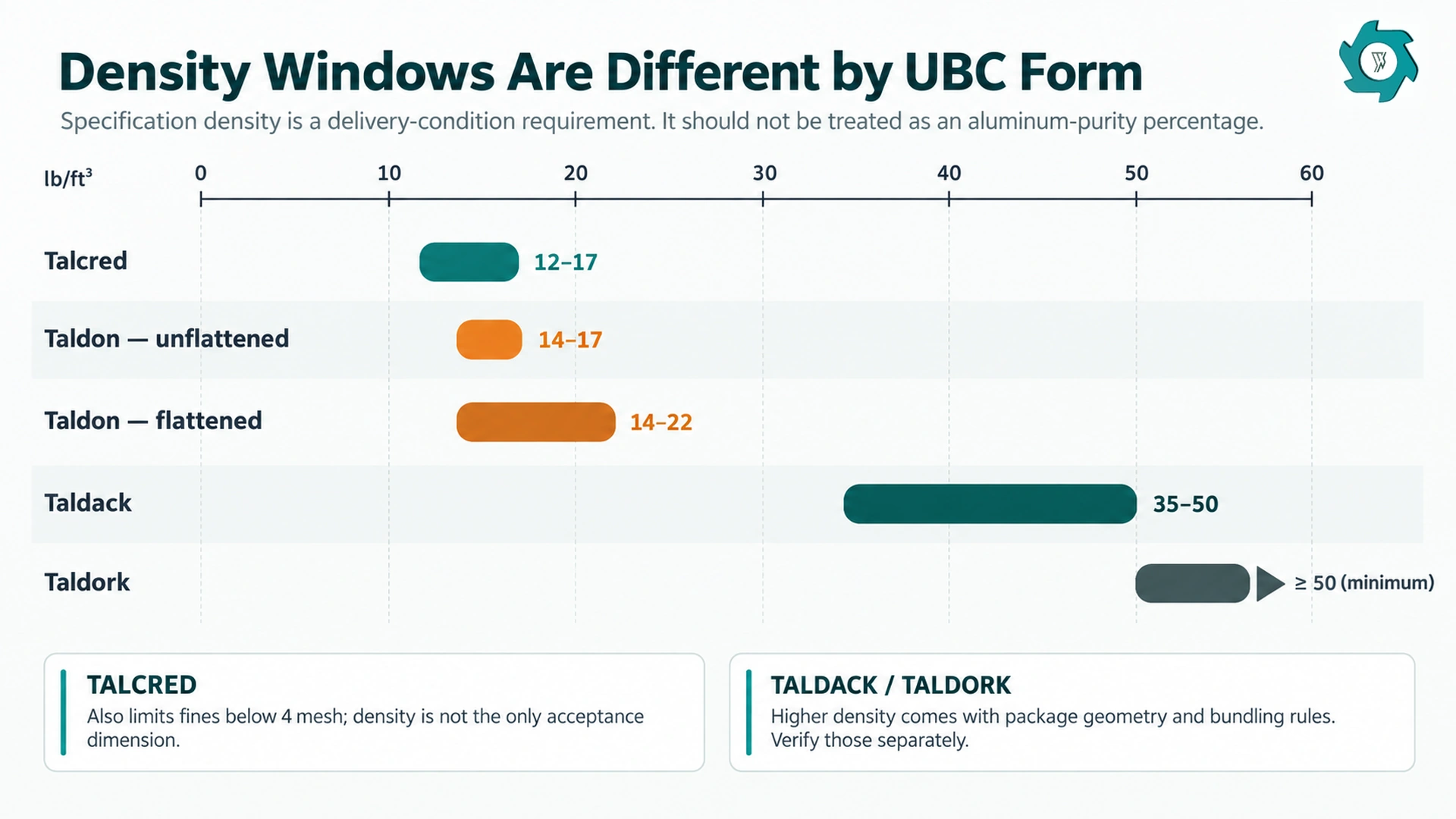
A common purchasing mistake is to assume that greater density means higher grade. The trade definitions do not support that conclusion. Talcred can be relatively low-density because it is shredded. Taldork is much denser because it is briqueted. That is a change in physical presentation, not a declaration that one lot contains a higher percentage of aluminum than another.
The specifications share a more important commercial boundary that they are UBC products. Talcred, Taldack and Taldon expressly exclude aluminum items other than used beverage cans, while Taldork also states that non-UBC aluminum is unacceptable.[2][3][4][5] That point is easy to miss when a plant focuses only on a magnet, a baler or a density number.
The broader aluminum scrap grades guide explains why commercial grade, alloy identity and plant receiving class are different layers. For this UBC comparison, the practical takeaway is narrower: changing the physical form does not give permission to blend foil, siding, cast aluminum or miscellaneous light-gauge scrap into the lot. If the buyer wants a broader material mix, it should be purchased under a different description.
Talcred: Shredded Aluminum UBC Scrap
Talcred is the only one of the four that defines a shredded product. ReMA/ISRI lists a density of 12–17 lb/ft³ (193–273 kg/m³) and states that fines below 4 mesh, listed in the specification as 6.35 mm, should not exceed 5%.[2] That fines limit deserves close attention in plant operation. Shredding can help break open compacted cans and uncover contamination, but pushing the material too hard—or sending it through the line too many times—may create enough fines to move the final lot away from the intended specification.
The material must be magnetically separated and free of the listed foreign materials, including steel, lead, plastics, glass, wood, dirt, grease and trash. Free lead is a rejection condition, and non-UBC aluminum is not acceptable under the specification.[2]
Buyer check: Record the target density range, the fines test boundary, how the sample is taken, and what happens to oversize pieces or loose contaminants. If your buyer uses a different fines screen or a tighter limit, that is a contract requirement and should be written separately.
Talcred can make sense when bales need to be opened for cleaning, when a mill wants a controlled shredded feed, or when downstream preparation is built around a defined particle condition. The finished form should follow the receiving requirement.
Taldack: Densified UBC in Biscuit Form
Taldack describes UBC that has been densified into biscuits. The official density range is 35 to 50 lb/ft³ (562 to 802 kg/m³), and each biscuit is limited to 60 lb (27.2 kg). The specification also defines a nominal size envelope, requires banding slots in both directions, calls for uniform biscuit size within a bundle, and sets bundle dimensions and strapping details.[3]
This is where a simple “high-density UBC” purchase order can fail. A supplier may hit a density number but still deliver biscuits that are too heavy, inconsistent, difficult to bundle, or packaged in a way the receiver did not agree to. Taldack also differs from Taldork in an easy-to-overlook logistics detail: the Taldack specification does not accept skids or support sheets, while the Taldork specification permits bundled briquettes or briquettes stacked on skids under its own package rules.[3][5]
ReMA/ISRI also states that Taldack material must be magnetically separated, must be free of the named contaminants, and cannot contain other aluminum items. Items not covered in the specification—including moisture—plus any variation should be agreed before shipment.[3] Moisture can change paid weight and handling behavior even when the outside of a biscuit looks acceptable.
Taldon: Baled Aluminum UBC Scrap
Taldon is the form most recyclers recognize: baled used beverage cans. The density window depends on whether the cans are flattened. The specification sets a minimum of 14 lb/ft³ (225 kg/m³), a maximum of 17 lb/ft³ (273 kg/m³) for unflattened UBC, and a higher maximum of 22 lb/ft³ (353 kg/m³) for flattened UBC.[4]
The bale itself is part of the specification. It must have at least 30 cubic feet (0.85 m³) of volume and stay within the stated dimensional ranges. The official page also defines permitted steel-band or wire tying arrangements, allows equivalent-strength aluminum bands or wires, and does not allow skids or support sheets.[4]
That means a baler should be selected from the receiving specification backward. The plant needs to know the bale cross-section, practical bale length, target weight, tying method, loading method and downstream handling equipment. A press with more force is not automatically more suitable. The hydraulic scrap metal baler selection should therefore be matched to the required finished bale and the normal UBC feed condition.
As with the other UBC specifications, Taldon requires magnetically separated material and excludes steel, lead, bottle caps, plastics, glass, wood, dirt, grease, trash and other foreign substances. Free lead is grounds for rejection, and non-UBC aluminum is not acceptable.[4]
Taldork: Briqueted Aluminum UBC Scrap
Taldork moves to an even denser physical form. The briquette density must be at least 50 lb/ft³ (800 kg/m³). The specification gives a nominal square or rectangular profile range of 12 to 24 inches by 12 to 24 inches, with variable length from 8 to 48 inches. Briquettes are bundled or stacked on skids, must not overhang the pallet, and the complete package is limited to 48 inches in height. The bundle weight must not exceed 4,000 lb (1.814 metric tonnes), and banding requirements also apply.[5]
The commercial value of that density is obvious in logistics, but density also reduces visual access. A dense package can hide liquid or contaminants if the upstream sorting process is weak. The feed needs to be controlled before briquetting, then the finished package still needs evidence that the agreed form and cleanliness requirements were met.
The official specification requires magnetic separation and excludes steel, plastic, glass, dirt and other foreign material; non-UBC aluminum is unacceptable and free lead is a rejection basis. Moisture and other items not covered in the text are to be agreed between buyer and seller, along with any variation.[5]
How to Read Density Without Turning It Into a False Quality Claim
Density windows overlap at the lower forms and separate sharply at densified/briqueted forms. Density says how tightly the UBC is presented; it does not replace contamination inspection.
At the gate, density is often estimated from net package mass divided by measured external volume. That can be a useful screening calculation, but a contract should state the agreed measurement method because deformed bales, rounded edges, voids, straps and irregular packages can change the result. Do not quietly switch between a theoretical press setting, a machine-display value and a measured shipment density.
A good receiving record separates three numbers: gross package weight, tare or excluded packaging weight, and net UBC weight. It then records the measured dimensions used for the density calculation. For Taldack and Taldork, check the individual unit as well as the bundle/package limits. For Taldon, record whether the lot is sold as flattened or unflattened UBC because the maximum density is different.
Density also should not be used as a substitute for yield. A wet, dirty or mixed package can weigh more. That does not make it a better UBC product. If paid metal yield, moisture deductions or contamination deductions matter commercially, write those measurement rules as separate contract terms.
A Receiving Checklist That Works Across All Four Codes
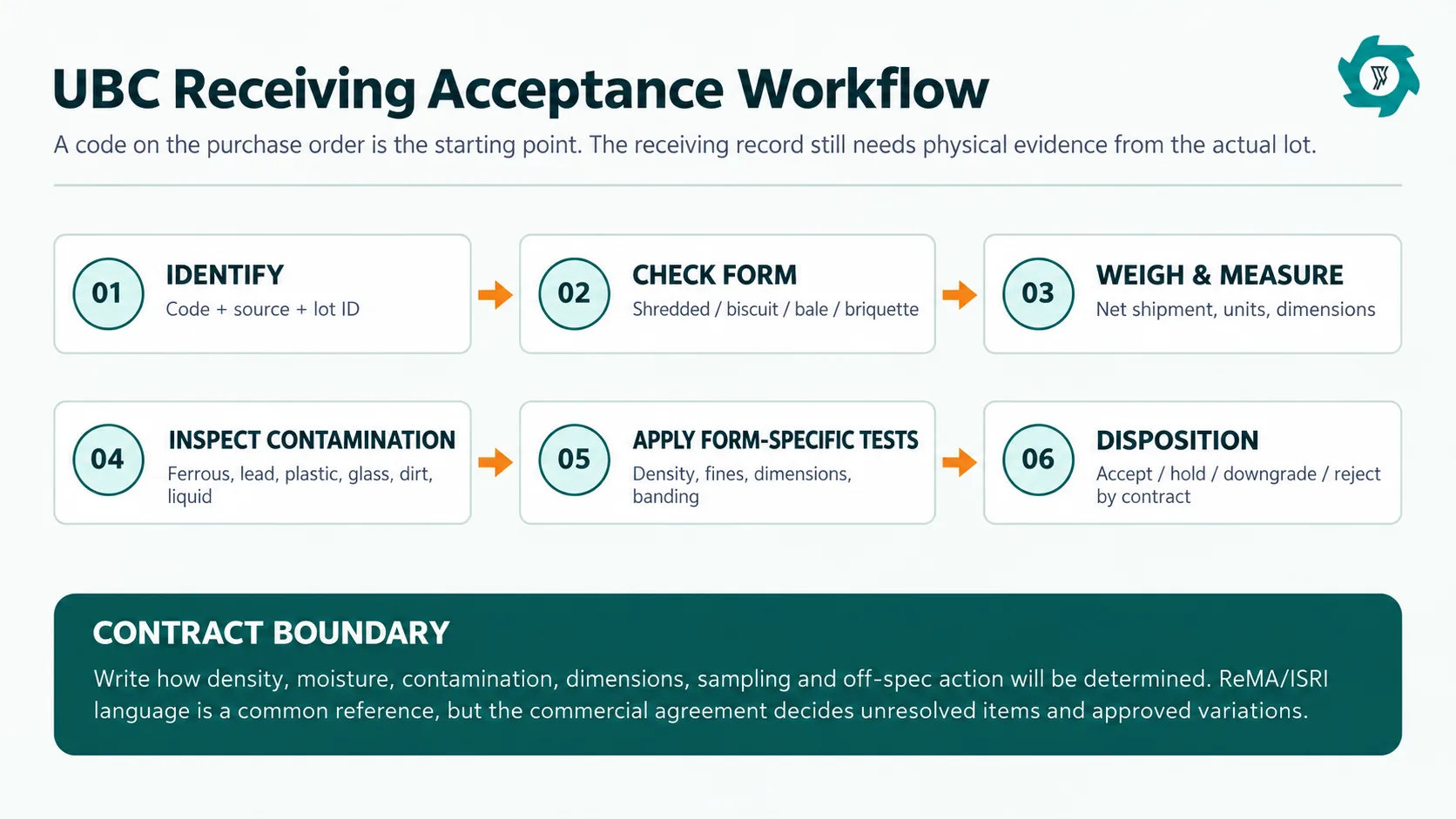
The lot should move from identity to evidence to disposition. A code on the bill of lading is not a substitute for inspection.
Plants that buy more than one UBC form benefit from one receiving sheet with code-specific fields. The first page can stay the same for every truck; the second section changes according to Talcred, Taldack, Taldon or Taldork.
1. Identify the lot
Record supplier, source, purchase order, declared code, lot number, vehicle or container ID and arrival condition. Photograph the load before unloading if packaging condition affects a later claim.
2. Confirm the physical form
Check that the shipment is actually shredded material, biscuits, bales or briquettes. If the form does not match the purchase description, hold the lot before mixing it with accepted inventory.
3. Weigh and measure
Record net weight and the dimensions needed for density or package checks. For bundled products, also record unit count and any individual-unit limits that matter.
4. Inspect contamination
Look for ferrous material, non-UBC aluminum, plastics, glass, dirt, liquid and prohibited items. A magnet is useful for free ferrous checks, but it does not prove the absence of every foreign substance.
5. Apply form-specific tests
For Talcred, include the agreed fines check. For Taldack, inspect biscuit and bundle consistency. For Taldon, verify bale volume, dimensions and tying. For Taldork, verify briquette and package limits.
6. Record disposition
Use pre-agreed categories such as accepted, accepted with deduction, held for review, downgraded by agreement or rejected. Do not invent the commercial remedy after a dispute begins.
If the receiver needs chemistry, coating, moisture or a special contamination threshold beyond the published trade description, add the method and acceptance rule to the purchase specification. The goal is to make the evidence repeatable when two people inspect the same type of lot on different shifts.
Contamination, Moisture and Hidden Material: Where Disputes Usually Start
The four UBC descriptions overlap strongly on cleanliness. Magnetic separation is a recurring requirement, foreign materials are restricted, free lead is unacceptable, and the material is not supposed to become a catch-all light-aluminum grade.[2][3][4][5] In practice, the harder question is not whether contamination is undesirable. It is how the lot will be inspected and how a commercial deduction is calculated.
For loose or shredded material, representative sampling is easier because the material can be accessed from several points. Dense bales and briquettes are different. The outside may look clean while trapped steel cans, plastic, dirt or liquid remain inside. If the buyer regularly opens packages for audit, the contract should state how selected units are chosen and how the result applies to the lot. If the supplier relies on upstream sorting records, say which records accompany the shipment.
Moisture deserves its own line item. Taldack and Taldork explicitly identify moisture among the items that may require agreement between buyer and seller.[3][5] Even when a displayed specification does not state a universal moisture percentage, the receiving contract can still define one. This is especially important for outdoor-stored cans, residual beverage liquid and dense packages that are difficult to inspect internally.
How the Scrap Specification Changes the UBC Recycling Line
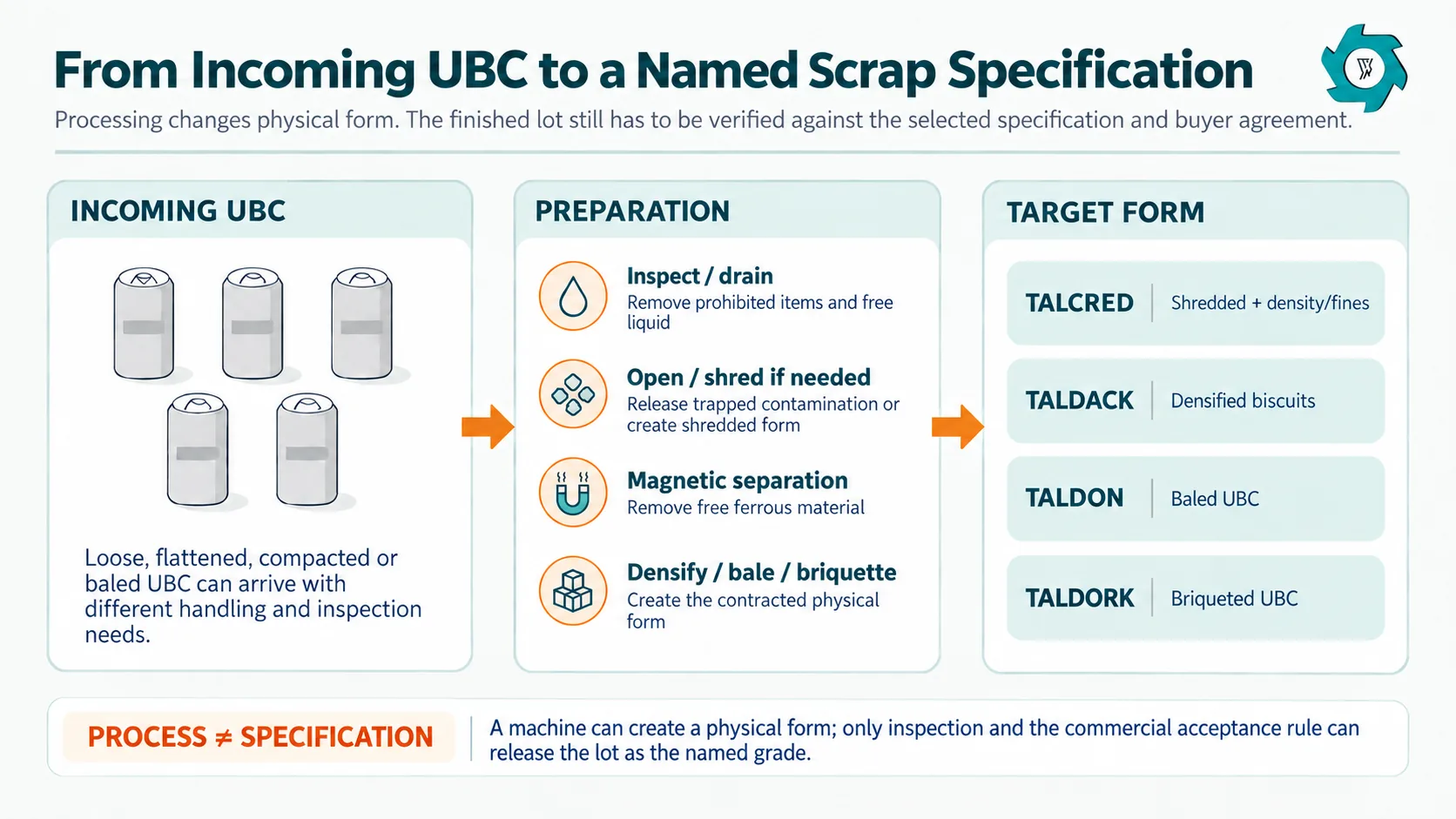
Equipment creates the physical condition; verification releases the lot to the named commercial specification.
A recycling line should be designed around the incoming condition and the intended saleable form. YUXI’s UBC aluminum can recycling line is configured differently for clean loose cans, mixed dry containers and baled UBC. Clean loose cans may need inspection, optional magnetic removal and baling. Mixed dry recyclables may require screening, ferrous removal and non-ferrous recovery. Dense bales may need controlled opening so hidden contamination can be released before the UBC is sold loose, shredded or re-densified.
If the target is Talcred, the line has to control the shred and the fines fraction. If the target is Taldon, bale geometry and tying are part of the product, so the baling and discharge arrangement must be selected accordingly. Taldack and Taldork impose much higher density and more specific package-form requirements, so the densification stage and handling system need to be designed around those limits.
The used aluminum can recycling process also shows why there is no reason to shred every UBC stream. Over-processing clean cans can add wear, fines and unnecessary handling. The commercially correct route is the simplest one that repeatedly produces the agreed output.
A lot can meet a UBC code and still face additional mill-specific requirements, or it can be accepted under a mill specification that differs from the standard code. The furnace-ready aluminum scrap guide is useful when the buyer needs to add alloy, dryness, charge-size or other receiver-specific conditions on top of the trade description.
What to Put in a UBC Purchase Specification or RFQ
Named trade code and revision basis. Write Talcred, Taldack, Taldon or Taldork and state that the current agreed specification text controls.
Source and material identity. Confirm that the lot is used beverage cans and state any source restrictions that matter to the buyer.
Physical form. State shredded, biscuit, bale or briquette condition and any flattened/unflattened distinction.
Density method. Define what weight and dimensions are used, when measurements are taken and how irregular packages are handled.
Dimensions and packaging. Copy the applicable commercial limits into the PO or attach the specification; do not leave package geometry to memory.
Fines requirement where applicable. For Talcred, state the screen basis and how the sample will be obtained.
Contamination and prohibited items. Include the ReMA/ISRI exclusions plus any tighter buyer rule.
Moisture or free-liquid rule. If the buyer deducts or rejects for moisture, write the limit and method rather than relying on “dry” as an undefined word.
Sampling and inspection. Define when the lot is considered accepted and what inspection may be performed before final settlement.
Off-spec disposition. Predefine whether a load is held, rejected, reworked, downgraded or accepted with an agreed deduction.
Common Mistakes When Buying or Producing These UBC Grades
Calling any compacted can package “Taldon”
Taldon is not a generic word for compressed cans. The bale has density, volume, dimension and tying requirements. If the finished package falls outside those boundaries, call it what the buyer has agreed to call it rather than forcing the code onto it.
Using density as a purity percentage
A 50 lb/ft³ briquette is not “50% better” than a 25 lb/ft³ bale. Density is a mass-per-volume property. Cleanliness, UBC identity and prohibited materials are separate acceptance dimensions.
Ignoring the fines clause in Talcred
A shredder can meet a nominal density target while producing too much small material. The fines limit needs its own evidence.
Higher density can reduce transport volume, but it can also change handling, package inspection and the receiving mill’s preferred charge condition. The buyer’s unload, storage and downstream preparation system should be checked first.
Mixing accepted lots before receiving is complete
Once an off-spec shipment is blended into a large inventory pile, evidence disappears. Keep the lot traceable until inspection and commercial disposition are complete.
FAQ
What is the main difference between Taldon, Talcred, Taldack and Taldork?
They describe different physical forms of aluminum used beverage can scrap. Taldon is baled UBC, Talcred is shredded UBC, Taldack is densified UBC in biscuit form, and Taldork is briqueted UBC. Each form has its own density and, where applicable, size, fines, bundling or tying requirements.
Is Taldork automatically a higher-quality UBC grade than Taldon?
Taldork has a higher minimum density because it is briqueted, but density is not an aluminum-purity ranking. Both products still need to meet their material-identity and contamination requirements and any additional buyer terms.
What is the density requirement for Taldon UBC bales?
Taldon requires at least 14 lb/ft³. The maximum is 17 lb/ft³ for unflattened UBC and 22 lb/ft³ for flattened UBC. The bale must also meet the specification’s volume, dimensional and tying requirements.
What extra quality check is especially important for Talcred?
Talcred includes a fines requirement: the specification limits fines below 4 mesh, listed there as 6.35 mm, to no more than 5%. A buyer should also verify density, magnetic separation, UBC identity and contamination.
Do ReMA/ISRI UBC codes replace the purchase contract?
The codes provide a common commercial reference, but the specifications also allow buyer–seller agreement for variations and for items not fully covered. Moisture, sampling, deductions, special contamination limits and off-spec disposition should be written into the contract when they matter.
Does every UBC recycling plant need a shredder to make a saleable product?
Clean loose UBC may only need inspection, liquid control, optional ferrous removal and baling. Shredding is useful when a shredded product such as Talcred is required, when dense bales must be opened, or when contamination must be released before further separation.
Define the UBC Output Before Selecting the Equipment
Send the normal feed condition, representative contamination, current package form, required tons per hour and the buyer’s target UBC specification. The process should be built backward from the accepted product, not forward from a machine name.
Daniel
Metal Recycling Equipment Specialist,YUXI Machinery
Daniel has over 7 years of experience serving the international recycling market.
He focuses on metal shredding and recycling systems,including feedstock evaluation,equipment selection,size reduction,separation,and complete line configuration.





 Request Quote