




 Request Quote

Product Center
-
- Biomass Shredding and Recycling Line
- OCC Paper Dry Pulping & Cardboard Recycling Line
- Scrap Aluminum Recycling Line
- Waste Car Recycling Line
- Waste Refrigerator Recycling Line
- Copper Aluminum Radiator Recycling Line
- Motor Rotor Recycling Line
- Copper Wire Recycling Line
- Waste Ink Cartridge Recycling Line
- Aluminum UBC Scrap Recycling Line
Get a Quote
Contact Us


The phrase “metal recycling equipment manufacturer” covers very different suppliers. One company may be strongest in automobile hammermill plants, another in shear/balers, another in low-speed shredding, and another in complete lines that combine size reduction with magnetic and non-ferrous separation. A useful shortlist therefore has to compare process responsibility.
This guide looks at ten manufacturers whose current public portfolios are relevant to scrap yards, metal processors, recyclers, steelworks and industrial recovery projects. The emphasis is on what each supplier can own in the process: feed preparation, shredding or shearing, secondary liberation, separation, compaction, controls, commissioning and long-term support. For a broader view of how these stages connect, the metal recycling equipment and processing overview shows how standalone machines fit into a multi-stage recycling line.
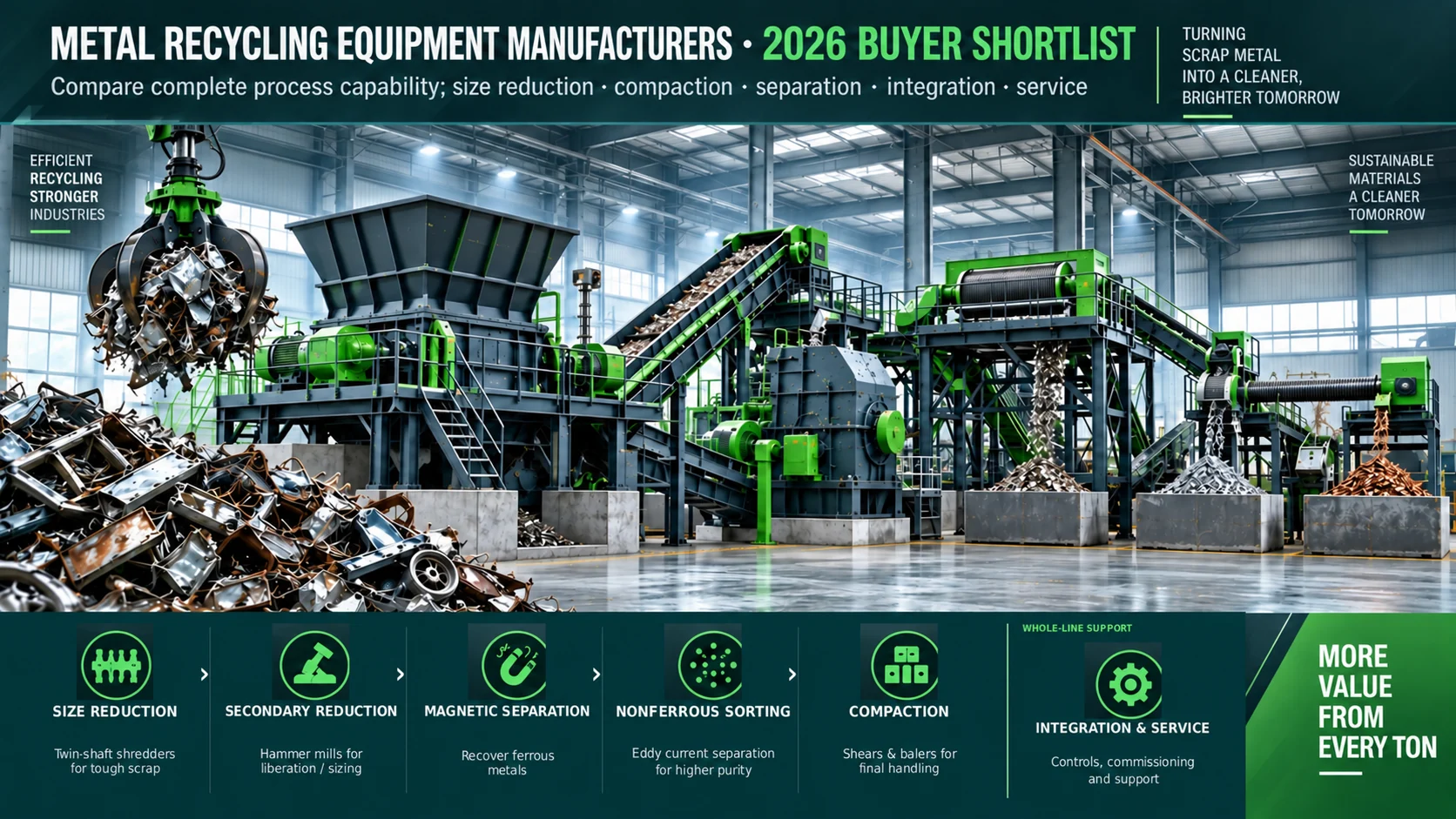
Top 10 metal recycling equipment manufacturers at a glance
| Rank | Manufacturer | Relevant equipment focus | Best shortlist fit |
|---|---|---|---|
| 1 | LINDEMANN | Shredders, pre-shredders, shears, balers, briquetters and integrated scrap plants | Heavy ferrous, ELV and mixed-scrap projects needing broad process ownership |
| 2 | Danieli Centro Recycling | Pre-shredders, hammermill shredders, scrap shears and ferrous/non-ferrous downstream systems | Large engineered projects tied closely to steelmaking or aluminum recycling |
| 3 | YUXI Machinery | Primary metal shredders, hammer mills, vertical crushers, shears, balers and separation equipment | Project-configured lines that may combine several reduction and recovery stages |
| 4 | WENDT | Hammermill shredders, pre-shredders, conveyors, emission control and downstream metal recovery | Automobile and non-ferrous plants where system integration is central |
| 5 | Zato | Twin-shaft and single-shaft shredders, hammer mills, metal separation and demolition shears | Ferrous/non-ferrous projects comparing pre-shredding, liberation and sorting together |
| 6 | LEFORT | Shear/balers, balers and hammermill shredders in stationary and mobile formats | Scrap yards where cutting, compaction and mobility matter as much as shredding |
| 7 | FOR REC | Rotary shears, twin-shaft shredders, hammer mills and metal-recovery plants | Modular European-style lines for mixed scrap, cars, motors and non-ferrous recovery |
| 8 | Harris | Scrap shears, balers, shear/logger/balers and metal shredders | North American yards prioritizing heavy scrap handling, compaction and service |
| 9 | American Pulverizer | Automobile and ferrous hammermill systems with conveyors, magnets and separation options | Hammermill-centered U.S. projects and complete ferrous shredding systems |
| 10 | SSI Shredding Systems | One- to four-shaft low-speed shredders and integrated metal processing systems | Difficult or unusual ferrous/non-ferrous feeds needing engineered rotary-shear reduction |
How to Compare Metal Recycling Equipment Manufacturers Beyond Shredder Capability
A useful manufacturer comparison should look beyond the primary shredder and examine how much of the material route each supplier can actually support. For many projects, the important question is not only who can reduce the scrap, but who can take responsibility for the connected stages that determine feed stability, liberation, recovery, product handling and overall line performance.
Five filters were used. First, the manufacturer had to show current metal-specific equipment rather than a generic waste machine with “metal” added to an application list. Second, the portfolio had to connect to at least one important adjacent duty such as shearing, baling, hammermill liberation, magnetic recovery, non-ferrous separation or complete plant integration. Third, the equipment had to fit identifiable metal streams—ELVs, light iron, heavy scrap, aluminum, motors, white goods, turnings or mixed non-ferrous material. Fourth, the public information had to show some evidence of application engineering, service or system integration. Fifth, the supplier had to give a buyer enough scope information to build a meaningful RFQ.
That last point is where many “top manufacturer” articles stop too early. ReMA’s scrap specifications exist because buyers and sellers need agreed descriptions for traded recycled commodities, not vague labels.[1] Equipment procurement benefits from the same discipline: define the input and the saleable output before comparing machines.
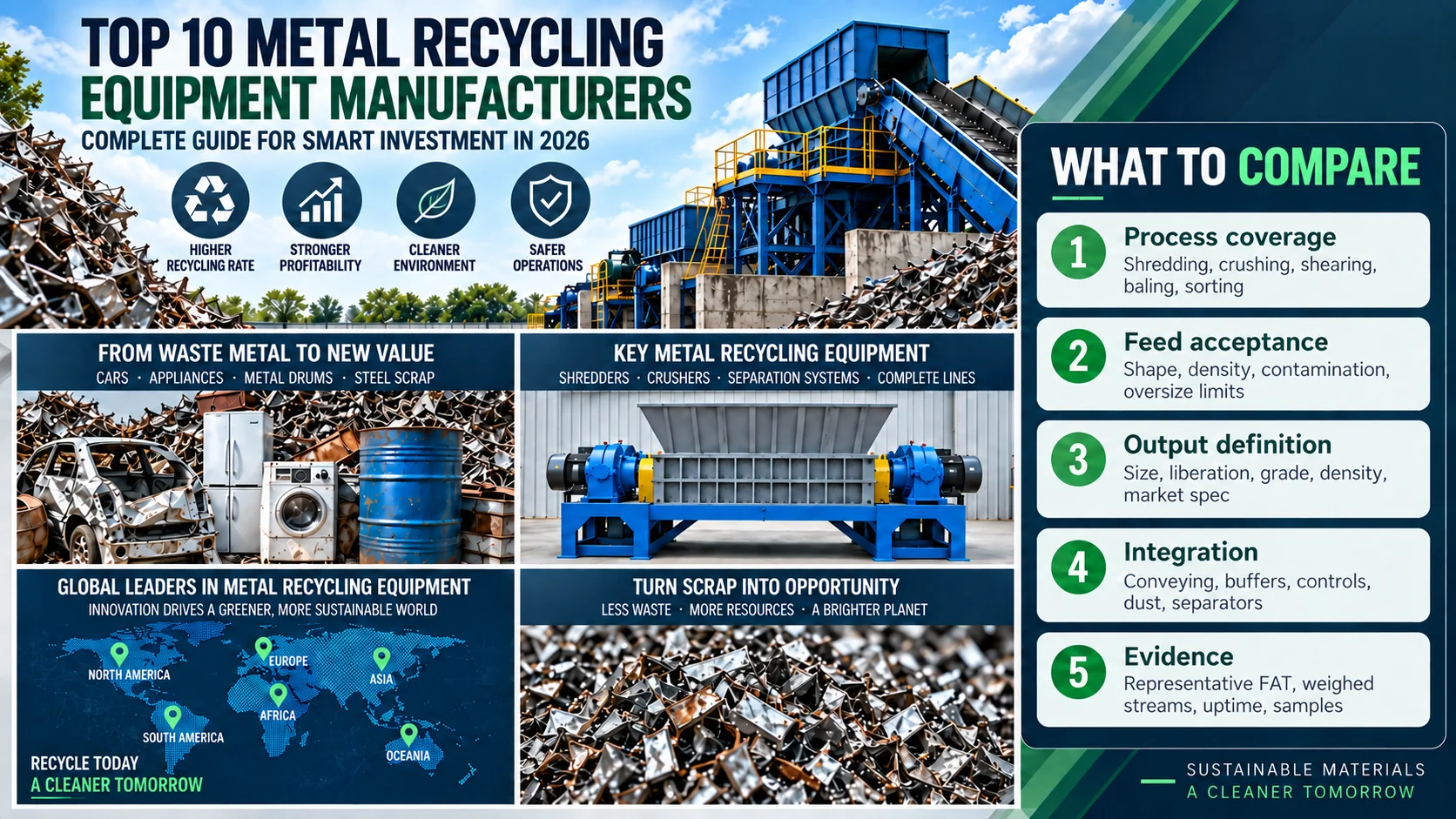
Top 10 metal recycling equipment manufacturers
1. LINDEMANN — broad metal-specific process coverage
LINDEMANN belongs at the top of this particular shortlist because its current machinery range is built around scrap processing rather than general solid waste. The portfolio covers pre-shredding and high-performance shredding, scrap shears, balers and briquetters, with complete plants extending into ferrous and non-ferrous recovery. For a buyer with mixed heavy scrap or ELV feed, that creates a useful single discussion around how feed is opened, reduced, separated and prepared for sale or melting.
The advantage is most visible on large sites where the first machine cannot be selected in isolation. A pre-shredder may stabilize the feed to a hammermill; air treatment and downstream separation can become part of the plant boundary; and a shear or baler may be the correct route for some scrap grades that should not go through the shredder at all. Ask LINDEMANN to define exactly which stages it owns, the interfaces with owner-supplied equipment and the acceptance basis for each final fraction.
2. Danieli Centro Recycling — engineered scrap systems close to the melt shop
Danieli Centro Recycling is a strong reference when metal recycling is part of a larger steel or aluminum production investment. Its current portfolio includes pre-shredders, large shredders, downstream cleaning and separation, hydraulic scrap shears and aluminum recycling equipment. That breadth makes it relevant where the value of the recycling line is measured not only by throughput but by how consistently the output meets the next metallurgical step.
For procurement teams, the useful question is whether Danieli’s proposed boundary begins at raw scrap receiving or at prepared feed, and where it ends: after shredding, after metal recovery, or at furnace-ready handling. A large integrated supplier can remove interface risk, but only if utilities, civil work, controls, dust treatment, product sampling and downstream receiving conditions are written into the same scope.
3. YUXI Machinery — multi-stage equipment for configurable recycling routes
YUXI Machinery’s current metal-recycling portfolio extends beyond a single shredder type. It includes a twin-shaft metal shredder for primary reduction, a hammer mill metal crusher for further liberation, vertical crushing options, shears, separation equipment and hydraulic balers. The practical fit is a project where the buyer is still deciding which stages are actually necessary rather than shopping for a preselected machine model.
The same site also presents an eddy current separator for non-ferrous recovery and metal baling machines for densification. Clean production offcuts may only need cutting or baling. Mixed light scrap may need primary reduction before separation. Aluminum streams can require a different route again; YUXI’s scrap aluminum recycling line is the more relevant reference when non-ferrous recovery is the main objective.
4. WENDT — integrated shredding and downstream recovery
WENDT is particularly strong when the “equipment” being purchased is really a connected shredding system. Its public portfolio covers pre-shredders, hammermill shredders, infeed conveyors, emission-control elements and non-ferrous downstream recovery. That makes it a natural benchmark for automobile shredder and aluminum projects where the value is created after the main mill as much as inside it.
Buyers should pay close attention to the downstream guarantee. A hammermill can create liberation, but recovery depends on screening, magnetic separation, eddy current and sensor-based stages receiving a material distribution they were designed for. The RFQ should state which metal products must be sampled, which residue streams are measured and where recirculation is counted.
5. Zato — pre-shredding, hammer milling and metal separation in one discussion
Zato’s current metal-recycling range includes twin-shaft shredders, single-shaft units, hammer mills, metal separation systems and demolition shears. It is a useful shortlist candidate when the process may require a low-speed machine before a higher-speed liberation stage, followed by recovery rather than disposal of a mixed residue.
That combination can be attractive for compact lines, but the buyer still needs to separate machine capability from line capability. Ask what happens to oversize, how unshreddables are handled, what fraction reaches the hammer mill, and what material-size window is required by each separator. Those interface conditions often determine practical uptime more than the headline motor size.
6. LEFORT — strong shear/baler and mobile-yard capability
LEFORT earns its place because many metal recyclers do not need a classic shredder-centered flowsheet. Its portfolio emphasizes shear/balers and balers in stationary, portable, mobile and track-mounted forms, with hammermill shredders also represented. For demolition scrap, long sections, mixed yard material or operations that need to move the machine to the scrap, that architecture can be more relevant than a fixed shredding plant.
Compare LEFORT on chamber geometry, loading method, cut length, material presentation and the practical handling cycle around the machine. A high cutting-force number by itself does not tell you whether the yard can feed continuously or whether the downstream magnet, truck loading or furnace receiving step becomes the new bottleneck.
7. FOR REC — modular reduction and recovery for mixed metal streams
FOR REC combines twin-shaft shredders and rotary shearing machines with hammer mills and metal-recovery equipment. Its current metal-treatment material shows multi-stage routes in which primary shearing is followed by hammermill processing and then magnetic and eddy-current separation. That makes the company relevant for mixed scrap, car-derived material, motors and other feeds where liberation and separation must be planned together.
A buyer should confirm whether the proposed system is designed around a narrow, controlled feed or a genuinely variable yard mix. The more variable the feed, the more important buffer capacity, automatic reversal behavior, foreign-object management and maintenance access become.
8. Harris — shearing, baling and ferrous/non-ferrous processing equipment
Harris is a practical U.S.-market reference for scrap processors comparing shears, balers, shear/logger/balers and metal shredding equipment. Its value in a shortlist is the ability to evaluate whether scrap should be cut, logged, baled or shredded.
For a yard processing several grades, ask the supplier to map each feed to the preferred machine route and to show how grade changes affect housekeeping, cross-contamination and cycle time. The best equipment choice can be the machine that leaves valuable material least altered while making transport, furnace charging or downstream sorting easier.
9. American Pulverizer — hammermill-centered ferrous and automobile systems
American Pulverizer remains a strong benchmark for automobile and ferrous hammermill systems. Its public system capability includes infeed and takeaway conveyors, magnets, eddy current separation and engineering around complete shredding installations. That is useful for North American buyers whose process starts from a hammermill-centered architecture and needs proven connections to conveying and metal recovery.
The main diligence point is feed preparation. A hammermill plant receiving prepared light iron is a different project from a line expected to accept dense bales, unprepared vehicles or highly variable demolition material. Vehicle projects should also keep depollution and dismantling boundaries explicit; batteries, fluids, fuel systems and other hazardous components belong in the upstream preparation plan.
10. SSI Shredding Systems — engineered low-speed reduction for difficult feeds
SSI is narrower than several companies above in terms of metal-specific shears or balers, but it is a significant reference for engineered one-, two-, three- and four-shaft shredding systems. Its low-speed rotary-shear approach is relevant when bulky, contaminated or unusual ferrous and non-ferrous materials need controlled reduction before recovery, transport or further processing.
SSI becomes especially useful in a shortlist when the feed is the problem. Instead of forcing a standard hammermill line onto a difficult material, a buyer can compare cutter architecture, torque strategy, feed control and downstream particle-size requirements. The key is to define whether the SSI shredder is the final reduction step or only the first stage before screening, sorting or another mill.
Match the manufacturer to the process
Once a shortlist is built, stop comparing brands and draw the material route. Start with the incoming condition: loose or baled, long or compact, light-gauge or heavy, ferrous or non-ferrous, clean or attached to plastics and rubber. Then define what the next buyer or process needs. A steel mill may want a dense, predictable ferrous feed. A secondary aluminum processor may care more about alloy cleanliness and non-metal removal. A scrap exporter may simply need densification and transport efficiency.
Only then should equipment architecture be fixed. Low-speed shredding is useful for opening and coarse reduction. Hammer milling adds impact and liberation but also changes wear, fines and dust behavior. Shears reduce long or bulky ferrous pieces without creating a shredded mixture. Balers densify material without trying to liberate attached components. Separation needs a feed that has already been reduced enough for magnets, eddy current systems or other sorters to see individual pieces.
This process logic also fits the broader waste-management hierarchy: material recovery should be chosen according to the characteristics of the waste stream and the practical route available for returning useful material to service. No single processing method is appropriate for every metal feed.[2]
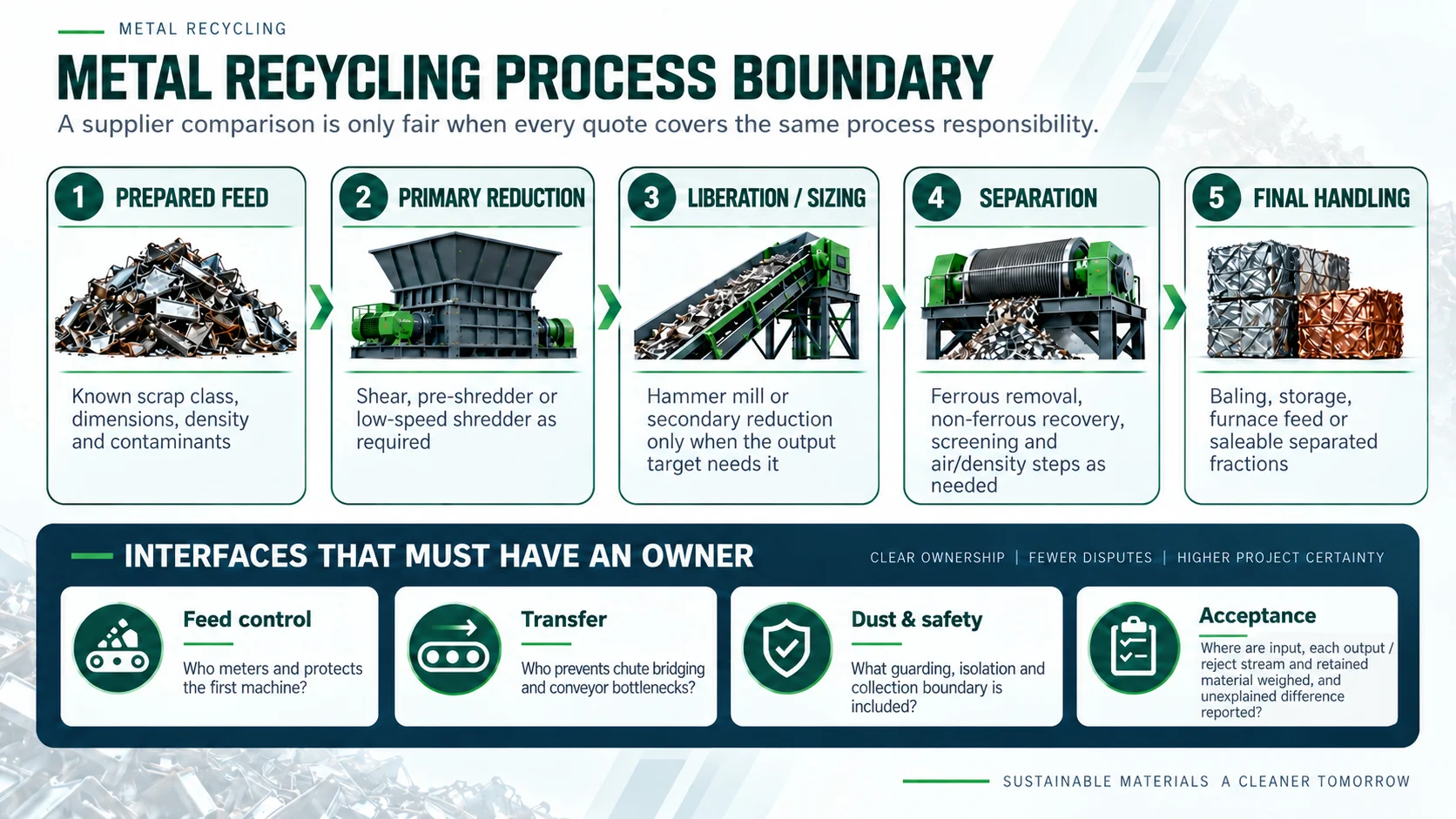
Normalize the RFQ and FAT before comparing equipment prices
Manufacturer quotes often look comparable because they contain the same headline nouns. The expensive differences sit in the boundaries. One bid may include a feed table and dust collection; another may stop at the machine flange. One supplier may quote throughput on clean production scrap; another may assume a representative mixed feed.
Start with a feed passport: material names, photographs, maximum dimensions, typical dimensions, loose or baled condition, approximate bulk density, known contaminants and any pre-removal steps. Then define the output in market terms. ReMA specifications are useful evidence that recycled commodities are traded using agreed descriptions and allowable contamination.[1]
For FAT, require representative feed and an agreed test duration. Record weighed input, accepted product streams, oversize or return, fines or dust, metal rejects, other rejects, retained material and unexplained difference separately. Also record running time, elapsed time, stops, automatic reversals, manual clearing and the agreed energy boundary. If recirculated material is counted twice, or retained material disappears inside a residual category, the mass balance can look better without the process actually performing better.
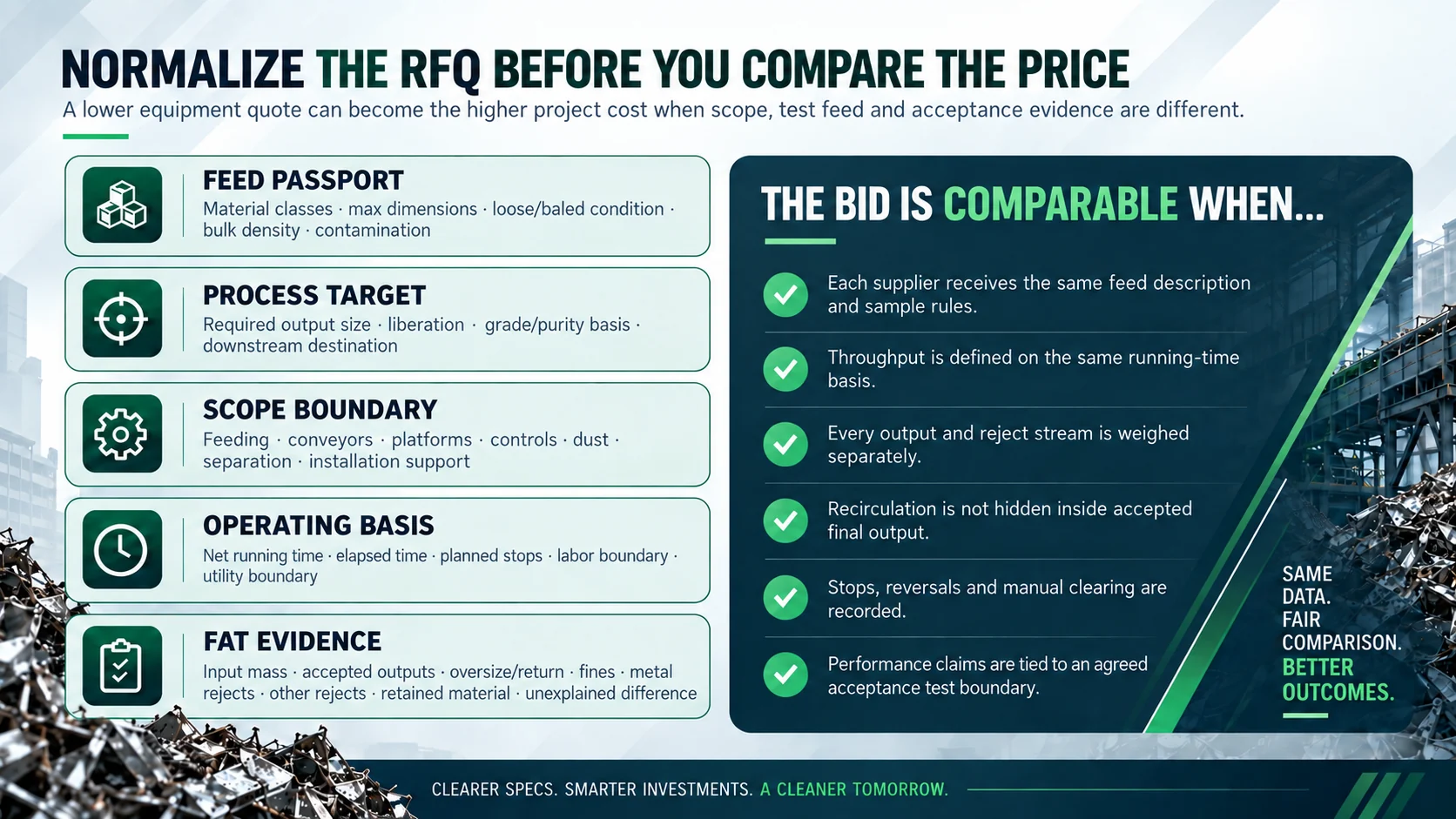
Minimum RFQ package for a serious supplier comparison
- Feed photos or video plus maximum and typical dimensions.
- Material mix and the contaminants that are allowed to enter the line.
- Required sustained throughput and the running-time basis used to calculate it.
- Target products: size, grade, density, purity or downstream destination.
- Available power, footprint, loading method and discharge/collection method.
- Required owner/supplier boundary for civil work, platforms, controls, dust handling, installation and commissioning.
- FAT method, measured outputs and tolerance for unexplained mass difference.
Safety and maintenance access belong in the manufacturer comparison
Metal recycling equipment combines high torque, rotating parts, hydraulic energy, heavy feed and frequent wear-part access. OSHA’s machine-guarding guidance identifies rotating parts, ingoing nip points, flying material and points of operation as hazards that require safeguarding.[3] For servicing and maintenance, OSHA’s hazardous-energy standard requires an energy-control program where unexpected energization or release of stored energy could injure employees.[4]
Those requirements are not a reason to assume a manufacturer’s machine is compliant simply because it has guards. They are a reason to ask better design-review questions. Can wear parts be reached after isolation without climbing through another hazard? Are hydraulic or gravity-stored energies addressed in the maintenance procedure? Are clearing points visible and accessible? Can the line be divided into practical isolation zones? Is the control philosophy defined for automatic restart, reversal and interlocked conveyors?
In a multi-machine line, maintenance access is also a throughput issue. If one separator needs a long shutdown to clean or a shredder requires difficult wear-part access, the nominal capacity of the rest of the plant is irrelevant during that stop. Include access time, changeout method and critical spare parts in the commercial comparison.
Common mistakes when choosing a metal recycling equipment supplier
| Mistake | What it hides | Better question |
|---|---|---|
| Comparing only motor power or cutting force | Feed presentation, chamber geometry, rotor/cutter design and downstream bottlenecks | What feed was used to establish the quoted performance? |
| Asking for one “purity” number | Undefined sample method, moisture, particle size and cross-contamination | Which output stream is sampled, when, and by what mass basis? |
| Using maximum throughput as the purchase target | Short test peaks, favorable feed or excessive recirculation | What sustained rate can be demonstrated over an agreed test window? |
| Buying the full catalog | Unnecessary stages, energy use, wear and dust | Which stage can be removed without missing the output requirement? |
| Ignoring interfaces | Bridging, conveyor overload, unstable buffers and control disputes | Who owns each transfer point and control interlock? |
| Leaving FAT until after the order | A dispute about what “works” actually means | What measurable acceptance criteria will be written into the contract? |
FAQ
Who makes the best metal recycling equipment?
There is no universal best manufacturer. A supplier that is strong in large automobile shredding plants may be excessive for clean aluminum offcuts, while a shear/baler specialist may be a better fit for long ferrous scrap. Compare manufacturers against your feed, output, installed scope and acceptance test.
What equipment is normally included in a metal recycling line?
The equipment mix depends on the material and the required output. A line may use feeding equipment, primary and secondary size reduction, magnets, non-ferrous separation, screens, conveyors, dust control, and final baling or collection. Some projects need only part of this sequence.
Should I buy a complete line from one manufacturer?
Using one supplier can make coordination easier when the process stages depend heavily on each other, but that does not necessarily mean the project will cost less or perform better. The key is whether the supplier accepts responsibility for material transfer, controls, output definitions and FAT across the connected equipment.
How should two metal recycling equipment quotes be compared?
Normalize the feed description, throughput basis, output specification, utilities, installation boundary, dust and safety scope, spare parts and FAT method. If those items differ, the quoted prices are not directly comparable.
What should be tested during factory acceptance?
Use representative material and record input mass, each accepted product, oversize or return, fines, rejects, retained material, unexplained difference, running time, elapsed time, stops, reversals, manual clearing and agreed quality samples.
Build the shortlist around your actual scrap
Send the material photos, maximum dimensions, material mix, required sustained capacity, target output, downstream destination, power supply and available layout. The useful first answer is not a model number—it is a process boundary showing which stages are necessary and what must be proved before shipment.
References
- ReMA: specifications.
- EPA: waste hierarchy.
- OSHA: machine guarding.
- OSHA: lockout.
Online Message