




 Request Quote
Product Center
-
- Biomass Shredding and Recycling Line
- OCC Paper Dry Pulping & Cardboard Recycling Line
- Scrap Aluminum Recycling Line
- Waste Car Recycling Line
- Waste Refrigerator Recycling Line
- Copper Aluminum Radiator Recycling Line
- Motor Rotor Recycling Line
- Copper Wire Recycling Line
- Waste Ink Cartridge Recycling Line
- Aluminum UBC Scrap Recycling Line
Get a Quote
Contact Us


Electrostatic separation belongs near the end of a recycling line, when a dry, liberated fraction needs a cleaner conductive/non-conductive split. That is why supplier selection starts with the prepared feed—not a brochure voltage number.
Top 10 manufacturers to consider
| Manufacturer | Relevant equipment focus | Buyer fit to investigate |
|---|---|---|
| 1. YUXI Machinery | High-voltage electrostatic separation for dry conductor/non-conductor refining. | Cable granules, copper/plastic fractions and e-scrap integration. |
| 2. Bunting | Electrostatic equipment with magnetic and eddy-current systems. | Dry, liberated recycling or mineral fractions requiring trials. |
| 3. hamos | Electrostatic sorting for plastics, metals and mixed fractions. | Plastic and mixed-material sorting projects. |
| 4. ST Equipment & Technology | Triboelectrostatic belt separation. | Dry-beneficiation applications with continuous process duty. |
| 5. Stokkermill | E-Sorting electrostatic separators for conductive/non-conductive dry fractions. | Fine copper/plastic granules, PCB recycling, WEEE and secondary metal recovery. |
| 6. Eriez | High-tension electrostatic sample-preparation equipment. | Technology comparison and laboratory test-method work. |
| 7. Recy Technologies | Triboelectric electrostatic separation systems for mixed rigid polymers. | PET, PP, PVC, HDPE, ABS and other plastic-recycling applications. |
| 8. Armost Recycling-Tech | Electrostatic plastic separation systems for charged mixed polymer flakes. | WEEE, ELV and rigid-plastic recycling where ABS/PS and similar polymers require refining. |
| 9. Mineral Technologies | MT Carrara high-tension roll and electrostatic separation equipment. | Mineral sands, industrial minerals and fine dry conductive/non-conductive separation. |
| 10. WANROOETECH | High-voltage electrostatic separation integrated into cable and recycling systems. | Copper-wire recycling and metal/plastic polishing after upstream separation. |
Define the feed boundary before comparing bids
A high-voltage electrostatic separator should receive a liberated, classified and sufficiently dry fraction. It is commonly a refining stage, not a substitute for preparation. In cable applications, an air flow gravity separator may make the first heavy/light split, leaving electrostatic separation to polish the remaining fraction.
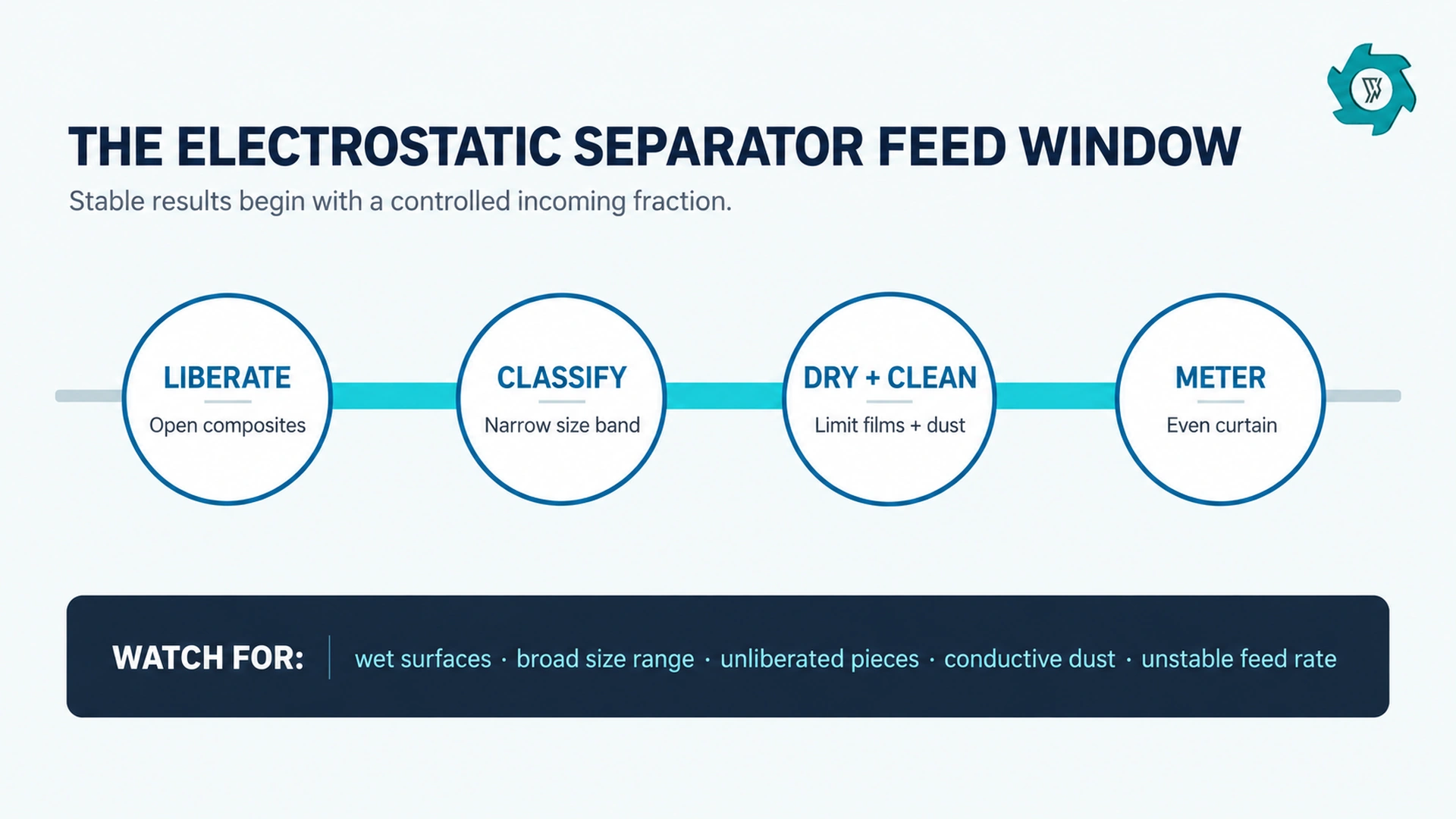
High-tension roll systems exploit differences in electrical conductivity. Conductors and insulators take different trajectories after charging, but moisture, particle-size distribution, dust and liberation state affect the result.1 Never compare a “separation rate” unless the report names the feed, size distribution, moisture condition, throughput, collected streams and calculation basis.
Information gain: three checks most supplier lists omit
Qualified-product capacity, not just feed capacity
Request both the separator feed rate and the rate of product meeting the required purity. A high input rate may create a large middlings stream that needs recirculation or disposal. Record purity, recovery and mass rate for every saleable fraction. This reveals the economic output.
Second-stage value from real middlings
Before accepting a second stage, weigh and assay the first-stage middlings. Model value recovered at several recovery levels; deduct cleaning labor, dust handling, power, spares, floor area and reject handling. A staged trial turns a generic “higher purity” promise into a transparent return decision.
Commissioning-readiness scorecard
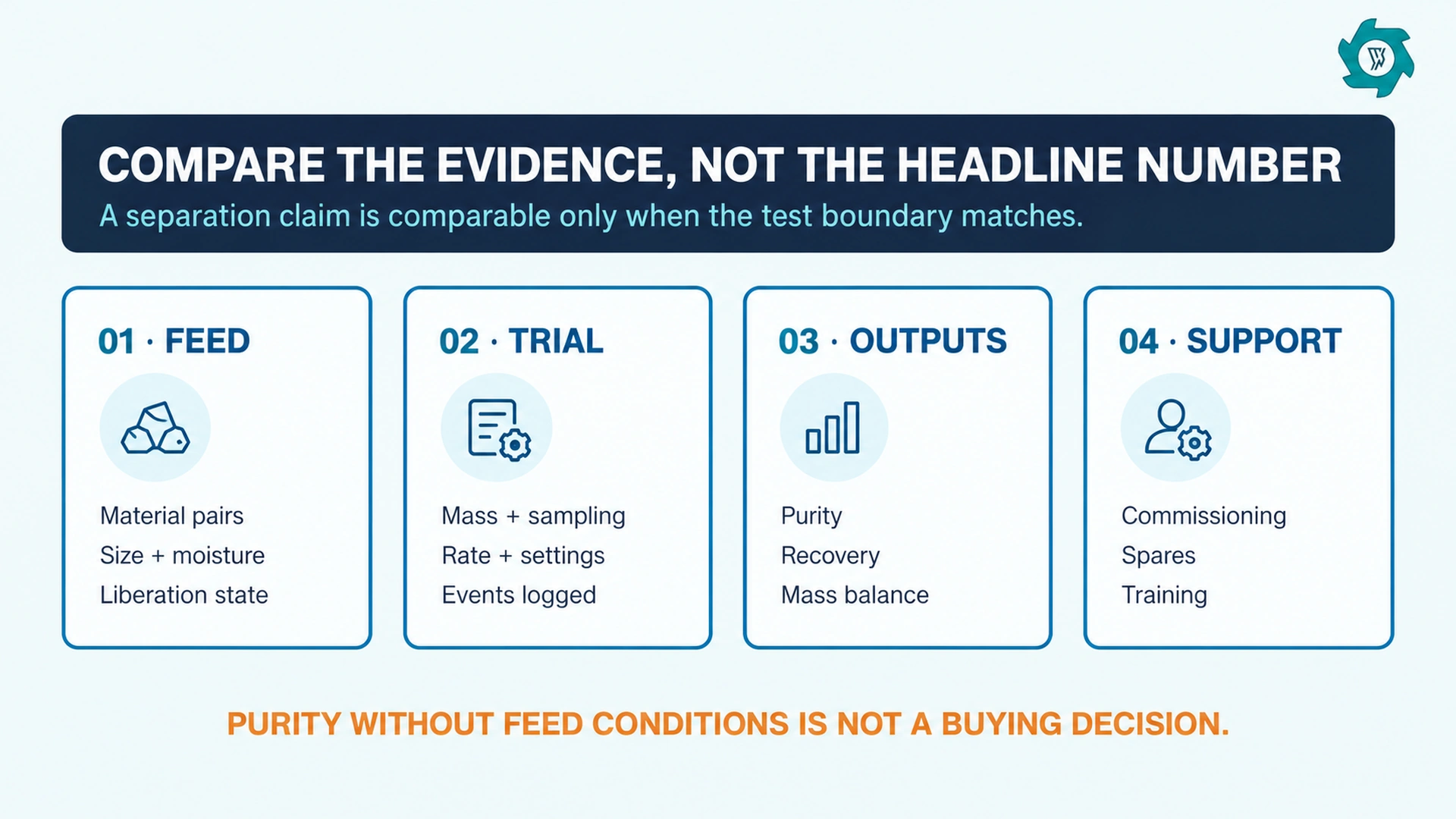
Allocate 30 points to representative test evidence, 20 to clear process boundaries and interfaces, 15 to product-quality and recovery definition, 15 to electrical/safety/documentation scope, 10 to commissioning/training, and 10 to spares/response path.
Use a comparable trial and FAT boundary
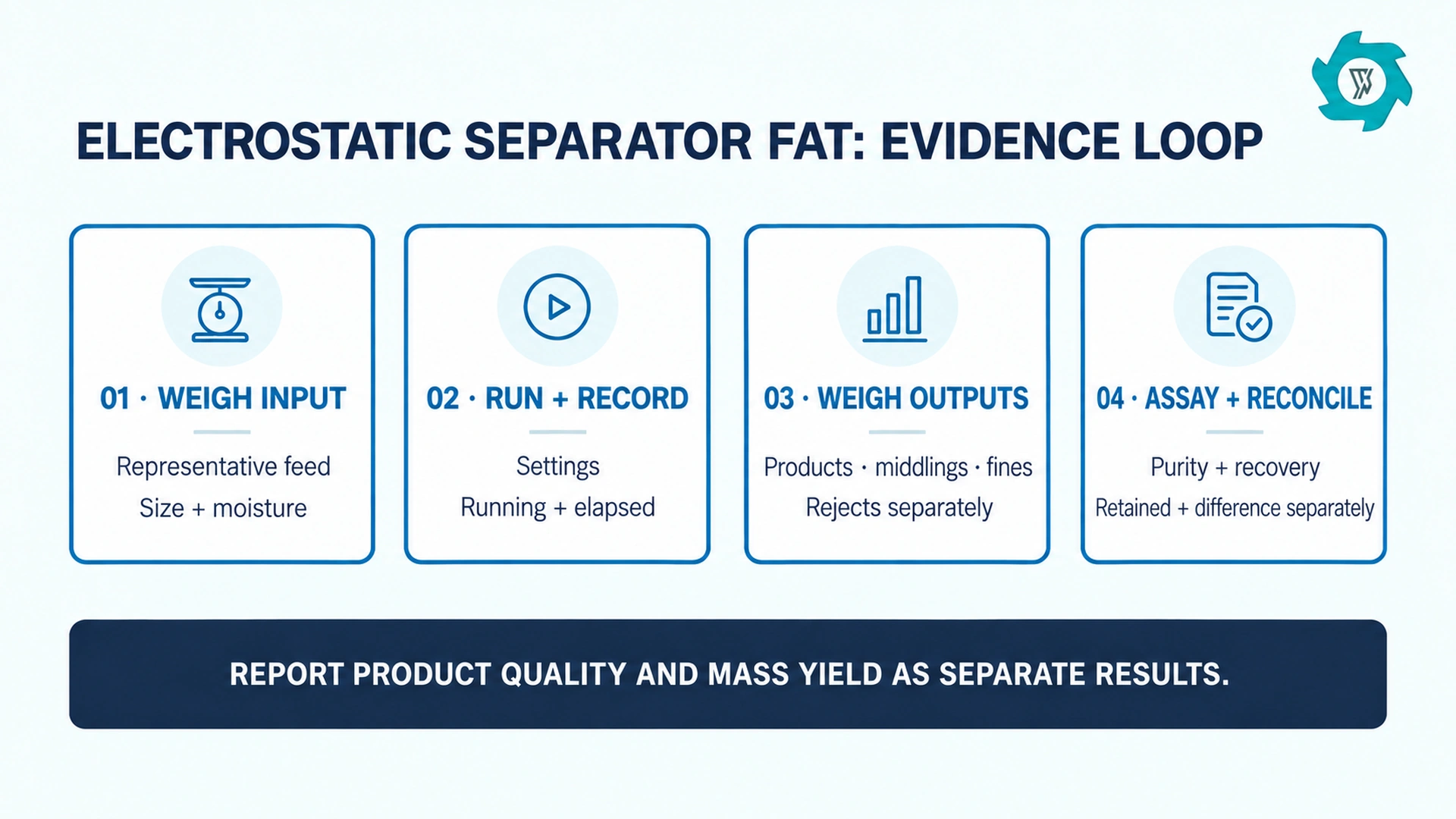
A factory trial explores whether material can separate and finds an operating window. A factory acceptance test (FAT) demonstrates supplied equipment against an agreed boundary. Agree the sample plan, initial mass, sieve bands, moisture measurement, settings, sampling method, assay method and acceptance logic before either event.
| Record | Why it matters | Buyer question |
|---|---|---|
| Feed mass, source and size bands | Shows if the test represents normal production. | What material was excluded? |
| Moisture and ambient condition | Surface water can alter charging behavior. | What site conditioning is assumed? |
| Running and elapsed time | Separates output from stops and cleaning time. | What interrupted operation? |
| Every output stream | Prevents valuable loss into fines or middlings being hidden. | Where did the unexplained difference go? |
| Purity and recovery | Shows the clean-product versus captured-value trade-off. | Which constraint is a hard limit? |
Published work on granular plastics found that high humidity changed surface charging behavior and reduced results for the reported conditions.2 Record it, then define responsibility for drying, enclosure or conditioning in the project scope.
Where the separator fits
Cable scrap may pass through cutting or shredding, copper wire granulation, magnetic removal, screening and gravity separation before electrostatic refinement. An eddy current separator often performs a different upstream job: recovering non-ferrous conductor from a bulk stream. The electrostatic stage is justified only when it adds measurable value to a stable prepared fraction.
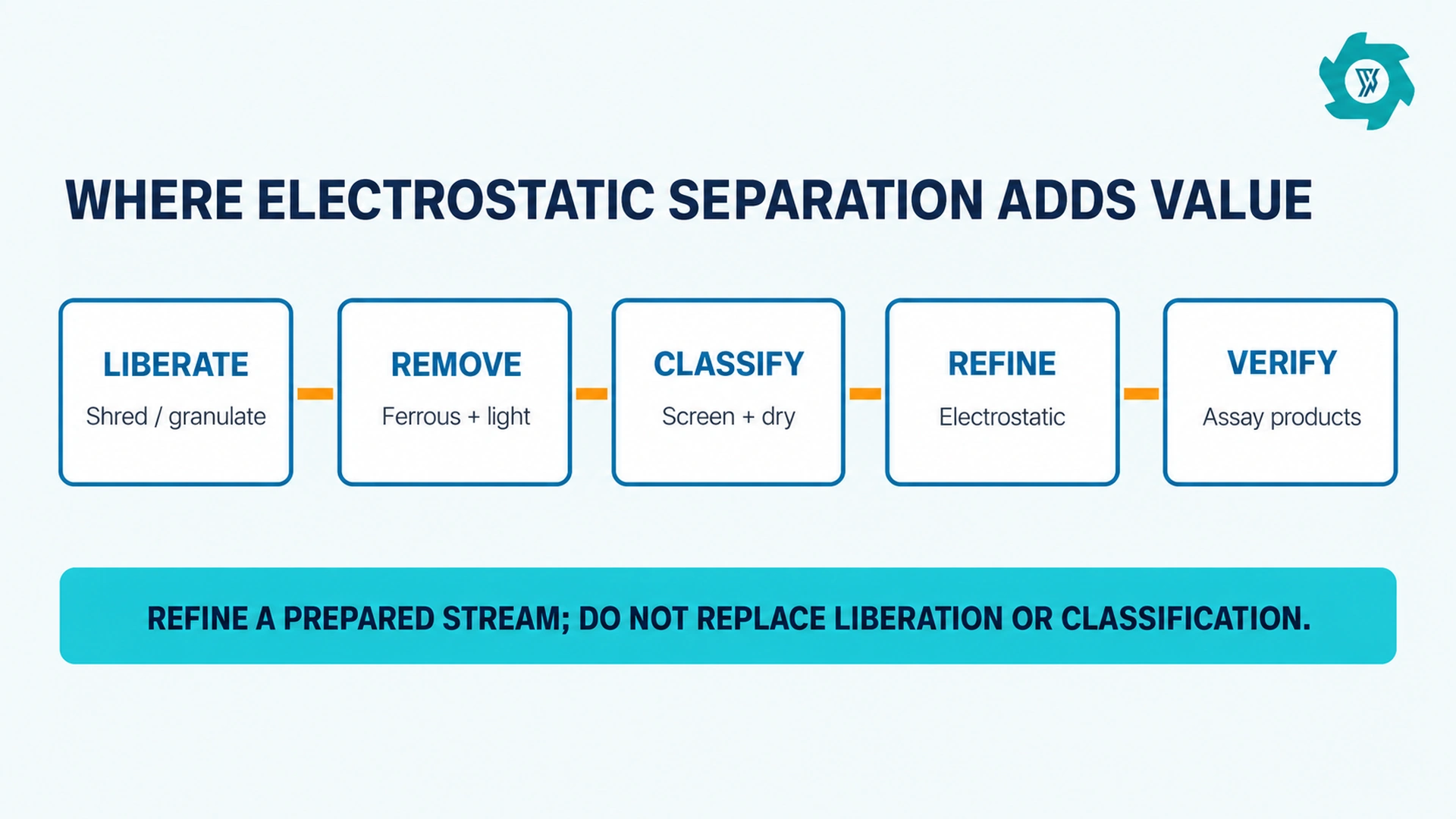
Trace contamination before buying another machine. It may come from unliberated composites, a broad screen cut, unstable airflow, magnetic carryover, moisture pickup or discharge recontamination. On a copper wire recycling line, improving one upstream condition may return more value than adding a second separator.
Application-fit matrix: identify the separation problem before choosing a supplier
Not every conductive/non-conductive mixture should go straight to an electrostatic roll. Buyers should first map the material pair, the liberation state, the particle-size bands and the destination market. For insulated cable granules, the commercial aim may be low plastic carryover in copper; for shredded printed-circuit material, the aim may be recovery of a fine metal fraction without dragging excessive non-metal into the product. For a mineral fraction, the target may be a specification limit on a contaminant. These are different separation contracts, even when the same machine name appears on a quotation.
| Observed feed condition | Likely root cause | Preferred decision before buying |
|---|---|---|
| Large composite pieces remain | Incomplete liberation | Review cutting, granulation or impact duty; do not expect electrostatics to open composite particles. |
| Wide size span with heavy fines | Uncontrolled classification | Screen into meaningful size bands and test them separately. |
| Product purity varies by shift | Moisture, dust or feed-rate drift | Instrument feed condition and dosing before changing electrode settings. |
| Good purity but low metal value recovered | Over-conservative splitter setting or loss to middlings | Measure recovery and assay middlings; optimize the value balance. |
| Repeated cleaning or high-voltage trips | Dust loading, poor housekeeping or unsuitable feed | Define extraction, cleaning access and interlock procedure in the scope. |
How to turn a laboratory result into a plant design
A laboratory result is evidence of separation potential, not proof of production performance. Scale-up changes the width of the feed curtain, feeder stability, dust burden, collection arrangement, operator access and elapsed time lost to normal interventions. Ask the manufacturer to identify which settings can transfer directly, which need validation on a larger unit, and what conditions invalidate the laboratory result. A useful scale-up note has three parts: the exact laboratory feed description, the proposed production feed window, and the open risks that need a commissioning trial.
Separate the technical scale-up from the commercial scale-up. Technical scale-up asks whether the particles will charge and split consistently. Commercial scale-up asks whether the added value of a cleaner fraction exceeds depreciation, utilities, labor, spares, cleaning and quality-control cost.
Cost drivers buyers should normalize across quotations
Capital price is only one part of the decision. Compare feeder and distribution hardware, high-voltage enclosure, dust interface, access doors, collection bins or conveyor discharge, control system, guarding, commissioning, training, recommended spares and remote/local support. Clarify whether the supplier’s stated throughput assumes one pass or a recirculation loop. The difference changes conveyor duty, buffer capacity, operating labor and the real cost per tonne of qualified product.
For operating cost, track kWh per tonne at the separator boundary, planned cleaning minutes per shift, unplanned stoppage minutes, consumable replacement interval, rejected mass, middlings mass and laboratory cost per quality check. A low-cost run that misses the buyer’s purity specification is not comparable with a slower run that delivers accepted material.
RFQ fields that prevent expensive assumptions
- State the material composition by expected range, not only a single ideal percentage.
- Provide normal and worst-normal feed photos, plus sieve analysis and moisture history where possible.
- Identify the last upstream separation stage and whether it changes with product mix.
- State whether the desired product is sold, reprocessed or disposed; this determines the value of purity versus recovery.
- Specify the energy boundary: separator only, or feeder, extraction and auxiliary equipment too.
- Request electrical drawings, safety interlocks, cleaning access, grounding requirements and lockout points before release for manufacture.
- Ask for a recommended spare-parts list divided into commissioning spares, annual spares and critical outage spares.
Commissioning plan: the first 30 days should produce a baseline
Commissioning should end with a repeatable operating recipe. During the first production month, establish a baseline by material family and size band. Record feed rate, moisture condition, selected machine settings, product purity, product recovery, middlings mass, dust/reject mass, running time and interventions. If the plant later loses purity or yield, that baseline lets the operator distinguish feed change from equipment drift.
Set action limits in advance. For example, a rising middlings rate should trigger a check of feed size, moisture and splitter position before a major adjustment is made. A growing unexplained mass difference should trigger inspection of dust collection, retained material and sample handling. This is better than changing several settings at once and losing the ability to explain the outcome.
Maintenance and safety questions that should appear in the supplier comparison
High-voltage equipment needs defined inspection and isolation procedures. Ask how operators confirm the safe state before cleaning, which surfaces need routine cleaning, how insulation condition is checked, what indicates abnormal leakage or arcing, and how access is interlocked. The correct arrangement depends on the exact machine and local rules, so these are scope questions rather than generic operating instructions.
Also ask who owns performance when dust extraction is provided by another contractor. Electrostatic separators are sensitive to the condition of the feed; a poorly designed extraction connection, condensation point or open transfer chute can become a separation problem even if the separator itself is correctly built. Put these interfaces on the layout and FAT plan.
Supplier decision worksheet
| Decision item | Evidence to request | Red flag |
|---|---|---|
| Application match | Representative test report and feed photographs | Performance claim based only on a different material family |
| Yield | Weighed outputs and assay by stream | Purity reported without recovery or middlings |
| Scale-up | Written statement of production feed window and risks | Laboratory result presented as guaranteed plant output |
| Integration | Interface drawing, elevations, electrical and dust boundaries | “By others” scope with no defined hand-off condition |
| Support | Commissioning plan, training agenda and critical-spares list | No response path for high-voltage or controls faults |
When electrostatic separation is the wrong next investment
There are situations where an electrostatic separator is technically interesting but commercially premature. If the incoming material is wet, sticky or inconsistent because storage is uncontrolled, first solve handling and conditioning. If particles are still composite, improve liberation. If the stream changes daily and no one can identify the dominant material pairs, build a sampling and classification routine before ordering a refining stage. And if the buyer cannot define the destination or value of either product stream, a purity improvement has no economic objective.
This “do not buy yet” test is useful in supplier meetings. It shows whether the supplier is willing to protect the project boundary or simply maximize equipment scope. A credible partner may recommend a screen, dryer, dust-control change or additional upstream liberation before recommending electrostatic refinement.
Value recovery: choose the operating point, not the highest purity point
Every separator has an operating trade-off. Moving splitters or changing feed conditions can increase purity while lowering recovery, or increase recovery while raising contamination. The right operating point is the one that maximizes contribution margin after applying the buyer’s actual penalties, sales specifications and disposal costs. Create a simple table for each trial condition: input mass, product mass, product assay, product value, middlings mass, reject mass, reprocessing cost and elapsed time. Then compare contribution per input tonne.
This also prevents a common comparison error: one supplier may report a very clean product after discarding more valuable material, while another reports slightly lower purity with much higher recovered value. Neither result is “better” until the outlet specifications and cost of each route are applied.
Acceptance tolerances should be agreed before the FAT
An acceptance test needs a defined response when the mass balance does not close or when a product result falls near its target. Agree how samples are taken, how duplicate samples are handled, which laboratory method applies, and what tolerance triggers repeat testing or investigation. State whether retained material is allowed in the balance, where it is physically located, and whether it is weighed before or after cleaning. “Unexplained difference” must never be used as a convenient residual category without a limit and follow-up action.
Set the boundary for running time too. A trial may include start-up adjustments, but the final evidence should say exactly which period was used for sustained-rate calculation. Report both running time and elapsed time; otherwise cleaning, blockages and reconfiguration can quietly disappear from the capacity number.
Supplier due diligence beyond the machine drawing
Find out who on the supplier’s side will handle process testing, controls, commissioning, and local service. Then ask to see the documents they expect to hand over, such as the general arrangement, foundation and interface details, electrical single-line drawing, control description, interlock list, maintenance plan, spare-parts list, and FAT procedure.
Also separate proprietary claims from proven site facts. A supplier can explain what its design is intended to do, but performance should be tied to your feed sample and agreed test conditions. If an advertised capacity, purity or recovery number is supplied, record it as supplier-published unless it is demonstrated under your defined boundary.
Site acceptance test: preserve the evidence chain
The SAT should check that shipping, installation, utilities, and upstream connections have not altered the operating conditions proven during the FAT. Use the same or demonstrably equivalent feed, repeat the same product definitions and preserve the original sample plan.
At handover, create an operating envelope document: approved material families, expected size bands, maximum moisture condition, normal feed-rate range, product quality targets, cleaning triggers and fault escalation contacts. This is more useful to operators than a generic performance statement because it turns trial knowledge into a controlled production routine.
Buyer mistakes that create misleading comparisons
- Sending a hand-picked clean sample: test normal and worst-normal feed separately.
- Combining middlings with product: report each material route independently.
- Comparing rated throughput: compare qualified-product throughput at the same quality constraint.
- Ignoring moisture history: record storage condition as well as the single test reading.
- Leaving dust collection out of scope: define the process and performance interface.
- Accepting a one-off result: run repeat samples and record changes in settings and events.
FAQ
What should a buyer send before requesting an electrostatic separator quote?
Send a representative feed sample or photos, material classes, particle-size distribution, moisture condition, target throughput, desired product quality, upstream equipment and site electrical data.
Can an electrostatic separator replace an eddy current separator?
An eddy current separator is often placed earlier in the process to remove non-ferrous metals from mixed material. Electrostatic separation tends to follow later, once the feed is dry and the particles are sufficiently liberated for conductive and non-conductive fractions to separate cleanly.
What is the difference between a factory trial and a factory acceptance test?
A trial explores whether a material can be separated and identifies a process window. A factory acceptance test uses an agreed representative feed, measurement method and acceptance criteria to demonstrate the supplied equipment against a defined boundary.
Which result should be reviewed alongside product purity?
Review recovery and mass balance alongside purity. A clean product can be achieved by losing valuable material to middlings, fines or rejects, so every output stream should be weighed and sampled separately.
Why must test results state the feed condition?
Moisture, dust, particle size, liberation and material mix can alter charging and trajectory. A result without these conditions cannot be compared fairly with another supplier’s result.
When is a second electrostatic stage justified?
A second stage only makes sense if the first pass still leaves enough valuable material behind to justify the added equipment, cleaning, power use, and quality checks. Confirm it with a staged trial and separate mass balance.
Get a Quote Now
Send feed photos, particle-size and moisture information, target throughput, quality target and the upstream/downstream layout. A defined feed lets the proposal be engineered around the job rather than guessed from a generic capacity figure.
References
- Waste Management: separator applications.
- IEEE: humidity effects.
Online Message