




 Request Quote



What Happens to a Refrigerator at an Industrial Recycling Plant?
A complete industrial process has two distinct halves. The first makes the appliance safe and predictable to process: receiving, inspection, refrigerant recovery, compressor and oil handling, and removal of unsuitable parts. The second half is mechanical: cabinet shredding, secondary liberation, foam extraction, magnetic separation, non-ferrous recovery and final material cleanup.
A plant receiving complete end-of-life appliances needs upstream depollution equipment and operating procedures. A mechanical line receiving already evacuated refrigerator cabinets starts later. YUXI’s waste refrigerator recycling line uses the same distinction: complete units require pre-treatment before the cabinet enters shredding and separation.
For U.S. projects, EPA describes appliance recycling as recovery of refrigerant and removal of hazardous components followed by shredding of evacuated appliances.[1] The EU WEEE Directive likewise requires selective treatment for refrigerants and other specified components, and it requires gases in refrigeration circuits and certain foams to be properly extracted and treated.[2] The exact compliance route depends on the country and facility, but the engineering sequence is clear: depollution comes before uncontrolled size reduction.
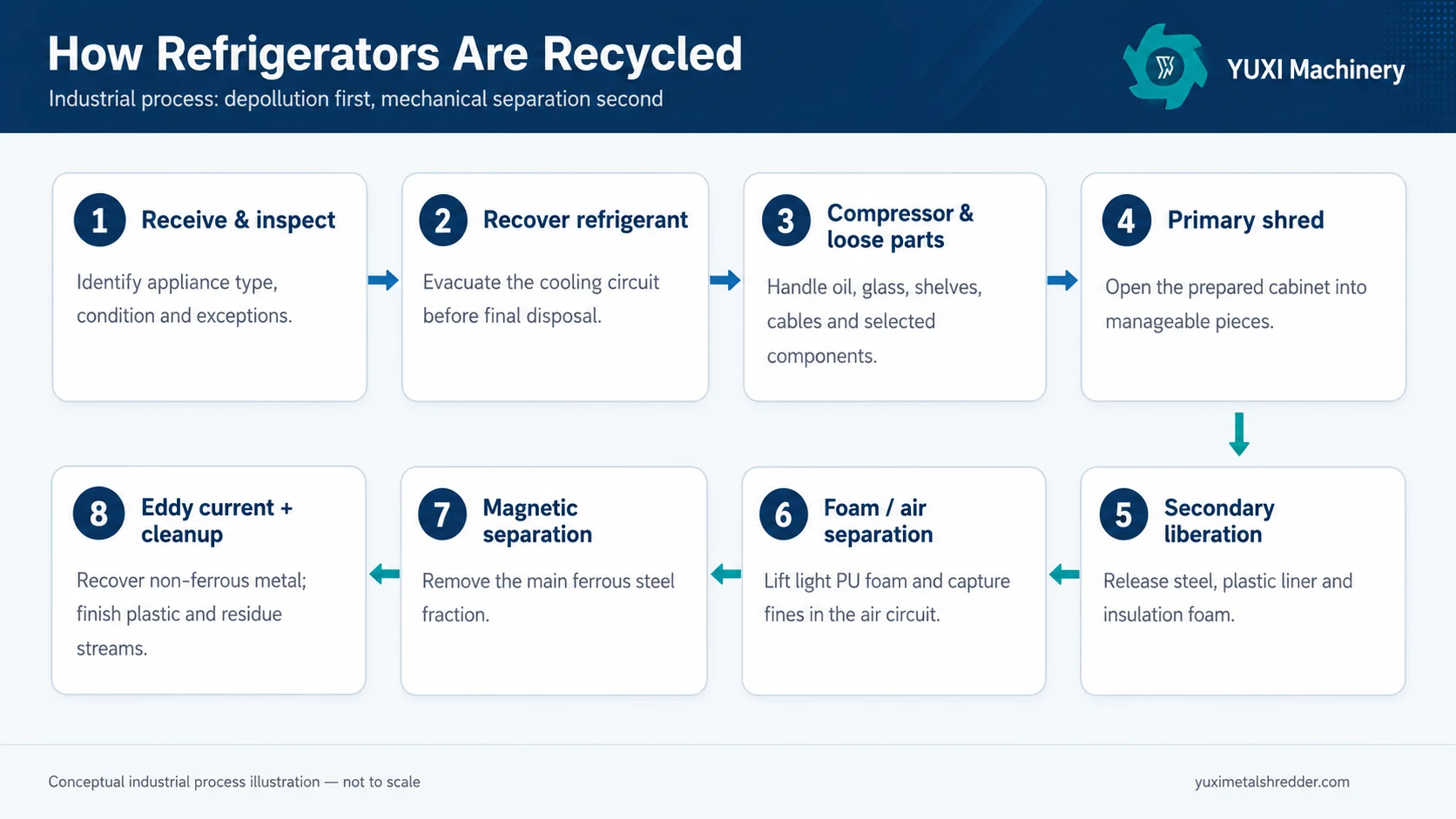
The Industrial Refrigerator Recycling Process at a Glance
| Stage | Main job | Typical output / handoff |
|---|---|---|
| 1. Receiving & inspection | Identify appliance type, condition, size and exceptions | Accepted units routed to the correct pre-treatment path |
| 2. Refrigerant recovery | Recover refrigerant from the cooling circuit | Evacuated cooling circuit and recovered refrigerant stream |
| 3. Dismantling & compressor/oil handling | Remove unsuitable or valuable loose parts and manage compressor oil | Prepared cabinet plus separately collected components |
| 4. Primary shredding | Open the bulky cabinet | Coarse refrigerator pieces suitable for controlled conveying |
| 5. Secondary crushing / liberation | Break attachments between steel, plastic liner and foam | More liberated mixed material |
| 6. PU foam and air separation | Lift light foam and capture fines | Foam fraction plus a denser material stream |
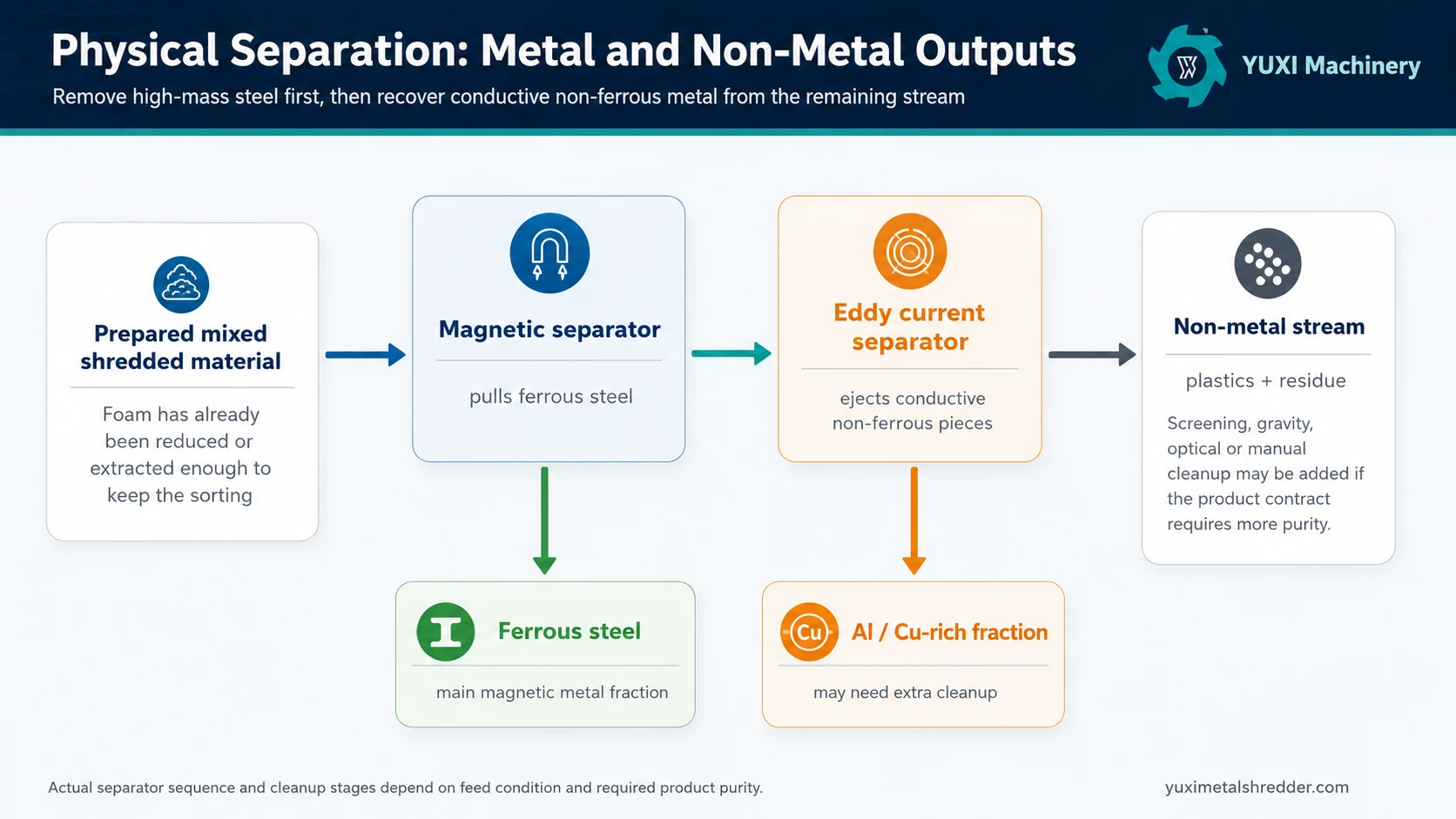
| 7. Magnetic separation | Recover ferrous steel | Steel product and non-magnetic remainder |
| 8. Eddy current / cleanup | Recover conductive non-ferrous pieces and finish non-metal streams | Al/Cu-rich fraction, plastics and residue |
Some add screening, density separation, optical sorting, manual quality control or separate copper/aluminum cleanup. Published research on refrigerator recycling nevertheless shows the same core logic: manual dismantling and depollution first, then shredding and physical separation using air/density, magnetic and eddy current techniques.[3][4]
Step 1: Receive, Identify and Stage the Refrigerators
The first useful question is not “How many refrigerators can the shredder take?” It is “What exactly arrives at the plant?” Municipal collections can include compact refrigerators, side-by-side units, chest freezers, commercial cabinets, damaged appliances and machines spanning several refrigerant generations. Dimensions, average weight, retained components and contamination can all shift the workload.
A receiving station therefore needs a feed-acceptance rule. Operators check whether the unit belongs in the refrigerator stream, whether the cooling circuit appears intact, whether obvious foreign material is present, and whether the appliance needs an exception route. Units with unknown or non-conforming contents should not be pushed forward just to keep the shredder busy.
Refrigerators are processed as individual units during inspection and depollution, while the mechanical line is loaded by mass. That is why a useful plant specification carries both appliances per hour and tonnes per hour, together with average appliance weight and the exact process boundary.
Step 2: Recover Refrigerant Before Mechanical Processing
Refrigerant recovery is the first hard release gate. U.S. EPA guidance says the Clean Air Act prohibits the knowing release of most refrigerants during appliance disposal, and the final disposer is responsible for ensuring that refrigerant is recovered.[1][5] Older appliances may contain CFC or HCFC refrigerants, later units may contain HFCs, and some newer household refrigerators use hydrocarbons such as isobutane. A mixed incoming population should be treated as a design input, not as a footnote.
The practical sequence is simple to describe even though the equipment and compliance details are site-specific: connect the correct recovery equipment, evacuate the cooling circuit, route the recovered refrigerant to the required downstream management, and document the release condition before the unit moves on.
For a more detailed pre-shred checklist, see YUXI’s guide to refrigerator depollution before shredding.
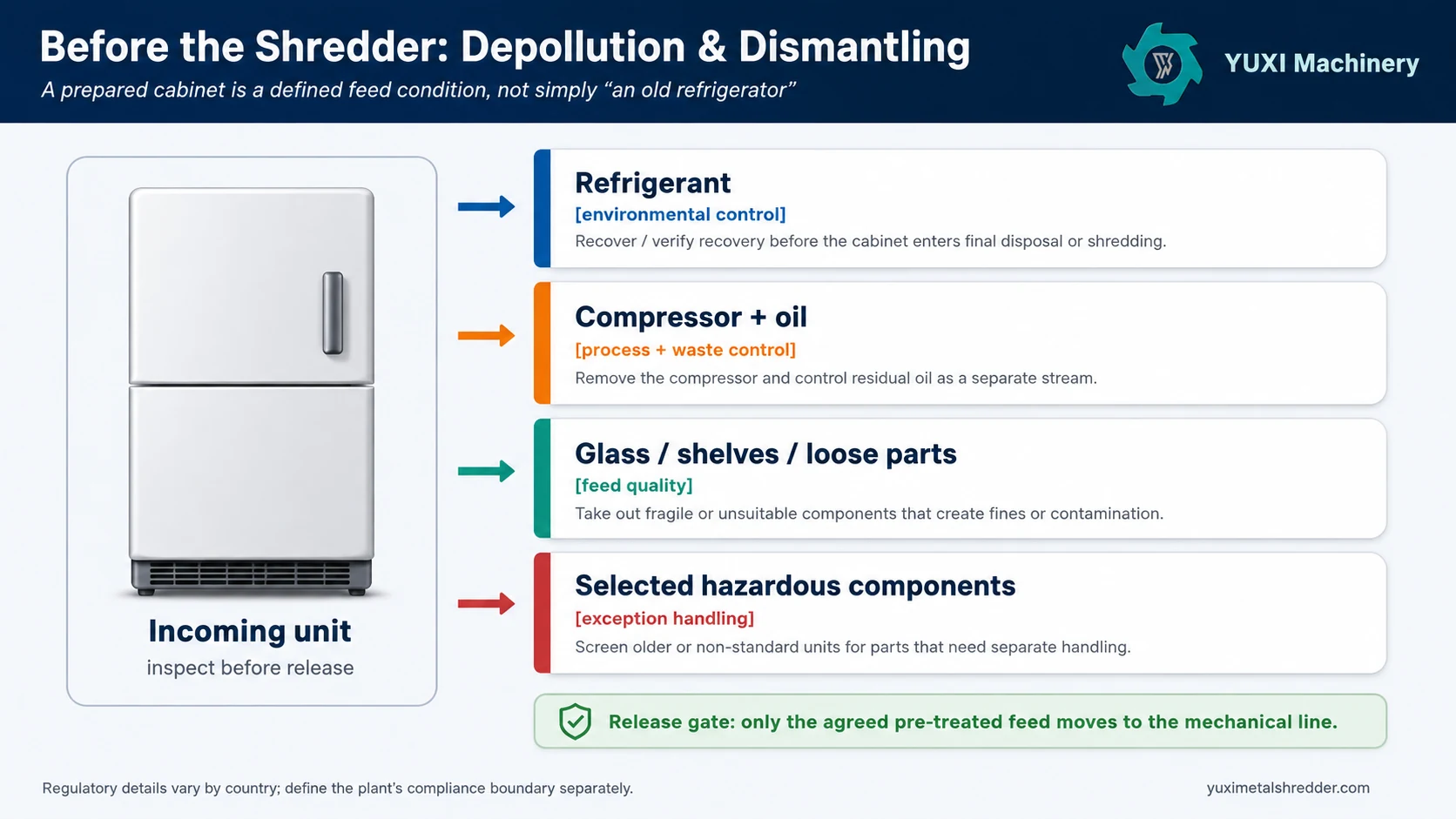
Step 3: Remove the Compressor, Oil and Unsuitable Parts
After refrigerant handling, the compressor is normally removed and residual oil is collected or managed at a dedicated station. That keeps a dense component and a liquid waste stream out of the cabinet shredding section. It also allows the compressor to follow its own recovery route.
Glass shelves, loose drawers, food waste, bottles and unrelated household debris are usually better removed before mechanical size reduction. Accessible cables, circuit boards and copper tubing may also be taken out when the value gained is worth the manual time. These are not all equivalent obligations; some are environmental controls, while others are process choices made to protect equipment or improve product quality.
Older or unusual appliances need additional screening. EPA notes that legacy units may contain mercury-containing components, contaminated oils and PCBs.[1] The right operating rule is to identify where those exceptions can occur and give the dismantling team a route for them.
Step 4: Primary Shredding Opens the Refrigerator Cabinet
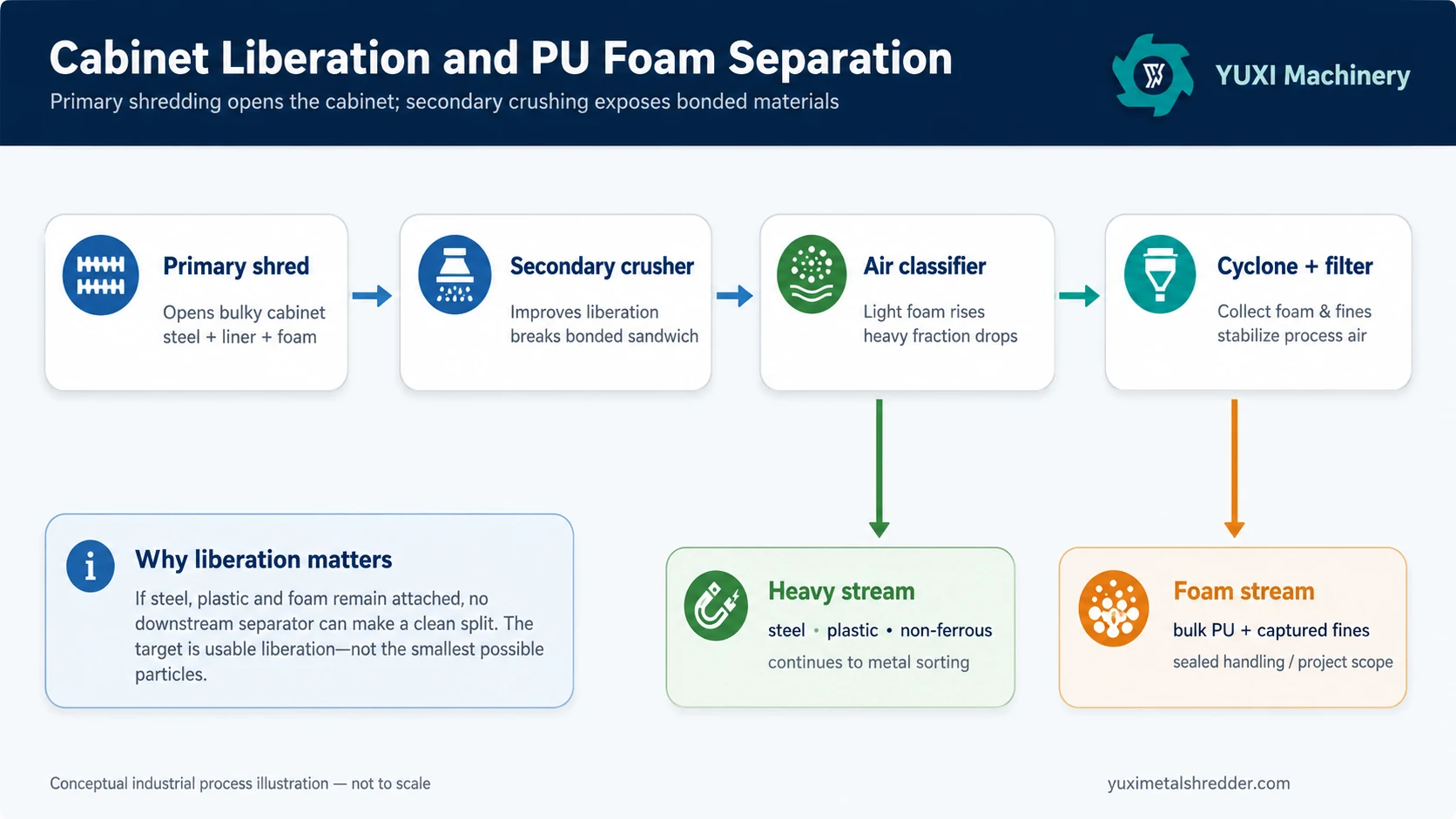
Once the refrigerator body has reached the agreed pre-treated condition, it can enter the mechanical line. A low-speed, high-torque double-shaft shredder is commonly used to grip the cabinet and tear it into coarse pieces. The job at this stage is opening, not final separation.
That distinction matters because a refrigerator cabinet is a bonded sandwich. Thin steel sheet, plastic liner and rigid polyurethane insulation are joined together across broad surfaces. If the first shredder only bends the cabinet into large folded bundles, later equipment has little chance to make clean products. If it over-processes the material into unnecessary fines, dust load and downstream classification can become harder. The target is a controlled coarse output that the next machine can liberate efficiently.
The refrigerator recycling equipment guide explains how the primary shredder, secondary crusher, foam system and separators divide these jobs across the line.
Step 5: Secondary Crushing Liberates Steel, Plastic and Foam
It breaks more of the attachment between steel skin, plastic liner, tubing and insulation. That physical liberation is what turns a cabinet fragment into particles that can respond differently to air, magnets and eddy currents.
In practice, separation problems often start here. A clean magnetic separator cannot remove foam from a steel-foam composite because the two materials are still physically attached. An eddy current separator cannot produce a clean non-ferrous product if the feed arrives in deep clumps of plastic and foam. Before changing separator settings, check whether the material has been opened and presented properly.
Step 6: Separate PU Foam and Control the Air Circuit
Refrigerator foam behaves very differently from ordinary metal scrap. Once it is broken out of the cabinet, it is light, takes up a lot of space, and can easily be picked up by moving air. A controlled airflow stage can lift the foam away from heavier steel, plastic and non-ferrous pieces. Cyclones and filters then separate bulk foam and fine dust from the process air.
The separator is only one part of that circuit. Feed depth, duct leakage, fan pressure, cyclone discharge, filter loading and rotary valves all change the actual cut point. Too little air leaves foam in the heavy stream. Too much air can pull thin plastic or small metal pieces into the foam stream. Stable operation comes from balancing the whole loop rather than setting the fan to its maximum frequency.
There is also an important environmental distinction. The cooling-circuit refrigerant is recovered upstream. The foam blowing agent is inside the insulation matrix and may be released when foam is cut or crushed. EPA’s appliance-disposal guidance notes that foam blowing agents are part of the refrigerator material system and that foam recovery has historically gone beyond the minimum refrigerant-recovery requirement in the United States.[1] The EU WEEE framework requires gases in qualifying foams and refrigeration circuits to be extracted and treated.[2] A project specification should therefore say whether it includes only physical foam separation, contained foam handling, or dedicated blowing-agent recovery/treatment.
Step 7: Recover Ferrous Steel with Magnetic Separation
After the light foam load has been reduced, a drum or overband magnet removes the ferrous fraction. Steel is typically the largest metal fraction by mass, so recovering it early simplifies everything downstream. The remaining stream is smaller and no longer dominated by magnetic sheet metal.
Magnetic recovery still depends on feed presentation. A deep burden can shield material; wide variation in particle size changes trajectories; and attached plastic or foam lowers apparent product purity. A stable, spread material layer usually helps more than simply specifying a stronger magnet.
Step 8: Recover Non-Ferrous Metal and Clean the Remaining Streams
After the steel has been removed, the remaining material goes to the eddy current separator. Aluminum and copper move into one stream, while plastics and other non-metallic materials follow a different one.
An eddy current separator can remove the non-ferrous metals, but that doesn’t mean the material is fully sorted. When the feed size varies a lot, copper and aluminum may still come out together. If a cleaner final product is needed, another sorting step may have to be added.
What Materials Come Out of Refrigerator Recycling?
A well-defined line produces several different products rather than one “recycled refrigerator” output. The exact mass balance depends on appliance design, age, what was removed by hand and how far the downstream separation goes.
| Recovered stream | Where it comes from | Typical next step |
|---|---|---|
| Ferrous steel | Cabinet skins, frames and other magnetic pieces | Metal recycling / steelmaking route |
| Aluminum- and copper-bearing fraction | Tubing, heat-exchanger parts, wiring fragments and other conductive non-ferrous pieces | Further sorting or non-ferrous metal processor |
| Plastics | Inner liner, door trim, drawers and other polymer parts | Polymer sorting/recycling where market and composition allow |
| PU foam | Cabinet insulation | Collection, densification, recycling or controlled downstream treatment according to project scope |
| Compressor and dismantled parts | Removed before cabinet shredding | Dedicated metal recovery or approved component handler |
| Refrigerant / oil / regulated components | Depollution stations | Recovery, reclamation, recycling or disposal under applicable rules |
| Residue | Fines, contamination and material outside product specifications | Approved downstream treatment or disposal |
EPA’s current appliance-disposal page notes that almost all refrigerator materials can in principle be recycled, including the metal cabinet, refrigerant, compressor oil and foam blowing agent; it also points out that real-world handling of glass, plastics and foam varies by facility and program.[1] For equipment procurement, it is therefore safer to specify the actual output streams and cleanliness targets than to rely on one universal “recycling percentage.”
Recycling Rate, Recovery Rate and Product Purity Are Different Numbers
- Recovery rate asks how much of a target material is captured into its intended stream.
- Product purity asks how much of that stream is actually the target material.
- Recycling rate may refer to the share of total appliance mass sent to recycling rather than disposal, depending on the reporting method.
A line can show high steel recovery while producing a steel product contaminated with foam and plastic. It can also produce very clean non-ferrous material while losing too much aluminum into the residue. A useful factory acceptance test checks both sides of the cut: what the product contains and what remains in the reject stream.
How Refrigerator Type Changes the Recycling Process
Industrial plants rarely receive one uniform refrigerator model. Older units may differ in refrigerant and foam chemistry; newer household appliances may use flammable hydrocarbon refrigerants; freezers can carry more insulation; large commercial cabinets can change lifting and shredder feed geometry.
That variation is one reason the safety plan belongs in the process design. Refrigerant identification, ventilation, gas monitoring, ignition control, dust management and interlocks need to match the actual incoming population and local requirements. The separate YUXI guide to refrigerator recycling plant safety covers the main control layers in more detail.
Do not treat “complete refrigerator” as a single machine specification. A quotation should state the allowed appliance types, largest cabinet, average mass, condition at mechanical-line entry and excluded items. That turns the feed from a marketing phrase into an engineering contract.
How Long Does Industrial Refrigerator Recycling Take?
There isn’t really a standard cycle time for one refrigerator, because an industrial plant doesn’t process them one at a time. Receiving and depollution are usually measured by unit count, while shredding and separation operate as continuous material-flow stages. A cabinet can move through the mechanical section quickly, yet the full plant throughput may still be limited by refrigerant recovery, manual dismantling, secondary crushing, foam collection or bin changes.
For capacity planning, state both units per hour and tonnes per hour, then define whether those figures refer to complete appliances entering the site or pre-treated cabinets entering the shredder. YUXI’s refrigerator recycling capacity guide explains why those two capacity figures should always travel together.
Common Process Mistakes to Avoid
Sending complete refrigerators straight to the shredder
The mechanical capability to bite a cabinet is not the same as a safe or compliant process. Refrigerant, oil and specified components need a defined upstream route.
Trying to fix poor liberation with stronger separators
If steel, plastic and foam remain attached, the separator is being asked to solve a mechanical problem. Check the shredder/secondary-crusher handoff first.
Treating foam separation as “fan + duct”
Air balance depends on the full circuit: classifier, cyclone, filters, duct losses, discharge seals and feed burden. Any one of them can move the separation point.
Comparing capacity numbers with different feed boundaries
Eighty complete appliances per hour and eighty evacuated cabinets per hour are not the same job. The first includes front-end depollution labor and equipment.
Quoting one purity number without a sampling method
Define product name, sample point, sample mass, test duration and how carryover is measured.
What Should Be Specified When Buying a Refrigerator Recycling Line?
(1)Representative photos and videos of incoming refrigerators and freezers
(2)Average and maximum cabinet dimensions and measured unit weight
(3)Expected appliance age mix and known refrigerant information where available
(4)Exact pre-treatment condition at the mechanical-line inlet
(5)Required sustained units/hour and tonnes/hour
(6)Target product streams and contamination limits
(7)PU foam collection, dust control and blowing-agent treatment boundary
(8)Workshop dimensions, clear height, electrical standard and utilities
(9)Local environmental, fire, electrical and worker-safety requirements
(10)Factory acceptance test feed, duration, sampling method and allowed stoppages
The shredder is sized around the largest prepared cabinet and required primary output. The crusher is sized around liberation duty. The air system is sized around foam and dust load. The magnetic and eddy current stages are sized around the mass and particle-size distribution they will actually receive.
Plan the Process Around Your Actual Refrigerator Feed
Send YUXI your refrigerator/freezer photos, pre-treatment condition, capacity target, required recovered fractions and workshop layout. We can use that information to define the process boundary and build the equipment sequence around the real feed instead of a generic machine list.
FAQ: How Are Refrigerators Recycled?
Can a complete refrigerator go directly into an industrial shredder?
It should not be treated as unrestricted direct shredder feed. Complete units normally require inspection, refrigerant recovery, compressor and oil handling, and removal of unsuitable or regulated components before the cabinet enters mechanical size reduction.
What is removed from a refrigerator before shredding?
At minimum, the plant needs a defined route for refrigerant and applicable regulated components. Many facilities also remove the compressor, manage compressor oil, and take out glass, shelves, loose parts and selected valuable components before cabinet shredding.
How is the polyurethane foam separated?
Secondary crushing liberates more of the insulation from steel and plastic. A controlled airflow system lifts the low-density foam into a cyclone/filter circuit while heavier material continues to downstream metal separation.
How to separate steel, copper and aluminum?
A magnetic separator removes ferrous steel. The prepared material can then go through an eddy current separator to pull out conductive non-ferrous metals. In most cases, this leaves a fraction containing mainly aluminum and copper.
Is the Refrigerant Same As the Blowing Agent in the Foam?
No. The refrigerant needs to come out before shredding. The foam is different because some blowing agent may still be trapped inside. Once that foam is cut or crushed, some of the gas may be released. On some lines, normal ventilation is enough; on others, extra gas collection or treatment is added. The setup can vary from one project to another, depending on the refrigerators being processed and the local requirements.
Where Does a Refrigerator Recycling Line Usually Slow Down?
Receiving, refrigerant recovery, manual dismantling, shredding, secondary liberation, foam extraction, separator burden depth or product-bin handling can each become the limiting stage. Capacity should be tested across the connected line using representative feed.
References
- U.S. EPA — appliance disposal.
- EUR-Lex — WEEE Annex VII.
- Garcia et al. — refrigerator material recovery study.
- Park et al. — refrigerator recycling separation study.
- U.S. EPA — refrigerant consumer FAQ.