




 Request Quote

Product Center
-
- Biomass Shredding and Recycling Line
- OCC Paper Dry Pulping & Cardboard Recycling Line
- Scrap Aluminum Recycling Line
- Waste Car Recycling Line
- Waste Refrigerator Recycling Line
- Copper Aluminum Radiator Recycling Line
- Motor Rotor Recycling Line
- Copper Wire Recycling Line
- Waste Ink Cartridge Recycling Line
- Aluminum UBC Scrap Recycling Line
Get a Quote
Contact Us


A briquette press does not receive “biomass” in the abstract. It receives a real stream with a moisture range, particle-size distribution, bulk density, fiber shape, contamination level and short-term feed-rate variation. If those conditions move outside the press’s tested window, operators usually see the symptoms downstream: unstable filling, fluctuating compaction load, cracked briquettes, excess fines, plugging or frequent manual adjustment.
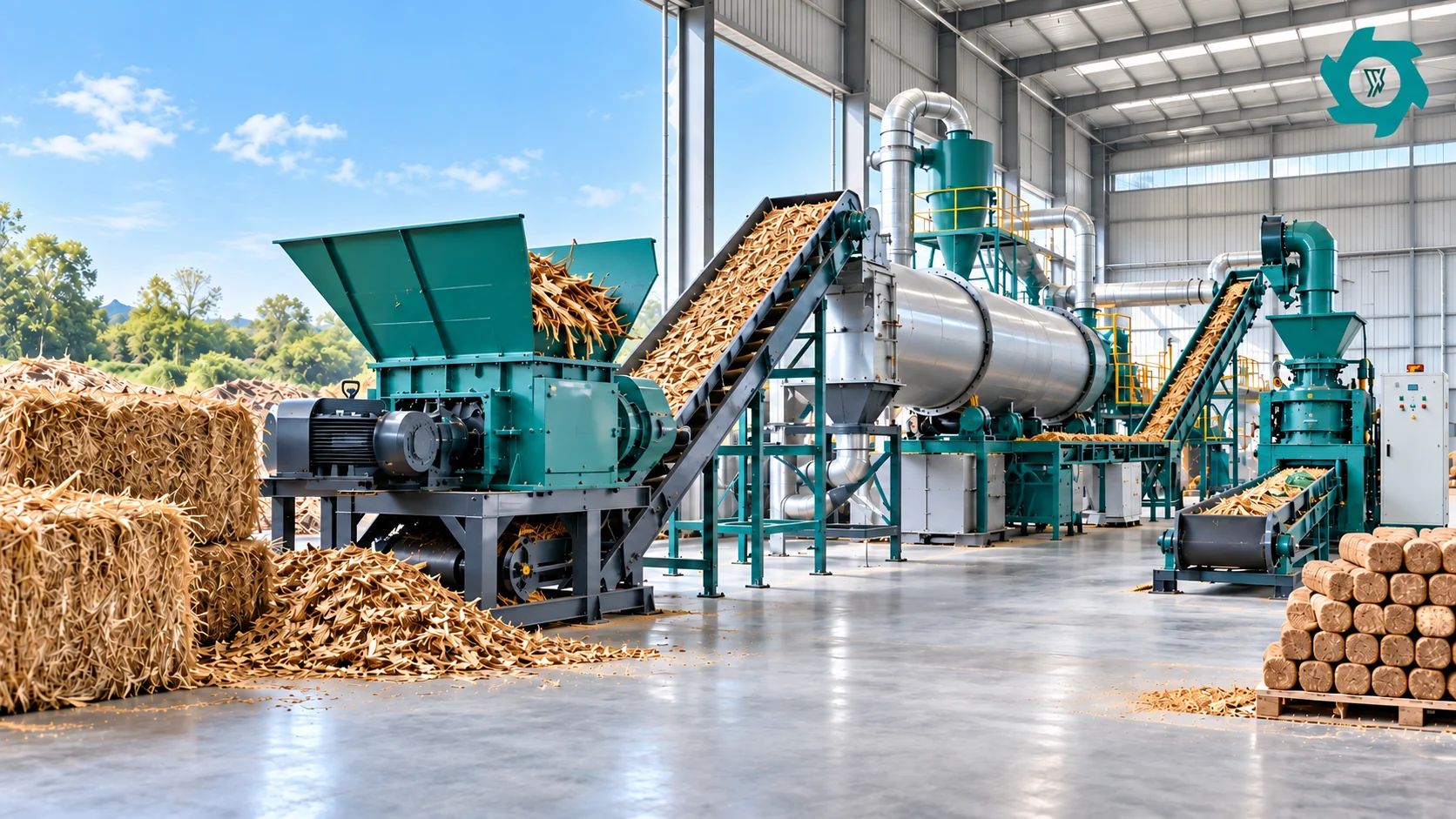
The practical job of feedstock preparation is therefore to deliver a documented press-inlet condition. The broader biomass shredding and recycling line covers receiving, feeding, primary shredding, optional fine crushing, separation, screening and transfer.
Start with the briquette press supplier’s written feed window. Define the accepted feedstock family, moisture method and range, particle-size distribution, maximum oversize, bulk-density range where relevant, prohibited contaminants, feed temperature and required mass flow. Then select only the preparation stages needed to hold that window with representative material. Do not buy a dryer, hammer mill or tighter screen because a generic article says every briquetting line needs one.
Do not copy pellet-preparation rules into a briquetting project
Pelletizing and briquetting are both densification processes, so they share several upstream concerns. They are not the same machine duty. A pellet mill typically works through relatively small die holes and usually depends on fine, controlled feed. Briquetting equipment can use piston, screw, hydraulic, roller or other forming arrangements, and acceptable feed geometry changes with the press and feedstock. FAO’s long-standing briquetting guidance distinguishes different press technologies and emphasizes that successful projects depend on understanding the characteristics of the residue and the selected process rather than applying one universal recipe.[1]
Pellet production has its own pretreatment requirements, which are discussed in more detail in biomass pretreatment for pellet production. Briquetting needs a different check. The prepared material has to enter the press evenly, moisture must stay within a workable range, and particle shape should not cause bridging or empty pockets. The condition of the finished briquette then provides a practical indication of whether the upstream preparation is suitable for the press.
Research reviews support this machine-specific view. Briquette quality can change with moisture, particle size, feedstock mix, pressure, and forming temperature. Research may give useful starting ranges for a certain material or press, but those numbers should not be treated as universal settings.[2] They are better used to plan trials, while the final purchase specification should be based on testing with the actual feed and machine.
Write the press-inlet specification before selecting preparation equipment
| Press-inlet field | What the buyer should define | Why it changes the preparation line |
|---|---|---|
| Feedstock family | Wood sawdust, straw, rice husk, bagasse, mixed crop residue, clean waste wood, or an approved blend | Fiber stiffness, ash, lignin, abrasiveness and flow behavior are not interchangeable. |
| Moisture | Normal, minimum and maximum; wet-basis or dry-basis; sampling and test method | Changes drying duty, friction, compressibility, storage behavior and finished strength. |
| Particle-size distribution | Agreed sieve fractions, top size, long-fiber limit and fines fraction | Determines whether primary cutting, fine milling, screening or recirculation is required. |
| Bulk density / flow | Measured condition plus the filling behavior expected at the feeder | Controls volumetric capacity, feeder selection, surge-bin size and press starvation risk. |
| Contamination | Metal, stone, soil, plastic, wire, treated wood and other prohibited material | Changes cleaning, wear protection and whether a lot can be accepted at all. |
| Feed rate | Continuous dry-matter or prepared-feed requirement, not only incoming wet tonnes | Sizes buffer volume, dryer duty and reduction equipment around the press demand. |
The key is to keep the specification testable. Recognized solid-biofuel sampling guidance covers materials ranging from fine particulate biomass to coarse residues and bales, giving buyers and suppliers a common basis for collecting representative samples.[3] Standardized oven-dry methods are also available for determining moisture content under defined test conditions.[4] Use named methods where practical so supplier and buyer are not comparing results produced by different sampling conventions.
Primary shredding solves form and flow before it solves final size
Long straw, branches, pallet fragments and compacted crop residues are usually poor direct feeds to a briquette press. Their first problem is geometry. They bridge hoppers, wrap rotating parts, form low-density surges and make metering erratic. Primary shredding is useful when it turns that irregular material into a stream that can be conveyed, separated, dried, buffered and metered predictably.
This is why the first shredder target should not automatically equal the final briquetting particle size. The primary stage may only need to open bales, shorten long fibers and reduce bulky pieces enough for the next process. The separate biomass shredder vs hammer mill guide explains the handoff in more detail: use low-speed primary reduction to make variable material feedable; add fine impact milling only when the receiving process can prove that a finer distribution is necessary.
For a briquetting project, that evidence should come from press trials. If the press accepts a coarser prepared fraction without increased breakage, unstable load or poor density, additional grinding may simply add power, wear and dust. If long fibers repeatedly bridge the press feeder or create weak sections in the briquette, a finer second stage may be justified. The correct decision is a measured response to the press.
Moisture is a process variable, not a single number
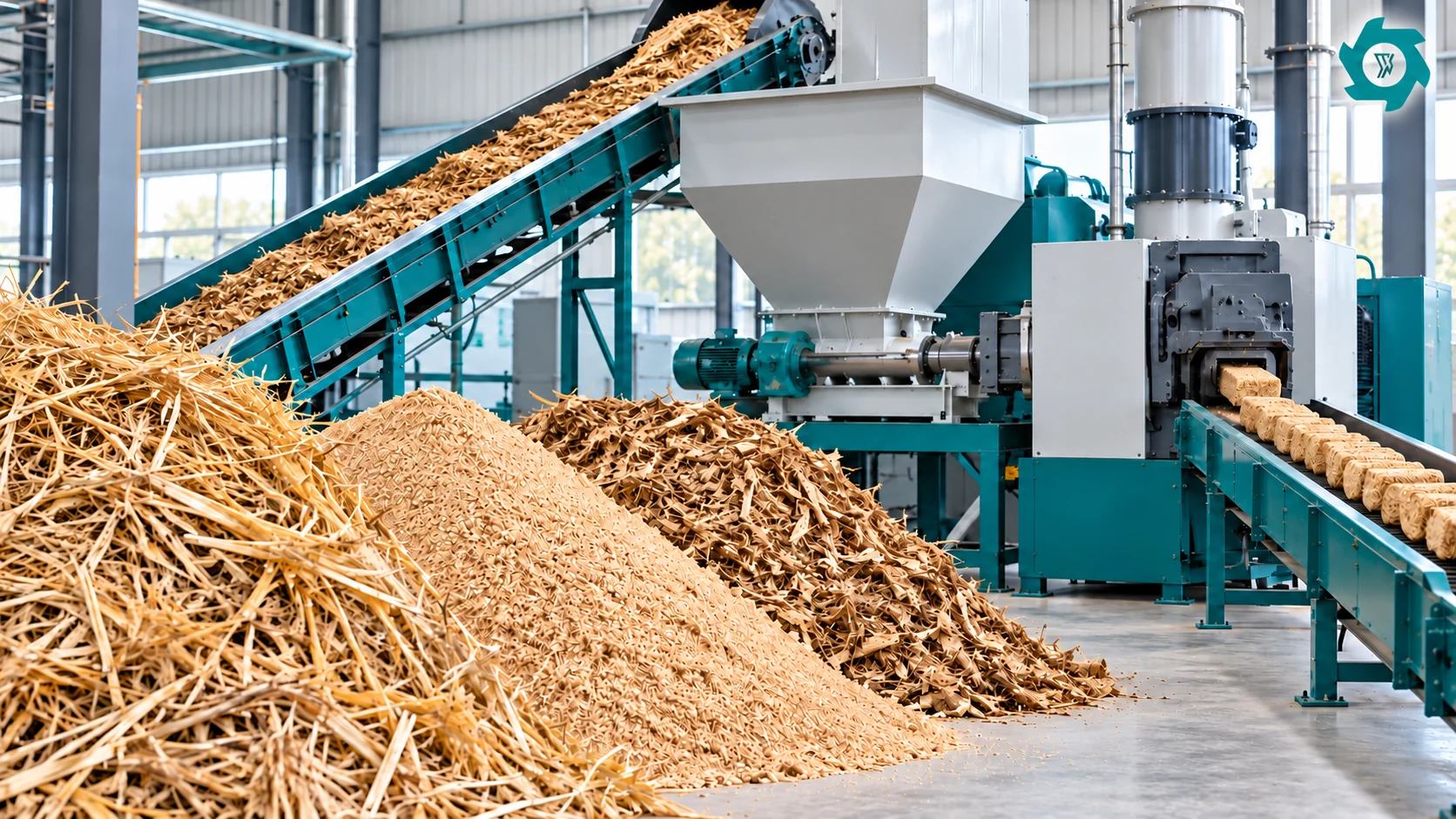
Moisture is often discussed as if there were one correct briquetting value. A 2020 review of biomass briquetting literature reports that moisture can support particle bonding and lubrication, while excessive moisture can weaken densification; it also notes that reported optimum values vary with material and conditions.[2] The useful takeaway is not “set every dryer to X percent.” It is that both overly wet and overly dry feed can move the press away from its stable operating window.
For project design, separate three questions. First, what moisture range arrives at the plant? Second, what range can the selected preparation equipment handle reliably? Third, what range has the briquette press demonstrated on the buyer’s material? Only the third number should become the press-inlet acceptance limit.
Wet-basis moisture is especially important because many routine solid-biofuel methods report moisture as a percentage of the total as-received mass. The reference moisture method expresses the result on an as-received, wet-basis basis, which should be stated clearly in the purchase and acceptance specification.[4]
Sampling frequency also matters. One grab sample at receiving can miss a wet bale core, rain-affected layer or poorly mixed storage pocket. For variable feed, pair incoming-lot samples with timed samples near the press inlet. Trend the results against press load, interruptions and briquette defects.
Particle size should be specified as a distribution
A hammer-mill screen size is not a finished-product specification. Material can contain fines, elongated fibers and irregular fragments even when it has passed through a nominal opening. For briquetting, the more useful record is a particle-size distribution (PSD) plus a separate rule for the longest or most problematic pieces.
Standardized sieve methods can be used to describe particle-size distribution consistently across different prepared biomass fractions, with different procedures available for coarser and finer particulate fuels.[5] These methods are not “briquette press settings.” They are tools for describing the prepared feed consistently.
Briquetting tests often work with feed in the millimeter range, but there is no single particle size that suits every press or material. Finer feed can pack well, although it takes more grinding and usually creates more dust. Some coarser material may help packing, but oversized pieces or long fibers can disturb feeding and weaken the briquette.[2] A better approach is to test several realistic particle-size mixes and compare the results instead of grinding everything as fine as possible.
Bulk density and short-term flow can limit capacity before the press motor does
Biomass is often sold and transported by mass, but feeding systems work volumetrically. Loose straw can occupy several times the space of denser sawdust for the same dry mass. A press may be capable of the required mass throughput while its feeder, day bin or screw cannot supply enough low-density material continuously.
Bulk density is not a fixed number. The same material may give a different result after it has been shaken, compressed, dried, or exposed to moisture again.[6] A value measured in the lab may therefore be quite different from what operators see once the material has moved through conveyors and settled in a hopper.
For design, combine bulk density with a timed volumetric observation. Record bin level, feeder command, press demand and any starvation or surge event. If the material is very light, a larger live-bottom area, agitation, staged compaction or a larger buffer may improve the real rate more than a larger press drive. This is one reason the agricultural waste recycling line guide treats straw, corn stalks and bagasse as different handling problems.
Decide the order of shredding, drying and fine reduction from material behavior
Drying a large, thick, irregular feed may be inefficient because pieces do not expose similar surface area. Fine grinding very wet fibrous material may also be unstable because elastic fibers smear, compact or blind screens. A useful sequence places each operation where the material is easiest to control.
| Incoming material | Preparation logic | Briquetting-specific check |
|---|---|---|
| Dry baled straw | Open and meter → primary cut → clean → condition or fine-size only as needed → buffer | Watch long-fiber tail, bulk density and feeder bridging. |
| Wet straw / crop residue | Open → primary cut for drying consistency → dry → screen/fine-size → buffer | Do not judge press capacity until inlet moisture has stabilized. |
| Clean sawdust | Inspect → dry or condition only if needed → screen abnormal oversize → buffer | Avoid unnecessary grinding when the existing sawdust already fits the press window. |
| Wood offcuts / pallets | Primary shred → liberate/remove ferrous contamination → dry if required → secondary sizing → buffer | Define treated/coated wood acceptance separately from particle size. |
| Bagasse / wet fibrous residue | Meter with open discharge → condition/dry → size-control after moisture is suitable | Verify dewatering/drying boundary and avoid assuming a dry-biomass screen will behave the same. |
The biomass fuel preparation system guide uses the same engineering principle for boiler fuel: define what the next process accepts and avoid unnecessary reduction. Briquetting adds a tighter requirement at the forming interface, but the philosophy remains sound.
Buffering and blending are part of feedstock preparation
A laboratory sample can be perfectly on specification while the press still runs badly because the feed arriving second by second is not stable. A dryer discharges in waves, a loader changes supplier lots abruptly, or a hammer mill alternates between coarse and fine material.
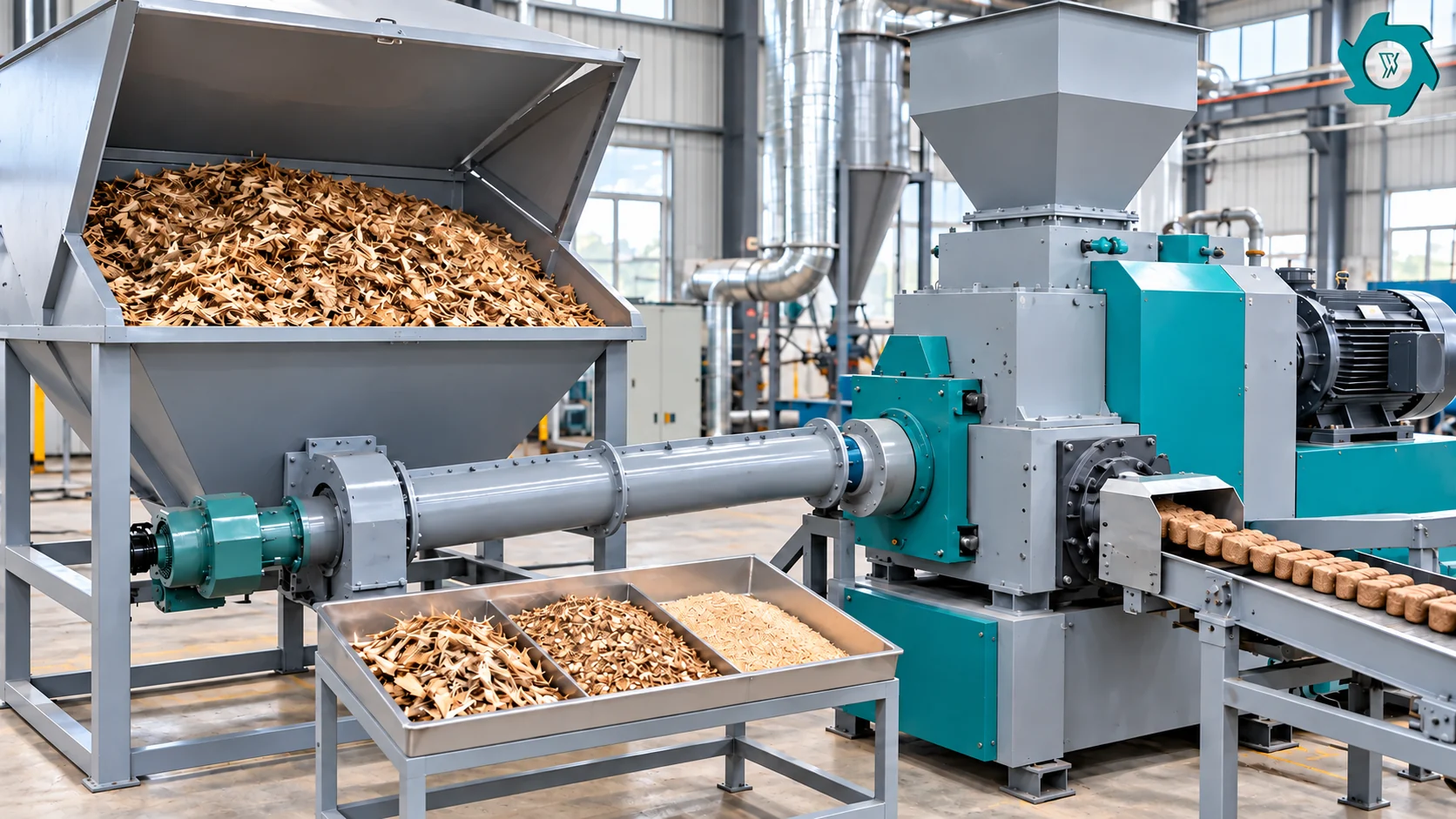
A correctly sized buffer decouples preparation from forming. It gives the upstream equipment room to cycle without forcing the briquette press to follow every short surge. Mixing or controlled blending can also reduce sudden transitions between approved feedstock lots. The important word is controlled: blending must not be used to hide a rejected high-moisture or contaminated lot inside good material.
Trend at least four variables around the buffer: level, feeder output, inlet moisture and a simple PSD or oversize indicator. If the press load becomes unstable whenever the buffer is near empty, the problem may be starvation rather than pressing force. If instability appears after a supplier transition, the feedstock passport and blend ratio should be checked before changing machine settings.
Finished briquette quality is evidence about the preparation line
The finished briquette is also feedback from the process. Density, dimensions, surface cracking, breakage, fines generation and mechanical durability can reveal whether the feed window is stable. Mechanical durability testing provides a consistent way to evaluate how well briquettes resist shocks and abrasion during handling and transportation.[7]
Do not reduce every quality problem to moisture. A weak briquette can also reflect excessive coarse pieces, poor size distribution, contamination, unstable feed rate, inadequate forming conditions or a feedstock whose natural binding behavior differs from the trial material. Correct troubleshooting moves upstream one variable at a time.
For commissioning, retain press-inlet samples together with corresponding briquette samples. If a quality complaint appears later, the plant can compare the material state, operating recipe and product result instead of relying on operator memory.
Run a press-inlet FAT that separates preparation performance from press performance
A useful acceptance test needs a clear boundary. If the preparation line and press are supplied as one package, the full run can be tested together, but data should still show whether a failure came from preparation or forming. If the press is supplied separately, define the preparation FAT endpoint at the press-inlet buffer.
| Evidence | Record separately | Why it matters |
|---|---|---|
| Input | Net as-received mass, feedstock identity, moisture increments and known contaminants | Proves what material the line actually received. |
| Prepared accepted feed | Mass delivered inside the agreed press-inlet window | This is the useful output of the preparation system. |
| Oversize / return | Material sent back for another pass | Prevents recirculation from being counted repeatedly as new production. |
| Fines / dust | Collected fine fraction or dust-collection output | Shows the cost of aggressive grinding and the dust-control burden. |
| Metal rejects | Recovered or rejected ferrous/nonferrous contamination where applicable | Separates cleaning performance from unexplained loss. |
| Other rejects | Stone, plastic, soil-rich or prohibited material | Keeps non-metal rejects visible. |
| Retained material | Material remaining in hopper, conveyors, mill, screen, collector and buffer | Closes the test boundary without hiding inventory. |
| Unexplained difference | Mass not accounted for after all measured streams | Must be reported separately and investigated above the agreed tolerance. |
Alongside the mass balance, record running and elapsed time, stops, reversals, manual clearing, screen cleaning, feeder starvation, kWh within the stated boundary, timed moisture samples and timed PSD samples. For a press-integrated trial, add press load, briquette mass rate, breakage and the agreed finished-product quality checks.
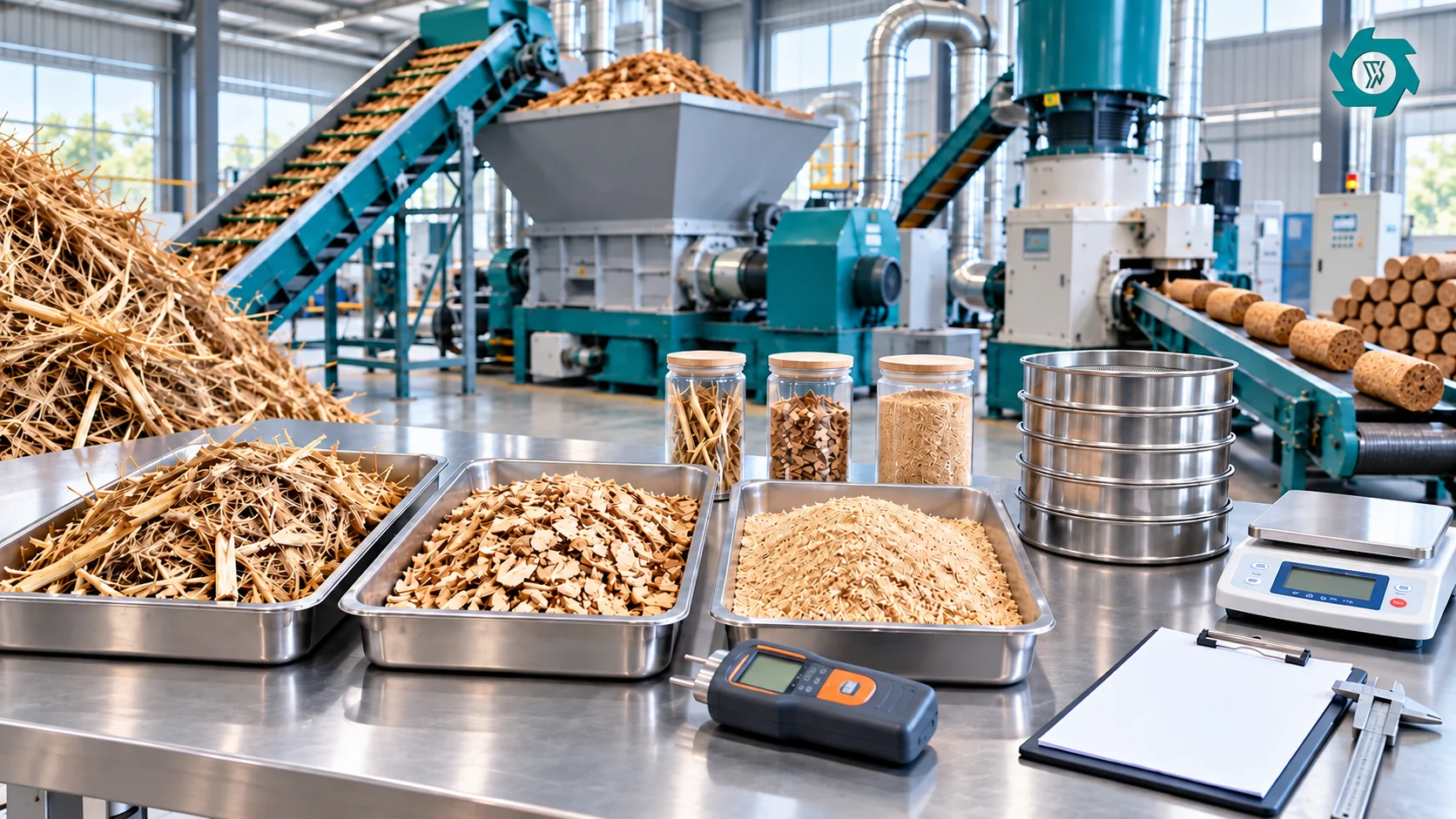
Do not let fine grinding create a dust problem the briquette press never asked for
Fine dust can build up during dry grinding, screening, conveying, or collection. With wood and other organic materials, that dust may become combustible and needs to be treated as a real operating hazard.[8] The control measures should match the material being processed and the conditions inside the plant, so the assessment has to be made for the actual site.
Track the fines fraction, captured dust and housekeeping burden during trials. A smaller grinder screen may improve one briquette metric while increasing energy use, wear and dust-handling requirements.
RFQ checklist for a biomass briquetting preparation line
- Feedstock evidence: provide photos, delivery form, supplier/source, seasonal range, normal and worst-case moisture, contamination and representative samples where possible.
- Press information: identify the press type, model or supplier and request a written inlet specification rather than relying on a general online moisture or size rule.
- Capacity basis: state required as-received feed, dry-matter feed and accepted prepared-feed rate. Do not mix these three numbers.
- Size requirement: specify PSD and maximum troublesome piece/fiber condition.
- Moisture method: name the basis, sampling point, frequency and test method used for acceptance.
- Cleaning boundary: state what metal, stone, soil, plastic and prohibited biomass the supplier is expected to remove and what must be rejected upstream.
- Buffering: define how long the press should continue receiving stable feed when upstream equipment cycles or a loader changes lots.
- Trial matrix: test normal material plus the wettest, lightest or most difficult material the contract includes. A demonstration on ideal sawdust is not evidence for mixed agricultural residues.
- Acceptance data: require separately weighed output routes, timed moisture and PSD samples, operating event logs and a declared energy boundary.
- Press result: when the press is inside the test boundary, tie preparation acceptance to stable briquette production and agreed quality evidence.
Common buyer mistakes
Buying the finest grinder first
Fine grinding feels like a safe choice because smaller material looks more uniform. It can also create unnecessary power draw, wear and dust. Prove the press requires the finer recipe before making it the base design.
Designing around annual-average moisture
A yearly average hides rainy lots, wet bale cores and storage changes. Drying equipment and acceptance limits must cover the contracted operating range, not just the middle of it.
Using only incoming tonnes per hour
Wet mass, rejects and recirculation can all inflate a throughput claim. Report accepted press-ready feed and dry matter alongside gross input.
Changing press settings before checking feed variation
When briquette quality moves, first compare inlet moisture, PSD, bulk density, feed rate and lot identity. A mechanical adjustment cannot permanently correct unstable raw material.
FAQ
What moisture content is best for biomass briquetting?
There is no universal value for every biomass and press. Literature shows that moisture strongly affects densification, but the final acceptance range should come from representative trials with the selected press, stated on a defined moisture basis and method.
Does biomass always need fine grinding before briquetting?
Fine reduction is needed only when the incoming material is too large, too long or too inconsistent for stable feeding and forming. Clean fine sawdust may need only screening or moisture adjustment, while straw and bulky residues often need staged reduction.
Should particle size be specified as one maximum number?
Usually not. A particle-size distribution plus a maximum oversize or long-fiber rule is more useful because fines, elongated fibers and coarse fragments can affect feeding differently.
How should briquetting preparation capacity be reported?
Report gross as-received input, dry-matter input and accepted press-ready feed for the same test window. Keep oversize return, fines or dust, rejects, retained material and unexplained difference separate.
What should be tested during factory acceptance?
Use representative feed and record mass routes, moisture, PSD, running and elapsed time, stops, interventions and energy. If the press is included, also record stable briquette output and the agreed product-quality checks.
Configure preparation around the press you will actually run
A robust briquetting line starts with a material and press combination, not with a shopping list of shredder, dryer and hammer mill. Define the inlet window, test the difficult feed conditions, use the coarsest preparation recipe that meets product requirements, and make the acceptance evidence visible. That approach reduces the chance that a plant looks complete on a flow sheet but spends production time fighting variable feed.
Send representative feedstock photos or video, delivery form, normal/minimum/maximum moisture, contamination, existing particle-size condition, required prepared-feed rate, selected briquette-press information and any finished-briquette requirement. YUXI can then review which feeding, shredding, separation, drying interface, fine-sizing and buffering steps are justified before the press.
References
- FAO: briquetting.
- MDPI: review.
- ISO: sampling.
- ISO: moisture.
- ISO: particle size.
- ISO: bulk density.
- ISO: durability.
- OSHA: dust.
Online Message