




 Request Quote

Product Center
-
- Biomass Shredding and Recycling Line
- OCC Paper Dry Pulping & Cardboard Recycling Line
- Scrap Aluminum Recycling Line
- Waste Car Recycling Line
- Waste Refrigerator Recycling Line
- Copper Aluminum Radiator Recycling Line
- Motor Rotor Recycling Line
- Copper Wire Recycling Line
- Waste Ink Cartridge Recycling Line
- Aluminum UBC Scrap Recycling Line
Get a Quote
Contact Us


A biomass line does not become better simply because it has more
machines. Start by checking the condition of the material after primary shredding. If the next process can already handle it, a second crusher may add little benefit. Extra size reduction can mean more power use, faster wear, more fines and dust, and additional recirculation or maintenance without improving the value of the final product.
If primary output is still too coarse, too variable or too difficult
for the next machine to meter, a second reduction stage can be
justified. The decision should therefore be made at the handoff between
processes. The broader biomass
shredding and recycling line can be configured with feeding, primary
shredding, separation, optional secondary sizing, screening, dust
control and discharge.
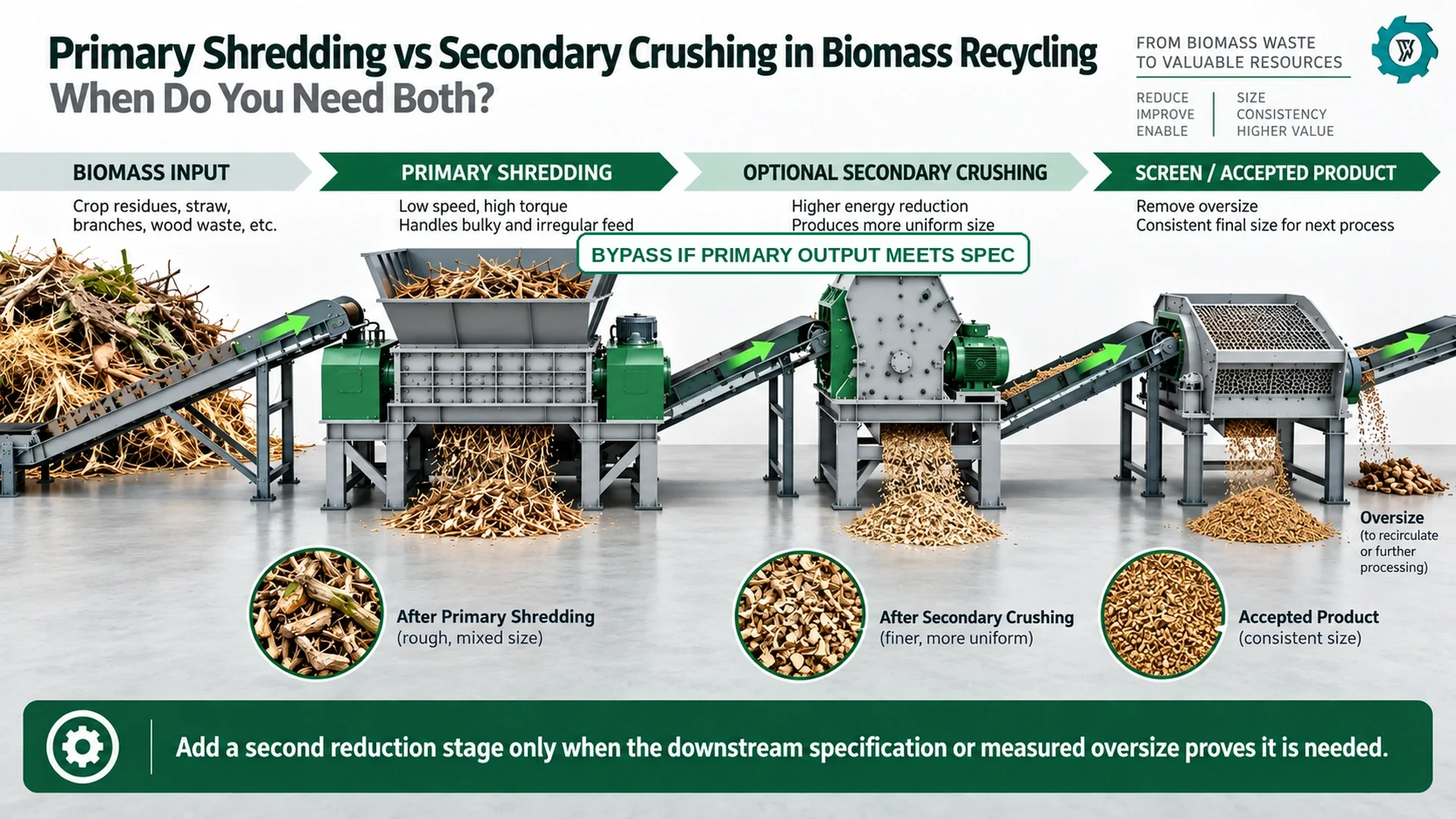
Use both only when primary output fails a defined downstream requirement
Primary shredding is mainly a form-and-flow operation. It opens
compacted material, shortens long fibers, reduces bulky branches or
boards, and turns an irregular incoming burden into something a
conveyor, magnet, buffer or downstream machine can handle consistently.
Secondary crushing is a deeper sizing operation. It applies more
cutting, impact or repeated breakage after the material has already been
made feedable. Here, “secondary crushing” means a downstream size-reduction duty after
primary shredding rather than one specific machine type. Depending on the
feedstock and required output, that duty may be handled by a hammer mill,
fine crusher or another controlled reduction machine.
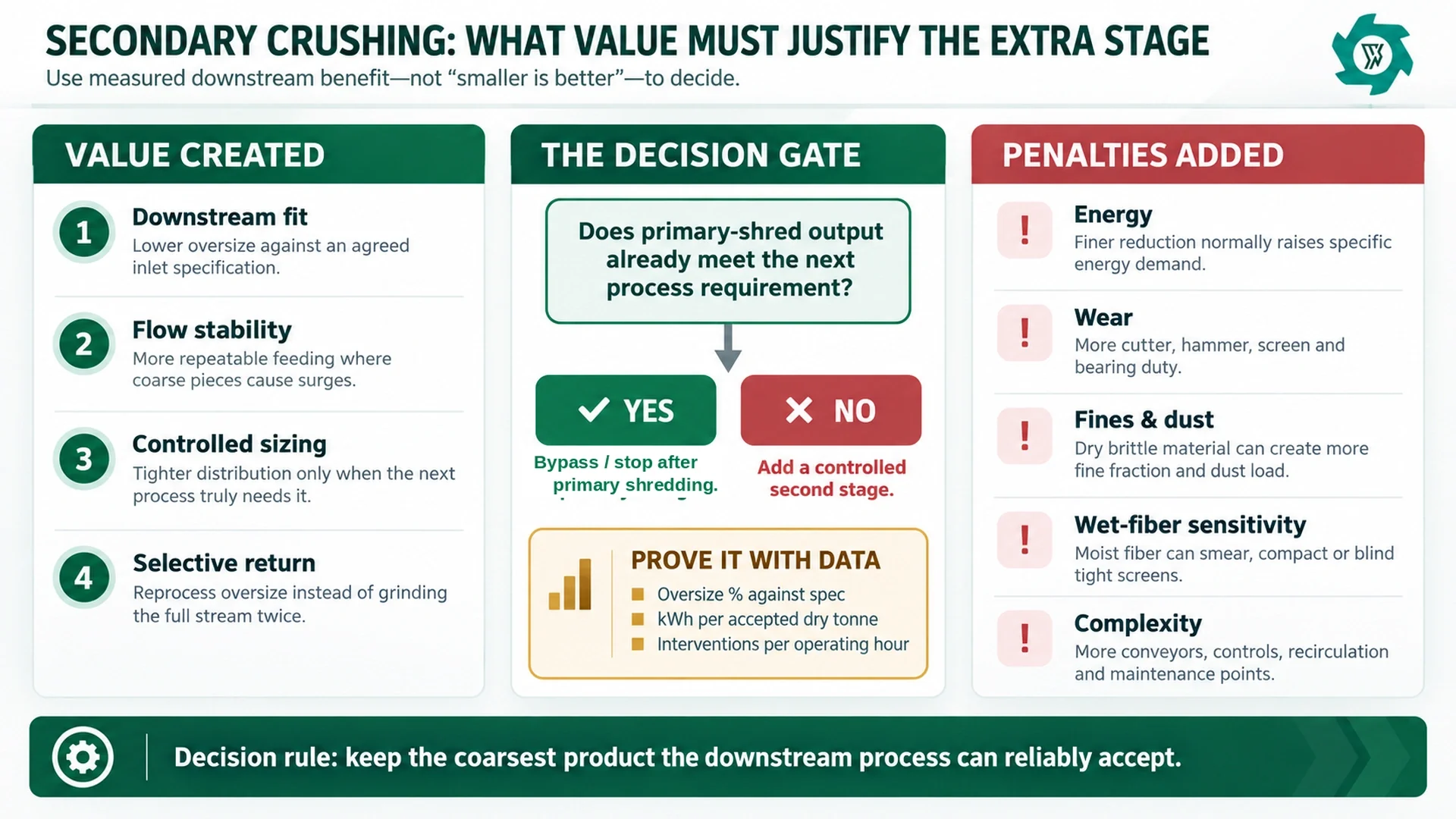
Keep the coarsest product that
the next process can reliably accept. Add secondary crushing
only when a written downstream requirement, representative trial or
measured oversize fraction shows that the primary-shredded material is
not good enough.
Typical reasons to add the second stage include a smaller maximum
particle size, a tighter particle-size distribution, a feeder opening
that repeatedly rejects long pieces, a densification or conversion
process that needs finer preparation, or a persistent oversize fraction
that cannot be solved by primary-shredder settings alone. Reasons
not to add it include “smaller looks better,” unused motor
capacity, a supplier’s standard flow sheet, or a desire to quote one
nominal output size without proving what the receiving process actually
needs.
Primary shredding and secondary crushing solve different process constraints
The two stages are often discussed as if they are simply coarse and
fine versions of the same machine. That misses the engineering reason
for staging. A primary machine receives the widest material variation. A
secondary machine should receive a narrower, better-controlled
burden.
| Question | Primary shredding | Secondary crushing |
|---|---|---|
| Main process job | Open, shorten and reduce bulky or irregular biomass | Further reduce an already controlled feed to meet a tighter downstream requirement |
| Feed condition | Bales, long stalks, branches, pallet pieces, mixed wood, green waste | Pre-shredded, metered material within a defined size, moisture and contamination window |
| Most important evidence | Stable feeding, manageable discharge, reversal rate, interventions, maximum piece behavior | Final distribution, oversize fraction, energy per accepted tonne, fines, wear and screen condition |
| Typical failure when overused | Excessive primary reduction slows the line before contaminants are removed | Unnecessary energy, dust, wear and recirculation; wet fiber may smear or blind screens |
| Best stopping point | When output is already acceptable to the next process | When the agreed final size or process window is met |
A separate biomass
shredder vs hammer mill guide is useful when the buying question is
which machine mechanism fits a specific duty. The decision here is
different: even if a secondary mill is technically capable, does the
process need that additional duty at all?
Research on biomass comminution supports the need to avoid
unnecessary fine reduction. Specific energy demand generally rises as
the target size becomes smaller, and moisture can make the penalty more
severe for fine grinding.[1]
Instrumented hammer-mill work on switchgrass, wheat straw and corn
stover also showed that size-reduction energy changes materially with
operating conditions and the desired particle distribution rather than
remaining a fixed machine number.[2]
The first decision gate: can the primary-shred output go forward as it is?
Before specifying a second machine, define the receiving process. The receiving equipment may care about
maximum dimension, mass fraction above a certain size, fiber length,
bulk density, bridging tendency, moisture, contamination or feed-rate
stability.
For example, a conveyor may tolerate a coarse product but fail on
rare long strips that bridge a transfer. That problem may be solved by
cutter geometry, feed orientation or an oversize return loop. A boiler
fuel system may accept a broad coarse fraction as long as its feeder
remains stable. Composting may benefit from woody structure that would
be lost if everything were reduced to fine particles. A pellet line, by
contrast, may need a much tighter feed window before the pellet mill,
but the fine-grinding stage is normally justified by that pellet
requirement rather than by a generic biomass rule.
Write the acceptance window in measurable terms. Useful fields
include maximum accepted piece size, oversize mass percentage,
particle-size distribution where relevant, moisture range, prohibited
contaminants, expected bulk density, allowable long-fiber fraction and
the required accepted-output rate. If the primary-shred sample meets
that window over a representative run, the second stage has not yet
earned a place.
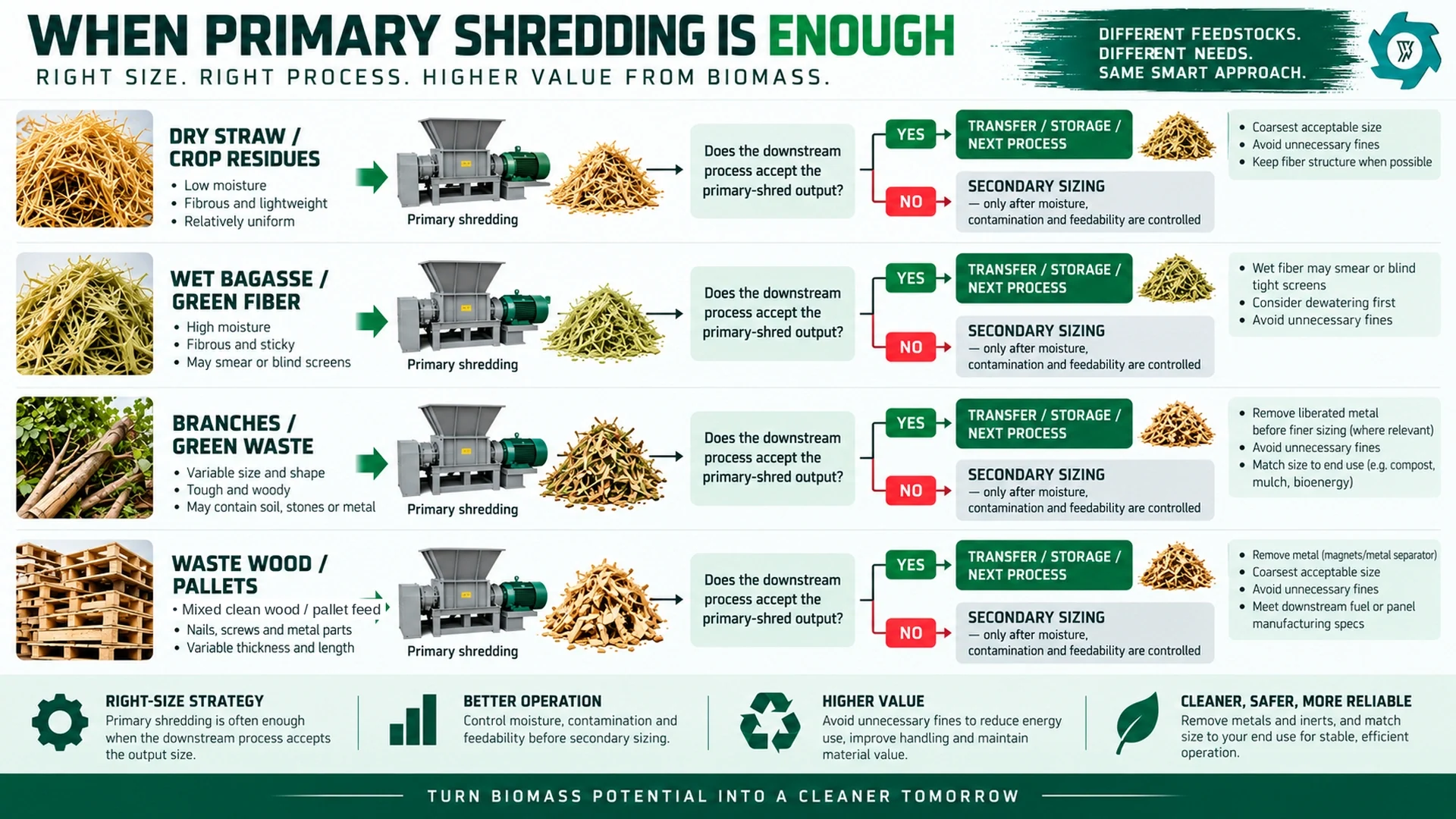
When primary shredding alone is usually the better process
A one-stage route is attractive when the downstream operation values
flowability and manageable form more than fine size. It is also more
forgiving when feedstock changes seasonally.
For green waste destined for compost preparation, primary shredding
may already create enough surface area and mixability while retaining
woody structure. Crushing the entire stream finer can create more fines
and may make wet leaf-rich material harder to screen. The detailed green
waste recycling process explains why screen position and oversize
return should be tied to the compost recipe rather than treated as a
universal fine-sizing requirement.
Coarse fuel preparation can also stop after primary reduction when
the fuel-handling and combustion system has been demonstrated to accept
that output. The correct stopping point is the largest practical size
that still moves through storage, dosing and combustion equipment
without unacceptable bridging or feed variation.
When secondary crushing earns its place
First, the next machine has a hard feed-size limit. A dryer inlet,
screw feeder, densifier, reactor or other conversion step may not
tolerate the longest pieces from primary shredding. If those pieces
repeatedly cause plugging or load spikes, a second stage can remove the
problem more reliably than asking operators to clear it manually.
Second, the destination needs a tighter distribution. If a line produces many acceptable pieces but also a persistent oversize tail, the project should quantify that oversize
fraction. A screen can then direct only the oversize to secondary
crushing while the acceptable fraction bypasses it. This selective route
is often more efficient than sending 100% of the material through the
finer stage.
Third, pellet, briquette or other densification preparation may
require finer and more consistent feed. That route should be designed
from the densification machine backward. Drying order, moisture
distribution and grinder condition matter as much as the nominal screen
opening. The biomass
pretreatment for pellet production guide covers that
downstream-specific preparation in more detail.
Fourth, primary-shredded waste wood may still be too coarse for a
customer’s fuel, board or chip specification. In that case the sequence
should normally allow nails and other liberated ferrous pieces to be
removed before the finer stage. The purpose is to protect the secondary
machine and avoid repeatedly fragmenting avoidable contamination.
Fifth, process stability can justify additional sizing when a small
long-piece fraction repeatedly stalls the next feeder.
Do not feed the secondary stage with an uncontrolled material state
A second-stage machine is usually less tolerant of variation than a
primary shredder. It should not be used to hide front-end problems.
Wet fibrous biomass is the clearest example. Bagasse, green crop
residues and damp straw may fold, smear or compact instead of fracturing
cleanly. Tight screens can blind, and a machine that performs well on
dry material can lose throughput rapidly on wet pockets. If the
secondary stage depends on a screen, establish a moisture acceptance
range and test the wettest normal material.
Metal and stones should also be addressed before finer crushing
wherever practical. Pallets, demolition wood and field-collected
residues can contain nails, wire, stones or soil. Primary shredding may
liberate embedded ferrous pieces so that a magnet can remove them before
the secondary machine. The waste
wood recycling process shows why contamination control belongs
between stages when the feed includes pallets, boards or mixed
timber.
Feed-rate control matters as well. A second-stage crusher should see
a metered burden, not the cyclic discharge of a loader or a whole bale
collapsing at once. A buffer conveyor, surge hopper or controlled
transfer can often improve secondary performance more than simply
installing a larger motor.
The hidden cost of “make it smaller”: energy, wear, fines and dust
Fine reduction is not free. Biomass comminution studies repeatedly
show that energy consumption rises as particle size is driven downward
and that material properties such as moisture influence the
result.[1] Work on multi-stage milling
of forest residues found that staging could reduce energy compared with
making a very large reduction in one step for the tested conditions, but
the result still depended on moisture and target
size.[3] The lesson is not that every
line needs more stages. It is that the chosen reduction ratio and how it
is distributed across stages should be tested on the real material.
Wear rises for the same reason. More contacts are required to create
more surface area and a smaller distribution. Screens, hammers, knives,
liners and bearings all see additional duty. If abrasive soil enters
with roots or field residue, the wear penalty can increase further.
Dry brittle biomass may also create a larger fines fraction. That can
reduce saleable yield if the customer wants chips rather than dust, and
it can increase housekeeping and dust-control duty. OSHA specifically
treats combustible dust accumulation and dust-collection systems as
ignition and housekeeping concerns that require appropriate hazard
controls.[4] A purchasing decision that
adds fine grinding should therefore include dust handling.
Consider a screen-and-return loop before crushing the full stream twice
Place an appropriate screen after primary shredding and measure the
mass that meets the downstream specification. If most material is
acceptable, send that fraction forward and return only oversize to a
secondary stage or controlled recut. The accepted stream should never be
recirculated simply because the plant diagram shows a loop.
This arrangement can reduce unnecessary work, but it has limits. Wet
fibers can blind screens. Long strips can orient themselves and pass
openings that do not represent their true length. A screen aperture is
not automatically the same thing as final particle size. The trial
should therefore measure the actual output distribution and the mass
fraction recirculated rather than relying on the nominal opening.
The return loop also needs a throughput limit. A line can appear
productive while the same material circulates repeatedly. Report fresh
feed, accepted product and return mass separately. If the oversize
return becomes too large, the primary cutter setup or the
secondary-stage duty should be reconsidered.
Feedstock-specific route choices
The same equipment list can behave very differently across biomass
types. The table below shows how the stage decision changes with
material behavior.
| Feedstock | Primary-stage priority | When secondary sizing may help | Reason to delay or bypass it |
|---|---|---|---|
| Dry straw and crop residues | Open bales, shorten long fibers, stabilize volumetric feeding | Downstream densification or conversion needs a proven smaller distribution | Low density and long fiber may limit feed before motor power; unnecessary fine reduction increases dust |
| Wet bagasse or green fiber | Keep an open discharge path and prevent compaction | After moisture is controlled and a downstream size requirement is proven | Wet fiber may smear, bridge or blind tight screens |
| Branches and green waste | Accept maximum branch diameter and irregular shapes without repeated intervention | A customer or compost operation requires a controlled fraction | Coarse woody structure can be useful; soil accelerates wear |
| Waste wood and pallets | Reduce bulky wood and liberate nails or fittings | A fuel, board or chip customer requires finer material | Remove liberated metal before the finer stage when practical |
| Mixed agricultural residue | Buffer changes in bulk density, moisture and component mix | A stable second-stage recipe exists for the accepted blend | One annual-average feed description can hide wet or tough fractions that dominate operation |
The key is to qualify a route for the material window. If a project expects dry straw in one season and wet crop
residue in another, it may need a bypass around the secondary stage,
different screens or a different operating recipe rather than one
permanent flow path.
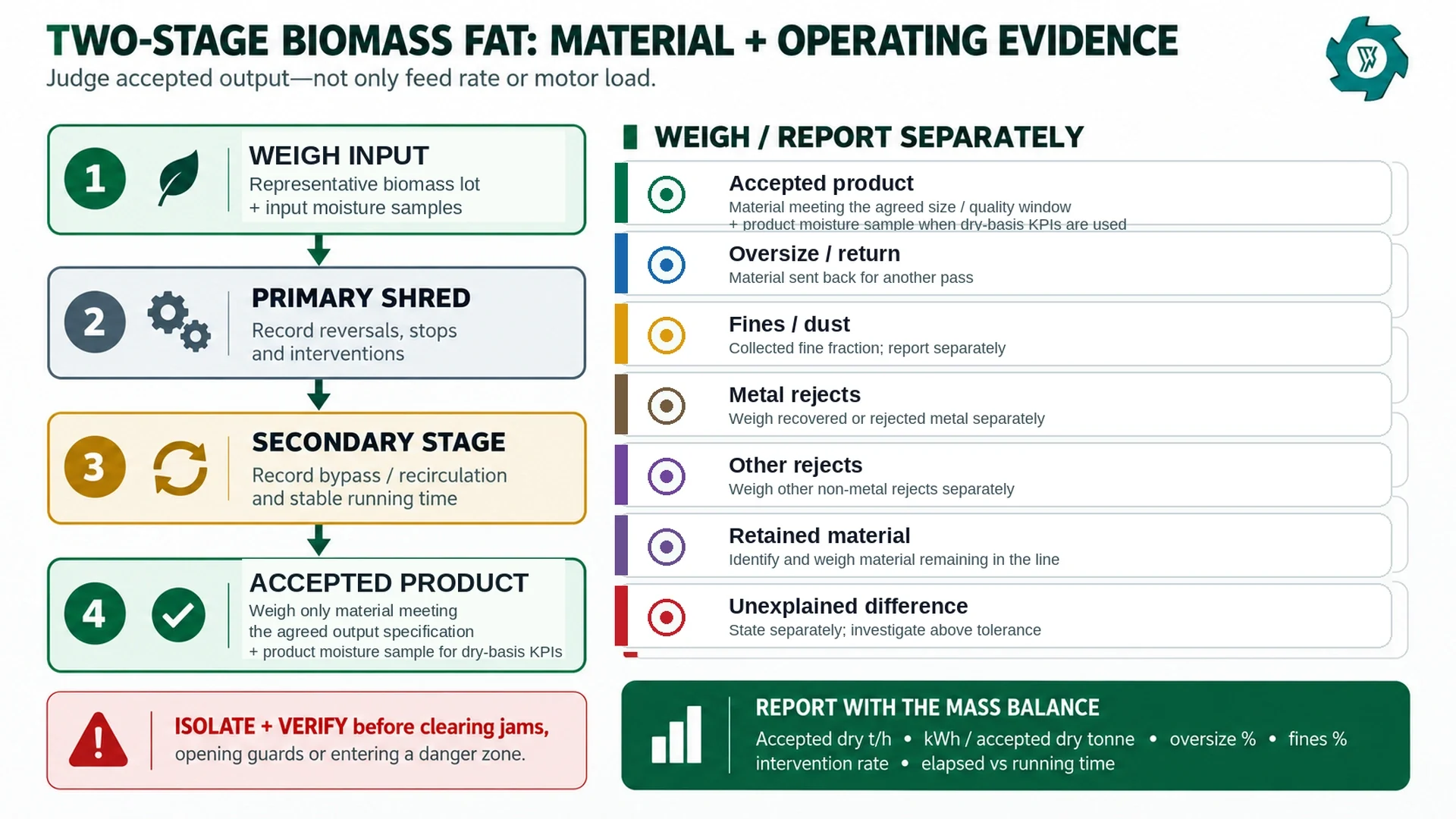
Factory acceptance testing: prove that the second stage adds useful output
A two-stage line should be accepted as a process. The test boundary should start with weighed
representative feed and end with weighed accepted product plus every
meaningful side stream.
Record the feedstock identity, incoming form, moisture range,
contamination, feed rate and the largest normal pieces. Weigh the fresh
input and take representative moisture samples. Where dry-basis KPIs are
reported, also take representative moisture samples from the accepted product.
Weigh and report separately: accepted product; oversize or return;
collected fines or dust; metal rejects; other rejects; retained
material; and unexplained difference. Retained material is material
physically left in conveyors, chambers, hoppers or screens at the end of
the boundary. Unexplained difference is not the same thing and should
not be used as a convenient residual category.
Log operating evidence at the same time: stable running time, elapsed
time, reversals, stops, overloads, operator interventions, manual
clearing, screen changes, crusher power and the state of wear parts. If
an intervention requires access to a danger zone, energy isolation and
verification are essential; OSHA machine-hazard guidance specifically
warns against cleaning or repair without proper de-energization and
lockout procedures.[5]
Use three KPIs that expose whether the second stage is worth keeping
The first KPI is accepted-product yield: accepted
product divided by total weighed input over the same test boundary. If
secondary crushing creates more fines or rejects without improving
downstream acceptance, its yield contribution may be negative even if
gross throughput looks high.
The second KPI is specific energy per accepted dry
tonne. Measure total line energy or the energy of the relevant
stage, correct throughput to a dry basis when moisture varies, and
divide by material that actually passes the acceptance specification.
This allows two recipes to be compared fairly when one recirculates more
oversize.
The third KPI is interventions per operating hour. A
finer product is not an improvement if operators must repeatedly clear
wrapping, blocked screens or transfer chutes. Track where each
intervention occurs and link it to the feedstock lot, moisture and
operating recipe.
Add oversize percentage and fines percentage to those three KPIs when
the product specification makes them important.
Procurement questions that prevent an unnecessary second crusher
Ask the supplier to quote the primary-only and two-stage routes
separately where both are technically possible. Compare accepted-output
rate, final distribution, installed power, wear parts, dust-control duty
and footprint.
If the plant will process materials with different sizing needs,
request a bypass. Also define the secondary machine’s maximum incoming
size, moisture range, contamination limits and allowable surge. If
screening creates a return stream, state where it returns and how
recirculation will be measured during acceptance testing.
Common mistakes when designing a two-stage biomass line
Mistake 1: treating nominal screen opening as guaranteed
product size. Biomass particles are irregular and fibrous.
Orientation, shape and fracture behavior matter. Verify the output
distribution with samples.
Mistake 2: counting recirculated material as new
production. Fresh feed and oversize return must be measured
separately. Otherwise a high internal circulation rate can make a weak
process look productive.
Mistake 3: using one average moisture value. Wet
pockets may dominate fine-crushing behavior even when the average sample
appears acceptable. Specify a normal range and a maximum accepted
condition.
Mistake 4: placing fine crushing before removing obvious
contamination. Soil increases wear; metal can damage fine-stage
components; fragmented contaminants can become harder to remove
later.
Mistake 5: adding a second stage because a competitor’s flow
sheet has one. The receiving process, not the diagram, should
determine the stopping point.
Mistake 6: measuring only tonnes per hour. A useful
acceptance test also measures accepted yield, oversize, fines, energy,
interventions and elapsed time.
Final decision checklist
Before buying or enabling secondary crushing, answer seven questions.
What exact downstream requirement does primary output fail? How much of
the primary stream is actually outside that requirement? Can only the
oversize be reprocessed? Is the secondary feed dry, clean and metered
enough for reliable operation? What additional kWh, wear and dust duty
does the stage add? Does accepted-product yield improve? Can the result
be repeated on the wettest, toughest and most variable normal feed
lots?
If those questions have clear evidence-based answers, a two-stage
route can be a strong process design. If they do not, the safer
engineering choice is usually to keep the line simpler, test the primary
output properly and add deeper reduction only when the downstream
process proves it needs it.
FAQ
What is the main sign that secondary crushing is necessary?
The strongest sign is a measured failure of the primary-shred output against a downstream requirement, such as excessive oversize, repeated feeder blockage, an unacceptable particle-size distribution or a densification process that requires finer preparation.
Can a screen replace secondary crushing?
A screen can separate acceptable material from oversize, but it does not reduce size by itself. If only a small fraction is oversize, screening plus selective return to a crusher can be more efficient than sending the whole stream through a second reduction stage.
Should wet biomass be sent directly to a secondary crusher?
Wet fibrous biomass can smear, compact or blind tight screens. Confirm moisture, feedability and discharge behavior first; drying or a more open route may be more reliable before fine sizing.
How should two-stage biomass capacity be verified?
Use a representative timed run and report weighed input, accepted product, oversize or return, fines or dust, metal rejects, other rejects, retained material and unexplained difference as separate streams. Take representative moisture samples for the input and accepted product when dry-basis KPIs are reported. Record running time, elapsed time, interventions and energy so accepted dry tonnes per hour and kWh per accepted dry tonne can be calculated.
Get a Quote Now
Send feedstock photos, normal and maximum moisture, maximum incoming size, contamination, required throughput and the receiving process’s accepted particle-size window. YUXI can compare a primary-only route with a two-stage configuration and define the trial evidence needed before the second reduction stage is included.
Online Message