




 Request Quote
Product Center
-
- Biomass Shredding and Recycling Line
- OCC Paper Dry Pulping & Cardboard Recycling Line
- Scrap Aluminum Recycling Line
- Waste Car Recycling Line
- Waste Refrigerator Recycling Line
- Copper Aluminum Radiator Recycling Line
- Motor Rotor Recycling Line
- Copper Wire Recycling Line
- Waste Ink Cartridge Recycling Line
- Aluminum UBC Scrap Recycling Line
Get a Quote
Contact Us


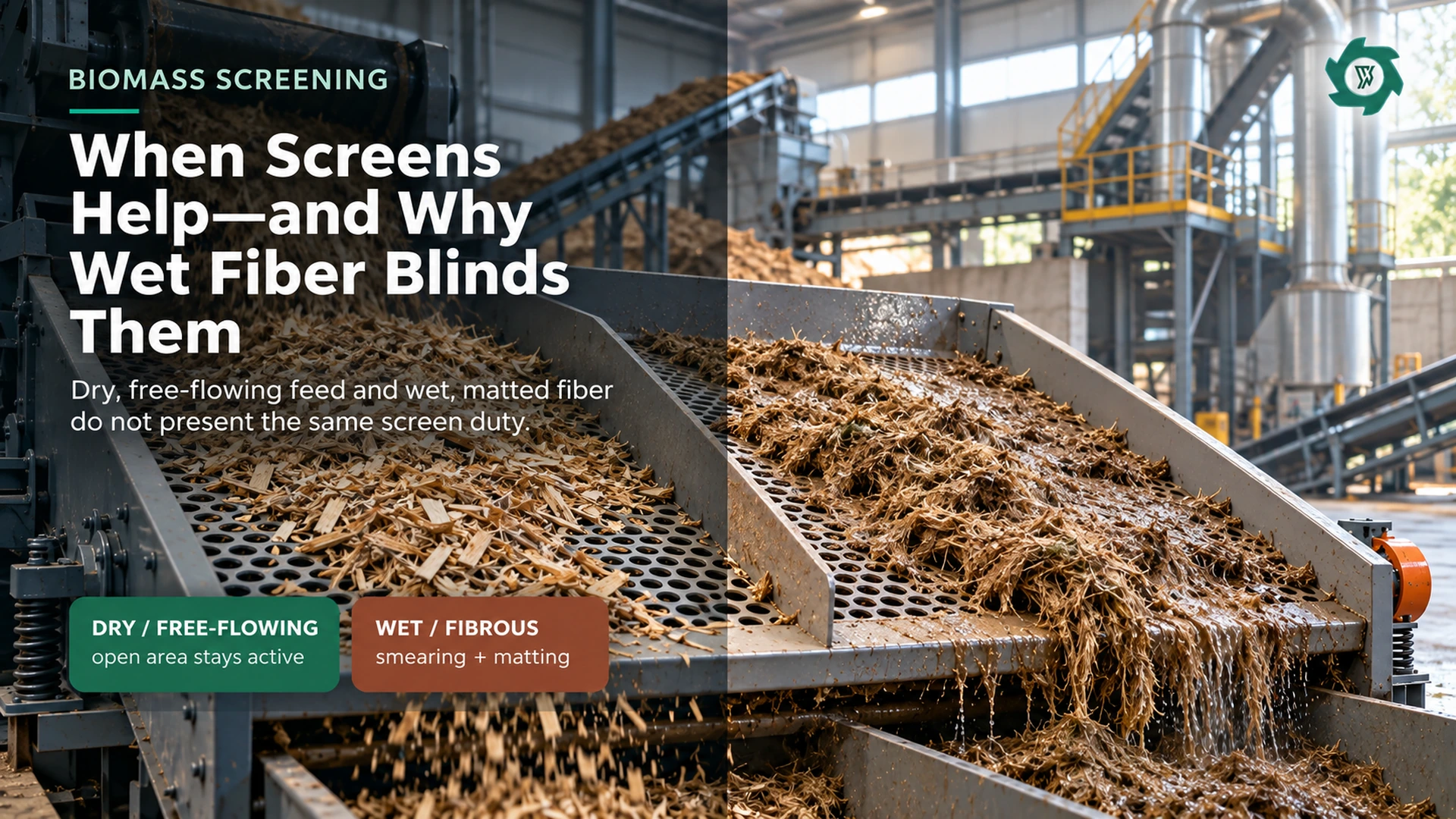
A screen can stabilize a biomass product, close a shredder loop, remove fines or protect the next process. It can also become the line’s most persistent restriction when damp, flexible fibers cover the openings faster than the deck can clear them.
That distinction matters because screening is often added as if it were a universal finishing step. It is not. The current biomass shredding and recycling line is configurable around feedstock, moisture and downstream requirements; screening is one optional process stage within that larger arrangement, not a default requirement for every crop residue or wood stream.
A useful screen must do two things at the same time: separate the fraction the buyer actually cares about and remain sufficiently open to do that job at the required sustained rate.
What a Biomass Screen Can Actually Control
Material is presented to an aperture or separation surface and given repeated opportunities to pass or remain above the cut. In a biomass line, that can support several different duties: remove oversize after shredding, reject an excessive fine fraction, scalp soil-rich fines from a dirty stream, or create a controlled feed for a dryer, mill, boiler, gasifier, pellet system or other receiver.
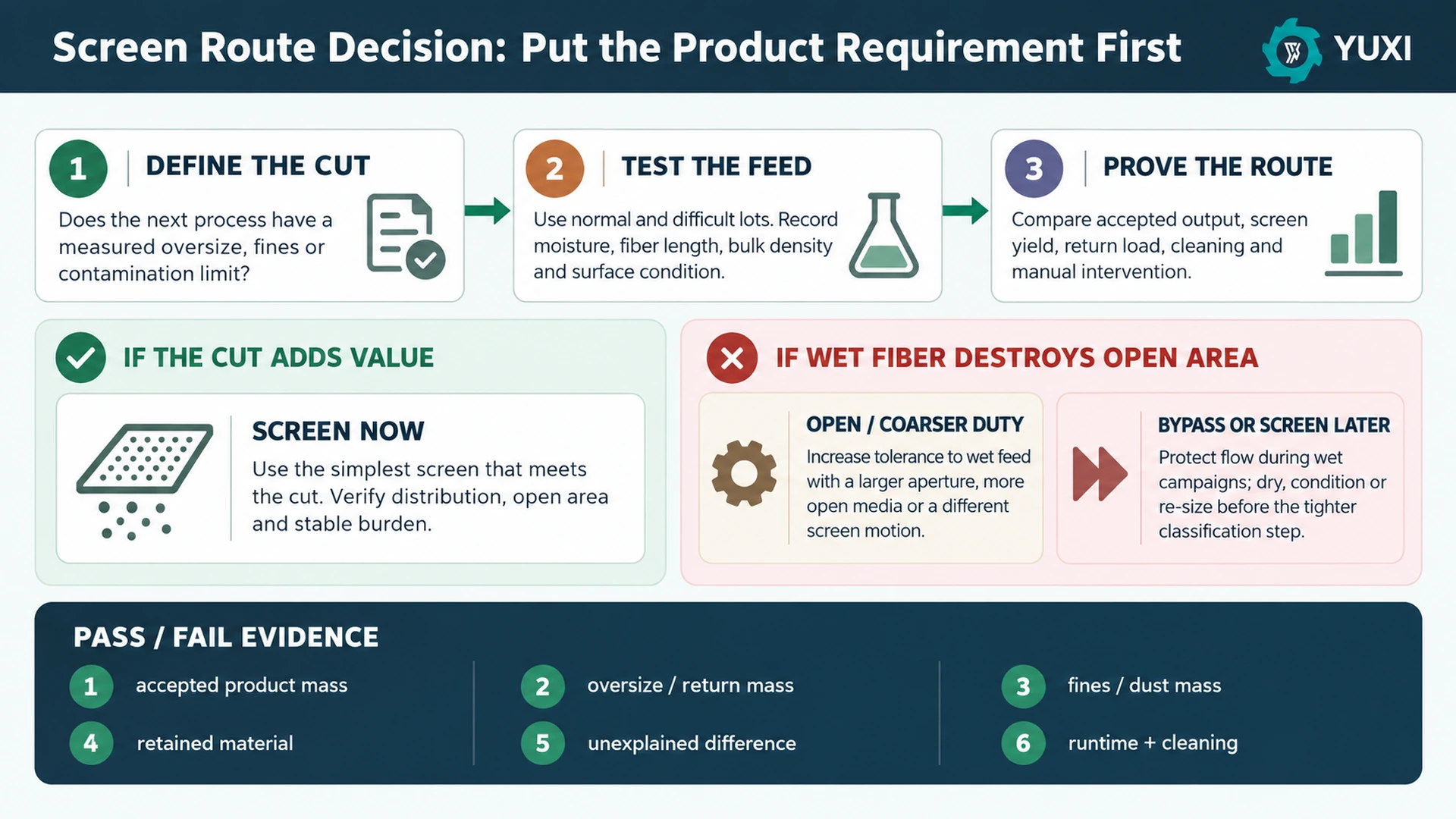
The first buying question should be: what measured problem does the screen solve? A 25 mm aperture is not a process objective. A statement such as “no more than the agreed mass fraction above 50 mm enters the next conveyor” is much closer to one. It identifies the material property that will be sampled and accepted.
For purchasing and FAT work, use a declared sieve method to characterize the test material, then evaluate the production screen separately. A laboratory sieve test can show how much material falls into each size fraction, but it cannot prove that a full-scale screen will hold the same cut at the required feed rate, bed depth or moisture condition.[1][2]
When Screens Help—and When They Do Not
Screening adds value when the receiving process pays for a narrower distribution, rejects a defined oversize, suffers from excessive fines, or needs a contaminant fraction removed before it creates wear or quality problems. It is less useful when the next stage can already accept the shredder discharge and the screen merely creates another recirculation loop.
| Screen duty | When it helps | Evidence to request | Common mistake |
|---|---|---|---|
| Oversize control after shredding | The next process has a real maximum-size or long-piece limit. | Mass above the limit, accepted fraction, return load and number of repeat passes. | Counting recirculated material as new throughput. |
| Fines removal | Excess fines increase ash, dust, handling losses or create a buyer penalty. | Fines yield, composition, moisture and destination. | Removing useful organic material without proving value. |
| Dirty-feed scalping | Soil, grit or small inert material is concentrated in a separable size range. | Ash/contaminant change by fraction and the mass rejected. | Assuming size alone can separate all contamination. |
| Closed shredder loop | Oversize can be economically returned for another controlled reduction pass. | Fresh feed, return flow, net accepted output and fines growth. | Allowing repeated return to inflate wear and dust. |
| Final product grading | A buyer or downstream machine purchases a defined distribution. | Sampling plan and particle-size results on saleable output. | Using screen aperture as a substitute for product testing. |
Screening only adds value when the rejected fraction actually carries the unwanted material. In forest-residue trials, removing a selected fraction reduced ash in some feedstocks, while tests on hog fuel showed that the benefit changed with the source material.[3][4] In practice, the screen should be judged by the change it creates in the saleable or downstream feed, not by the fact that a screen is installed.
For green waste, final compost grading and oversize management bring biological and product-quality questions that extend beyond mechanical screening; those are covered in the dedicated green waste recycling process guide.
Why Wet Fiber Blinds Screens
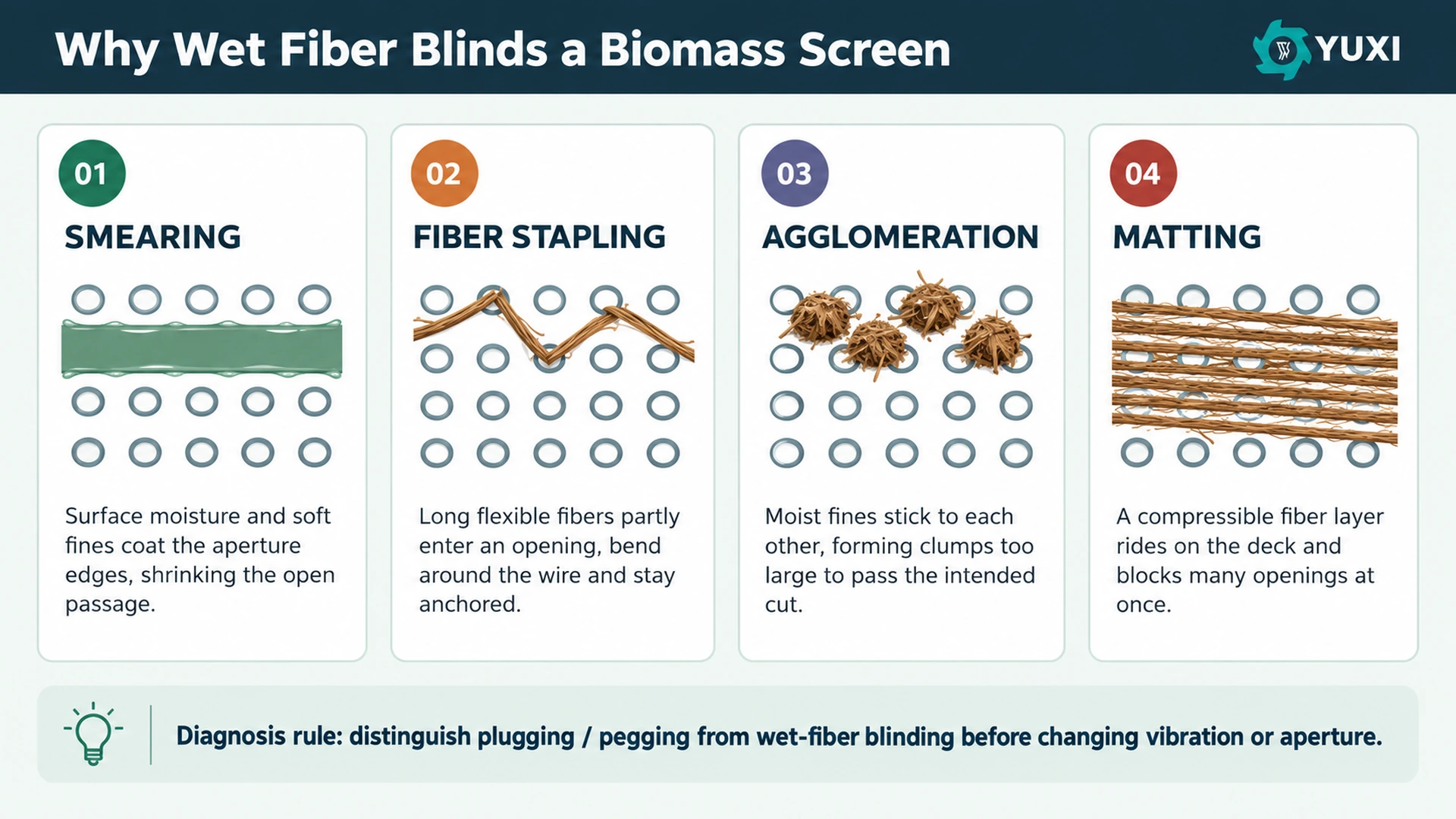
1. Smearing closes an opening from the edges inward
Soft, wet fines can coat screen wires or perforated plate. The opening may still look visible from above while its useful cross-section is already smaller. As more material rubs over that film, the deposit thickens. The machine continues to vibrate, but effective open area falls and undersize reports to the oversize stream.
2. Long fibers can staple around screen media
A flexible fiber can enter an aperture partway, bend under motion and wrap around the edge. This behavior is commonly called fiber stapling. It can occur on wet or dry fibrous feed, although damp fibers can be more persistent because they deform rather than break cleanly. Once several fibers anchor, they catch additional material and start a local mat.
3. Moisture can turn fines into agglomerates
Individual fine particles may be smaller than the opening, yet cohesive wet fines can travel as a clump. The screen then sees an apparent oversize particle that does not match the laboratory size of the individual components. This is one reason a moisture change can shift screen yield without any change to the installed aperture.
4. A compressible mat can blind many holes at once
Wet bagasse, green leaves, grass-rich material and other flexible plant fibers can form a blanket across the deck. The burden stops behaving like discrete particles. Instead, it moves as a connected mass, particularly when feed depth is high or the deck motion does not break the mat apart. At that point, adding more feed can reduce separation much faster than expected because the remaining open area is buried.
Moisture does not affect every lignocellulosic feed in the same way. Depending on the material and sieving conditions, it can change both screening yield and the severity of blinding, so there is no single moisture threshold that can be applied to every biomass stream.[5] This is why the difficult feed condition should be tested rather than inferred from a dry sample.
The wet-bagasse case is especially useful for understanding this behavior because the feed is soft, springy and compressible. The sugarcane bagasse processing guide discusses hopper compaction, open discharge and condition-dependent bypass in more detail. Here, the main point is that a screen must be treated as a flow restriction whose usable open area changes with feed condition.
Do Not Select a Biomass Screen by Aperture Size Alone
Aperture size is only the nominal geometric cut. Actual separation depends on how often particles see an opening, how they orient, whether the opening stays clear and whether the feed layer is shallow enough for undersize to reach the media.
Effective open area matters more than nameplate open area
A useful plant indicator is the share of the deck that remains available during operation. If a panel starts with high nominal open area but one-third of it is coated, pegged or matted, the working area is no longer the catalogue value. Photographing fixed deck zones before and after a test can make that loss visible. Some plants also track a simple blinded-area estimate by marked inspection zones.
Particle shape changes probability of passage
Wood chips and chopped stalks are not spheres. A long sliver may pass end-first through an opening smaller than its length, while a flat leaf fragment can bridge a much larger opening. This is why product acceptance should include a defined method for long pieces, oversize and fines instead of assuming screen aperture equals maximum particle dimension.
Burden depth can hide the screen from the undersize
Screening requires stratification. Smaller particles need opportunities to migrate toward the media. A deep, uneven bed reduces those opportunities. Wet fiber makes the problem worse because it can lock particles together and resist stratification.
Motion must match the material
Motion that is useful for dry granular feed can compact a damp fiber mat or accelerate wear without restoring open area. The correct combination of stroke, frequency, inclination and retention time is specific to the machine and duty. Buyers should ask what operating range was actually used in the representative trial.
Aperture geometry and media flexibility can change blinding behavior
Round holes, square holes, slotted openings, wire mesh, perforated plate and flexible polymer media do not present the same release geometry. Slotted apertures may help elongated particles in one duty and allow unacceptable long pieces in another. Flexible media can help shed sticky buildup in some services but must still withstand abrasion, impact and temperature.
Cleaning devices are secondary controls, not a substitute for a wrong process route
Balls, sliders, brushes, wipers and other anti-blinding devices can help in specific screen designs. They should be treated as part of a tested configuration. If the deck is being buried by a wet cohesive mat, a more aggressive cleaning device may not solve the root problem of burden, moisture or unsuitable cut point.
Screen Types and Where Each Can Fit
No screen type wins every biomass duty. The selection should follow the material state and separation objective, then be proven at representative feed rate.
| Screen family | Useful characteristics | Where it can fit | Wet-fiber caution |
|---|---|---|---|
| Vibrating / oscillating deck | Defined media, compact footprint, strong classification on suitable particulate feed. | Wood chips, prepared fuel, controlled shredded biomass and product grading. | Fine media can smear or staple when wet flexible fibers dominate. |
| Trommel / rotary drum | Tumbling and lifting action, long screening path, relatively open handling of heterogeneous material. | Green waste, forest residue, compost-related duties and coarse classification. | Sticky mats can still coat apertures; drum length does not replace open area. |
| Star / disc-style screen | Active gaps created by rotating elements; can handle irregular organics and separate by effective dimension. | Some green-waste and organics duties where flexible material defeats flat media. | Wrapping, wear and inconsistent flexible-piece orientation still need testing. |
| Scalping / coarse grate | Simple removal of large unprocessable pieces before a downstream stage. | Pre-protection or coarse oversize rejection. | Not a precision sizing device; wet fines can ride with oversize. |
If a project already needs substantial secondary reduction, screen selection also has to account for how the crusher and screen interact. The biomass shredder vs hammer mill comparison explains why coarse opening and fine, screen-controlled grinding are different duties; do not make a production screen carry a size-reduction burden the upstream equipment was never designed to remove.
Where to Place the Screen in a Biomass Line
The same physical screen can perform very differently depending on where it is installed. Position changes feed condition, particle liberation, moisture, contamination and recirculation.
Before primary shredding: use screening only for a distinct scalping duty
A coarse pre-screen may remove loose soil or small inert contamination from a suitable material stream, but long unliberated bales, branches and wet clumps often make precise pre-screening unreliable. The buyer should prove that the rejected fraction actually concentrates the unwanted material.
After primary shredding: the most common place to control oversize
Primary cutting can release smaller pieces and create a more screenable stream. It can also produce long flexible slivers and wet fines. A closed loop can return oversize for another pass, but the mass of that return must be measured. Otherwise, a machine may show impressive internal circulation while net accepted output remains low.
After drying or conditioning: often stronger for a fine cut
If the final use genuinely requires a tighter distribution, reducing surface moisture before the fine screen can improve flow. Drying is not automatically justified—it costs capital and energy—but it can move the screen into a more stable operating condition. Pellet-feed preparation, for example, combines moisture and particle-size requirements that should be managed as separate measured variables rather than one machine setting.
At the final product boundary: sample what is actually sold or transferred
A final screen can define saleable product, but acceptance still belongs to sampled output, not the installed hole size. Where the material is used as boiler fuel, the biomass fuel preparation system guide explains why the receiving fuel specification should drive the preparation route.
When a Bypass Is Better Than “More Screening”
A condition-dependent bypass is often misunderstood as a concession. In a variable biomass plant, it can be a deliberate control strategy. If wet-season feed blinds a fine screen but the next receiver can accept a coarser temporary stream, bypassing the sensitive deck can protect total line availability.
The key is to define the rule before startup. The PLC recipe should identify which feed condition allows bypass, which product destination can receive that material and how the lot is labeled. If a downstream process cannot accept the bypassed material, then the plant needs another response: slower feed, a more open screen, pre-conditioning, drying, a different media design or a different separation stage.
| Observed condition | Better first response | What not to assume |
|---|---|---|
| Dry feed, stable distribution, low blinding | Optimize feed spread and cut point around product yield. | That the same settings will work after rain or seasonal moisture change. |
| Moderately damp feed, local aperture coating | Reduce burden, inspect media/cleaning, test a more open geometry. | That motor or vibration increase alone restores classification. |
| Wet flexible feed forming a continuous mat | Protect flow with bypass, pre-conditioning or a later screening position. | That a fine flat deck should be forced to process every accepted feed condition. |
| High return load but acceptable screen cleanliness | Check whether upstream reduction and cut point are aligned. | That all returned material represents screen failure. |
| Fines rising after repeated recirculation | Measure passes and reduce unnecessary reprocessing. | That tighter size always improves product value. |
Diagnose the Blinding Mechanism Before Changing the Machine
Good troubleshooting starts with evidence collected while the problem is happening. A screen that is clean after shutdown may have been heavily blinded under burden. Photograph the same zones at defined intervals where safe remote viewing is possible, record the feed lot and moisture, and link each cleaning event to production data.
| Symptom | Evidence to collect first | Likely checks | Poor shortcut |
|---|---|---|---|
| Fine material appears in oversize while openings look coated | Deck photos, moisture, fines condition and blinded-area estimate. | Smearing, agglomeration, burden depth, media release. | Reduce aperture immediately. |
| Long fibers remain wrapped through apertures | Fiber length, aperture geometry and exact anchoring points. | Fiber stapling, screen media, upstream cut length. | Increase speed without checking wrap severity. |
| Screen capacity declines through the shift | Accepted t/h by time, cleaning log and open-area change. | Progressive buildup, sticky fines, return-load growth. | Quote the first 10 minutes as line capacity. |
| Return conveyor stays full | Fresh feed vs return mass and oversize distribution. | Cut point, upstream size reduction, false recirculation capacity. | Count both streams toward production. |
| Product becomes too fine despite stable screen | Fines at each pass and number of recirculation cycles. | Over-processing in the return loop. | Add another fine screen. |
Moisture should be measured on a declared and repeatable basis. Reference and simplified test methods are available for solid biofuels, but the important purchasing requirement is consistency: state the method used, whether the result is reported on an as-received basis, when the sample was taken and which test lot it represents.[6][7]
RFQ and FAT Evidence for a Biomass Screen
A quotation should define the duty before it defines the machine. Send representative feed evidence, normal and difficult moisture, bulk density, fiber length, contaminants, required continuous mass flow, the desired product distribution and the next process. Ask the supplier to state the expected screen route for each feed condition, including any bypass and return stream.
Define at least two feed cases
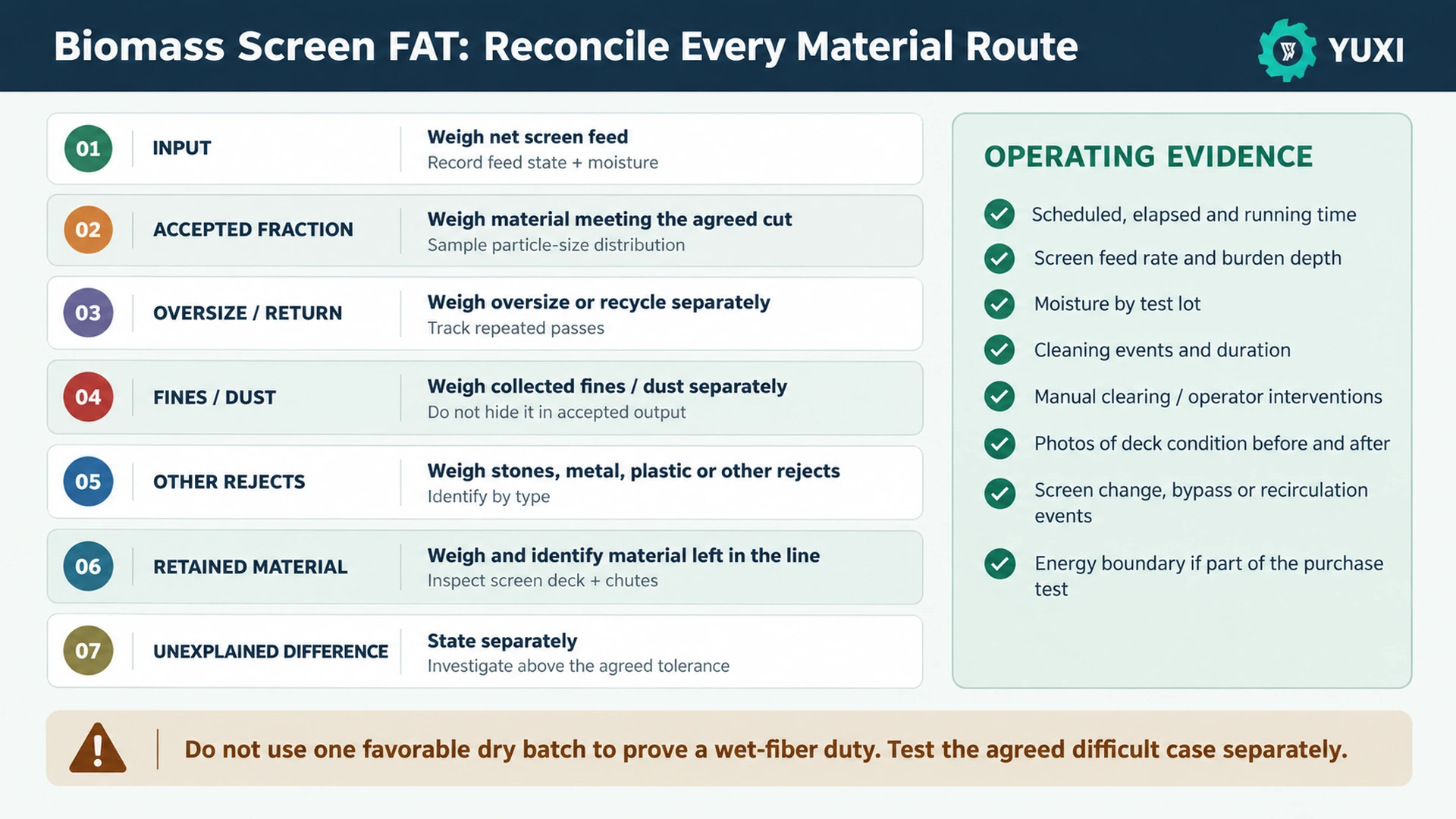
Use a normal operating lot and a difficult compliant lot. For a moisture-sensitive screen, the difficult case should represent the wettest material that is still allowed by the purchase specification. Do not blend the two results into one average. A screen can pass on dry material and fail on wet fiber for completely different reasons.
Weigh each material route separately
The test mass balance should identify net screen feed, accepted fraction, oversize or return, fines or dust, other rejects and material retained in the machine. State unexplained difference separately and investigate it when it exceeds the agreed tolerance. This prevents internal recycle or material left in chutes from being mistaken for saleable output.
Record time in a way that exposes cleaning losses
Report scheduled test duration, elapsed time and actual running time. Log every stop, slowdown, cleaning event, manual clearing or operator intervention with cause and duration. If the screen requires repeated manual cleaning to maintain the stated rate, that time belongs in the capacity evidence.
Verify product quality at the same time as throughput
Sample the accepted and return fractions during the same stable period used for the capacity claim. Report the agreed particle-size classes and any relevant long-piece or fines limit. The screen only passes the test when both rate and product condition meet the written acceptance criteria.
Include the deck condition in the evidence package
Before and after photographs, or safe remote inspection images during the run, are unusually valuable for wet-fiber screening. They show whether the machine maintained open area or simply pushed material across a progressively blinded deck. Include the cleaning device condition and any media damage.
Safety, Dust and Maintenance Access
Screening equipment combines moving drives, eccentric masses, belts, shafts, rotating drums or stars, transfer conveyors and pinch points. Fixed and interlocked guarding should be selected for the installed machine. Before cleaning, unjamming or servicing exposes a worker to moving parts, the relevant energy sources should be isolated and controlled under the site’s hazardous-energy procedure.[8]
Dry biomass screening can release fine organic dust, and some wood or agricultural dusts can present a combustible-dust hazard. Where that hazard exists, the design should address dust capture, containment, housekeeping and potential ignition sources.[9] The final controls should reflect the actual material, particle-size distribution, enclosure and local requirements.
Maintenance access deserves the same attention as screen area. Ask how panels are changed, how operators inspect the underside, where blocked material falls during cleaning, whether a safe platform is required and how the drive is isolated.
Buyer Checklist: What to Send Before Screen Selection
- Representative feed photos and video for dry, normal and wet conditions.
- Material type, fiber length, maximum piece size, bulk density and contamination.
- Normal and difficult moisture measured on a declared basis.
- Required continuous net feed rate and operating hours.
- Why screening is required: oversize, fines, contamination or downstream machine limit.
- Required particle-size distribution, including long-piece and fines limits where relevant.
- Preferred location in the line and whether bypass or recirculation is allowed.
- Destination and commercial value of accepted product, oversize and fines.
- Dust, noise, guarding, access, power and workshop constraints.
- Written FAT criteria covering rate, product quality, moisture case, cleaning and mass balance.
For dry baled crop residues, front-end opening and controlled metering can dominate the screen result because surging and long fibers change burden depth.
FAQ
When does a biomass line actually need a screen?
A screen is justified when it controls a measured requirement such as oversize, fines, contamination or a downstream feed limit. If the receiving process accepts the unscreened material, adding a screen can create extra transfer points, wear, dust and recirculation without improving product value.
Why does wet biomass blind a screen?
Wet biomass can smear over aperture edges, staple long fibers around the screen media, agglomerate fine particles into larger clumps and form a compressible mat across the deck. These mechanisms reduce effective open area even while the screen is still moving.
Should I simply use a larger screen aperture for wet fiber?
Sometimes, but aperture size is only one variable. Screen motion, open area, aperture shape, burden depth, feed distribution, fiber length, moisture condition and cleaning action also affect performance. A larger opening is useful only if the downstream process can accept the coarser cut.
Is a trommel always better than a vibrating screen for wet biomass?
No. Trommels can offer a gentler tumbling and lifting action, while vibrating screens can provide efficient classification on suitable free-flowing feed. Star or disc-style screens may help with difficult organics in some duties. The correct choice depends on the actual feed condition, cut point, contamination and required capacity, so representative testing matters more than the machine name.
When is a screen bypass useful?
A bypass is useful when seasonal or batch moisture pushes the material outside the proven screening envelope but the next process can temporarily accept a coarser or unscreened stream. The bypass should be an engineered operating route with defined interlocks and product rules, not an improvised workaround.
What should a biomass screen FAT record?
Use representative normal and difficult feed lots. Weigh net input, accepted fraction, oversize or return, fines or dust, other rejects and retained material separately, then report unexplained difference separately. Also record moisture, scheduled and running time, cleaning events, manual clearing or operator interventions, screen condition and particle-size samples.
Send the Feed Condition, Not Just the Screen Size
Share representative material photos, moisture range, required throughput, desired particle-size distribution and the downstream process. YUXI can review whether the project needs screening now, a more open classification stage, a bypass, or a later fine-screening step.
References
- ISO: particle size.
- ISO: fine sieving.
- Dukes et al.: forest residues.
- Nati et al.: trommel screen.
- Varela et al.: moisture effect.
- ISO: moisture reference.
- ISO: moisture simplified.
- OSHA: lockout.
- OSHA: combustible dust.
Online Message