




 Request Quote

Product Center
-
- Biomass Shredding and Recycling Line
- OCC Paper Dry Pulping & Cardboard Recycling Line
- Scrap Aluminum Recycling Line
- Waste Car Recycling Line
- Waste Refrigerator Recycling Line
- Copper Aluminum Radiator Recycling Line
- Motor Rotor Recycling Line
- Copper Wire Recycling Line
- Waste Ink Cartridge Recycling Line
- Aluminum UBC Scrap Recycling Line
Get a Quote
Contact Us


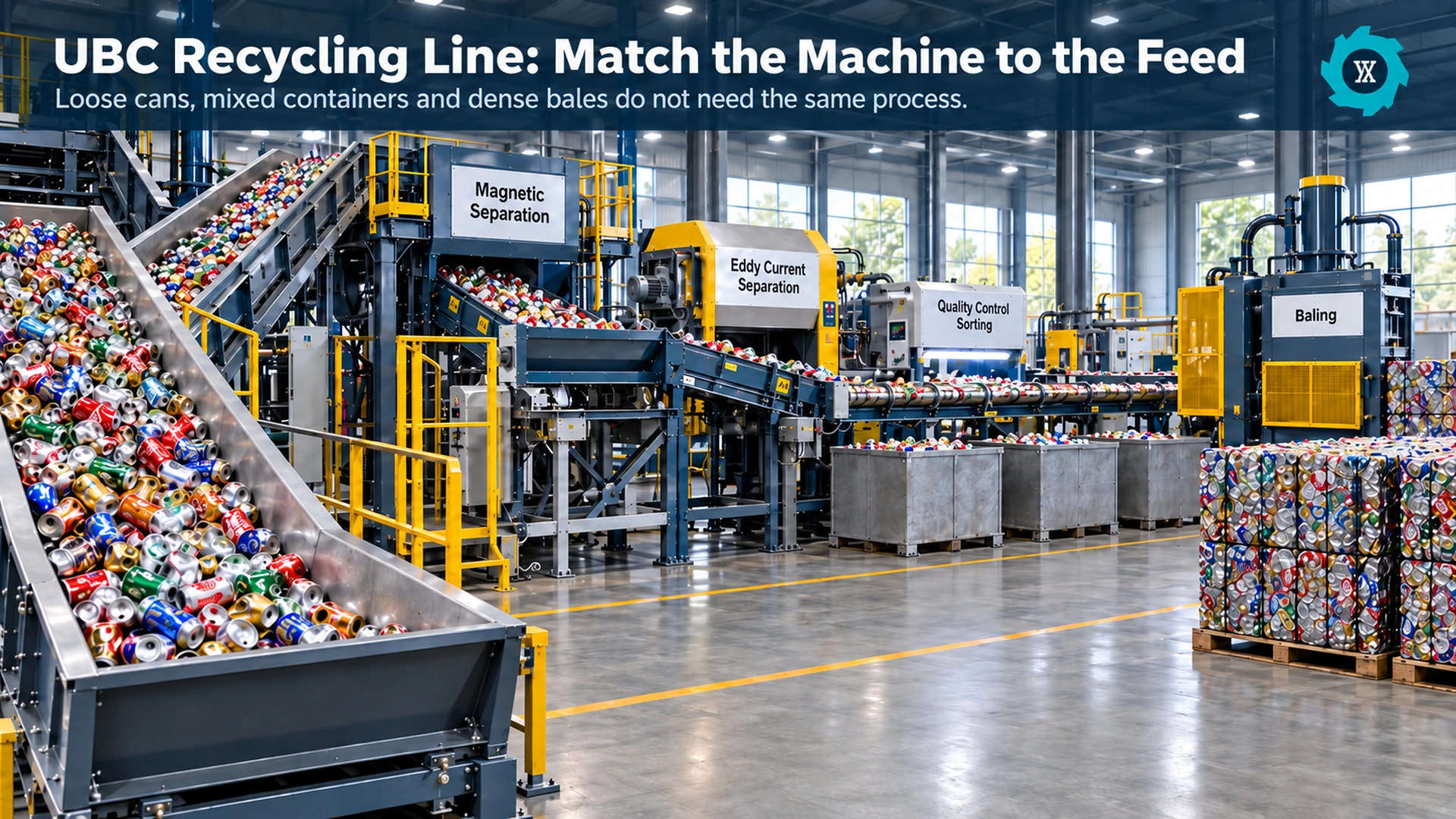
The most useful manufacturer comparison starts with the material arriving at your gate: loose UBC, compacted cans, dense bales, or a mixed dry-recyclables container fraction. Those feeds need different equipment, different test boundaries, and often different types of suppliers.
Aluminum beverage cans are valuable enough that small recovery losses can matter financially, but a high-value commodity does not justify unnecessary processing. The UBC aluminum can recycling line is therefore a useful reference point for this guide: clean loose cans may only need inspection and densification; mixed container streams need recovery and quality control; dense bales may need opening before contaminants can be released.
Quick Comparison: Top 10 Aluminum Can Recycling Machine Manufacturers
| Rank | Manufacturer | Region | Relevant equipment focus | Best-fit buying situation |
|---|---|---|---|---|
| 1 | TOMRA Recycling | Norway / global | Sensor sorting, AI-assisted UBC quality control | MRFs and processors that need high-automation UBC-versus-non-UBC cleanup |
| 2 | YUXI Machinery | China | Configurable UBC receiving, bale opening/shredding, separation and baling lines | Buyers seeking a feed-specific physical UBC line with multiple process routes |
| 3 | CP Group | USA | MRF systems, can densifiers, conveyors, screens, ECS integration, baling integration | North American single-stream and container-line projects needing turnkey integration |
| 4 | STEINERT | Germany / global | CanMaster and non-ferrous eddy current separation | Projects where aluminum-can recovery from prepared packaging waste is the core bottleneck |
| 5 | Machinex | Canada / global | MRF design, eddy current recovery, optical sorting and baling | Retrofits and full MRF container-line upgrades |
| 6 | MSS | USA | AI, optical and sensor-based aluminum quality control | End-of-line UBC cleanup where non-UBC aluminum and non-metals must be identified |
| 7 | ELDAN Recycling | Denmark / global | Dedicated UBC size reduction and cleaning systems | Loose or baled cans requiring downsizing and contaminant removal before downstream use |
| 8 | Pellenc ST | France / global | NIR/VIS plus AI sorting for UBC versus non-UBC aluminum | Sensor-upgrade or polishing stages where aluminum grade distinction matters |
| 9 | Eriez | USA / global | Eddy current separators and magnetic separation | Plants that need robust ferrous/non-ferrous recovery modules rather than a complete UBC line |
| 10 | Bunting | USA / UK / global | Magnets, eddy current separators and modular metal-recovery systems | MRF and recycling lines needing configurable ferrous and aluminum recovery stages |
What Counts as an “Aluminum Can Recycling Machine”?
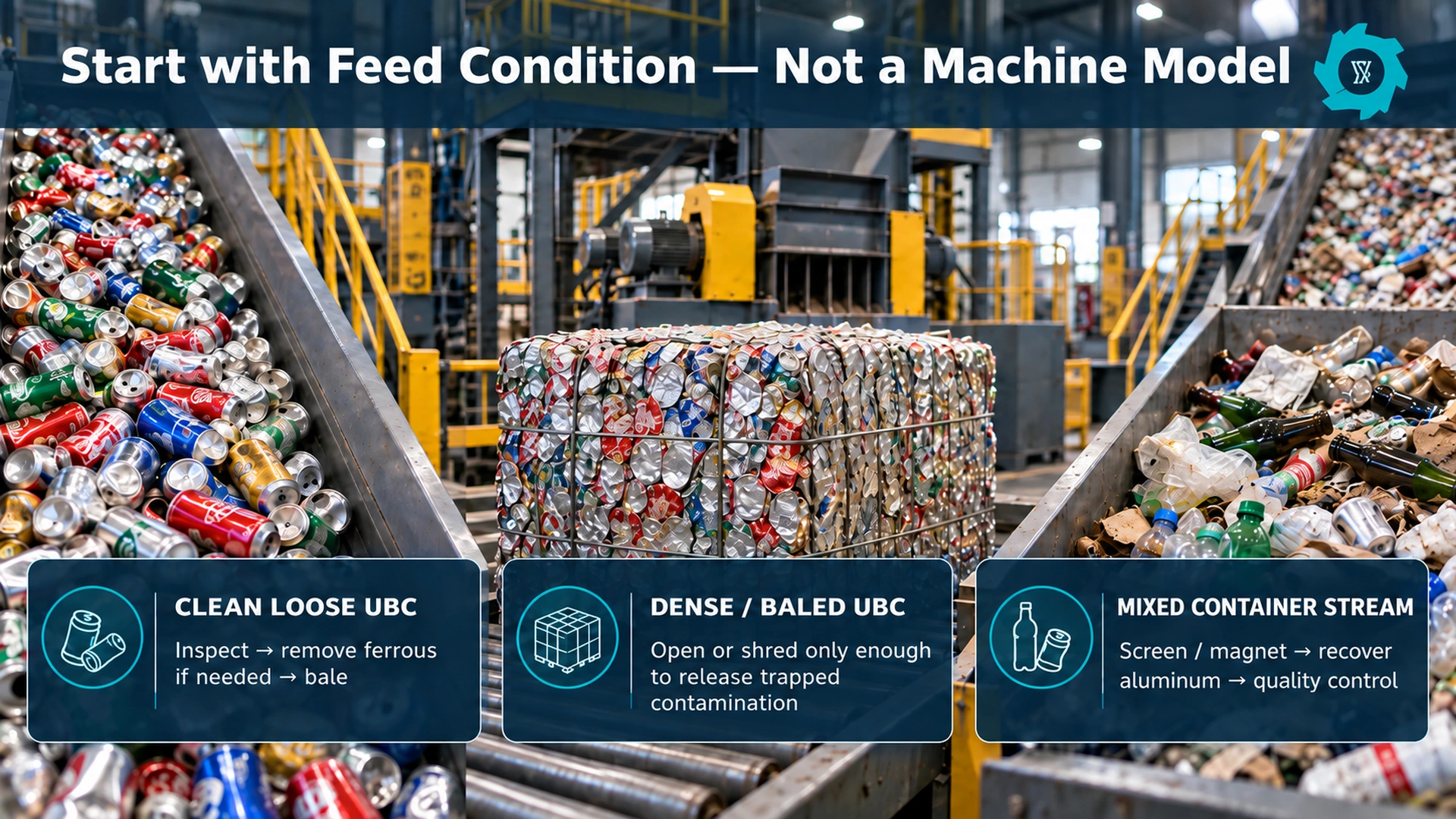
A buyer searching for one machine may actually be planning one of three projects: densifying already-clean loose cans, recovering UBC from mixed containers, or preparing dense bales for a mill. The equipment boundary changes with each route.
Route A: clean loose UBC
If cans are already separated, drained and reasonably clean, the process may be short: receiving, visual inspection, optional magnetic removal, a controlled feed to the press and baling. A shredder is not automatically an advantage. Extra size reduction can create fines, increase maintenance, expose more coated surface, and add a dust-control obligation without improving the product.
Route B: mixed container recovery
Here the primary job is separation. The line may first remove fines or flatten the burden, then extract steel cans magnetically, recover aluminum with an eddy current separator, and add optical, AI or manual quality control before the UBC fraction is stored or baled. The performance of the separator depends on how the feed is presented. For a deeper explanation, see magnetic vs eddy current separation for aluminum scrap.
Route C: dense UBC bale preparation
Dense bales can trap steel, plastic, glass, liquids, dirt and other aluminum. The challenge is to open the mass enough to expose those contaminants without reducing every can into unnecessary fines. The correct solution can be a bale breaker, low-speed shredder or another controlled opening stage followed by magnetic separation, screening, light-fraction removal and quality control. The downstream buyer’s specification determines whether the product leaves loose, downsized or rebaled.
How We Evaluated the Manufacturers
A conventional “top manufacturer” list often rewards the company with the biggest catalog. That does not tell a UBC buyer whether the line can handle the worst normal bale, whether the eddy current separator will see a stable material layer, or whether the factory test will account for aluminum lost into rejects. This ranking uses six practical questions instead.
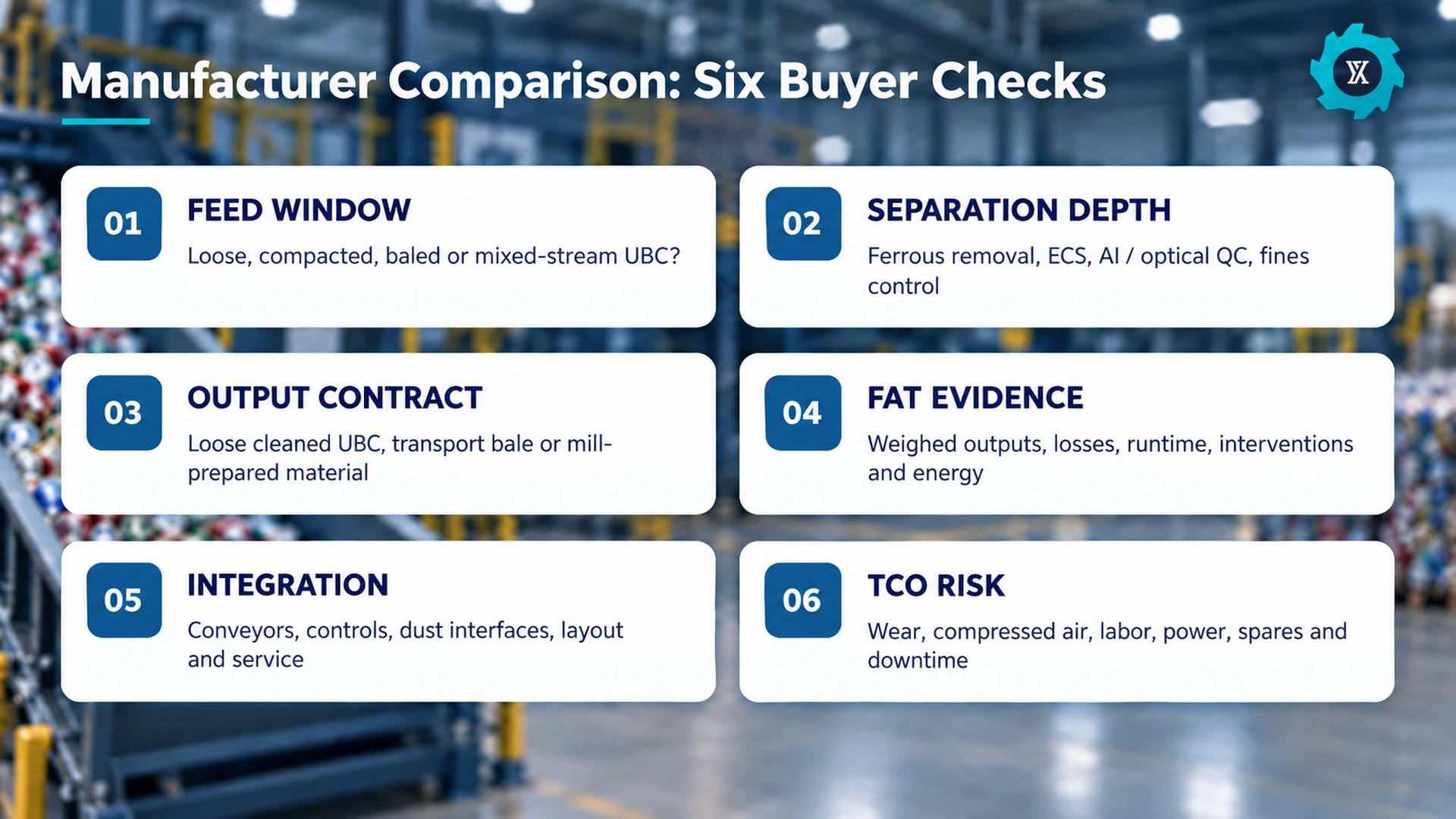
- Feed window. Does the supplier clearly distinguish loose, compacted, baled and mixed-stream UBC?
- Separation depth. Can the proposed route remove the specific contaminants that actually reduce product value?
- Output contract. Is the target defined as a bale, cleaned loose UBC, opened material or a mill-prepared fraction with measurable limits?
- FAT evidence. Will the test record every important output and loss stream, not just tonnes per hour and a visually clean product?
- Integration. Are conveyors, controls, access, dust interfaces, downstream handoff and layout treated as part of the system?
- Total-cost risk. What happens to labor, wear, compressed air, power, spares, cleaning time and downtime when the feed becomes less favorable?
1. TOMRA Recycling
Best fit: high-automation UBC recovery and quality-control applications in MRFs or container-sorting plants.
TOMRA earns the first position because its current public technology is unusually specific to the hardest part of modern UBC sorting: distinguishing beverage cans from other aluminum and non-aluminum objects after primary recovery. Its GAINnext platform adds deep-learning object recognition to the AUTOSORT family, and the company publicly identifies UBC aluminum as a dedicated application. An eddy current separator can pull non-ferrous metal from the stream, but it cannot identify whether the aluminum is a beverage can, aerosol can, tray, or another product.
In a new plant, TOMRA is better considered as a higher-value sorting step within the overall material-handling and recovery system. Receiving, burden control, screening, magnets, bunkers and baling still have to be engineered around it. Its strongest business case appears when manual aluminum QC is expensive, inconsistent or difficult to staff, and when the buyer’s downstream contract rewards a tighter UBC grade.
RFQ question: ask what contaminants were present in the reference test, whether the quoted purity/capture figure is measured at end-of-line or across the entire plant, and what belt loading, object presentation and compressed-air demand were required.
2. YUXI Machinery
Best fit: buyers who want a configurable physical UBC preparation line rather than a single sorting module.
YUXI’s strongest relevance in this ranking is the way the UBC project can be divided by feed state. The published line distinguishes clean loose-can baling, recovery from mixed dry recyclables, and opening/preparation of dense bales. That is a practical structure for RFQs because it prevents a buyer from paying for shredding when the cans are already clean, or from specifying a baler-only system when contamination is trapped inside compacted feed.
A typical YUXI project can combine receiving conveyors, inspection, bale opening or controlled shredding, magnetic separation, screening, optional eddy current recovery, quality control and baling. The engineering value is not the number of machines. It is the ability to remove stages when the feed does not justify them. A buyer should send bale dimensions and weight, loose bulk density where applicable, representative contamination data, expected hourly mass flow, product form, power standard and workshop constraints before comparing models.
A physical UBC preparation line is not automatically a decoating, melting, alloy-adjustment or rolling line. If the commercial project extends into can-sheet production, those thermal and metallurgical systems must be specified separately. The downstream recycling process then continues through mill preparation, remelting and, where required, alloy and sheet-production stages that sit outside the physical UBC preparation line described here.
RFQ question: request a flowsheet showing every reject discharge, sampling point, recirculation route and retained-material location, then require those streams to be accounted for during the acceptance test.
3. CP Group
Best fit: North American MRF projects that need a system integrator rather than a stand-alone UBC machine.
CP Group has established experience in aluminum can processing, including the development of commercial can flattening and densification equipment. Its current MRF solutions integrate material feeding, screening, magnetic separation, eddy current recovery, optical sorting, storage, and baling within a coordinated processing system. Recent project material also shows the company integrating eddy current recovery of primarily aluminum in large commercial lines. For a buyer upgrading a single-stream facility, that integration experience can be more important than the specification of one separator.
CP’s value proposition is strongest when the UBC fraction is one product inside a broader MRF. The aluminum system has to coexist with fiber, glass and plastics, and upstream screening decisions can change the burden reaching the container line. This makes system-level throughput and availability more important than the nameplate capacity of the aluminum separator alone.
RFQ question: ask for the material balance before and after the aluminum recovery stage, plus the expected burden depth and composition at the eddy current separator. Also ask how UBC quality control is handled when the recovered non-ferrous fraction contains non-UBC aluminum.
4. STEINERT
Best fit: projects where non-ferrous recovery from prepared packaging waste is the main process bottleneck.
STEINERT’s CanMaster is explicitly positioned for non-ferrous recovery from post-consumer packaging and especially aluminum cans. This application focus makes it easier for a buyer to evaluate the separator as a defined process stage. An eddy current separator can only work with the feed it is given. Performance may drop when iron is still present, the material layer becomes too deep, particle size is inconsistent, or the splitter is not set correctly.
Many UBC facilities already have the upstream handling in place. What they need is a reliable aluminum recovery step that can fit into the existing prepared stream. That is a different procurement problem from buying a bale-opening line or a fully automated MRF.
RFQ question: provide representative size distribution and feed-layer data, then ask the supplier to state the tested belt speed, rotor configuration, splitter position and aluminum loss in the non-metal residue. If the plant will handle both whole cans and shredded pieces, ask whether one setup can cover both or whether the process should be separated by size.
5. Machinex
Best fit: MRF retrofits or complete container-line upgrades requiring separation and system integration.
Machinex publishes multiple MRF case studies where aluminum cans are recovered by eddy current separation and then passed through quality control. Its current project portfolio also includes single-stream systems using eddy current recovery, optical sorting and baling. That gives buyers a useful reference when UBC is not an isolated commodity but one of several saleable fractions leaving a large facility.
For retrofit work, the engineering problem is often constrained by an existing building, old conveyors, reused structural steel, limited elevation and a shutdown window. A manufacturer that can work around those interfaces may outperform a technically superior stand-alone machine that cannot be installed without major civil changes.
RFQ question: require a tie-in schedule and a responsibility matrix for reused equipment. Check whether the stated throughput is based on the full single-stream feed or only on the container or aluminum fraction.
6. MSS
Best fit: aluminum quality-control stations where UBC must be separated from non-UBC aluminum and non-metals.
MSS focuses on sensor-based sorting rather than complete UBC mechanical preparation. Its Vivid AI products are explicitly marketed for aluminum QC, including UBC versus non-UBC aluminum and non-metals. That is important at the end of a container line because commodity quality can be limited by objects that an eddy current separator correctly identifies as non-ferrous but that a UBC buyer does not want in the bale.
MSS also offers air-ejection and robotic configurations, which creates a useful engineering choice. High-volume belts with many simultaneous objects may favor air ejection, while tighter retrofit spaces or lower-volume positions may justify a robotic architecture. The buyer should not choose the extraction technology from a brochure; it should be based on objects per minute, belt width, target categories, compressed-air infrastructure, maintenance access and expected contamination.
RFQ question: ask for confusion-matrix style results by contaminant category where available. If foil, pet-food cans, aerosols and plastic are the known problems, the test should report how each class behaves.
7. ELDAN Recycling
Best fit: processors receiving loose or baled UBC that must be downsized and cleaned before downstream use.
ELDAN is one of the few companies in this list with a publicly described dedicated UBC recycling system. Its published material describes processing loose or baled cans, size reduction and the removal of ferrous metals, zinc, brass and organics. This puts ELDAN closer to a mill-preparation concept than suppliers that focus mainly on recovering intact cans from mixed municipal recyclables.
A dense bale can look like a uniform aluminum block while hiding straps, steel cans, dirt and other contaminants. Opening the bale changes the separation problem because contaminants that were mechanically trapped become available to magnets, screens and other stages. The risk is over-processing: excessive size reduction can produce a finer fraction that is harder to handle and easier to lose.
RFQ question: ask for the size distribution after each reduction stage and a metal-loss audit of fines and reject streams. The acceptance test should prove both product quality and aluminum retention.
8. Pellenc ST
Best fit: optical or AI polishing where a recovered aluminum fraction must be separated into UBC and non-UBC categories.
Pellenc ST’s AISORT combines infrared sensing with RGB/deep-learning functions, and the company lists UBC versus non-UBC aluminum as an application. This places it in the same high-value QC layer as other advanced optical suppliers. It is not a substitute for stable feed preparation; it is a way to make a more specific decision after the material has been presented to the sensor in a controllable way.
The business case depends on the downgrade cost of non-UBC contamination, the quantity of aluminum being lost through conservative manual sorting, and the staffing cost of the QC position. Buyers should measure those three values before assuming AI will pay for itself.
RFQ question: submit a labeled sample set that includes the actual confusing objects from the plant. Generic demonstrations with clean cans do not answer how the system will behave on crumpled, sleeved, dirty or partially flattened packaging.
9. Eriez
Best fit: recycling lines that need proven magnetic and eddy current modules for ferrous and non-ferrous recovery.
Eriez has a long-running eddy current product family and specifically lists aluminum cans/UBC among its applications. For an equipment buyer, the main advantage of a separator specialist is depth around rotor configuration, belt width, magnetic design and integration into recycling lines. The limitation is that the plant owner still has to engineer the correct surrounding process: feed distribution, ferrous removal, discharge control, maintenance access and product storage.
Particle size and shape deserve special attention. The article How Particle Size Affects Aluminum Eddy Current Separation explains why the visible “jump” of a clean can in a demonstration does not prove recovery on a broad, production-scale size distribution.
RFQ question: ask for test results on the smallest valuable aluminum fraction and the heaviest normal burden. A separator can look excellent on the median material while the economic loss concentrates at the edges of the distribution.
10. Bunting
Best fit: modular ferrous and aluminum recovery stages in MRFs, plastics, glass and metal-recycling systems.
Bunting supplies overband magnets, magnetic head pulleys and eddy current separators, and its published project material shows complete metal-recovery sequences where steel cans are removed first and aluminum cans are recovered afterward by eddy current separation. That sequencing reinforces a core design principle: the ECS should receive a prepared, reasonably liberated stream.
For plants with a strong in-house engineering team, modular equipment can be attractive because it allows the owner to assemble or retrofit a line stage by stage. The tradeoff is interface responsibility. Conveyor speed, burden control, chutes, dust covers, platforms and controls may sit between different vendors.
RFQ question: define who owns the interface guarantee. If the magnet, feed conveyor and ECS are supplied by different companies, the purchase order should state who is responsible for demonstrating the combined recovery result.
What the Ranking Does Not Tell You
The list identifies credible manufacturer types, but it does not select a machine for a specific plant. The decision turns on feed condition, required output and which process step is actually limiting revenue.
| Project situation | First technical priority | Manufacturer type to shortlist first | Common mistake |
|---|---|---|---|
| Clean loose UBC from a deposit stream | Inspection, ferrous check, reliable densification | Baling / simple line integrator | Adding shredding and sensor sorting without a quality problem to solve |
| Single-stream MRF container fraction | Stable material presentation and aluminum capture | MRF integrator + ECS supplier | Comparing total MRF tph with aluminum-line tph |
| Recovered aluminum needs UBC-grade cleanup | Remove non-UBC aluminum and non-metals | AI / optical QC specialist | Assuming a conventional ECS identifies aluminum product type |
| Dense UBC bales for mill preparation | Controlled opening and contaminant release | UBC size-reduction / preparation-line supplier | Over-shredding and losing aluminum into fines |
| Existing plant retrofit | Interfaces, elevation, shutdown plan, controls | Integrator with retrofit experience | Buying a stand-alone machine before checking building and conveyor constraints |
A Better RFQ: Normalize the Same Test Boundary
The easiest way to improve a manufacturer comparison is to stop asking every supplier a different question. Build one RFQ sheet and make every bidder respond to the same feed and output definition. The aluminum recycling equipment selection guide gives a broader framework; for UBC projects, the following fields are especially important.
Feed description
Loose, flattened, compacted or baled; bale dimensions and weight; wire or strap type; bulk density; moisture or residual liquid; steel-can percentage; plastics, glass, paper and non-UBC aluminum by weight.
Required product
Loose UBC, opened pieces or bale; bale dimensions and density; maximum ferrous/non-metal contamination; whether non-UBC aluminum must be removed; sampling method and buyer specification.
Operating window
Normal and peak tph, daily hours, loader or conveyor feed, expected stop/start pattern, power standard, compressed air, ambient conditions and maintenance staffing.
Project boundary
Receiving hopper, conveyors, platforms, controls, dust collection interface, magnets, screens, sensor sorting, baler, installation, commissioning, training, spares and FAT.
A supplier should be allowed to propose a simpler route if the feed supports it. For example, if clean loose cans already meet the buyer’s grade after a ferrous check, direct baling can be more economical than sending them through a shredder, screen and optical sorter simply because those machines are available.
Factory Acceptance Test: Prove Recovery, Not Just Throughput
Throughput is only one acceptance variable. A UBC line can hit the promised tonnes per hour while losing too much aluminum in the residue, requiring repeated operator clearing or building up material inside the system. A stronger FAT treats the plant as a mass-balance boundary.
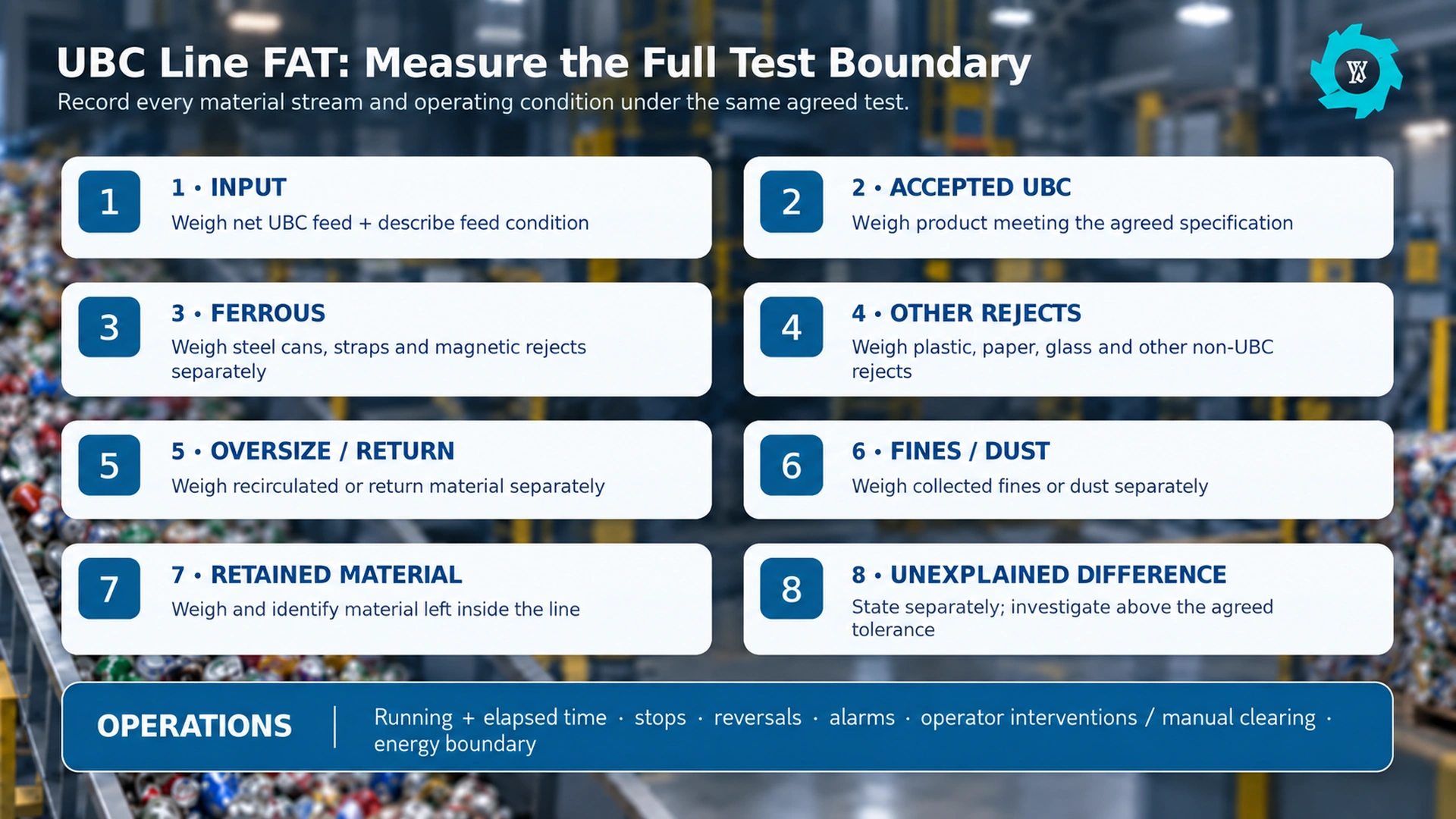
For a representative trial, define the start and finish condition of the line, weigh the net input, and account for every material stream. At minimum, record accepted UBC, ferrous output, other rejects, oversize or return material, collected fines/dust, retained material and unexplained difference separately. Retained material is physically located and identified inside the line; unexplained difference is a reconciliation item that should be investigated if it exceeds the agreed tolerance.
Operations evidence should be recorded alongside the mass balance: stable running time, total elapsed time, stops, reversals, alarms, operator interventions or manual clearing, and the energy boundary used for the kWh figure. If compressed air is material to the optical-sorter operating cost, measure or estimate it under a stated test condition.
Use at least one difficult but compliant batch. A trial with clean, dry cans under ideal conditions may not reflect how the machine will handle real feed. Dense bales, wet material, and cans packed with other debris can behave very differently. Testing with representative material gives the supplier a fair operating basis and gives the buyer a capacity figure that is closer to actual plant conditions.
Capacity: Ask Where the Bottleneck Moves
The biggest motor does not define a UBC line’s throughput. Loose cans are low-density and can overwhelm conveyor volume before mass flow becomes high. Dense bales create the opposite problem: the opening stage may be mechanically demanding even though the downstream separator sees a smaller volume. Mixed containers can bottleneck at screening, quality control or the baler.
Ask each manufacturer to state the expected limiting machine for three conditions: normal feed, high-contamination feed and the largest/hardest normal bale. Then ask what happens when that limit is reached. Does material recirculate? Does the operator slow the infeed? Does the line stop? Does product quality decline first?
Purity and Recovery Must Be Reported Together
A clean UBC bale can still come from an inefficient line if aluminum is being discarded in fines, ferrous output or non-metal residue. The commercial result depends on both product quality and metal retention. During trials, sample both sides of each important separation stage. Check the magnetic fraction for trapped aluminum. Check screen undersize and dust for small metal pieces. Check the ECS residue for cans or fragments that failed to eject.
This point is especially important when a process adds secondary size reduction. Smaller pieces can improve liberation, but they also increase surface area, dust and the number of particles that must be separated. The buyer should specify the smallest economically valuable aluminum fraction that the line is expected to retain.
Why UBC-versus-Non-UBC Sorting Is a Separate Decision
Eddy current separation answers a conductivity question. It creates different trajectories for conductive non-ferrous objects and non-conductive background material. It does not identify product identity. An aerosol can, aluminum food tray and beverage can can all behave as non-ferrous objects.
If the buyer’s contract requires a tighter UBC grade, a second decision layer may be needed. Modern optical and AI systems use combinations of image, color, near-infrared, metal sensing and trained object recognition to identify items that conventional physical separation cannot classify by product type. The business case should be tested against the actual downgrade penalty and manual-QC cost.
Total Cost of Ownership: Five Numbers Missing from Many Quotations
Normalize at least five recurring cost categories before comparing suppliers.
| Cost area | What to request | Why it changes the comparison |
|---|---|---|
| Wear parts | Expected life range on representative UBC, unit price, change time, stocked spares | Dense bale opening can have a very different wear profile from clean loose-can conveying |
| Labor | Operators per shift, QC positions, cleaning tasks, maintenance hours | Automation may shift cost from picking labor to maintenance and compressed air |
| Electricity | Installed kW and measured energy at the agreed test boundary | Installed power is not the same as actual kWh per tonne |
| Compressed air | Pressure, average and peak flow for optical/AI ejection | Air infrastructure can become a hidden retrofit cost |
| Downtime and cleaning | Access time, belt-change procedure, jam-clearing method, preventive-maintenance intervals | A machine with strong separation performance can still be expensive if routine access stops the whole line |
Safety and Dust Planning Belong in the RFQ
Aluminum-can lines contain conveyors, rotating equipment, presses, stored hydraulic energy and potentially size-reduction machinery. U.S. buyers should review guarding and hazardous-energy controls as part of equipment acceptance, not after installation. OSHA’s general machine-guarding requirements address hazards such as ingoing nip points, rotating parts and flying material, while 29 CFR 1910.147 covers hazardous-energy control during servicing and maintenance.[1][2]
Dust risk is process-dependent. Direct baling of clean cans is not the same dust scenario as shredding dirty, coated or mixed light scrap. If shredding, screening or fines collection is included, define what material can enter the line, where dust is generated, how it is captured, and how fire/explosion risk will be assessed for the actual dust. The aluminum recycling dust and fire-risk planning guide is a useful starting point for that project discussion.
Information Gain: Use a “Loss Map” Before Buying Another Machine
Before adding a new separator, perform a simple audit of where saleable aluminum is leaving the process. Take timed samples from the ferrous stream, screen undersize, light fraction, ECS residue, manual rejects and any fines collector. Weigh and hand-sort each sample. Convert the aluminum found in each loss stream to kilograms per operating hour.
If most aluminum is trapped in the ferrous fraction because cans are nested with steel, improve liberation or burden control before buying a second optical sorter. If the ECS residue contains intact cans, investigate feed depth, belt condition and splitter settings. If the product is clean but downgraded because of aluminum trays or aerosols, UBC-specific optical/AI QC becomes more defensible. The machine purchase follows the measured loss mechanism.
Market Context: Why Better UBC Capture Has Commercial Weight
Aluminum beverage cans remain an important part of the U.S. recycling stream. For cans shipped in 2023, the reported recycling rate was 43%, while recycled material accounted for an average of 71% of the content in a U.S.-made can. Aluminum cans also retained a substantially higher scrap value per ton than other common beverage packaging materials.[3] Industry efforts led by the Can Manufacturers Institute continue to focus on collecting more used beverage cans and improving their recovery through curbside programs and MRFs.[4] The material can also return to production relatively quickly. A 2025 industry study found that, on average, a recycled aluminum can in the United States can be back on the market as a new can in less than 60 days.[5]
Those numbers do not prove the ROI of a specific recycling machine. They do explain why UBC capture deserves a separate line item in MRF economics. The value is concentrated enough that preventing a small percentage of aluminum loss can be more important than increasing gross plant throughput by the same percentage.
Buyer Checklist Before You Request a Quote
- Photograph and weigh representative loose, compacted or baled UBC.
- Record bale dimensions, average/maximum bale weight and wire/strap condition.
- Hand-sort representative samples to estimate steel, plastic, glass, paper, dirt, residual liquid and non-UBC aluminum by weight.
- State whether the required output is a transport bale, cleaned loose UBC or opened/mill-prepared material.
- Provide normal and peak tons per hour plus daily operating hours.
- Identify the final buyer’s quality limits and sampling method.
- Define what equipment is already installed and which interfaces are reused.
- Require a flowsheet that labels every product, reject and recirculation stream.
- Require the FAT to weigh retained material and unexplained difference separately.
- Confirm guarding, lockout points, maintenance access, dust interfaces and emergency-stop philosophy before shipment.
FAQ
What equipment is needed for aluminum can recycling?
The equipment depends on the incoming UBC condition. Clean loose cans may need inspection, optional ferrous removal and a baler. Mixed container streams normally need screening or material conditioning, magnetic removal, aluminum recovery and quality control before baling. Dense UBC bales may need controlled bale opening or shredding before trapped contamination can be removed.
Does every aluminum can recycling line need a shredder?
No. Shredding is useful when dense bales must be opened, nested cans must be released or downstream separation needs a more controlled material size. Clean loose UBC can often be inspected and baled without shredding, which avoids unnecessary wear, fines and energy use.
How should buyers compare aluminum can recycling machine manufacturers?
Compare manufacturers against the same feed description, required output, test boundary and operating conditions. Have each supplier define the package clearly, including what is and is not included. They should also identify likely bottlenecks, reject streams, power and air requirements, maintenance access, spare-parts support, and the data that will be recorded during the FAT.
What should an aluminum can recycling line FAT measure?
A useful FAT records net input, accepted UBC output, ferrous output, other rejects, oversize or return material, fines or dust, retained material and unexplained difference separately. It should also record running and elapsed time, stops, reversals, alarms, operator interventions or manual clearing, and the agreed energy measurement boundary.
Need a UBC Line Proposal?
Send feed photos or video, loose/baled condition, bale dimensions and weight, contamination data, target throughput, required product, power standard and workshop dimensions. The process should be reduced to the simplest configuration that can repeatedly meet the output specification.
References
- OSHA: machine guarding.
- OSHA: lockout.
- Aluminum Association: can KPI.
- CMI: recycling initiatives.
- Aluminum Association: 60 days.
Online Message