




 Request Quote

Product Center
-
- Biomass Shredding and Recycling Line
- OCC Paper Dry Pulping & Cardboard Recycling Line
- Scrap Aluminum Recycling Line
- Waste Car Recycling Line
- Waste Refrigerator Recycling Line
- Copper Aluminum Radiator Recycling Line
- Motor Rotor Recycling Line
- Copper Wire Recycling Line
- Waste Ink Cartridge Recycling Line
- Aluminum UBC Scrap Recycling Line
Get a Quote
Contact Us


Quick answer: put the main magnet where pallet nails have been liberated
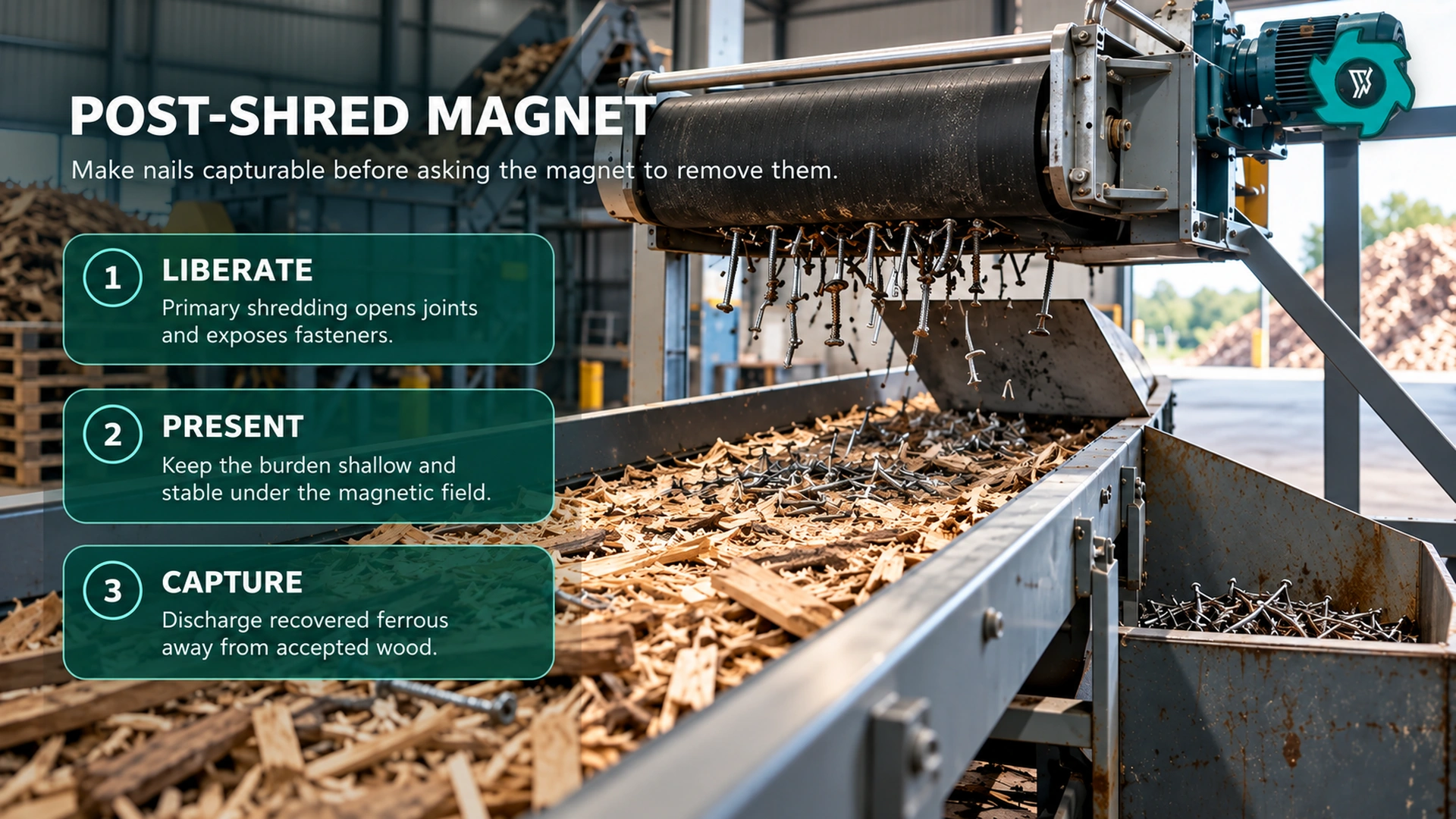
For end-of-life wood pallets, the most useful magnetic separation point is usually after primary shredding. Shredding opens deck-board and stringer joints, breaks wood away from nails and screws, and turns a bulky object into a conveyable stream. The magnet can then work on exposed ferrous metal.
That does not mean every piece of metal should be allowed into the shredder. Loose steel plates, long bars, tools, oversized brackets and other hazardous tramp objects still belong in receiving inspection or a dedicated pre-removal step. The wider biomass shredding and recycling line treats metal removal as part of the pallet and waste-wood process.
Magnetic separation starts before the magnet
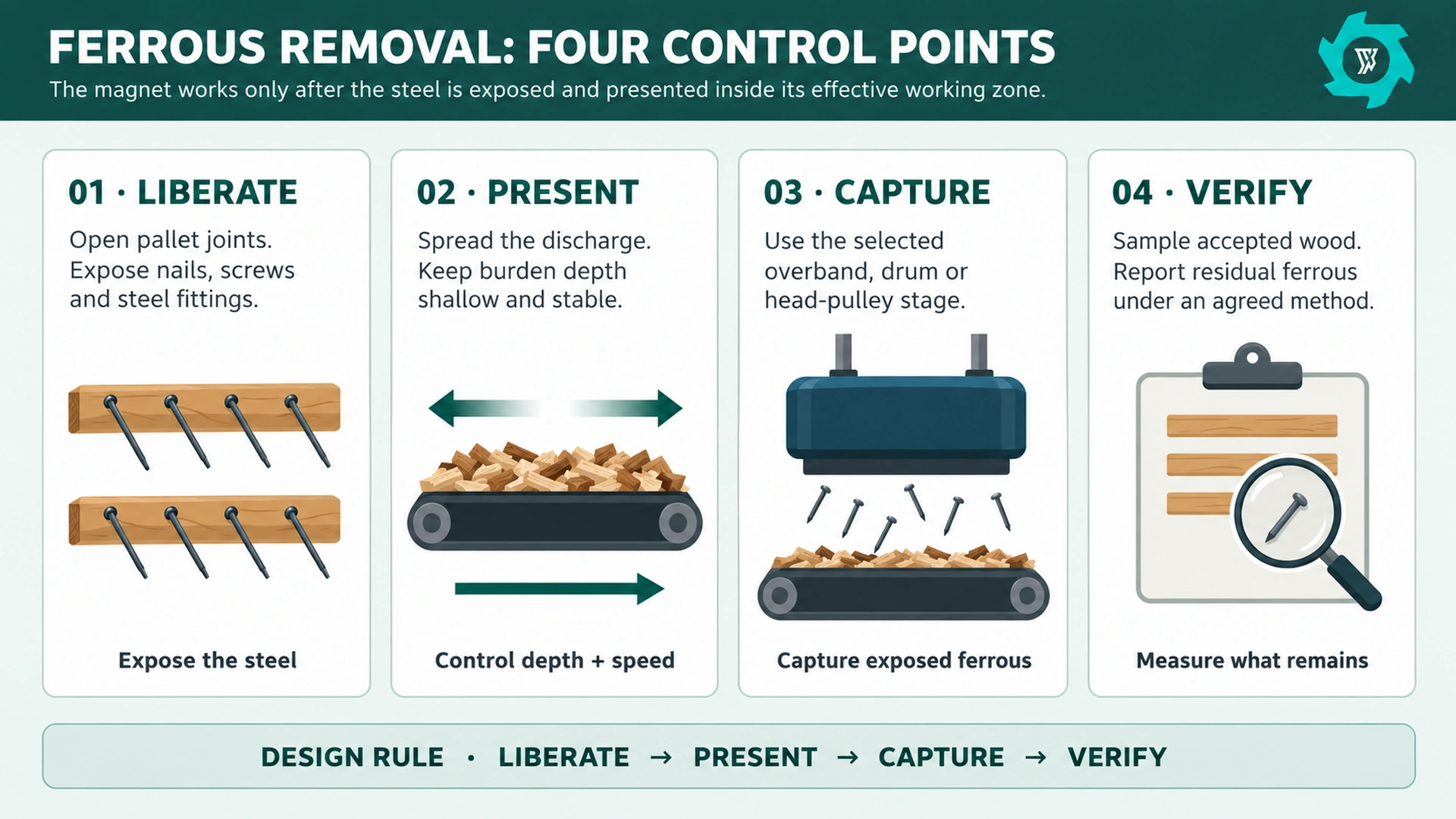
Buyers often compare magnet size, magnet type or advertised field strength first. In pallet recycling, that sequence is backwards. A separator cannot recover a nail that is still locked inside a thick board, and it may miss a liberated screw hidden at the bottom of an uneven, deep bed of wood. The separation problem has four linked control points: liberate, present, capture and verify.
Liberation means creating enough fracture around the fastener for the steel to become magnetically accessible.
Presentation means carrying the liberated mixture under or through the magnetic field in a controlled layer.
Capture is the separator’s job.
Verification measures the wood that passed the magnet, because the mass of recovered steel alone cannot tell you how much steel was missed.
Why intact pallets are a difficult magnetic target
An intact pallet gives the magnet several disadvantages at once. Fasteners may be countersunk, bent through dense stringers, hidden under blocks, or shielded by a large working distance. The pallet itself is thick and irregular, so the magnetic field is not acting on a thin, predictable layer. A pre-shred magnet can still remove loose exposed ferrous pieces riding on or between pallets.
Primary shredding changes that geometry. Joint failure exposes shanks and heads, board fragments become smaller, and a discharge conveyor can spread the material into a shallower burden. This is why the handoff after primary reduction is so important. The same logic appears in YUXI’s biomass shredder vs hammer mill discussion: difficult feed is first made controllable, then separation and finer processing are applied only after the material state has improved.
For pallet projects, shredder selection cannot be separated from nail liberation and downstream handling. A wood pallet recycling machine setup should be evaluated as a complete flow—from receiving and primary reduction to ferrous removal, sizing and the final wood specification—because each stage changes what the magnet receives.
Where to remove nails and ferrous metal: position by position
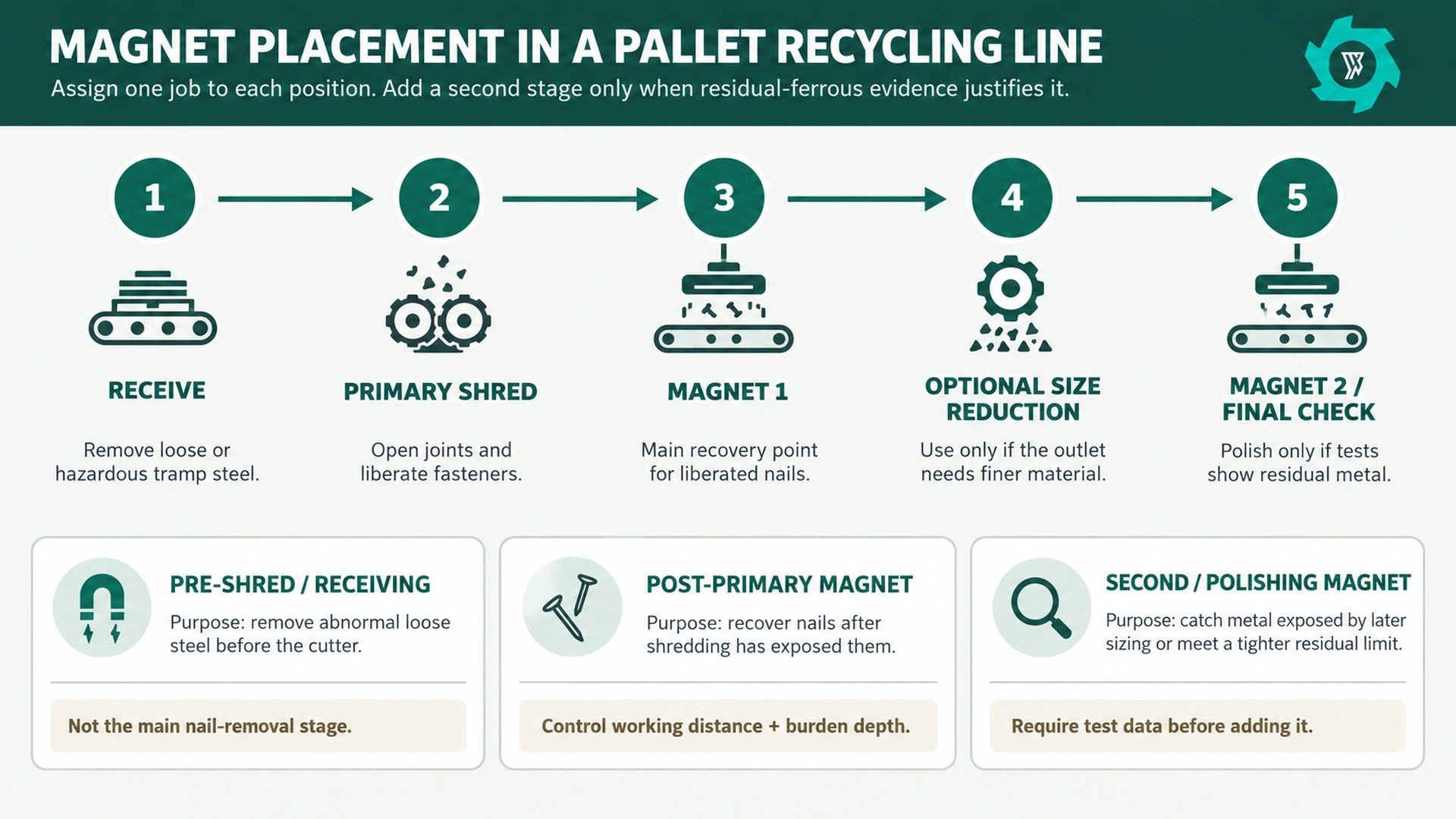
The useful layout comes from assigning a specific job to each position. In practice, most pallet projects can be judged with three questions: what must be removed before the cutter, what has become liberated after primary shredding, and whether any later size-reduction step exposes additional steel.
1. Receiving and pre-shred inspection: remove what the shredder should never see
The job of receiving control is to stop abnormal items that exceed the agreed feed envelope: large loose steel, tools, heavy brackets, long wire bundles, stones, batteries, pressurized items or contaminated pallets that the site does not accept. Ordinary embedded nails are different. If the shredder is designed and tested for that pallet class, those fasteners can remain with the pallet until the primary stage has a chance to liberate them.
This distinction protects both process stability and purchasing clarity. A supplier should not advertise “handles pallets with nails” if the actual acceptance envelope quietly excludes the normal nail load. Equally, a buyer should not interpret a downstream magnet as permission to send arbitrary steel through the cutters. Write normal embedded fasteners and prohibited tramp metal as separate lines in the feed specification.
2. After primary shredding: the main magnetic recovery point
The shredder has already done the mechanical work needed to expose much of the ferrous content, while the material is still coarse enough that wood dust and extreme fines have not yet been created unnecessarily. A suspended overband, cross-belt magnet, inline overband, magnetic drum or magnetic head pulley may all be considered here depending on the conveyor layout and cleaning duty.
Record the working distance that the installed arrangement must overcome: the physical suspension gap plus the actual burden depth. Then record conveyor width, speed, trough shape, average and maximum layer depth, particle-size range, moisture condition, expected ferrous load and the smallest fastener the project wants to capture reliably. The separator must be sized around the real conveyor state, not an empty belt.
3. Before a fine grinder: protect the most metal-sensitive stage
If the plant uses a hammer mill, secondary granulator or another high-speed fine-reduction machine, the material entering that stage should already have passed the main ferrous-removal point. A fine grinder should not be asked to finish liberating ordinary pallet nails if the same metal could have been removed earlier. Leaving steel in the feed increases cutter or hammer wear, raises the chance of impact events and can create avoidable sparks or hot fragments.
Where recycled pallet wood is being prepared for fuel, the receiving process normally cares about more than just size. Metal, stones, moisture and fines all affect handling. The biomass fuel preparation system guide treats magnets as one part of a broader contamination-control boundary.
4. After secondary sizing: use a second magnet only when it solves a measured problem
Secondary cutting can create new liberation. A nail that remained trapped in a thick first-pass wood fragment may become exposed after further reduction. That is the strongest technical reason for a second magnetic stage. The other reason is a strict residual-ferrous specification or a downstream machine that is unusually sensitive to metal.
Before buying a second separator, run a controlled comparison. Sample the wood after Magnet 1. Then, if secondary sizing is part of the normal recipe, sample after that sizing stage and after a temporary or trial polishing magnet. Compare residual ferrous on the same sample basis. If the second stage removes meaningful metal that would otherwise remain above the acceptance limit, it has evidence behind it. If not, it may be adding capital, cleaning and maintenance without improving the product.
Overband magnet, magnetic drum or head pulley?
| Separator route | Where it often fits | Strengths | RFQ questions |
|---|---|---|---|
| Self-cleaning overband / cross-belt | Above a conveyor after primary shredding | Continuous ferrous removal; separate discharge path; can handle a changing metal load | Working distance? Belt width and speed? Expected kg/h of ferrous? Discharge direction? Cleaning and belt-wear provisions? |
| Inline overband | Near a conveyor head where material trajectory opens | Can take advantage of material breakaway at transfer; continuous cleaning | Actual trajectory? Magnet-to-material distance? Chute and collection arrangement? What happens during surges? |
| Magnetic drum | At a controlled transfer after shredding or screening | Close interaction between material and magnetic surface; useful for smaller, prepared particles | Feed distribution? Drum loading? Nonmagnetic discharge geometry? Maintenance access? |
| Magnetic head pulley | As a conveyor discharge pulley / polishing stage | Compact integration and close contact at discharge | Can the existing conveyor accept it? What particle depth reaches the pulley? How are magnetic and nonmagnetic trajectories split? |
| Manual-clean suspended magnet | Lower metal load or intermittent duty | Simpler equipment where continuous self-cleaning is not required | How often must cleaning occur? What safe isolation method is required? Will cleaning interrupt throughput? |
The phrase “stronger magnet” can be misleading without installation data. Magnetic attraction drops as the target moves farther from the magnetic surface, so an empty-belt test tells little about a deep wood burden. The plant should document the maximum accepted burden depth and a normal operating band, then keep the feeder and upstream conveyor from burying the fasteners under intermittent surges.
Burden depth and belt speed are process variables, not commissioning details
Two identical magnets can perform differently on the same wood if one conveyor runs a shallow, evenly spread layer and the other carries a lumpy mound. The separator sees the distance to each ferrous object, not the average tonnes per hour. A low-density wood stream can look visually “full” while still moving modest mass, and that makes volumetric surges easy to overlook.
During trials, log belt speed and burden depth with the residual-ferrous sample. If residual metal rises at the same time as the layer becomes deeper, the plant has a process-control problem, not necessarily a magnet-strength problem. Possible corrections include metering the shredder discharge, widening the spread, changing the transfer geometry, reducing short surge peaks or moving the magnet to a point where the material naturally opens.
Use captured-metal mass as an indicator, not as recovery efficiency
Ferrous capture indicator = recovered ferrous mass ÷ net pallet feed mass
This is useful for comparing shifts, feed suppliers or recipes. A dirtier batch can produce a larger magnet discharge even if the separator itself is performing worse. For acceptance, pair captured mass with a test of what remains in the wood.
One buyer may specify residual ferrous as pieces per kilogram of accepted wood. Another may use milligrams or grams of ferrous per kilogram. A third may use a downstream detector/reject rate. Any of these can work if the sample location, sample mass, preparation method and pass/fail rule are written before the test.
Magnets do not remove every metallic contaminant
Standard pallet magnets target ferromagnetic material—mainly ordinary steel nails, staples, screws and brackets. They do not recover aluminum or copper in the same way, and some stainless steels may respond only weakly depending on grade and work history. Stones, glass, plastic straps, soil and coated debris are outside the magnetic separator’s job entirely.
A clean ferrous result can still leave a poor downstream feed. If non-ferrous contamination is credible, define a separate rejection, detection or sorting route. This becomes more important when the incoming material is not limited to relatively consistent pallets. A mixed waste wood recycling process may also receive plastics, stones, soil, wire, hardware and other contaminants that need different removal methods. If the downstream requirement is only to protect a hammer mill from ordinary pallet nails, a ferrous magnet may be enough. If the outlet requires a broader contaminant specification, design the full separation train around that specification.
How to verify residual ferrous after the magnet
Verification should answer a very simple question: what metal is still in the accepted wood? Take timed increments from the post-magnet product during stable operation and during credible feed variation. Record the sample mass and the exact operating conditions. Then use the agreed inspection, magnetic re-check or controlled hand-sort method to identify residual ferrous.
Keep at least two categories separate: free ferrous pieces and wood pieces that still contain embedded metal. Free nails after the magnet point toward a capture/presentation problem; metal still locked inside wood points toward incomplete liberation. The corrective action is different.
Diagnose misses by failure mode
| What the sample shows | Likely question | What to test next |
|---|---|---|
| Loose nails in accepted wood | Was the nail within the effective magnetic working zone? | Burden depth, belt speed, suspension distance, magnet coverage and surge condition |
| Nails still embedded in thick wood | Did primary shredding create enough liberation? | First-pass fragment thickness, cutter condition, recirculation or selective secondary sizing |
| Many small steel fragments | Is the separator optimized for the smallest target size? | Working distance, transfer geometry and a closer-contact polishing stage |
| Wood carried into ferrous discharge | Is capture too aggressive or material presentation unstable? | Discharge trajectory, belt speed, burden control and separator position |
| Residual rises during peak throughput | Is the magnet being buried by volumetric surges? | Metering, conveyor loading profile, burden-depth limit and buffer control |
Factory acceptance testing: prove both capture and cleanliness
A pallet-line FAT should use representative pallets and one declared observation window. Weigh the streams that leave the boundary, identify what remains inside the system at shutdown, and take timed product samples after the magnet. The result connects throughput, ferrous recovery and residual wood cleanliness in the same test.
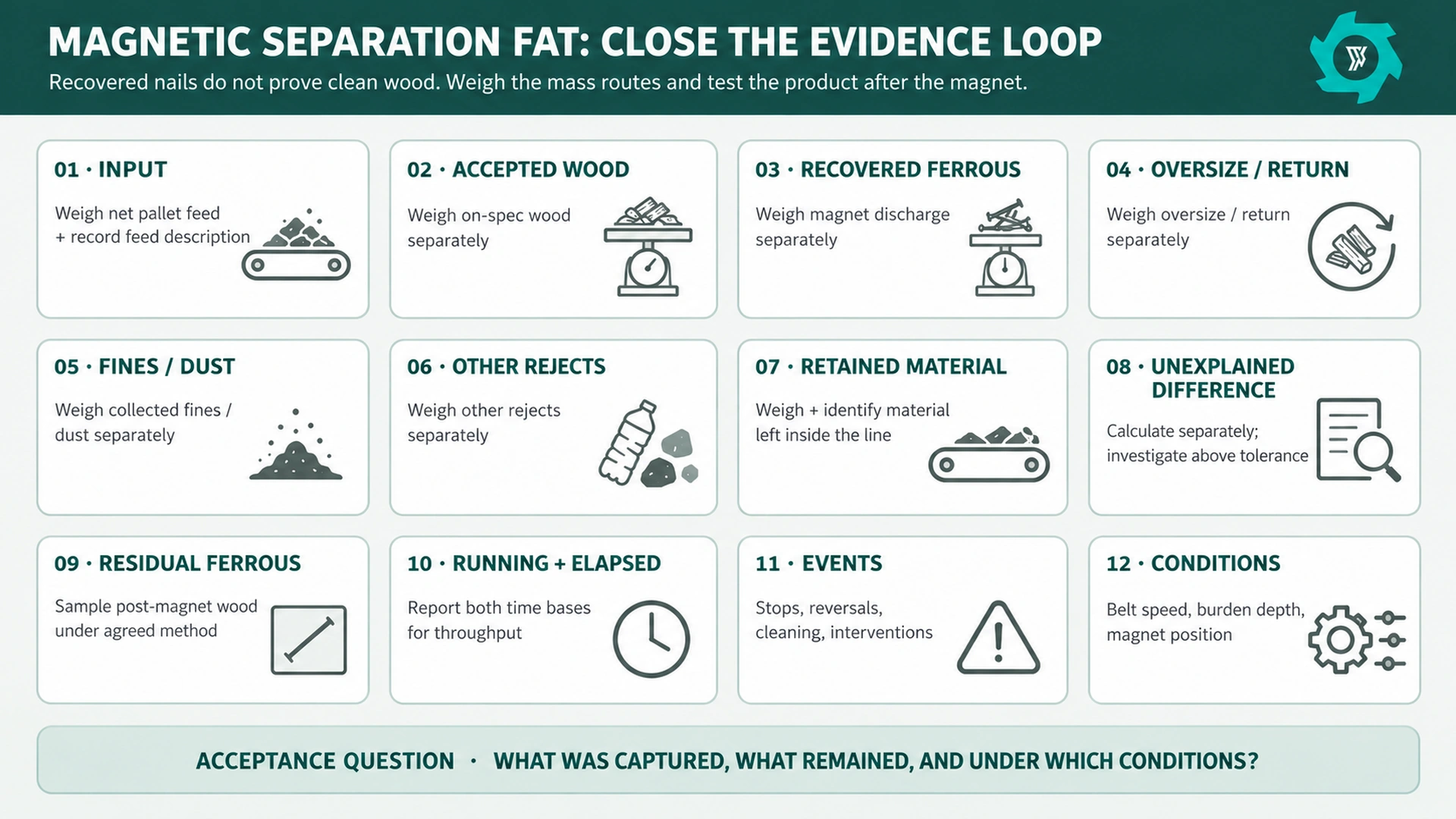
At minimum, weigh net pallet feed, accepted wood, recovered ferrous, oversize or return, fines or collected dust where present, other rejects and retained material separately. Identify retained material at shutdown, then calculate and report the unexplained difference separately rather than treating it as an output stream. Record both machine running time and elapsed observation time. Magnet cleaning, conveyor stoppages, bridge clearing, reversals and manual interventions belong in the same timeline.
OSHA’s hazardous-energy standard requires control of unexpected energization during covered servicing and maintenance activities, including cleaning and unjamming; isolation must be verified before work begins.1 Machine guarding is also required where employees could be exposed to ingoing nip points, rotating parts, flying chips or sparks.2 A magnet cleanout procedure therefore needs to be written around the entire conveyor/separator interface, not just the magnetic device itself.
Wood dust and fire controls still matter around a clean metal stream
Removing nails can reduce one source of damaging metal contact, but it does not eliminate wood-dust hazards. Dry shredded wood can generate airborne and settled dust at cutters, transfers, screens and collectors. NIOSH identifies wood dust as an occupational exposure hazard and recommends limiting exposure.3 NIOSH engineering-control guidance also documents local exhaust arrangements designed to capture wood dust close to the point where it is generated.4
Keep the magnetic section easy to inspect and service. Enclosures, extraction ducts, guards, and access doors should not make routine checks difficult or tempt operators to reach near moving parts. Ferrous discharge also needs a safe, visible collection point that can be emptied without awkward access. Where combustible dust is present, fire and explosion controls should be based on the material actually being processed and the conditions on site.
RFQ checklist: specify the installation, not just the magnet model
- Target contaminants: normal nails, staples, screws, plates and the smallest/least magnetic target that must be captured.
- Feed envelope: pallet construction, normal and worst-case fastener load, moisture and post-shred particle-size range.
- Conveyor geometry: belt width, trough or flat profile, belt speed, material trajectory and available installation space.
- Burden depth: normal, maximum continuous and short-duration surge depth at the magnet.
- Working distance: the installed magnet-to-target distance, not only the empty-belt suspension gap.
- Ferrous load: expected recovered mass per hour and peak conditions that set cleaning/discharge duty.
- Cleaning method: self-cleaning or manual; discharge direction; bin volume; safe access and isolation method.
- Downstream sensitivity: what equipment or product specification is being protected.
- Residual-ferrous acceptance: sample point, sample mass, metric, frequency and pass/fail limit.
- FAT evidence: separate mass streams, running and elapsed time, conveyor conditions, magnet events and retained samples.
Do not buy a second magnet because a layout drawing has an empty space for one. First establish the post-primary residual-ferrous result. Then ask whether later sizing creates new liberation or whether the downstream limit is still being missed. The second stage should solve an observed failure mode.
Design the magnet around the product the next process must receive
The end use decides how hard the separation stage needs to work. Pallet wood going to coarse industrial fuel preparation may have a different metal and size specification from wood entering a fine grinder, board-furnish preparation system or pellet pretreatment line. EPA notes that wood pallets represent the dominant share of wood packaging in municipal solid waste accounting and that recovered pallet wood is commonly chipped for recycling uses.5
Start with the receiving specification: maximum residual ferrous, particle-size distribution, moisture, fines and other contaminants. Then work backward. The magnet position, burden control and need for polishing should be justified by that outlet.
FAQ
Should nails be removed before or after shredding?
Remove loose, oversized or hazardous metal before the shredder. Ordinary embedded pallet nails are usually easier to recover after primary shredding has opened the joints and exposed more steel. The post-shred magnet is therefore commonly the main nail-removal stage, while pre-sorting remains a protection step.
Can one magnetic separator make recycled pallet wood nail-free?
One stage may be sufficient for a defined feed and residual-ferrous limit, but performance still depends on liberation, burden depth, belt speed, working distance, magnet design and the sampling method. If post-magnet samples remain above the agreed limit, improve presentation or test a second stage.
Is an overband magnet or magnetic drum better for pallet recycling?
Neither is universally better. A self-cleaning overband is useful above a conveyor when continuous removal and a separate ferrous discharge are needed. A magnetic drum or magnetic head pulley can provide intimate contact at a transfer point. Compare the actual conveyor geometry, particle size, metal load, cleaning duty and residual-ferrous target.
Where should a second magnet be installed?
Place it after the process step that creates new liberation. If secondary sizing breaks wood away from fasteners that survived the first pass, a second magnetic point after that stage can act as a polishing separator. Do not add it only because two magnets sound safer; use residual-ferrous data to justify the extra equipment.
What should a magnetic-separation FAT prove?
Use representative pallets and one declared test boundary. Weigh accepted wood, recovered ferrous, oversize or return, fines or collected dust, other rejects and retained material separately. Calculate and report the unexplained difference separately rather than treating it as an output stream. Record running and elapsed time, magnet cleaning events and conveyor conditions, then test timed post-magnet wood samples for residual ferrous.
Get a Quote Now
Send pallet photos, pallet construction, normal and maximum fastener load, moisture range, required throughput, target wood size, conveyor dimensions and the residual-ferrous criterion. YUXI can use those inputs to define the shredder–conveyor–magnet boundary and the evidence needed for a representative test.
References
- OSHA: energy control.
- OSHA: machine guarding.
- NIOSH: wood dust.
- NIOSH: dust control.
- EPA: wood data.
Online Message