




 Request Quote


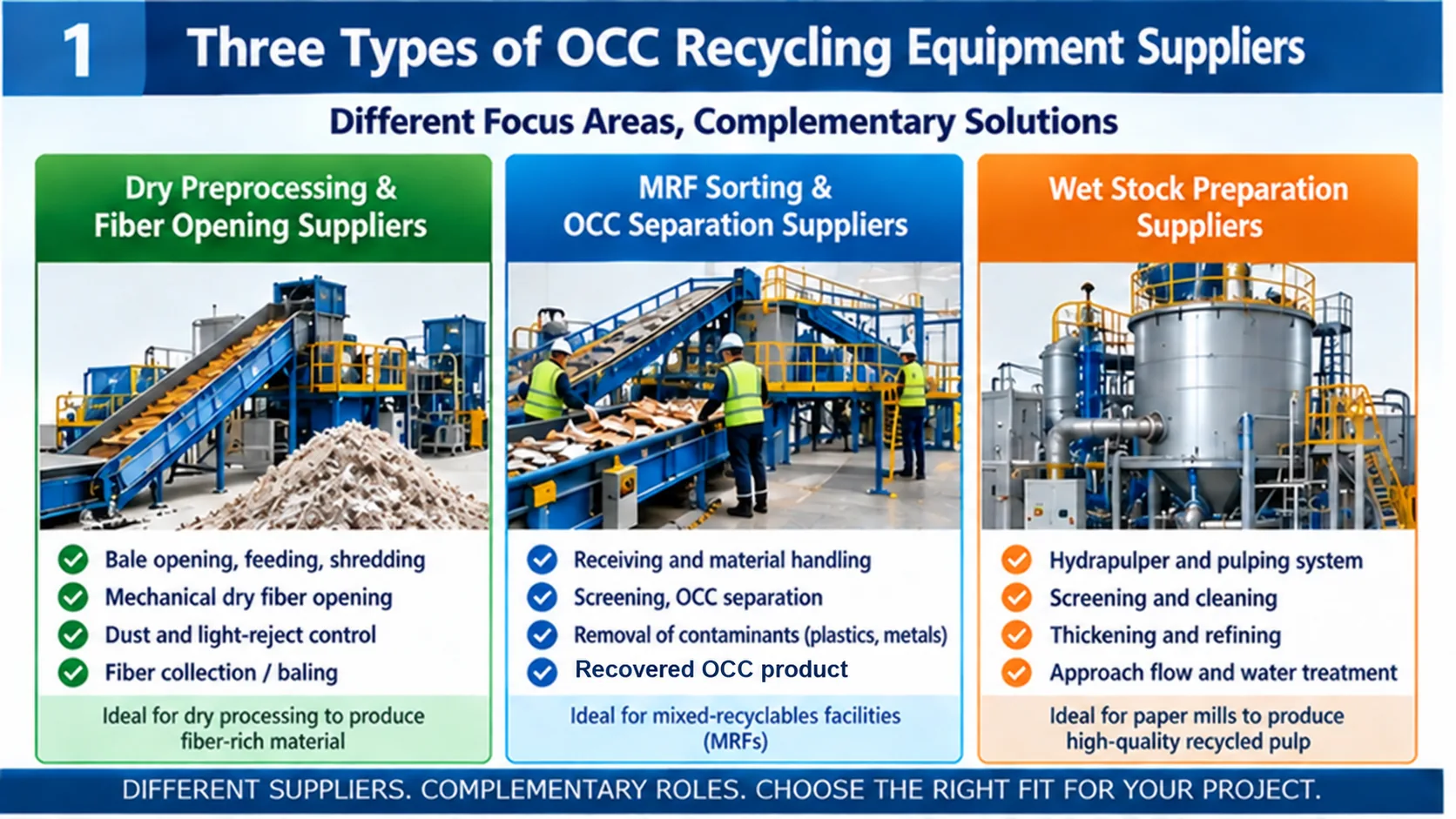
The phrase OCC recycling equipment manufacturer covers several very different businesses. One supplier may build dry cardboard preprocessing and fiber-opening lines. Another may specialize in MRF screens and optical sorting. A third may supply hydrapulpers, cleaners, screens and complete recycled-fiber stock-preparation systems for a paper mill.
This guide compares ten manufacturers relevant to industrial OCC projects, but they do not all compete for the same process boundary. Some concentrate on dry cardboard sorting and material preparation, some recover OCC inside mixed-recyclables facilities, and others supply wet stock-preparation systems for paper mills. The comparison therefore focuses on where each supplier fits in the material route, how much system integration it can take on, and what a buyer should require before treating two quotations as comparable.
Top 10 OCC Recycling Equipment Manufacturers at a Glance
| Rank | Manufacturer | Relevant equipment focus | Best shortlist fit |
|---|---|---|---|
| 1 | Bollegraaf Recycling Solutions | Paper/cardboard sorting plants, OCC screening, conveyors, optical sorting, balers and turnkey MRF integration | High-volume dry sorting projects that need OCC recovery from mixed paper or mixed recyclables |
| 2 | YUXI Machinery | OCC receiving, controlled feeding, primary shredding, magnetic separation, dry fiber opening, dust handling, collection and baling | Dry cardboard recycling projects producing transportable fiber-rich material without a conventional hydrapulper loop |
| 3 | Voith | BlueLine OCC stock preparation, raw-material handling, pulping, screening, cleaning and integrated recycled-fiber systems | Paper mills needing wet OCC stock preparation tied to board or packaging production |
| 4 | ANDRITZ | OCC pulping, detrashing, screening, cleaning, thickening, refining, reject treatment and process engineering | Large recycled-fiber projects where furnish quality, yield and mill integration drive the design |
| 5 | Valmet | Complete OCC lines, drum and vertical pulping, screening, cleaning, thickening, dispersing, refining and automation | Integrated paper and board mills comparing full stock-preparation responsibility |
| 6 | Kadant | OCC pulping systems, detrashing, screening, cleaning, reject handling, stock preparation and process optimization | Wet recycled-fiber systems where contaminant removal and fiber yield are central |
| 7 | CP Group | OCC screens, auger screens, disc screens, optical sorters, conveyors, controls and turnkey MRF systems | Commercial and single-stream plants separating OCC from mixed recyclable material |
| 8 | Machinex | OCC screens, ballistic separators, optical sorting, balers, conveyors, controls and complete MRFs | Automated North American and international sorting plants with OCC as one saleable commodity |
| 9 | STADLER | Paper/cardboard sorting plants, metering, magnets, paper separation, ballistic sorting, NIR, conveyors and baling | Dry paper and cardboard sorting facilities separating several marketable fiber grades |
| 10 | Bulk Handling Systems (BHS) | OCC separation screens, polishing screens, optical sorting, air separation and integrated MRF systems | MRF retrofits and mixed-recyclable projects where front-end OCC capture improves downstream sorting |
Why OCC Manufacturer Comparisons Often Go Wrong
OCC is traded as a recovered paper commodity, but the equipment required before sale or reuse depends on where the plant sits in the value chain. ReMA’s paper-stock guidelines exist because buyers and sellers need agreed descriptions, moisture rules and quality expectations.[1] The equipment RFQ needs the same discipline. A plant receiving relatively clean warehouse boxes has a different job from a single-stream MRF recovering cardboard from bottles, film and glass. A paper mill has a different job again because its output is pumpable stock for a paper machine.
That is why this list uses three practical supplier groups. Dry preprocessing and fiber-opening suppliers handle cardboard mechanically and can produce a loose or baled fiber-rich product. MRF sorting suppliers recover OCC as one commodity from a mixed stream through screening, conveying and automated separation. Wet stock-preparation suppliers start from recovered paper and use pulping, screening, cleaning, thickening and related water-based processes to prepare fiber for papermaking.
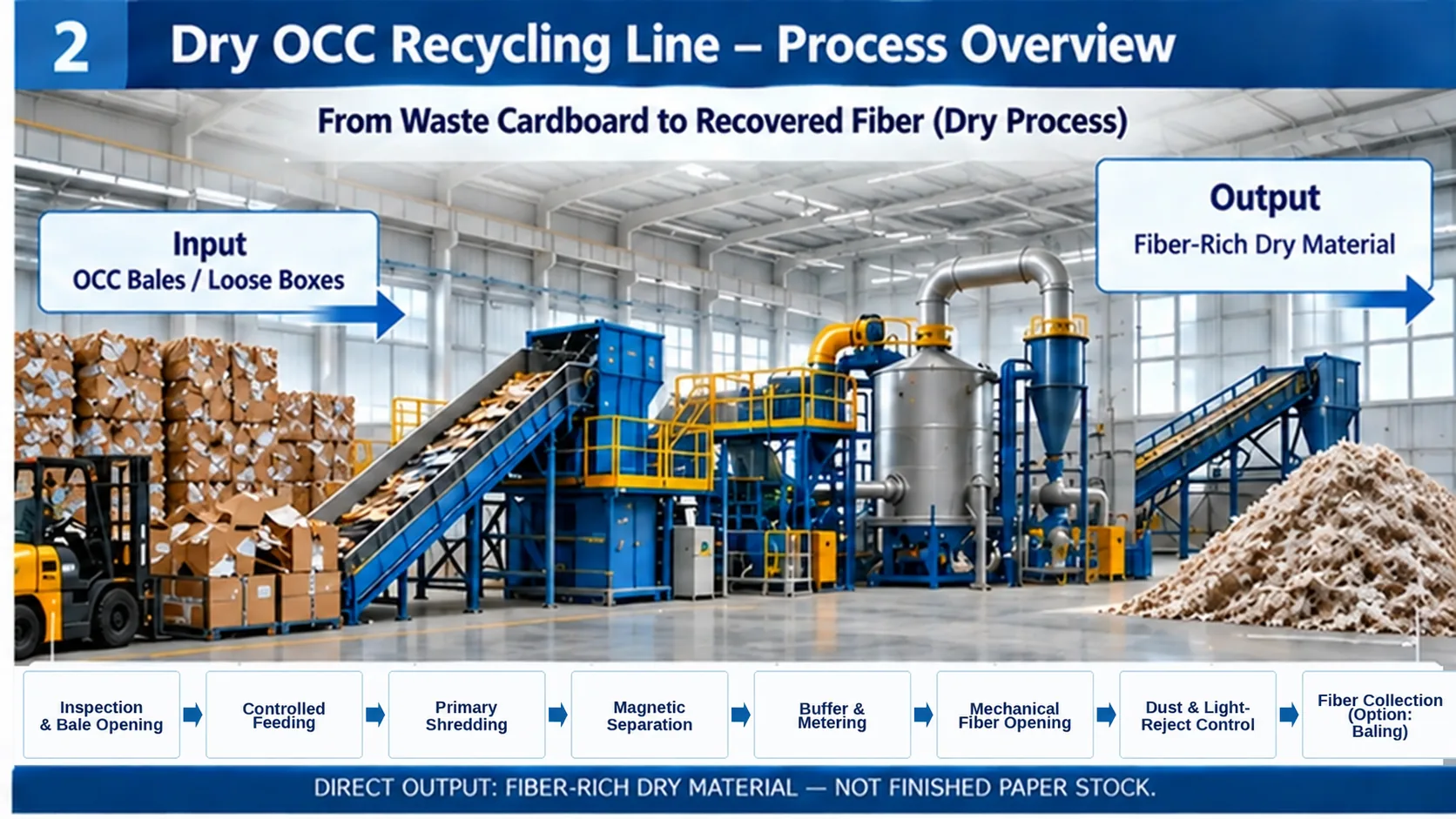
For buyers evaluating a dry process, the OCC paper dry pulping and cardboard recycling line shows one clear process boundary: inspection and bale opening, controlled feeding, primary shredding, magnetic separation, buffer and metering, mechanical dry fiber opening, dust/light-reject control, collection and optional baling. Its direct output is dry fiber-rich material, not finished paper stock.
Top 10 OCC Recycling Equipment Manufacturers
1. Bollegraaf Recycling Solutions — strong paper/cardboard sorting and system integration
Bollegraaf fits projects where the main job is to recover, sort and bale paper and cardboard in a dry MRF-style process rather than convert OCC into prepared paper stock. Its paper and cardboard portfolio includes turnkey installations, OCC screening, conveyors, optical sorting and baling. That is relevant to commercial paper plants and MRFs where cardboard must be separated early and prepared as a saleable bale. Buyers should ask for the assumed inbound composition, screen cut, material presentation, expected residual contamination and the quality-control arrangement before baling. Bollegraaf is most compelling when high-volume sorting, system integration and long-term plant optimization matter more than dry fiber opening itself.
2. YUXI Machinery — dry OCC fiber recovery with a defined mechanical process boundary
YUXI is relevant to buyers who want to convert OCC bales, loose boxes, kraft packaging waste or suitable paperboard into a more uniform dry fiber-rich material. The process route combines controlled feeding, primary shredding, ferrous removal, metering, mechanical fiber opening, dust handling, collection and optional baling. The key diligence point is the connection between stages: stable feed, exposed metal, controlled burden into fiber opening and reliable collection. If bales are the normal feed, review the OCC bale handling, wire removal and feeding guide.
3. Voith — complete wet OCC stock preparation for packaging paper
Voith belongs on a paper-mill shortlist when recovered OCC must be converted into prepared stock for downstream papermaking rather than simply sorted, shredded or baled. The system discussion can extend from raw-material handling into pulping, screening, cleaning and related stages before prepared stock reaches papermaking. This is not a direct substitute for a dry fiber-opening line. Procurement should identify the handoff point, included water/sludge/reject systems, utility boundary and stock-quality acceptance criteria. For a greenfield containerboard or recycled-board mill, coordinated wet-process responsibility is more important than whether a supplier also sells a standalone conveyor or screen.
4. ANDRITZ — broad recycled-fiber engineering from pulping through reject treatment
ANDRITZ is relevant when the project boundary extends through wet recycled-fiber preparation, including contaminant removal, fiber recovery and reject treatment. Its recycled-fiber portfolio covers pulping, detrashing, screening, cleaning, thickening, refining and reject treatment, with engineering around complete stock-preparation routes. It is especially relevant where furnish variability and contamination make fiber yield as important as final cleanliness. Buyers should define incoming furnish, dry-solids basis, contaminants, accept stream, reject streams and recirculation before reviewing guarantees. Large-supplier integration reduces interface risk only when instrumentation, water loops, controls, reject dewatering and auxiliary systems are written into the same process boundary.
5. Valmet — integrated OCC lines tied closely to paper and board production
Valmet offers full-scope OCC lines plus drum and vertical pulping, screening, cleaning, thickening, dispersing, refining and automation. Its natural fit is the paper or board mill that wants stock preparation designed around final product quality and paper-machine requirements. Translate the furnish requirement into measurable targets before comparing equipment: raw-material range, fiber loss, cleanliness, consistency and utility consumption. A supplier with both recycled-fiber and paper-machine knowledge can be attractive when the project boundary is broad, but it may be unnecessary for a recycler whose commercial product is simply baled dry fiber-rich material.
6. Kadant — OCC pulping, detrashing and fiber processing with strong reject focus
Kadant is relevant to OCC and recycled-stock preparation through pulping, detrashing, screening, reject handling and process optimization. Its systems are a useful benchmark when recovered paper contains baling wire, plastic, rags or heavy debris that must be removed without excessive fiber loss. When comparing Kadant, state whether the project is a new OCC system, an upgrade or a bottleneck-removal project. Require a clear feed basis, design capacity, reject load, stock-quality target and utility boundary, plus a site-performance test that uses normal commercial furnish rather than an unusually clean commissioning batch.
7. CP Group — OCC recovery inside high-throughput MRF systems
CP Group is relevant when OCC must be recovered as one saleable fraction from a mixed-recyclable stream rather than processed as a dedicated cardboard feed. Its equipment portfolio includes OCC screens, auger screens, disc screens, optical sorters, conveyors and controls, with complete MRF engineering and retrofits. The test should use the real incoming mix because recovery changes with size distribution, moisture, films, glass and burden depth. Ask for recovery and purity at the OCC product conveyor and for the routing of small cardboard that passes to later stages. This is a sorting-system decision; a separate downstream supplier may still be needed when recovered OCC must be mechanically opened into dry fiber-rich material.
8. Machinex — automated OCC screening, optical sorting and complete MRFs
Machinex combines OCC screens, ballistic separators, optical sorters, balers, conveyors, automation and turnkey MRF integration. It fits projects where OCC quality depends on a complete sorting architecture rather than one standalone machine. Very large cardboard can be recovered early while smaller pieces may travel with mixed paper and require later recovery. The RFQ should therefore define inbound composition, target OCC grade, recovery measurement point, QC arrangement, bunker/baler capacity and the operating scenario when one separator is unavailable. Automation benefits should be evaluated against representative material and an explicit labor assumption.
9. STADLER — paper and cardboard sorting plants with multiple fiber outputs
STADLER designs paper and cardboard sorting plants using metered feeding, ferrous removal, cardboard separation, ballistic sorting, NIR technology, conveyors, sorting cabins and baling. It is a useful candidate where the objective is to create several marketable paper fractions from a paper-rich feed. Buyers should request a mass-flow view by fraction and test how the line responds when the proportions of OCC, mixed paper, films and non-paper material move away from the design case. If the sorted material will later feed a dry fiber-opening or wet pulping system, make that receiving specification part of the STADLER output definition.
10. Bulk Handling Systems (BHS) — OCC separation and MRF retrofit capability
BHS fits MRF projects where front-end OCC separation, screening and downstream polishing must work as part of one integrated sorting system. It is especially relevant to retrofits where better front-end cardboard capture should improve downstream sorting. A new OCC screen can expose weak conveyors, undersized bunkers or slow balers, so the proposal should define incoming burden depth, screen opening, bypass routing and controls integration with existing equipment. The business case should include the expected change in product quality, recovery, labor and runtime.
Match the Manufacturer to the Output You Actually Need
Start with the handoff product. If the site only needs to recover intact OCC from mixed commercial or residential recyclables, MRF sorting suppliers are the natural reference group. If the site already receives sorted cardboard and wants to reduce volume, remove exposed ferrous material, mechanically open the paper structure and produce a transportable fiber-rich material, compare dry processing suppliers. If the output must be pumpable stock feeding a paper or board machine, compare wet stock-preparation specialists.
This distinction prevents unnecessary equipment. A clean warehouse stream may not need complex optical sorting. A single-stream MRF does not automatically need to shred recovered OCC. A dry fiber-opening line should not be burdened with wet-process guarantees it cannot physically produce. A paper mill should not accept a dry-line product description as a substitute for stock quality at the machine chest. For projects still deciding whether the correct boundary is a baler, shredder or complete dry line, the industrial cardboard recycling machine guide provides a useful equipment-boundary check.
Before issuing an RFQ, record representative moisture, bale condition, coatings, tape, plastic film, metal, wood, wrong paper grades and other contaminants. The OCC bale contamination and incoming inspection guide is useful for building that feed passport. ReMA’s current paper-stock guidance also treats moisture as a commercial issue that should be agreed between buyer and seller and measured using an agreed method.[1]
Normalize the RFQ Before Comparing Equipment Prices
One proposal may include bale opening, dust collection, platforms, controls, commissioning and spare parts; another may stop at the main machine. One supplier may base throughput on loose, dry boxes; another may assume dense opened bales. Unless the assumptions are normalized, the price comparison rewards ambiguity.
Use the same RFQ structure for every shortlisted supplier. Define feed form and composition, maximum and typical dimensions, moisture range, contaminants allowed into the system, sustained throughput, output condition, utilities, available footprint and the downstream receiving point. Then define ownership of conveyors, platforms, dust collection, fire-related interfaces, controls, electrical panels, installation, commissioning, training and spares. If budget planning is still early, the OCC recycling plant price and total project cost guide separates machine price from the broader installed project boundary.
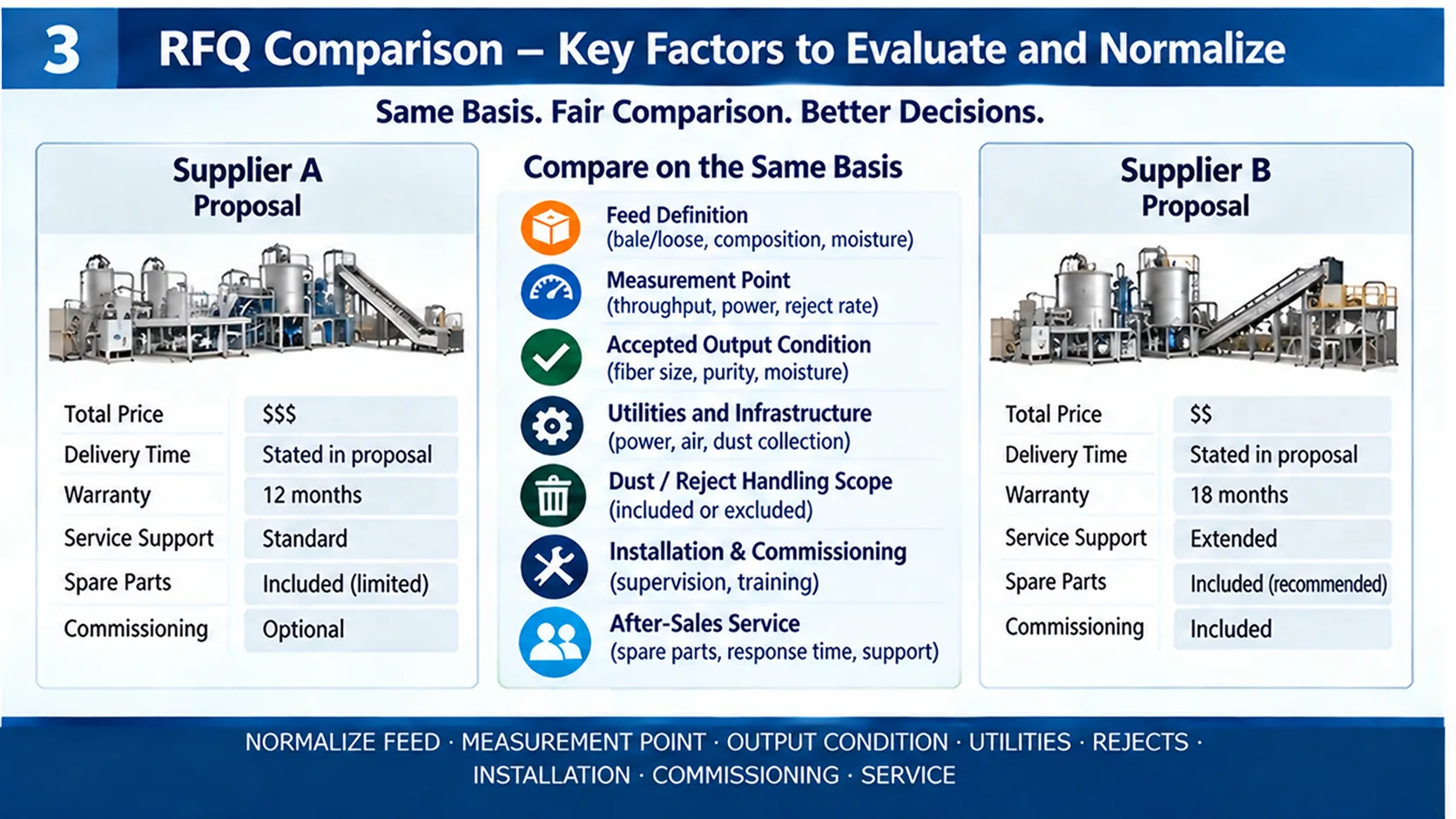
Minimum RFQ package for a useful manufacturer comparison
- Representative material photos, video and—where practical—sample material.
- Loose or baled feed, bale dimensions and weight, and typical feeding method.
- Material composition, moisture range and known contaminants.
- Sustained throughput requirement and the time basis used to calculate it.
- Target output: intact OCC grade, fiber-rich dry material, baled product or wet prepared stock.
- Required product quality, sampling method and downstream acceptance criteria.
- Available power, water if applicable, compressed air, floor area, clear height and loading routes.
- Dust, rejects, oversize, recovered metal and housekeeping boundaries.
- Installation, commissioning, training, documentation and critical-spares scope.
- Written FAT or site-acceptance method with tolerances and reporting format.
Use FAT Evidence to Compare What Suppliers Can Actually Prove
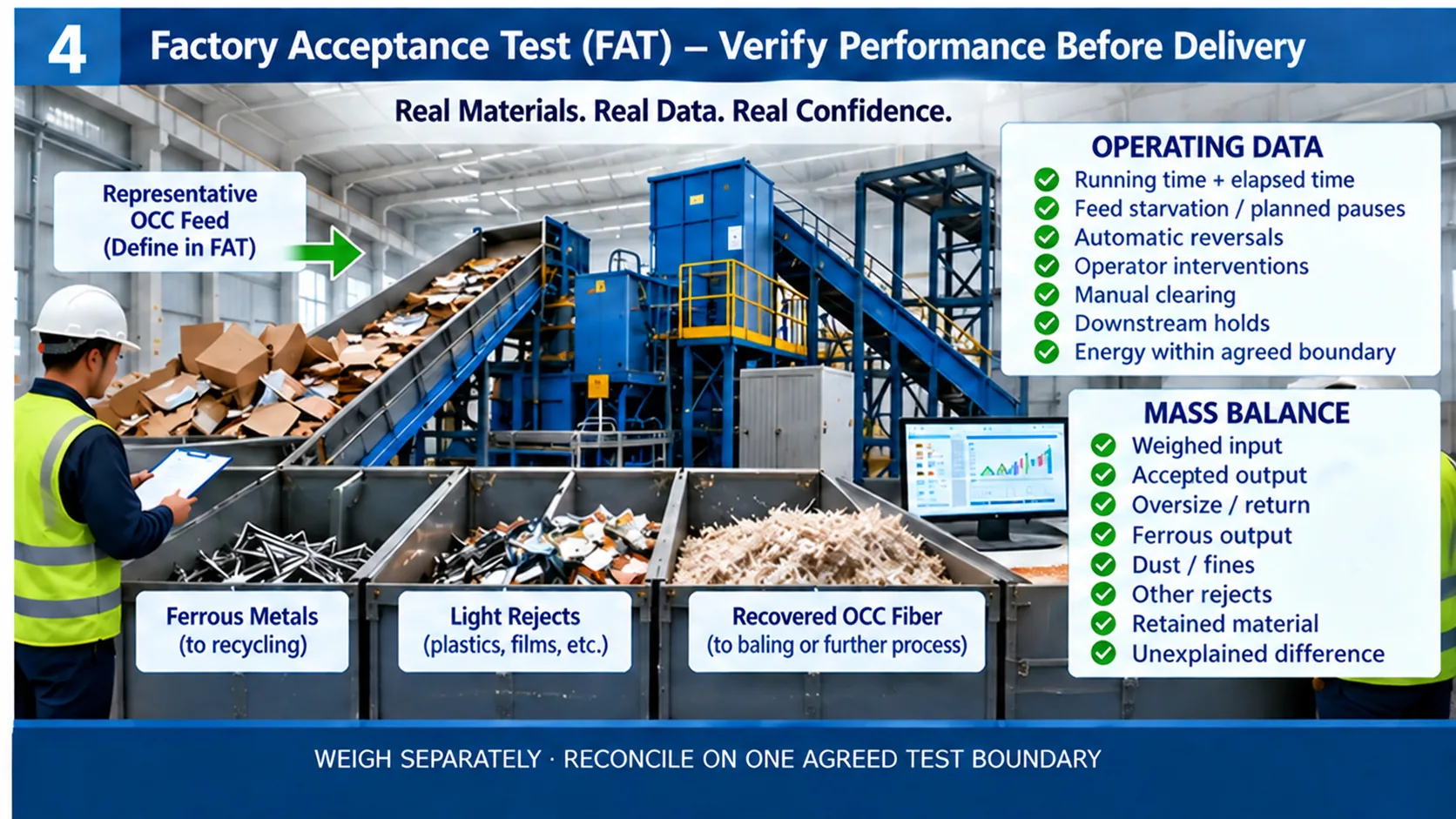
For dry OCC equipment, an acceptance test should prove the connected line, not just the motor turning. Define the representative feed first. Weigh the input. Record running time and elapsed time separately. Log feed starvation, planned pauses, automatic reversals, operator interventions, manual clearing and downstream holds. The accepted output must be weighed and sampled at an agreed point.
Mass balance should not hide losses. Record accepted output, oversize or return, ferrous output, dust or fines, other rejects, retained material and unexplained difference separately. If material is recirculated, it should not be counted as new input on every pass. If material remains in the machine at the end of the test, identify and weigh it. This makes two supplier demonstrations far easier to compare.
Wet stock-preparation projects need different quality metrics, but the same principle applies: the contract must define the feed, measured outputs, test duration, utility boundary and acceptance method before the order. A short peak rate is not the same as sustained production. A clean demonstration bale is not the same as the buyer’s normal OCC supply.
Safety and Dust Handling Belong in the Manufacturer Comparison
Paper recycling equipment can involve conveyors, shredders, screens, balers, rotating shafts, stored hydraulic energy and forklift traffic. OSHA’s paper-recycling guidance specifically highlights moving machinery, unexpected startup, baler hazards, crushing hazards and combustible materials.[2] A supplier comparison should therefore include guarding, isolation points, access for clearing and maintenance, emergency-stop zoning and restart logic.
OSHA identifies paper and pulp among materials that can present combustible-dust hazards when sufficiently fine material is dispersed under the right conditions.[3] That does not mean every OCC line has the same dust hazard or requires the same protection strategy. The practical point for buyers is that fines generation, pickup locations, duct routing, collection equipment, housekeeping and ignition-source control need to be considered as part of the system design rather than added after the main equipment has been selected. The quotation should also state which dust-related items are supplied by the equipment manufacturer and which remain the responsibility of the owner or a specialist contractor.
Common Mistakes When Shortlisting OCC Equipment Manufacturers
| Mistake | What it hides | Better procurement question |
|---|---|---|
| Comparing dry and wet OCC systems as direct substitutes | Different output states, utilities and downstream purpose | What exactly leaves the supplier’s process boundary? |
| Buying from a “tons per hour” number | Feed density, bale condition, contamination and downtime | What representative feed and time basis support the quoted rate? |
| Using one generic purity target | Undefined sample point and different product definitions | Which stream is sampled, how, and against what downstream specification? |
| Ignoring dust and reject handling | Unquoted equipment, disposal labor and operating risk | Where do fines, films, metal, oversize and other rejects physically go? |
| Comparing purchase price only | Missing platforms, controls, installation, utilities and spares | Which items are excluded from the installed operating system? |
| Accepting a demonstration without mass balance | Recirculation, retained material and hidden losses | Can every weighed input kilogram be reconciled to outputs, rejects, retained material and unexplained difference? |
Build the Shortlist Around the Material, Not the Brand Name
A practical shortlist normally becomes much shorter once suppliers are compared against the actual handoff points. First remove companies whose core process does not match the required output. A mill that needs pumpable recycled stock should not evaluate a dry sorting line as an equivalent solution, while a recycler selling recovered OCC or dry fiber-rich material may have no reason to buy a complete wet stock-preparation system.
Next, compare the interfaces that remain between the supplier and the owner. Identify who is responsible for bale opening, transfer conveyors, magnets, dust collection, reject discharge, baling, electrical panels, controls, platforms, installation and commissioning. Two proposals with similar main machines can create very different installed costs when one includes these interfaces and the other leaves them outside the quotation.
The U.S. EPA’s 2018 material data illustrate the scale of corrugated packaging in the U.S. waste stream: corrugated boxes were the largest single product category in municipal solid waste generation in that dataset and also represented the largest single paper and paperboard packaging product recycled.[4] For an equipment buyer, however, market size does not determine the process route. The more important question is what condition the OCC arrives in and what material the next customer or process step is prepared to accept.
Finally, rank the remaining suppliers by what can be demonstrated under an agreed test boundary. A useful offer should connect representative feed to sustained throughput, output condition, reject streams, operating events and measurable acceptance criteria. That evidence is more useful than a catalog capacity or a short demonstration using unusually clean material. Once the process boundary, commercial boundary and acceptance boundary are all clear, the final shortlist is usually much easier to defend internally.
FAQ
Who makes the best OCC recycling equipment?
There is no universal best manufacturer because OCC projects have different boundaries. Dry preprocessing and fiber-opening lines, MRF sorting systems and wet stock-preparation lines solve different problems. The best supplier is the one whose process responsibility matches your feedstock, required output, utilities, plant layout and acceptance test.
What equipment is usually included in an OCC recycling line?
Depending on the project, an OCC line may include bale opening, inspection, metered feeding, shredding, magnetic separation, screening, optical or air separation, dry fiber opening, dust collection, baling, or wet pulping and stock-preparation equipment.
How should two OCC equipment quotations be compared?
Normalize the feed definition, throughput basis, output condition, utilities, dust and reject handling, controls, installation boundary, spare parts, commissioning scope and FAT method. If those boundaries are different, the quoted prices are not directly comparable.
What should be tested during an OCC factory acceptance test?
Use representative material and record weighed input, accepted output, oversize or return, ferrous output, dust or fines, other rejects, retained material and unexplained difference separately. Also record running time, elapsed time, stops, reversals, interventions, manual clearing and the agreed energy boundary.
Is a dry OCC fiber-opening line the same as a paper-mill OCC stock-preparation line?
No. A dry line can inspect, reduce, separate and mechanically open cardboard into a fiber-rich dry material for collection or further processing. A paper-mill stock-preparation line normally uses water-based pulping, screening, cleaning, thickening and related systems to produce pumpable stock for papermaking.
Compare Your OCC Recycling Equipment Project
Send representative OCC photos, feed form, target output, throughput, utilities, space limits and FAT requirements so the equipment scope can be matched to your real project boundary.
References
- ReMA: paper specs.
- OSHA: paper hazards.
- OSHA: combustible dust.
- EPA: packaging data.