UBC Bale Specifications: Density, Size, Moisture and Contamination
Specify UBC bales by density, size, tying, moisture and contamination. Includes Taldon limits, receiving checks, sampling logic and equipment implications.
Henan University Science and Technology Park (Western) ,Zhengzhou, Henan ,China(Mainland)
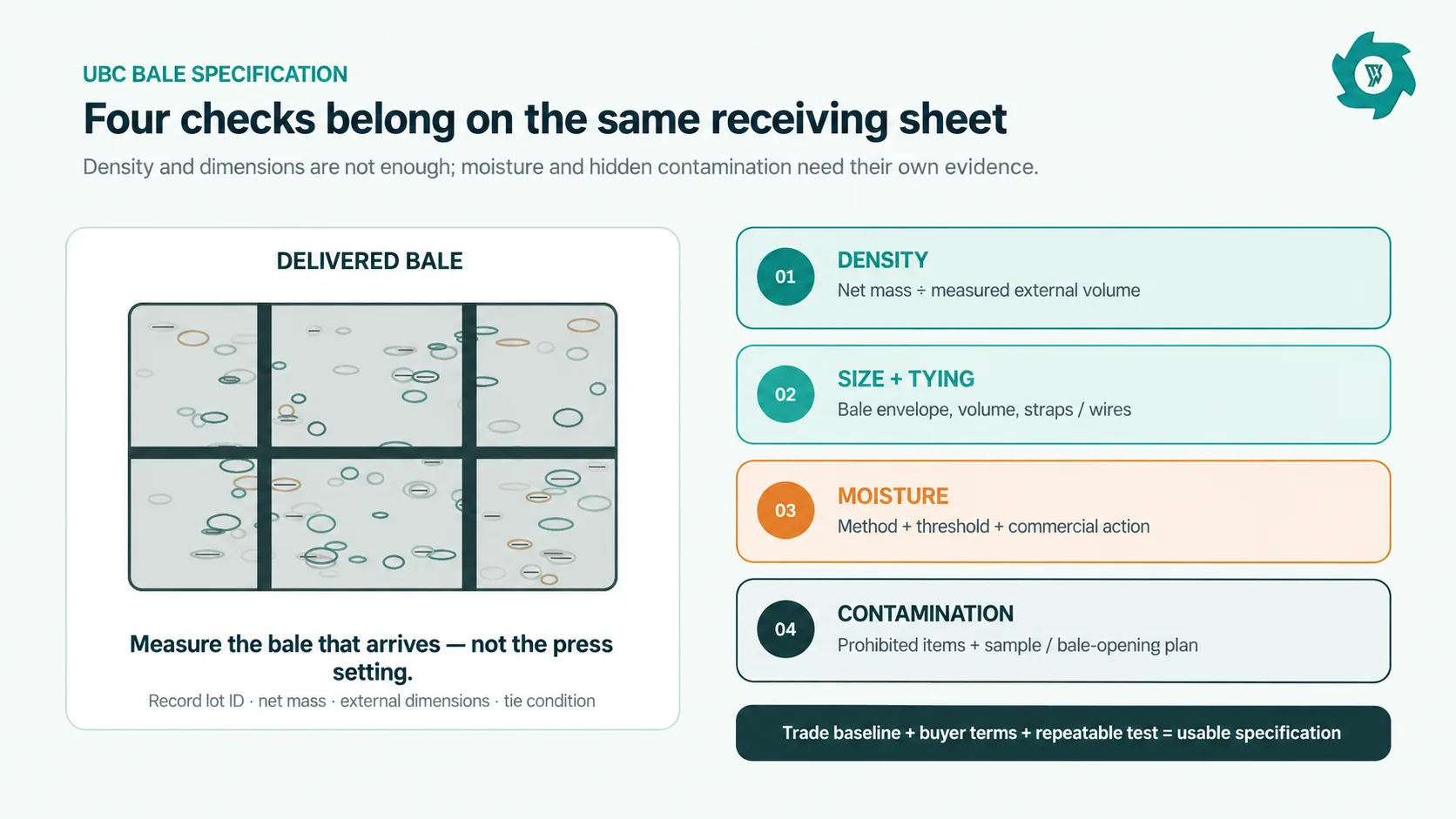
UBC bale specifications should tell the receiving team what can be measured on the delivered bale and what must be tested inside it. For baled aluminum used beverage cans, density, package geometry and tying control handling; moisture changes paid metal weight and housekeeping; contamination can be hidden by compaction.
If your contract uses ReMA’s Taldon description, the current published baseline is at least 14 lb/ft³, with maximum density of 17 lb/ft³ for unflattened UBC and 22 lb/ft³ for flattened UBC. It also defines a minimum bale volume, dimension ranges, acceptable tying methods and prohibited foreign material.[1] It does not give every buyer a universal moisture percentage. Moisture method, threshold and commercial consequence should therefore be written separately. Mill specifications may add their own receiving limits; for example, Novelis UK’s December 2024 supplier specification tests every UBC delivery for moisture and applies its stated deduction rule above 4% moisture.[2]
Figure 1. A useful bale specification separates package geometry from material-quality evidence. All four fields need a measurement or inspection rule.
Separate the Trade Baseline from the Buyer’s Receiving Specification
ReMA’s Taldon description is a useful common language for baled UBC, but it is not a substitute for a complete receiving contract. The public specification gives a density window, minimum package volume, bale dimension ranges, tying rules, a requirement for magnetic separation, a list of unacceptable foreign substances, and a rule that aluminum items other than UBC are not acceptable. It also says variations should be agreed between buyer and seller before shipment.[1]
A mill may need a narrower operating window than the trade description. A recycler may buy from multiple collection systems with different weather exposure. A processor may need an internal rejection rule for free liquid, batteries, aerosol containers or unusually loose bales even when those items are not described by a single percentage. The receiving specification is where these project-specific conditions belong.
Field
Trade baseline can define
Buyer should still define
Material identity
Baled aluminum used beverage cans
Approved sources, prohibited non-UBC aluminum, special source restrictions
Density
Minimum / maximum window for the named form
Measurement method, tare treatment, damaged-bale method, sampling frequency
Size and tying
Package envelope, volume and acceptable ties
Forklift, container, storage and bale-opening constraints
Moisture
Not a universal Taldon percentage
Sampling method, limit, deduction or rejection rule, free-liquid rule
Contamination
Foreign substances and non-UBC material are restricted
Sampling plan, sorting method, any commercial tolerance, disposition
The practical objective is repeatability. Two inspectors on different shifts should be able to apply the same written method and reach the same disposition. A specification that says “bales must be dry and clean” may sound strict, but it gives the receiving team no reproducible test.
Density: Measure the Delivered Bale, Not the Press Setting
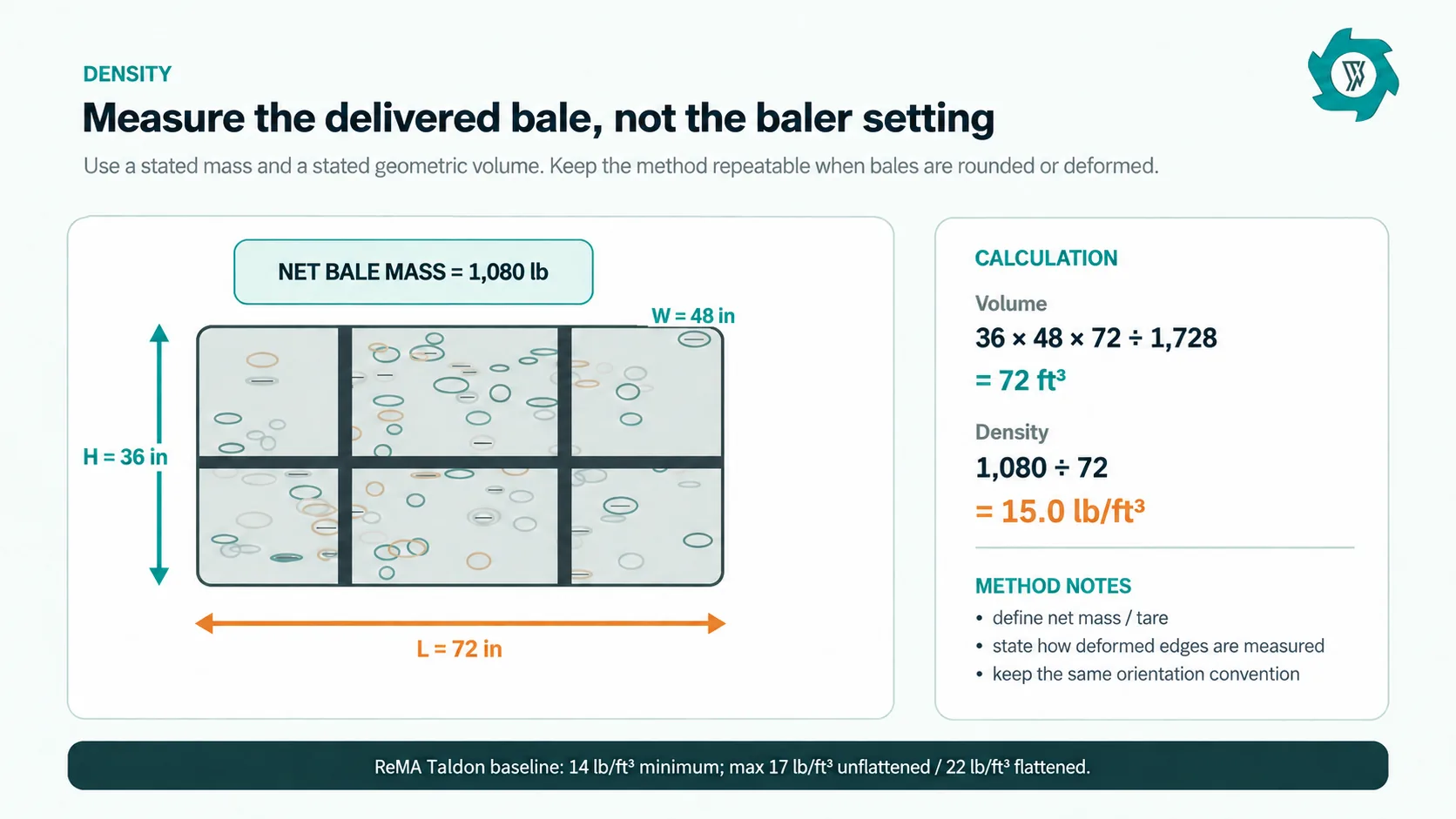
For Taldon, ReMA currently publishes a minimum density of 14 lb/ft³ (225 kg/m³). The maximum is 17 lb/ft³ (273 kg/m³) when the UBC is unflattened and 22 lb/ft³ (353 kg/m³) when it is flattened.[1] These values describe the bale that is bought and sold.
Figure 2. This worked example uses a 1,080 lb bale measuring 36 × 48 × 72 in. Its geometric volume is 72 ft³, giving 15.0 lb/ft³.
Write the geometry rule before the first disputed load
Real bales are not perfect rectangular solids. Faces can bulge, corners can round, straps can pull the center inward and damaged packages can arrive skewed. If one inspector measures the largest points and another averages across the face, calculated density can change even though the bale has not changed. The purchase specification should say where dimensions are taken and how visibly deformed bales are handled.
The same discipline applies to mass. Record gross scale weight, any agreed tare, and the net mass used in the density calculation. Do not mix a truck-scale net figure for an entire load with an individual-bale volume unless the number of bales and allocation method are clearly stated. For audit lots, individual bale weights are much more useful because they reveal outliers that a load average can hide.
Density is a handling property, not proof of cleanliness
A heavier bale can contain more metal per cubic foot, but it can also contain retained liquid, dirt or foreign material. Density therefore belongs next to moisture and contamination checks. It also affects processing behavior. Very loose bales can break apart during handling; very dense bales can demand more controlled opening and can conceal interior material that surface inspection misses.
Size and Tying: Geometry Is an Unloading and Process Condition
ReMA’s Taldon page requires at least 30 ft³ (0.85 m³) of bale volume and gives three dimension ranges: 24–40 in, 30–52 in and 40–84 in. Those ranges are roughly 0.61–1.02 m, 0.76–1.32 m and 1.02–2.13 m. The same specification permits four to six 5/8 in × 0.020 in steel bands or six to ten #13 steel wires; aluminum bands or wires are acceptable when equivalent in strength and number. Skids and support sheets are not acceptable under that description.[1]
Those numbers are commercial rules, but their engineering value is just as important. Bale envelope determines whether the receiving forklift can safely pick the package, whether a clamp or grab has enough opening, whether the bale fits container and warehouse constraints, and whether the inlet of a bale breaker is large enough. A buyer who writes only a target bale weight may receive a package that is technically the right mass but awkward to unload or too wide for the intended feed system.
The same issue works in reverse when a plant is producing bales. A metal baling machine should be selected around the required bale envelope, weight, tying arrangement, feed rate and discharge method. For UBC, a stable finished package is a product requirement and a logistics requirement at the same time.
Inspect ties as part of the load condition
Receiving inspection should record missing, broken, loose or protruding ties before the bale is moved. Ties are also a process input. If bales will be opened mechanically, the supplier and equipment engineer need to know whether the packages arrive with steel bands, wire, aluminum ties or a mixed practice. A magnetic separator can remove liberated ferrous ties after opening, but that does not remove the need for safe handling and a defined strap-removal strategy before or during feeding.
Moisture: There Is No Single Universal Taldon Percentage
Moisture is where online UBC specifications become confusing. Supplier pages often publish one percentage as though it applies to every bale in every market. The current ReMA Taldon text does not publish a universal moisture limit. It gives the bale form and cleanliness baseline and allows variations to be agreed before shipment.[1] If moisture affects payment or acceptance, the buyer should write a method and a consequence.
A mill example is the current Novelis UK supplier specification. It states that all UBC deliveries are tested for moisture on arrival. Its published rule applies a weight deduction when moisture is more than 4%; the deduction is measured moisture minus 2%. The document gives a 4.1% test as an example, producing a 2.1% weight deduction.[2] This shows how a receiver can turn the word “dry” into a commercial procedure. It does not create a global UBC moisture standard.
Define four things: sample, method, limit and action
A moisture clause should identify how many bales or increments are sampled, where the sample is taken, what test method or device controls, and what happens when the result is above the limit. The action could be a documented deduction, hold for review, downgrade, rework or rejection. The chosen rule should match the receiver’s process and contract.
Free liquid deserves separate treatment. A bale may show only moderate measured moisture while still carrying pockets of retained beverage or rainwater. Free liquid affects odor, corrosion, floor housekeeping and paid weight, and it can make paper, labels and dirt stick to the aluminum. A receiving sheet should therefore have a visual free-liquid field in addition to the numerical moisture result.
Storage history helps explain abnormal results. Outdoor bales exposed to rain should not be treated as equivalent to dry indoor-stored bales just because the outer face has drained. When moisture disputes recur, record weather exposure, storage surface and time since baling.
Contamination: Define What Is Prohibited, Then Define How You Find It
The Taldon specification requires magnetically separated material and lists steel, lead, bottle caps, plastic cans and other plastic, glass, wood, dirt, grease, trash and other foreign substances as unacceptable. Free lead is grounds for rejection, and aluminum items other than used beverage cans are not acceptable under the description.[1] That is a clear identity boundary. The receiving challenge is proving what is inside a dense bale.
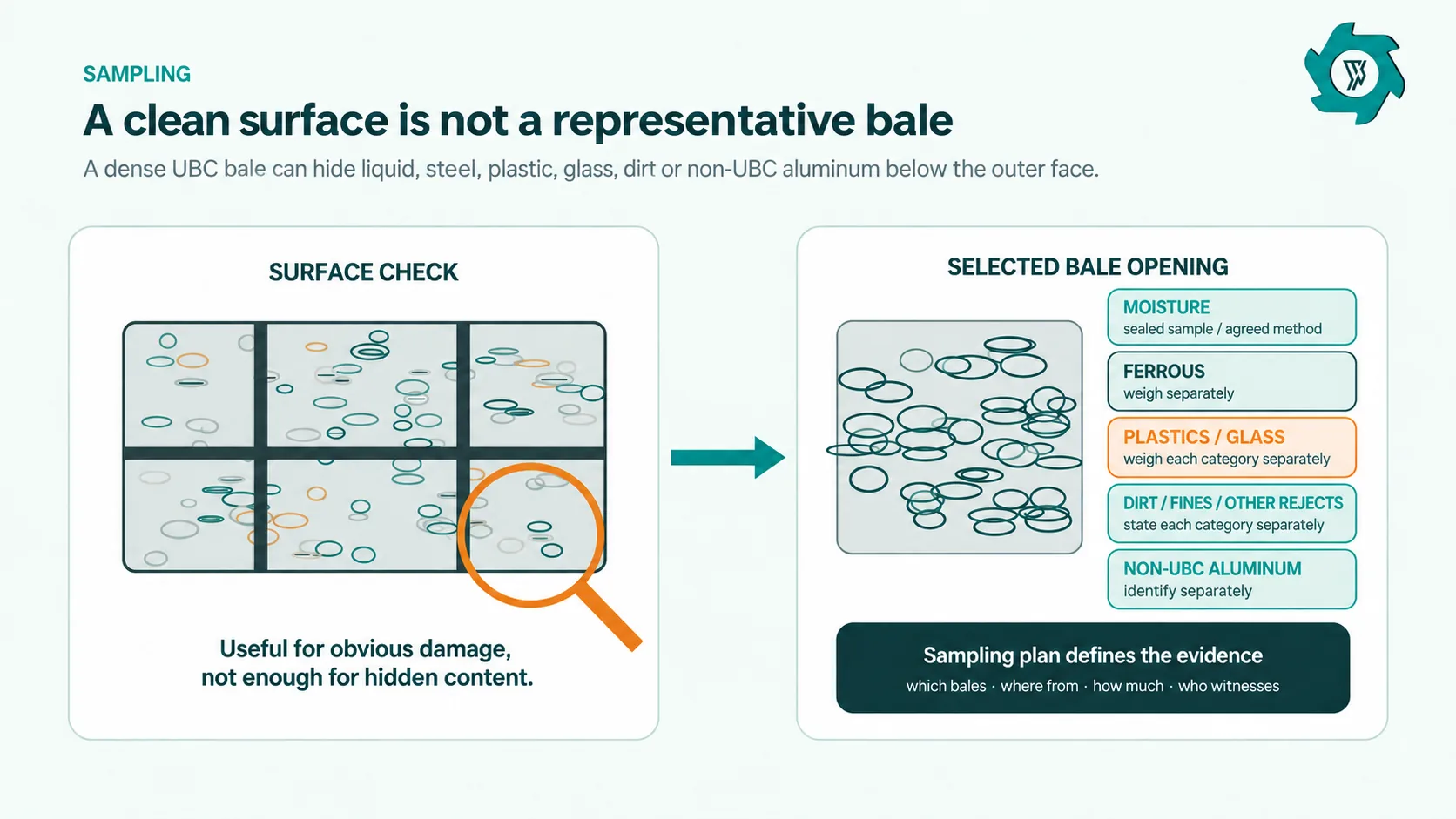
Figure 3. Surface inspection finds obvious problems. Selected bale opening creates evidence for hidden moisture and contaminant fractions.
Use the outside to screen; use an opened sample to verify
Start with the whole load. Photograph packaging, leaking areas, broken bales, visible steel cans, plastic, glass and suspicious items before unloading or mixing. Then apply the contract’s selection rule for deeper inspection. For higher-risk suppliers or new sources, that may mean opening more bales. For a stable source with a documented history, the sampling frequency may be lower.
Once a selected bale is opened, keep the streams separate. Record the opened bale’s net mass, then sort and weigh the categories the contract cares about: ferrous material, plastics, glass, dirt or fines, other rejects and, where practical, non-UBC aluminum. Moisture sampling should follow the agreed method and should not be replaced by a visual guess. If the buyer uses a commercial tolerance for a category, state it explicitly and state whether the calculation is wet-basis or dry-basis where that distinction matters.
Mill requirements can be more specific than the trade baseline. Novelis UK’s supplier document, for example, contains its own contaminant categories and commercial treatment. That type of mill rule should be cited by name in the purchase order if it controls the load. Do not copy one receiver’s percentage into a general article or supplier contract and present it as a ReMA limit.
Keep prohibited safety items outside the normal deduction system
Aerosols, pressurized containers, batteries, electronic waste and unknown sealed containers should not be treated as ordinary “a few percent contamination” in a mechanical UBC feed. The YUXI UBC process page calls for emptied, non-pressurized beverage cans and identifies such items for removal before mechanical processing. Safety exclusions need a separate hold/rejection path because a price deduction does not remove the physical risk.
A Practical Receiving Protocol for One Truckload
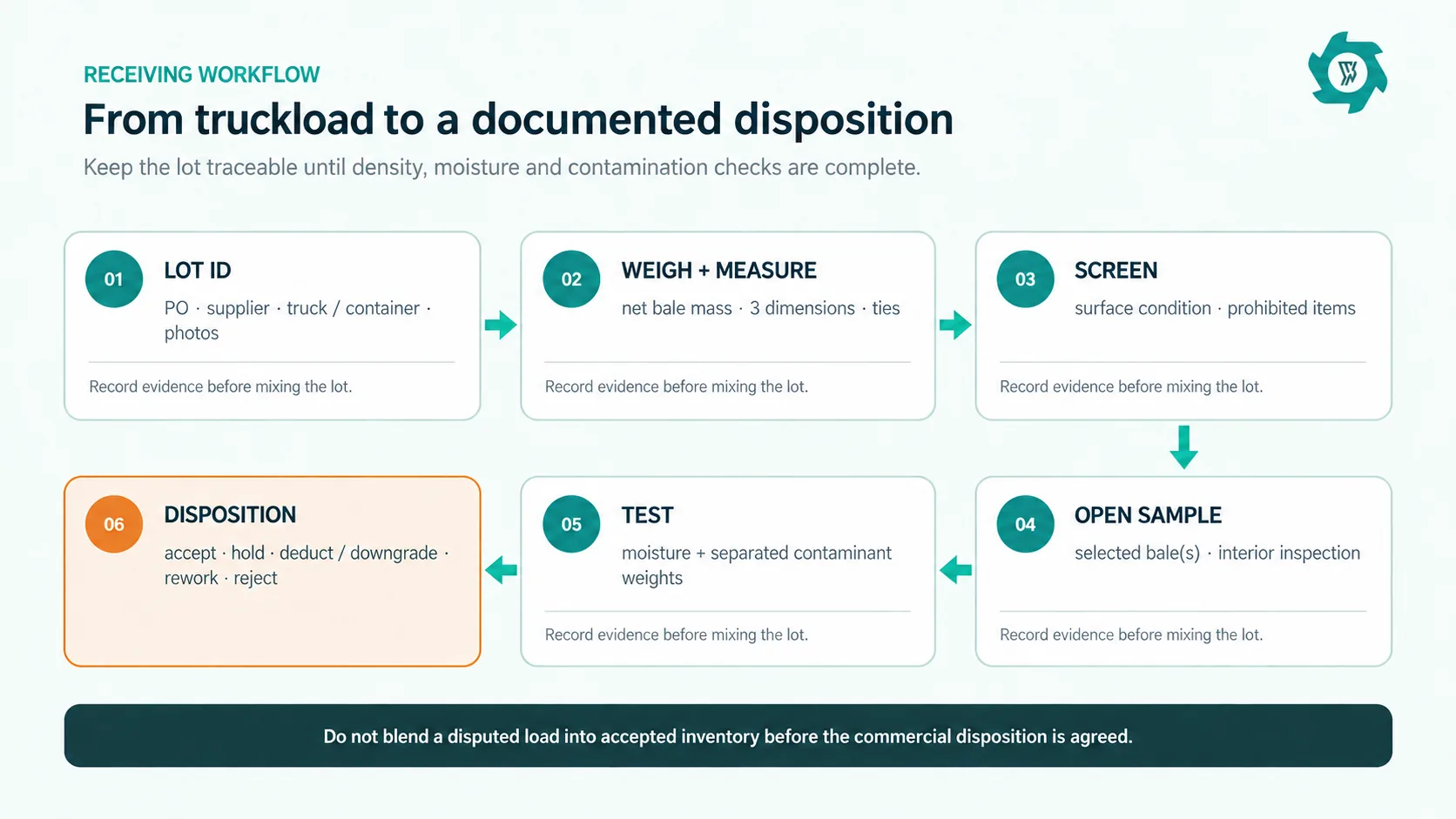
The most useful receiving procedure is short enough to run every day but detailed enough to reconstruct a claim. The sequence below keeps the lot traceable until evidence is complete.
Figure 4. The receiving decision follows the evidence. Hold disputed material separately until the commercial disposition is agreed.
Identify the lot. Record supplier, purchase order, truck or container, declared bale form, source where required, arrival date and photographs. Do this before the bales disappear into inventory.
Count and weigh. Capture load weight and the agreed tare. If individual-bale density will be audited, select and weigh those bales individually rather than relying on a load average.
Measure package condition. Record three bale dimensions, tie type and tie condition. Flag bales that are collapsed, unusually loose or outside the handling envelope.
Screen the exterior. Look for water leakage, obvious steel, plastics, glass, dirt, oil/grease, batteries, pressurized items and other visible non-UBC material.
Open the contract sample. Select bales using the pre-agreed rule. Preserve the opened mass and keep separated contaminants identifiable and weighable.
Test moisture and contaminant fractions. Use the stated test basis. Record raw results before applying any deduction formula or commercial tolerance.
Assign the disposition. Use named outcomes such as accepted, held for review, accepted with agreed deduction/downgrade, rework requested or rejected. Keep the lot segregated until this step is closed.
A dispute is much easier to resolve when the buyer can show one lot ID, photographs, selected bale numbers, dimensions, weights, moisture result and sorted reject weights.
How Bale Specifications Change the UBC Recycling Line
Bale specifications are not paperwork added after equipment selection. They describe the physical load the plant has to receive. YUXI’s UBC aluminum can recycling line distinguishes clean loose-can baling, mixed-stream recovery and baled-UBC preparation because these feeds behave differently. Dense bales may need controlled opening so trapped contamination can be released before magnetic separation, screening or quality control.
Dimension extremes affect the bale breaker opening, infeed conveyor width and loader handling. Density affects how readily the package tears apart and how large the instantaneous load can be when a bale enters the chamber. Tie type affects the removal plan and the ferrous stream after opening. Moisture changes housekeeping and can make fines, paper and light residue adhere to cans and equipment. Contamination level changes how much inspection, screening and reject handling the line needs.
Where a bale truly needs mechanical opening or downsizing, the supplier needs the actual bale envelope and density range before selecting a metal shredder or bale-opening duty.
The broader aluminum scrap recycling process also shows why opening is a means, not the output. The downstream objective is to expose and remove unwanted material while preserving a UBC fraction that meets the receiver’s acceptance rule. Clean bales that already meet the required condition should not be routed through extra reduction simply because a shredder is available.
Write a UBC Bale Purchase Specification That Can Be Enforced
A good purchase specification is a measurement sheet with commercial consequences. It should be concise enough to use at the gate, but it must identify the controlling trade or mill document and any agreed departures from it.
Specification field
What to write
Evidence at receiving
Commodity
Aluminum used beverage cans; state whether ReMA Taldon controls
Lot documents + opened material identity
Condition
Flattened or unflattened; emptied; no unidentified sealed containers
Visual + opened sample
Density
Required range and calculation method
Net mass + three measured dimensions
Bale envelope
Dimension / volume limits and handling constraints
Tape / laser measurement + photographs
Ties
Permitted bands/wires and condition
Count, type and damage record
Moisture
Sampling method, threshold, deduction/rejection formula
Test result + sample ID
Foreign material
Prohibited categories and any agreed commercial tolerance
Opened-bale sorted weights
Safety exclusions
Batteries, pressurized/unknown sealed containers, hazardous material
Immediate hold / rejection record
Sampling
Number or frequency of bales opened, selection rule, witness rules
Equipment suppliers need the same bale evidence that the receiving team uses. Send the normal bale and the extremes. At minimum, include photographs or video; minimum and maximum external dimensions; typical and maximum bale weight; calculated density range; flattened or unflattened condition; tie material and count; residual liquid/moisture condition; representative contaminants; required continuous feed rate; and the required output after opening or cleaning.
For a factory acceptance test (FAT), representative bales matter more than an impressive no-load demonstration. Agree the test boundary in advance. Record the actual bale dimensions, weights and tie condition; operating and elapsed time; stops, reversals, interventions and manual clearing; and separately weigh accepted output, ferrous output, oversize or return, fines or dust, other rejects and retained material. State the unexplained difference separately and investigate it when it exceeds the agreed tolerance. If moisture or contaminant removal is a performance condition, agree the sample method before the test.
The FAT should not turn one unusually clean demonstration bale into a universal capacity claim. A baled-UBC line can be limited by bale opening, feed control, screening, manual inspection or reject handling. Compare suppliers on the same feed condition and the same measurement point.
Common Mistakes That Create Bale Disputes
Using a mill moisture number as though it were the Taldon rule
ReMA and an individual mill specification answer different questions. Name the controlling document. If a Novelis receiving rule is used, call it a Novelis rule. If buyer and seller agree another method, write that method into the contract.
Quoting density without a measurement convention
A number with no geometry rule is fragile evidence. Bulged and rounded bales can produce different results depending on where dimensions are taken.
Inspecting only the cleanest face
Compaction hides material. Exterior inspection is useful for screening but cannot demonstrate the interior contaminant fraction. Use selected bale opening when the commercial risk justifies it.
Blending a disputed load before the test is complete
Once suspect bales are mixed with accepted inventory, traceability is lost. Keep the lot identifiable until sampling and disposition are closed.
Sending only an average bale to the equipment supplier
The extreme bale often decides whether an opener feeds smoothly. Maximum dimensions, highest density, the toughest tie configuration and the dirtiest representative feed should be visible during design review and, where practical, acceptance testing.
FAQ
What density should a baled UBC shipment meet?
If the contract uses ReMA Taldon, the current specification sets a minimum of 14 lb/ft³. It sets maximums of 17 lb/ft³ for unflattened UBC and 22 lb/ft³ for flattened UBC. A mill or buyer may also add its own receiving window, so the purchase order should identify which specification controls.
Is there one universal moisture limit for UBC bales?
The ReMA Taldon page does not publish a universal moisture percentage. Moisture limits, sampling methods and deductions should be written into the buyer–seller agreement. A mill specification can be used as the controlling requirement when both parties agree to it.
How should bale density be checked at receiving?
Use the delivered bale’s agreed net mass and measured external dimensions, calculate volume on a stated geometric basis, and divide mass by volume. The procedure should also say how rounded, bulged or damaged edges are measured so different inspectors do not create different density results.
Why open a bale if the outside looks clean?
A dense bale can hide liquid, steel, plastic, glass, dirt or non-UBC aluminum below the outer face. Opening selected bales under an agreed sampling plan provides evidence that a surface inspection cannot provide.
What bale data should be sent to an equipment supplier?
Send bale photos and video, minimum and maximum dimensions, typical and extreme bale weight, calculated density range, flattened or unflattened condition, wire or strap type, moisture condition, contaminant types, target throughput and the required cleaned or rebaled output.
Define the Bale Before Selecting the Line
Send representative UBC bale photos or video, minimum and maximum dimensions, bale weight and density range, tie type, moisture condition, contaminant types, required tons per hour and the required cleaned or rebaled output.
Daniel
Metal Recycling Equipment Specialist,YUXI Machinery
Daniel has over 7 years of experience serving the international recycling market.
He focuses on metal shredding and recycling systems,including feedstock evaluation,equipment selection,size reduction,separation,and complete line configuration.





 Request Quote