




 Request Quote



Quick Answer: The Slowest Sustainable Stage Sets UBC Line Capacity
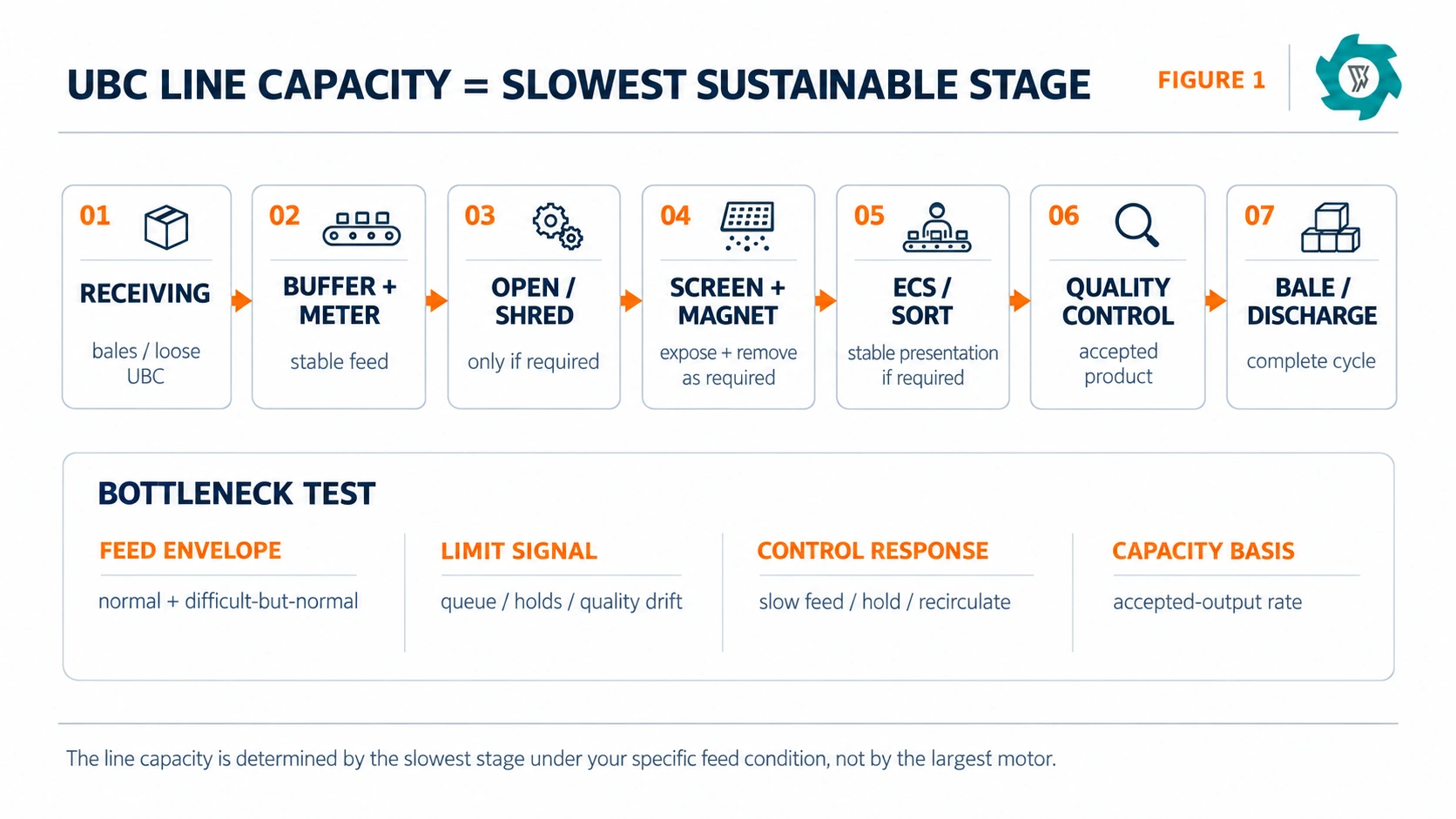
A UBC recycling line does not have one independent “tonnes per hour” number. Its sustainable capacity is the rate at which the complete system can accept representative material, process it through every required stage, and produce an accepted output without uncontrolled buildup, repeated manual clearing, excessive recirculation, or a loss of product quality. The limiting point may be receiving, metering, bale opening, shredding, screening, magnetic separation, eddy-current separation, inspection, baling, discharge handling, or even the available productive time in a shift.
That is why the largest motor or the fastest single machine should not be treated as line capacity. A machine can process a short burst faster than the rest of the plant can sustain. For procurement, the useful questions are: where is the mass measured, what output condition is accepted, what time basis is used, and which stage reaches its practical limit first under normal and difficult-but-normal feed?
The public UBC aluminum can recycling line is configured around incoming material condition rather than one fixed equipment train. Clean loose UBC, mixed dry recyclables, and dense baled UBC create different hydraulic, volumetric, separation, and handling duties. That distinction is central to capacity planning.
1. First Define Which Capacity You Are Talking About
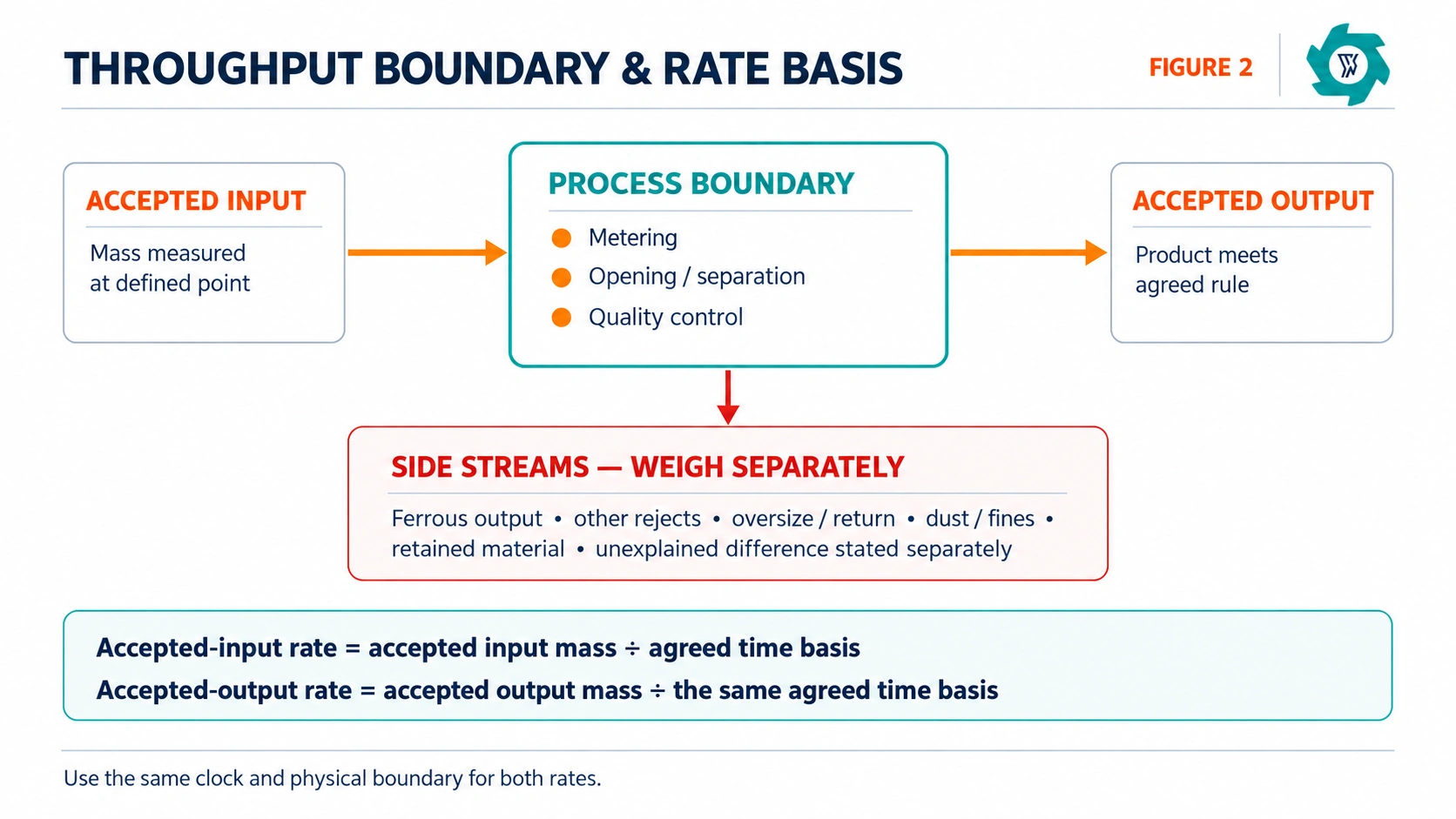
Capacity claims become confusing when different boundaries are compared. One supplier may quote material entering the first conveyor. Another may quote discharge from the shredder. A third may report accepted UBC after sorting. Those numbers can all be real, but they do not describe the same process boundary.
For a complete line, define at least two rates. Accepted-input rate is the accepted feed mass divided by the agreed time basis. Accepted-output rate is the mass of product that actually meets the agreed output rule divided by that same time basis. If the process creates ferrous output, non-metal rejects, oversize or return material, dust or fines, those side streams explain why accepted output can be lower than accepted input even when the equipment is operating correctly.
Use the same clock for both numbers. If accepted input is calculated from net running time while accepted output is calculated from elapsed time, the result is not a meaningful comparison. State whether the rate uses total elapsed time, stable operating time after start-up, or another agreed window. During an acceptance test, it is often useful to record both elapsed time and net running time, then report the rate basis explicitly.
Accepted-output rate = accepted output mass ÷ the same agreed time basis
Do not use “machine throughput” as a substitute for these definitions. The EPA describes mechanical scrap preparation as a sequence that can include size reduction, magnetic removal, eddy-current separation, screening, and pneumatic classification rather than one isolated operation.[1] That process logic is exactly why the boundary has to be written before a line-capacity figure becomes useful.
2. UBC Can Be Volume-Limited Before It Is Mass-Limited
Loose beverage cans are light for the amount of space they occupy. A line can therefore run out of hopper volume, conveyor cross-section, transfer-chute area, inspection-belt width, or baler charging volume before the mass flow looks high. This is one reason a specification written only as “3 metric tonnes per hour” is incomplete.
The same mass behaves very differently after compaction. A dense bale concentrates a large amount of UBC into one handling unit. Instead of filling a conveyor by volume, it can challenge a grab, bale table, infeed opening, opener, or shredder with a concentrated mechanical load. ReMA’s current UBC specifications illustrate how much physical form can change: Taldon defines baled UBC, Talcred shredded UBC, Taldack densified UBC, and Taldork briquetted UBC, each with its own density and package conditions.[2]
When bulk volume is the real constraint, increasing motor power does not solve the problem. The line may need a wider conveyor, a larger buffer, a better metering device, a different charging sequence, or more storage between receiving and the first process machine.
3. Treat the Plant as a Series System, Not a Collection of Nameplates
In a serial process, the sustained line rate cannot exceed the slowest stage for long. Faster upstream equipment simply fills the buffer ahead of the bottleneck. Once the buffer is full, the operator has to slow or stop the infeed. If there is no buffer, the stop can propagate immediately to the first conveyor.
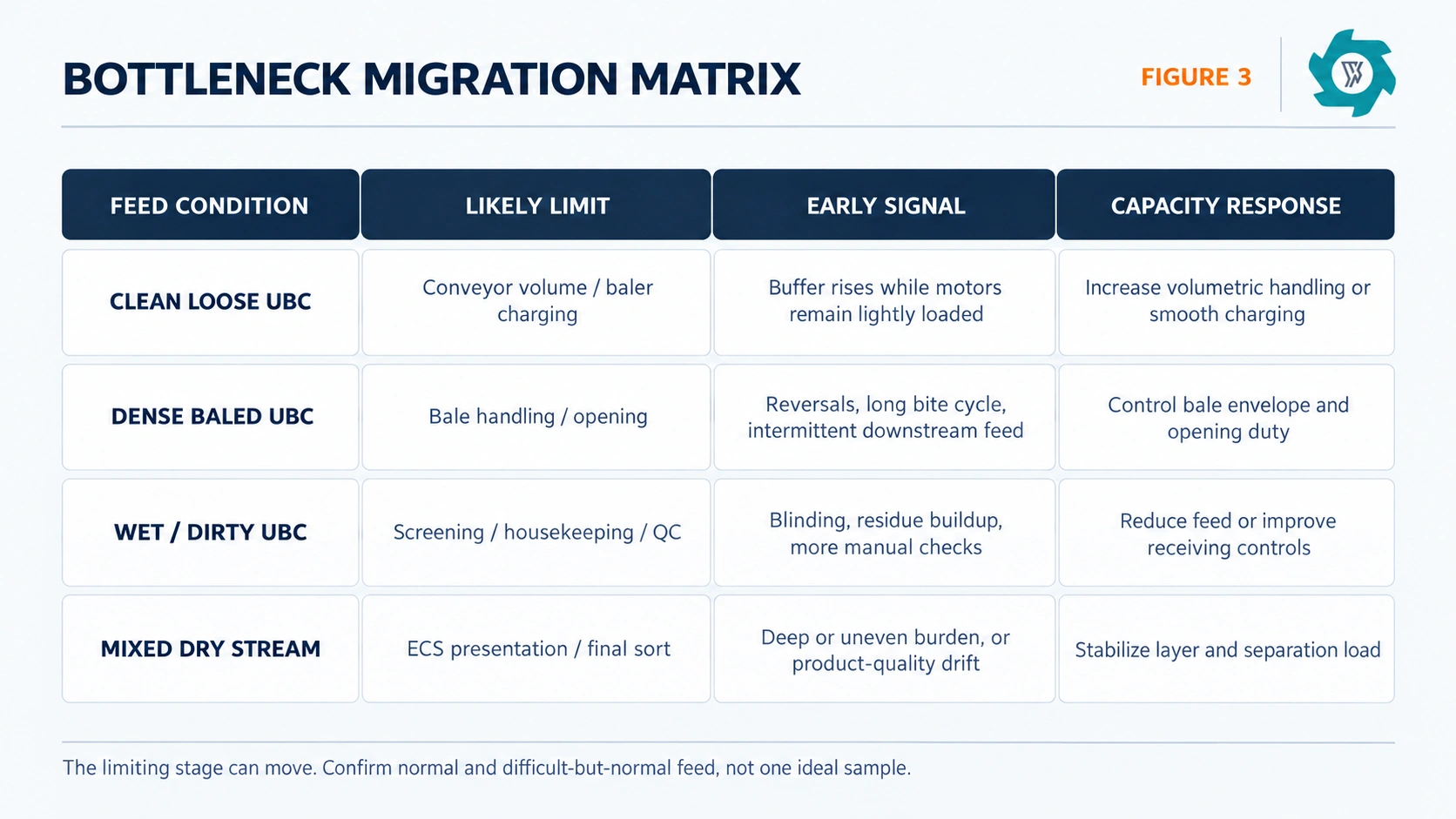
The best bottleneck is not necessarily a single permanent machine. It can move with the feed. A clean loose-can route may be limited by baler charging. A hard-bale route may be limited by opening. A dirty mixed stream may be limited by screening or quality control. Capacity should therefore be confirmed across the feed envelope, not only on one clean sample.
4. Receiving, Buffering and Metering Often Decide Whether the Rest of the Line Can Run Steadily
A line cannot sustain a stable mass rate if its first controlled feed point alternates between starvation and surging. Loader-fed systems are particularly sensitive to this. A large bucket can temporarily flood the next machine, then leave it empty while the loader returns for another charge.
For baled UBC, receiving also includes the time and equipment needed to identify, move, position, and release each bale. For loose UBC, the same duty may be controlled by conveyor volume rather than package handling. In either case, the feed system should be sized to deliver the required mass without forcing operators to push material manually into hazardous areas.
NIOSH has highlighted machine guarding, conveyor emergency stops, and control of hazardous energy as important protections in recycling operations.[3] A production target should never depend on bypassing guards, reaching into a chute, or clearing a live conveyor faster.
5. Bale Opening or Shredding Can Be the Limit, but Only When That Stage Is Actually Required
Dense UBC bales may need to be opened so trapped steel, plastics, glass, dirt, or other contamination can be released. The mechanical challenge is not the same as processing loose cans. The first bite can be intermittent, ties may affect feeding, and a difficult bale can trigger reversals or require a different loading rhythm.
The separate guide on choosing a UBC shredder for baled aluminum cans goes into machine selection. At complete-line level, the important question is narrower: can the opening stage deliver a stable downstream feed condition without becoming the long-term queue point?
Avoid solving a capacity problem by reducing material more than the downstream process requires. Extra cutting can increase fines, create more dust, increase wear, and raise the amount of material that must be screened or collected. If a primary stage already opens the bales sufficiently for the next process, a second size-reduction stage should not be added simply to advertise a higher machine count or a smaller nominal particle size.
When testing opening capacity, log reversals, stops, operator interventions, manual clearing, and any time the downstream line asks the opener to hold. A high instantaneous discharge during a bale collapse can look impressive while the average line rate remains modest.
6. Screens and Magnets Have a Capacity Limit That Is Also a Separation-Quality Limit
Magnetic separation has the same general issue. A magnet needs accessible ferrous material and a burden that allows the captured steel to leave the aluminum stream. Thick, tangled, or poorly opened material can physically trap contaminants. EPA descriptions of secondary aluminum preparation note the role of shredding, screening, and magnetic removal in physical cleaning before downstream processing.[4]
Capacity should therefore be checked together with the reject stream. If the line is pushed faster and the ferrous output suddenly carries more aluminum, or the accepted UBC retains more visible steel, the plant has not discovered free capacity. It has traded separation performance for mass flow.
7. Eddy-Current Separation Is Usually Presentation-Limited, Not Just Belt-Speed-Limited
An eddy current separator needs material to reach the rotor in a suitable size and a controlled, reasonably even layer. If the conveyor is overloaded, particles can shield each other, trajectories can overlap, and the splitter may receive a less distinct separation.
The detailed eddy current separator guide for aluminum cans explains feed preparation and recovery. For capacity planning, treat its usable rate as a function of presentation quality. Belt width and speed matter, but they do not independently define accepted-output capacity.
Watch the burden profile across the full belt width. A nominally “half-full” conveyor can still have one overloaded stripe if upstream discharge is poorly distributed. Stable metering, spread, particle condition, and removal of accessible ferrous material normally matter more than chasing maximum belt speed.
If an ECS is not needed for the incoming feed, do not add it simply because it appears in a standard equipment list. Clean UBC that already meets the required material condition may be inspected, magnetically controlled, and baled without a non-ferrous separation stage. Removing unnecessary stages can improve both capacity and maintainability.
8. Moisture and Contamination Consume Capacity Without Adding Aluminum Value
Wet or dirty UBC can make a line appear heavier while increasing the work required per metric tonne of recoverable aluminum. Residual liquid can change friction, carry fines into screens, increase housekeeping, and occupy mass that does not become aluminum product. The UBC bale moisture guide explains why receiving weight and usable metal should not be treated as the same thing.
Contamination creates similar side work. Steel increases magnetic-separation duty. Dirt and glass can raise abrasive load and fines. Plastic film can wrap or affect air handling. Unknown sealed items may require quarantine instead of processing. As contamination rises, the line may have to slow so the same sorting equipment can maintain product quality.
Do not hide this effect inside one optimistic capacity number. Define a normal feed and a difficult-but-normal feed. State the contamination range that belongs inside the guarantee and list abnormal or prohibited items separately. The purpose is not to guarantee performance on anything that arrives; it is to make the performance claim reproducible on an agreed feed envelope.
9. Final Quality Control Can Be the Deliberate Bottleneck
Some UBC plants are designed so final inspection or sampling has enough time to protect the product specification. If the accepted output is sold under a tighter contamination rule, the inspection station may become the rate-limiting stage before any motor reaches its limit.
The Aluminum Association notes the high economic value and circular role of recovered aluminum beverage cans in the recycling system.[5] For plant operators, that makes avoidable metal loss important. A faster line that sends more aluminum into fines, ferrous output, or residue may reduce the value recovered from each incoming load.
10. Baler Cycle, Bale Removal and Downstream Handling Can Cap the Whole Plant
When the final product is a dense UBC bale, the process is not complete when loose material reaches the baler hopper. Chamber filling, compression, hold, return, tying where applicable, discharge, and bale removal all consume time. If the upstream line produces material faster than the baler can clear it, the buffer rises until the upstream process is forced to hold.
The guide on choosing an aluminum can baler for UBC covers machine-specific selection. For line capacity, measure the complete operational cycle under material load. Empty strokes or isolated hydraulic speed do not show whether bales can be made and removed continuously.
11. Productive Time Is a Capacity Variable
A line rated at a sustainable accepted-output rate still does not produce that rate for every clock hour of a shift. Material changes, loader delays, housekeeping, planned inspections, minor stops, manual clearing, downstream holds, and maintenance stops reduce productive time.
For planning, separate rate from availability. First determine what the line can produce while it is operating inside the agreed condition. Then determine how much of the shift is actually available for productive operation. Multiplying an optimistic instantaneous rate by scheduled shift hours usually overstates daily output.
Planned cleaning, guarding checks and energy isolation still belong inside the operating plan. OSHA identifies moving machinery, unexpected startup and combustible dust as important scrap-recycling hazards, and specifically notes that finely divided aluminum can be explosible under appropriate conditions.[6]
12. Expect the Bottleneck to Move with Feed Condition
A useful capacity study does not ask only, “What is the bottleneck?” It asks, “What becomes the bottleneck under each expected feed condition?” This is where many line guarantees become too simple.
With clean loose UBC, the low bulk density may make conveyor volume, buffer discharge, or baler charging the main constraint. With dense bales, bale handling and opening may dominate. With wetter or dirtier material, screens, housekeeping, dust control, or quality inspection may slow the process. With a mixed dry-recyclables stream, the separator presentation layer or manual quality-control station can become the practical limit.
Once the limiting stage is identified, ask what happens when its capacity is reached. Does the control system slow the upstream conveyor? Does a buffer level trigger a hold? Does material recirculate? Does the operator intervene? Does product quality drift before an alarm occurs? These responses determine whether the plant fails gracefully or becomes unstable.
13. A Worked Capacity Example Shows Why Feed Rate and Product Rate Are Different
Consider an illustrative test, not a published machine rating. A line accepts 8,000 kg of representative UBC over two elapsed hours. The accepted-input rate is therefore 4.0 metric tonnes per hour. At the end of the same boundary, the accepted UBC product weighs 6,600 kg. The accepted-output rate is 3.3 metric tonnes per hour.
The 1,400 kg difference is not automatically “loss.” It may include ferrous output, non-metal rejects, oversize or return material, dust or fines, retained material, plus any unexplained mass difference. Those categories need to be weighed separately. If 300 kg is intentionally recirculated, for example, the line may process part of the same material more than once. Counting internal return as fresh feed would inflate the apparent throughput.
The separate guide on UBC aluminum recovery rate deals with product, rejects, metal loss, and mass-balance closure in more detail. For capacity testing, the key rule is simple: never report a tonnes-per-hour figure without the mass boundary and the accepted-output condition that gives the number meaning.
14. FAT: Prove the Capacity Boundary, Not Just One Machine Speed
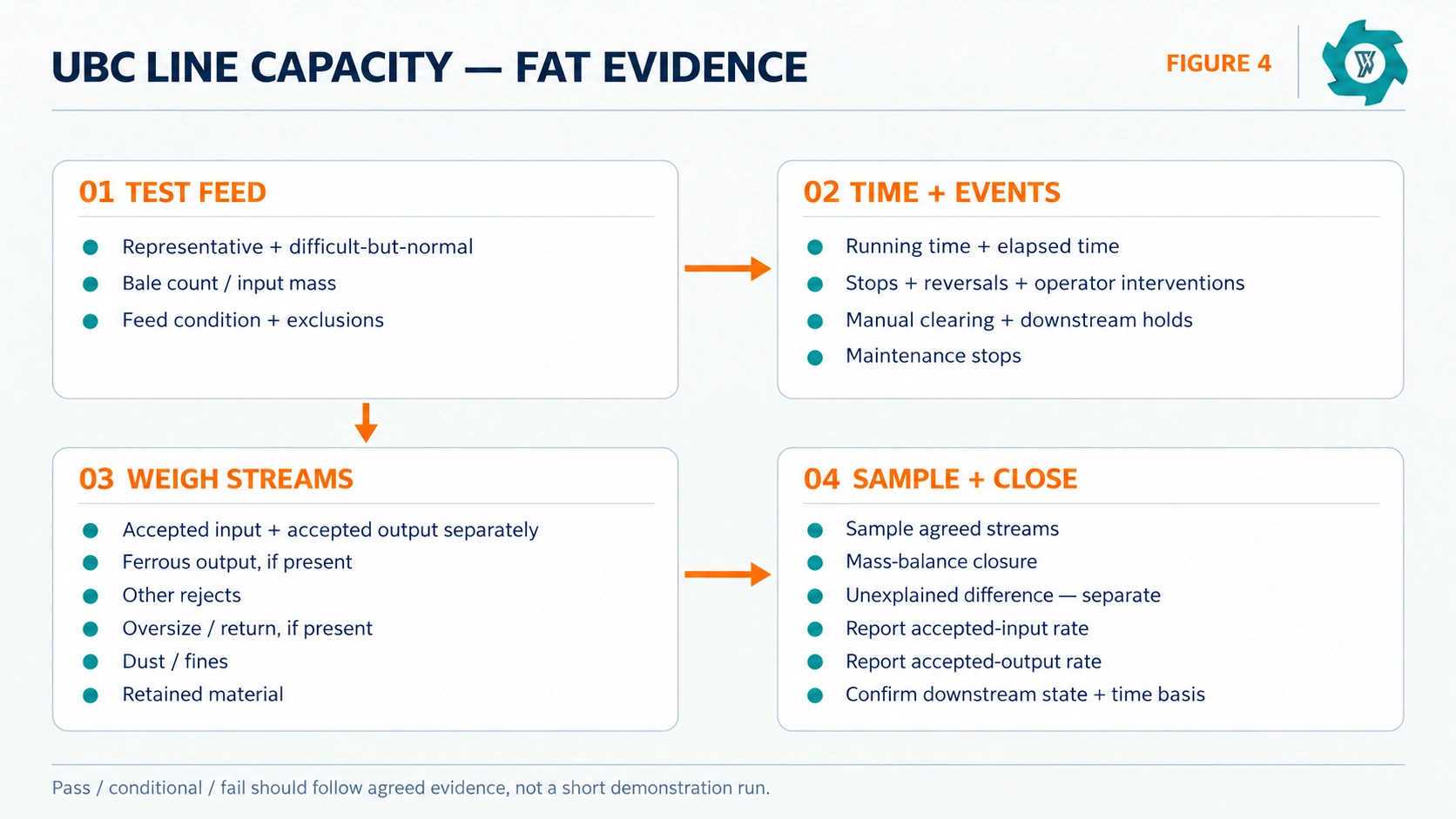
A factory acceptance test for a UBC line should be designed around representative feed plus a difficult-but-normal condition. Agree the test material before the run. For baled feed, record bale count, individual or total input mass, dimensions or density range where relevant, tie condition, moisture condition, and the normal contamination envelope. For loose feed, record the receiving condition, accepted input mass, and the way material is metered into the line.
Agree the time basis as well. Record running time and elapsed time. Log stops, reversals, operator interventions, manual clearing, downstream holds, and maintenance stops. If the line has a start-up period before the process stabilizes, state whether that time remains inside the capacity result or is reported separately. Do not choose the time basis after seeing the result.
Then weigh streams separately. Accepted input and accepted output must remain separate measurements. Where present, also weigh ferrous output, other rejects, oversize or return material, dust or fines, and retained material. Record any unexplained difference as its own line item rather than merging it with retained material.
Sampling should support the product rule and the metal-loss review. Sample accepted input and accepted output when required by the agreed method. Inspect or sample side streams that may carry meaningful aluminum value. A line can hit the mass-rate target while losing too much aluminum into rejects, so capacity and recovery should be evaluated together rather than traded silently.
Finally, confirm the predefined downstream state and test time basis before signing the result. If the final product is a bale, the FAT should include the bale output and the time needed to discharge it. If the product is loose cleaned UBC, the downstream collection condition must be stable enough that the line is not simply filling a temporary pile faster than it can be handled.
15. What to Put in a UBC Line RFQ
A capacity request should give the supplier enough information to identify the likely bottleneck before equipment is selected. Use a range where the material varies; one average sample can hide the difficult end of the real duty.
| RFQ field | What to provide | Why it changes capacity |
|---|---|---|
| Feed form | Loose, flattened, compacted or baled UBC | Changes volume flow, handling and opening duty |
| Bale data | Dimensions, mass, density range and ties | Sets receiving and opening loads |
| Moisture | Normal range, free-liquid condition and receiving method | Changes weight, handling, screening and housekeeping |
| Contamination | Ferrous, plastic, glass, dirt, fines and prohibited items | Sets separation depth and side-stream load |
| Required output | Loose cleaned UBC, opened pieces or finished bales | Defines the accepted-output boundary |
| Target rates | Accepted-input and accepted-output rate | Prevents a single-machine feed number from standing in for line production |
| Time basis | Elapsed, net running and stable operating period | Makes quotations and FAT results comparable |
| Working pattern | Hours per shift, shifts per day, loading method | Converts sustainable rate into daily output |
| Layout | Floor space, elevation, access and bale-removal route | Prevents handling conflicts from reducing uptime |
16. The Capacity Number Worth Buying Is the One You Can Reproduce
A credible UBC line capacity is not the highest number found in a machine table. It is the sustainable accepted-output rate produced by representative material, through the complete required process, on a defined time basis, with product quality and side streams measured well enough to explain the result.
Start with the feed envelope and final product. Identify where volume flow, mechanical opening, screening, separation, inspection, baling, or handling is most likely to limit the line. Then make the supplier state what happens when that stage reaches its limit. During FAT, measure accepted input, accepted output, side streams, time, and operator events on the same boundary.
That approach turns “How many tonnes per hour?” from a sales-table question into an engineering specification. It also gives the operations team a much better baseline for diagnosing the plant later, because they know which stage was expected to limit the line and which signals show that the bottleneck has moved.
Send Your UBC Feed and Target Rate
Share representative UBC photos or video, feed form, bale size and mass, moisture and contamination, target input and output rates, final product, operating hours, power supply and workshop layout.
Frequently Asked Questions
What is the real capacity of a UBC recycling line?
Real line capacity is the sustainable rate at which representative UBC can pass through every required stage and leave as accepted output on an agreed time basis. It is not automatically the rated capacity of the shredder, separator or baler.
Should UBC capacity be based on feed rate or finished product rate?
Report both. Accepted-input rate shows how quickly the line receives material. Accepted-output rate shows how quickly it produces material that meets the agreed product rule. Use the same physical boundary and time basis for both numbers.
Why can loose cans reduce tonnes per hour?
Loose cans occupy a large volume for their mass. Conveyors, hoppers, inspection belts and baler chambers can therefore reach their volumetric limit before motor load becomes high. Bulk volume and feeding method should be specified together with the mass rate.
Why can dense UBC bales reduce line capacity?
Dense bales concentrate material into a difficult handling and opening duty. Bale size, density, ties, spring-back and hidden contamination can increase loading time, reversing, manual clearing or the work required to create a stable downstream feed.
Can an eddy current separator be the line bottleneck?
Yes, especially when the feed layer becomes too deep or uneven for the required separation quality. The usable rate depends on feed presentation, particle condition, belt loading and upstream preparation, not belt speed alone.
How should UBC line capacity be verified during FAT?
Use representative plus difficult-but-normal feed, define the time basis and downstream state, log operating events, weigh accepted input and output separately, weigh reject or return streams, record retained material and unexplained difference, and report both accepted-input and accepted-output rates.
References
- U.S. EPA, metal processing methods.
- ReMA, 2026 specifications.
- NIOSH, recycling safety guidance.
- U.S. EPA, AP-42 aluminum.
- Aluminum Association & CMI, can KPI report.
- OSHA, scrap recycling and combustible dust.