




 Request Quote

Product Center
-
- Biomass Shredding and Recycling Line
- OCC Paper Dry Pulping & Cardboard Recycling Line
- Scrap Aluminum Recycling Line
- Waste Car Recycling Line
- Waste Refrigerator Recycling Line
- Copper Aluminum Radiator Recycling Line
- Motor Rotor Recycling Line
- Copper Wire Recycling Line
- Waste Ink Cartridge Recycling Line
- Aluminum UBC Scrap Recycling Line
Get a Quote
Contact Us


Why the Feed Comes Before the Eddy Current Separator
An eddy current separator can be one of the most productive recovery machines in an aluminum-can sorting line, but it cannot repair a badly defined feed. The machine acts on individual conductive objects. If aluminum cans reach the rotor buried under paper, mixed with free steel, stuck together by liquid, nested inside one another, or arriving in a deep surge, the discharge pattern becomes much harder to control. The result is usually described as an “ECS problem” even though the failure started upstream.
For used beverage cans, the first decision is therefore not rotor speed or belt width. It is whether the stream actually needs eddy current separation. YUXI’s UBC aluminum can recycling line separates three practical jobs: clean loose-can baling, mixed-stream can recovery, and preparation of dense UBC bales. The ECS belongs most naturally in the mixed-stream route, where aluminum must be recovered from plastics, paper, glass and other dry non-metals after free ferrous material has been removed. Clean UBC that is already separated may only need inspection, magnetic control and baling.
This distinction keeps the project economical. An ECS should be installed because it closes a measured aluminum-loss point. The same rule applies to shredding, screening and air separation. Add each stage only when the incoming cans and the required product give that stage a clear job.
Prepare UBC feed for an eddy current separator by removing prohibited items and free liquid, opening compacted material only when necessary, removing accessible ferrous metal, controlling fines or light contamination when they affect the sort, and metering the remaining stream into a thin, stable belt load. Then judge the ECS with both aluminum recovery and product grade.
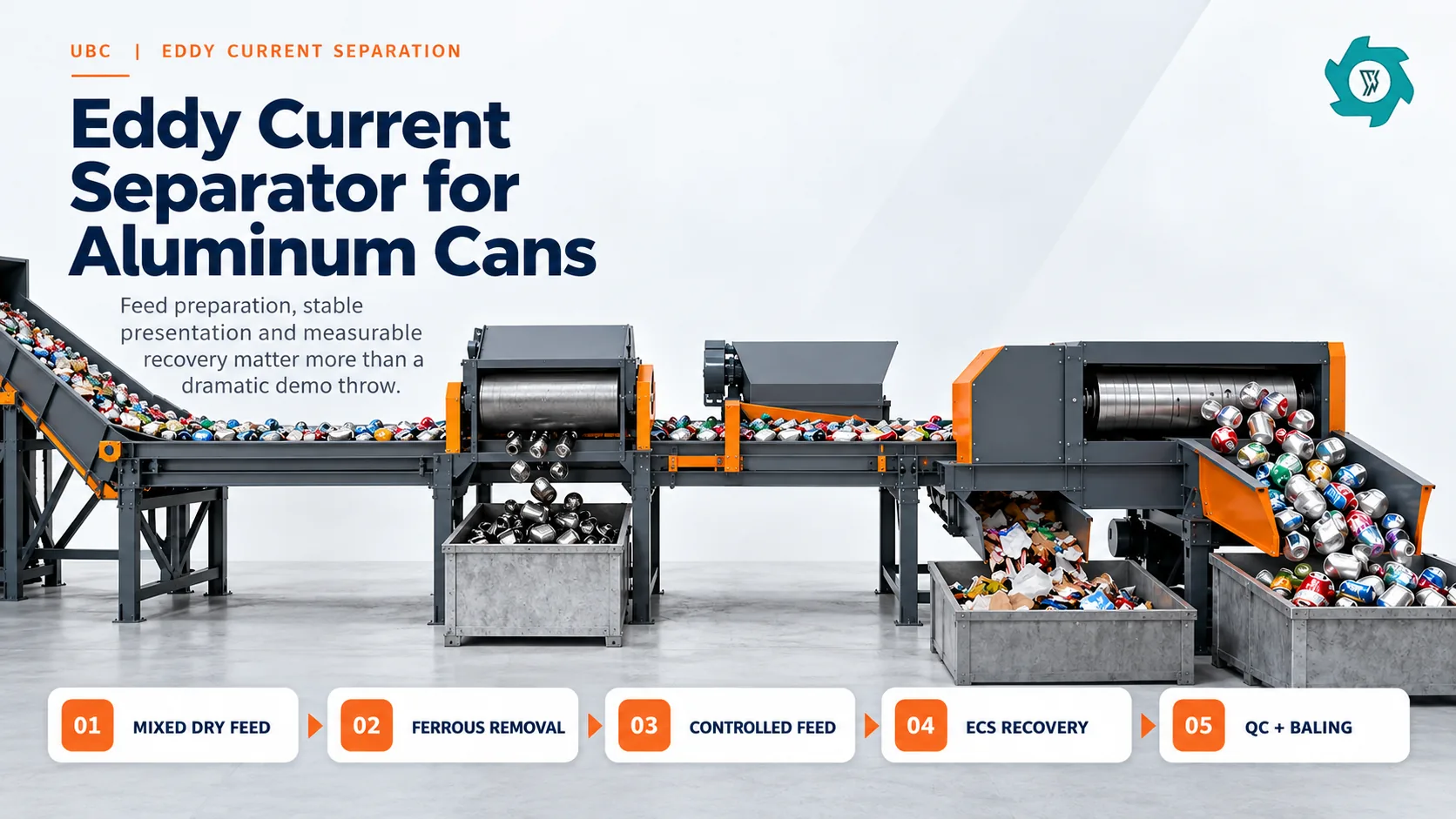
Where Eddy Current Separation Fits in UBC Recycling
An eddy current separator uses a rapidly changing magnetic field to induce electrical currents in conductive non-ferrous pieces. The induced response changes the particle or container trajectory at the end of the belt, allowing aluminum to travel farther than non-metal material. The underlying principle is well established in the technical literature, but the useful trajectory depends on the separator design and on the real feed presented to it.[1][2]
For UBC, that principle creates a simple process boundary. The machine can separate conductive aluminum cans or can pieces from suitable non-conductive material. It does not remove free steel better than a magnet, it does not identify can-body alloy chemistry, and it does not turn a wet or compacted bale into a sortable stream by itself. In a mixed dry recyclables facility, the ECS may work on whole or lightly deformed cans after screening and magnetic removal. In a mill-preparation line, the feed may first need bale opening or controlled shredding so hidden contaminants can be released.
That is why the related guide on magnetic separator vs eddy current separator for aluminum scrap should be treated as an equipment-boundary reference. The magnet deals with accessible ferrous material; the ECS is useful later when conductive non-ferrous material still has to be separated from a non-metal stream.
The U.S. EPA’s secondary-aluminum process description makes the same broader point from a pretreatment perspective: sorting and processing are used to remove other metals, dirt, oil, plastics and paint before downstream melting, and mechanical preparation can include size reduction, magnetic removal, screening and classification.[3] The exact arrangement is feed-dependent rather than universal.
Do Not Shred Aluminum Cans Just to “Help” the ECS
One of the easiest ways to overbuild a UBC project is to think that small pieces always separate better. Whole aluminum cans already have a favorable combination of conductivity and low density, and a mixed-container line may recover them without a shredder. If the cans are free, dry and reasonably presented, reducing them first can add wear, power demand, dust, fines and another conveyor transfer without solving a real problem.
Size reduction becomes useful when the feed condition demands liberation. Dense bales can trap steel cans, glass, plastic and nested containers. Compacted cans can shield contaminants from inspection. In those cases a bale breaker or controlled shredder can open the material and expose foreign objects to the next stage. The objective is not to make the smallest possible aluminum. It is to achieve the least aggressive opening that produces a controllable downstream feed.
The complete used aluminum can recycling process guide covers those route choices in more detail. For this article, the key procurement question is narrower: after any necessary opening, does a meaningful amount of aluminum remain mixed with non-metal material that an ECS can recover? If the answer is no, the separator has little value. If the answer is yes, the upstream equipment should be configured to present that aluminum consistently rather than merely to reduce nominal particle size.
A Practical UBC Feed-Preparation Sequence
The best separator tests usually look unremarkable upstream. The feed is controlled, the contamination is known, and the belt is not being asked to absorb random surges. The preparation sequence below is a useful starting point for mixed dry containers and opened UBC.
1. Remove prohibited and unsafe items before mechanical handling
Pressurized cans, cylinders, batteries, electronics, sealed unknown containers and other hazardous items do not belong in a confirmed UBC stream. They should be removed before conveyors, opening equipment or separators. Mechanical guarding is also part of the installed process; OSHA notes that moving machine parts, nip points and power-transmission components require safeguarding appropriate to the hazard.[4]
2. Control residual liquid and wet contamination
Residual beverage, wet paper and organics add false weight, promote sticking and make belt presentation less repeatable. For sorting, “dry” does not mean laboratory-dry; it means free-flowing enough that the material behaves consistently and does not arrive as wet clumps. If the incoming stream changes with weather, collection route or storage time, moisture should be recorded as a process variable.
3. Open compacted feed only when liberation requires it
Loose cans may bypass size reduction. Baled or heavily compacted material may need opening so steel, glass and non-metal items are exposed. The Aluminum Association’s can-recycling flow similarly shows compacted UBC being broken and separated from steel and foreign material before downstream thermal and melting stages.[5]
4. Remove accessible ferrous material before the ECS
A magnet should remove steel cans, straps, fasteners and other ferrous pieces that have been exposed by the preparation stage. This prevents the ECS from being used as a general “metal separator” and reduces the risk that ferrous pieces enter the high-speed rotor area. Audit the magnetic reject as well: aluminum mechanically attached to steel can be pulled out with the ferrous fraction and disappear from the apparent ECS loss calculation.
5. Screen or air-classify only where the feed justifies it
Screening is valuable when fines, broken glass, dirt or a broad size distribution create different separation behaviors. Air classification can help where light paper or plastic dominates, although lightweight aluminum can also be vulnerable to an aggressively tuned air system. The objective is to create a more stable ECS feed, not to maximize the number of machines. Detailed size-distribution effects are already covered in the aluminum ECS particle-size guide.
6. Meter and spread the feed before the rotor
The final feeder is often as important as the separator itself. Aluminum should arrive across the useful belt width without deep piles, persistent bare zones or repeated slugs. Whole cans do not have to form a perfect laboratory monolayer, but they should not ride over one another so heavily that one container shields another or creates collisions at the discharge. A surge bin, metering conveyor or vibrating feeder can be justified when the upstream flow is intermittent.
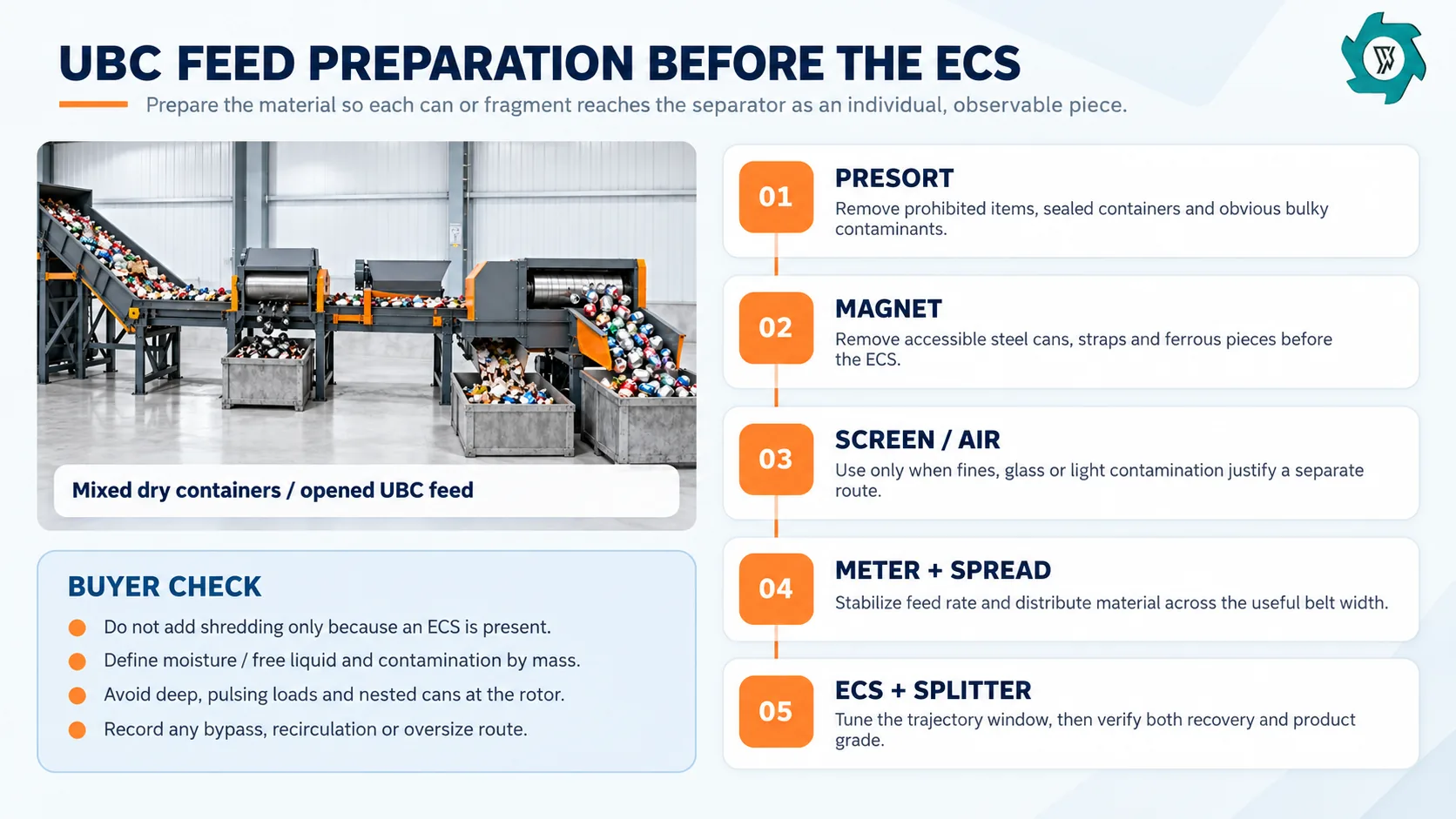
Whole Cans, Opened Bales and Shredded Can Pieces Need Different Decisions
| UBC feed condition | What the ECS can do well | Preparation priority | Common mistake |
|---|---|---|---|
| Whole cans in mixed dry containers | Recover visible aluminum containers from plastic, paper and glass-rich material. | Presort, remove steel cans, stabilize loading and keep the belt reasonably open. | Shredding everything first and creating fines that did not previously exist. |
| Opened UBC bale | Recover aluminum pieces that remain mixed with released non-metal contamination. | Open the bale without over-processing, remove straps/steel, then route fines and light material deliberately. | Assuming every opened bale needs ECS even when the aluminum fraction is already sufficiently clean. |
| Shredded can fraction | Recover conductive pieces from a controlled non-metal fraction after liberation. | Control size distribution, fines and burden depth; verify that the valuable aluminum has not moved into undersize. | Using one splitter setting across a very broad size and shape distribution. |
The separate shredded UBC size and fines guide deals with accepted size windows, fines, screening and size-based mass accountability. For an ECS purchase, that information becomes an input to the test plan rather than the subject of the test itself.
Treat ECS Settings as a Recorded Operating Window, Not a Magic Number
Operators usually have several variables that influence the landing zones: feed rate, distribution across the belt, belt speed, rotor configuration or speed where the machine permits adjustment, and splitter position. The exact controls vary by design, so a quotation should state which settings are actually adjustable and which are fixed by the machine.
The mistake is to change two or three variables at once until the aluminum “looks right.” A cleaner approach is to freeze the feed condition, record the baseline settings, change one variable, and sample both product and residue. If recovery improves while non-metal carryover increases sharply, the change may not be an improvement. If grade improves because the splitter is moved farther from the belt while more cans fall into residue, the plant may simply be trading saleable aluminum for a visually cleaner product.
Research and modeling of ECS both emphasize that particle trajectory is the result of electromagnetic force combined with gravity, velocity, geometry and particle behavior.[1][2] That is why the operating window must be validated on representative material and at realistic continuous loading.
Recovery and Grade Are Different — Report Both
Recovery asks how much of the available aluminum reached the accepted product. Grade asks how much of the accepted product meets the agreed UBC or aluminum product specification. A separator can produce high recovery and poor grade if the splitter captures too much non-metal. It can also produce a very clean product and poor recovery if the splitter rejects too many cans.
Aluminum recovery (%) = aluminum mass in accepted UBC product ÷ aluminum mass in accepted input × 100
Accepted product grade (%) = mass meeting the agreed UBC product specification ÷ total accepted product mass × 100
Determine the aluminum mass in the accepted input either from a representative composition sample taken before the run or from the measured aluminum mass across all bounded output streams. Use the same method for every comparison. If the buyer specifies a UBC product rather than total aluminum purity, non-UBC aluminum should be classified separately instead of automatically being counted as conforming product.
The important phrase is “aluminum mass,” not total stream weight. If the residue bin weighs 400 kg, that number does not tell you whether it contains 1 kg or 40 kg of missed aluminum. Likewise, a 500 kg UBC product stream can look bright and metallic while still carrying a meaningful amount of plastic, paper or glass.
For a can-capture project at a material recovery facility, the economic objective may be to recover cans that otherwise leave with residue or another commodity. CMI has reported MRF studies in which a meaningful share of UBC can be missorted, and it documents facilities that added secondary can-capture equipment to recover additional aluminum.[6] Those examples support the value of measuring the actual loss point, but they are not universal recovery guarantees for another plant.
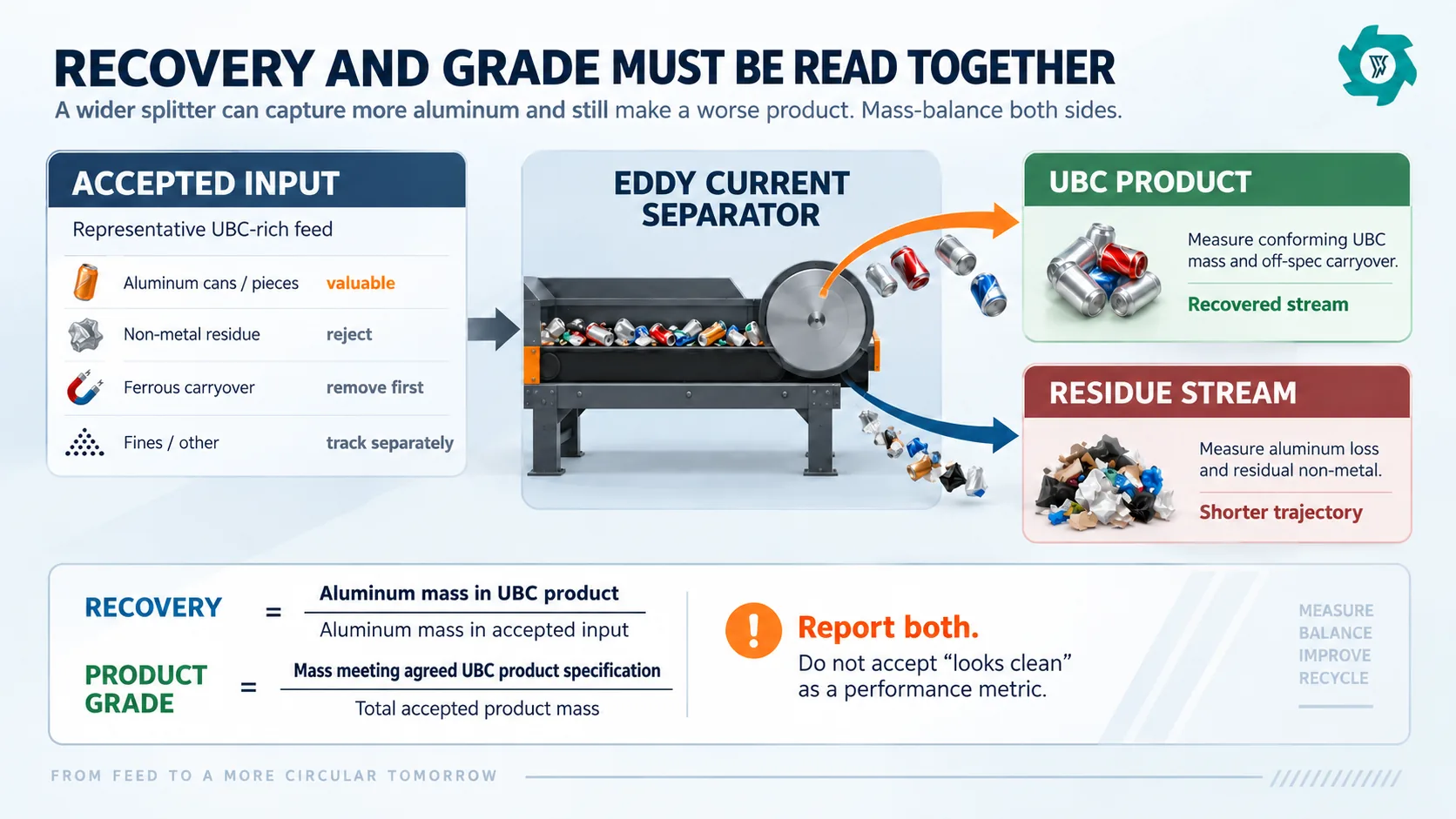
Track Where the Aluminum Actually Goes
A single “recovery percentage” can hide the wrong loss mechanism. A good mass balance separates the major streams so the buyer can see whether aluminum is being lost before, at or after the ECS.
- Ferrous output: aluminum attached to steel can leave upstream with the magnetic fraction.
- Fines or dust: aggressive opening, impact or screen handling can move thin aluminum into an undersize stream.
- Non-metal residue: this is the classic ECS loss point and should be sampled for missed cans or fragments.
- Oversize or return: a recirculation loop can hide unprocessed aluminum if it is not weighed separately.
- Retained material: cans can remain in hoppers, chutes, conveyors or collection boxes after the timed run.
- Unexplained difference: the mass-balance gap should be stated separately, not merged into retained material.
This discipline prevents the separator from being credited for losses that occurred elsewhere. If the magnet steals 3% of the aluminum before the ECS, an excellent ECS result does not repair the line recovery. If an air classifier removes light aluminum, the same logic applies.
Troubleshooting Common UBC Eddy Current Problems
| Symptom | Check first | Useful test |
|---|---|---|
| Aluminum cans appear in residue during high feed | Burden depth, surging, overlapping cans, unstable feeder discharge. | Hold separator settings constant and reduce feed to a stable layer; compare residue samples by time period. |
| Product grade drops when recovery is increased | Splitter moved too aggressively, broad trajectories, collisions at the discharge. | Sample both streams at several recorded splitter positions and plot recovery against grade. |
| Good hand-fed demo, weak production result | Hand spreading created an unrealistically easy feed. | Repeat with continuous upstream equipment at the agreed throughput and record burden variation. |
| Steel cans or straps reach the ECS product | Magnet position, liberation, deep burden at the magnet, hidden ferrous pieces. | Audit the magnetic reject and ECS feed; correct ferrous removal before retuning the ECS. |
| Wet cans travel unpredictably | Residual liquid, wet labels/paper, sticking on the belt. | Separate a dry and wet sample, record moisture condition and compare feed behavior before changing hardware. |
| Small aluminum appears in dust/fines | Over-shredding, brittle contamination, screen cut and transfer impact. | Weigh and sample the undersize stream; do not infer aluminum loss from total fines weight alone. |
| Results change after a feed-source change | Can condition, contamination mix, container shape, moisture and non-UBC aluminum. | Re-sample the incoming lot before altering accepted machine settings. |
What Buyers Should Put in the RFQ
An RFQ for a UBC eddy current separator should describe the material before it describes the machine. “Aluminum cans, 3 t/h” is not enough because the same weight can mean clean deposit-return cans, a mixed container stream, or opened mill bales with glass and paper contamination. Each case creates a different separator duty.
Provide representative photos and video, loose/compacted/baled condition, the planned upstream process, approximate steel and non-metal contamination by mass, residual liquid or moisture condition, dominant can condition, presence of non-UBC aluminum, target accepted throughput, desired output and the buyer’s sampling method. State whether fines and oversize are bypassed, screened or returned. Also state what equipment is already installed so the supplier knows whether the quotation includes a feeder, magnet, screen, ECS, chutes, controls or only the separator itself.
For the ECS, ask the supplier to identify the proposed belt width, feed-distribution method, rotor concept, adjustable operating variables, splitter arrangement, access for cleaning and belt service, control interfaces and the test basis behind any recovery statement. YUXI’s eddy current separator product page explains the basic conveyor-and-rotor mechanism; the RFQ should go further and tie the machine to the actual UBC feed and acceptance method.
Build the FAT Around Evidence, Not a Demonstration
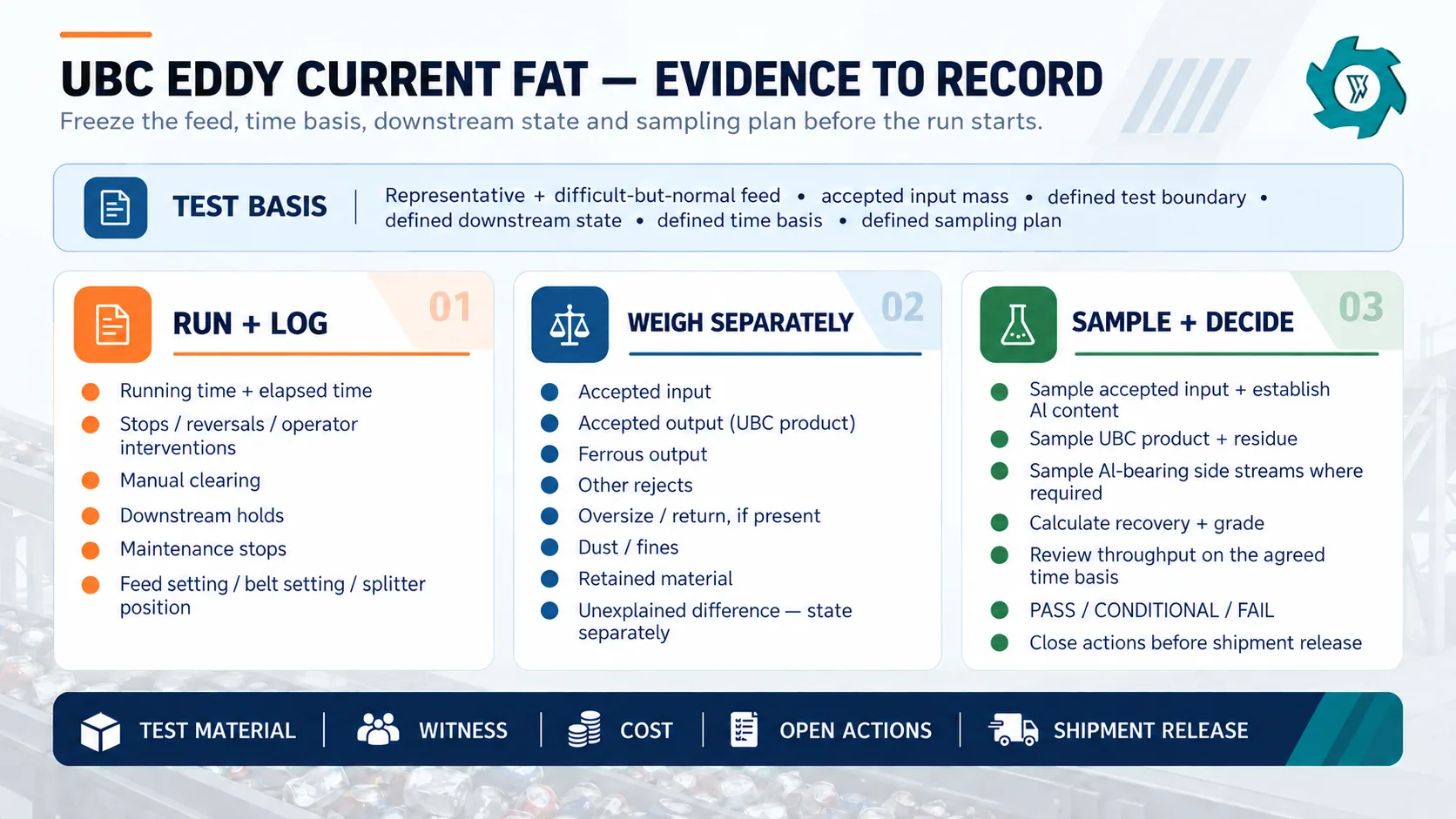
A factory acceptance test should be written before the machine is run. Use representative material plus a difficult-but-normal lot so the supplier is not testing only clean, hand-selected cans. Define the test boundary, the downstream state and the time basis before material enters the line.
Record running time and elapsed time separately. Log stops, reversals, operator interventions, manual clearing, downstream holds and maintenance stops. For the mass balance, weigh accepted input and accepted output separately. Then weigh ferrous output, other rejects, oversize or return material if present, dust or fines, and retained material. State any unexplained difference as its own line item.
Sampling should cover the accepted input, accepted UBC product and residue stream at minimum. If input aluminum content is reconstructed from the outputs instead of measured directly, every output stream that may contain aluminum must be weighed and sampled on the same test boundary. If the line includes a magnet, sample or inspect the ferrous reject for aluminum carryover. If it includes screening or air separation, sample those side streams as well when they carry meaningful metal value.
Reviews of aluminum scrap preparation emphasize that sorting, comminution and other pretreatments are valuable only when they improve scrap quality enough to justify their cost and complexity.[7] The Can Manufacturers Institute’s recycling roadmap likewise shows sorting and mill preparation as distinct stages in the can-to-can chain rather than one universal machine package.[8]
When an ECS Is the Right Investment — and When It Is Not
An ECS is a strong investment when there is a repeatable UBC loss in a dry non-metal stream and the upstream process can present that material consistently. A common example is a mixed dry-recyclables line where aluminum cans are otherwise leaving with residue or another commodity. Another is an opened UBC preparation line where non-metal contamination remains after ferrous removal and physical cleaning.
It is a weak investment when the incoming UBC is already clean enough for the buyer, when the main contamination is ferrous and can be solved magnetically, when the feed is too wet or chaotic to present consistently, or when the valuable aluminum is mostly being lost to fines created upstream. In those cases the correct project may be better presort, bale opening, magnetic separation, screening, feeder control, or simply a tighter receiving specification.
That decision is more useful than chasing a universal recovery number. The machine should be judged inside a defined process boundary with real feed, real loading and measured outputs. When the upstream preparation is stable and the acceptance test closes the mass balance, the ECS becomes much easier to buy, operate and troubleshoot.
Send the Feed Data Before You Ask for a Recovery Number
For a UBC eddy current review, provide representative material photos or video, feed condition, contamination by mass, moisture or residual-liquid condition, upstream equipment, required tons per hour, current aluminum loss point, target product and available workshop layout. YUXI can then review whether the project needs an ECS, what feed-preparation equipment belongs ahead of it, and how the FAT should measure the result.
Frequently Asked Questions
When does a UBC line actually need an eddy current separator?
Use an eddy current separator when aluminum cans or can pieces must be recovered from a prepared dry stream that still contains non-metal material. A clean UBC fraction that only needs inspection and baling may not need an ECS at all.
Should aluminum cans be shredded before eddy current separation?
Whole-can recovery can work well in mixed dry container streams when cans are free enough to separate. Shredding or bale opening is justified when dense bales, nested cans or trapped contamination must be opened, but unnecessary size reduction can create fines and extra loss points.
Why is a magnetic separator normally placed before the ECS?
The magnet removes accessible steel cans, straps and other ferrous pieces before the high-speed eddy current stage. This reduces ferrous carryover, protects downstream equipment and gives the ECS a better-defined non-ferrous-versus-non-metal separation job.
How do you measure aluminum recovery on an eddy current separator?
Measure the aluminum mass in the accepted UBC product and divide it by the aluminum mass in the accepted input on the same test boundary. Sample the residue as well, because total residue weight alone does not show how much aluminum was lost.
What is the difference between recovery and product grade?
Recovery measures how much of the available aluminum reaches the accepted product. Grade measures how much of the accepted product meets the agreed UBC or aluminum product specification. A splitter change can increase recovery while reducing grade, so both values should be reported together.
What should be recorded during a UBC eddy current FAT?
Define the test feed, test boundary, downstream state and time basis before the run. Record running and elapsed time, stops, reversals, operator interventions, manual clearing, downstream holds and maintenance stops. Weigh accepted input and accepted output separately, then ferrous output, other rejects, oversize or return material if present, dust or fines and retained material, and state any unexplained mass difference separately.
References
- Minerals Eng.: ECS review.
- Nagel: analytic model.
- EPA: AP-42.
- OSHA: machine guarding.
- Aluminum Association: can guide.
- CMI: MRF examples.
- Metals: scrap melting.
- CMI: recycling roadmap.
Online Message