




 Request Quote



Choose the Baler Backward from the Bale You Need
Choosing a UBC baler starts with the material coming into the machine and the bale that needs to come out. Feed volume, loading method, discharge arrangement, and actual cycle time all affect whether the machine can keep pace. Hydraulic force alone does not determine baler performance. The machine also needs to take in loose cans reliably and produce bales with a consistent size and weight.
A useful RFQ should first describe the UBC feed as it will actually arrive at the baler. Are the cans loose, flattened, or already partly compacted? Give the expected feed rate and approximate volume, and mention any draining or magnetic cleaning done before baling. The supplier also needs to know how the cans enter the machine. For the finished bale, state the size and weight you can handle, any density or customer requirement, how it will be tied, and what equipment will take it away.
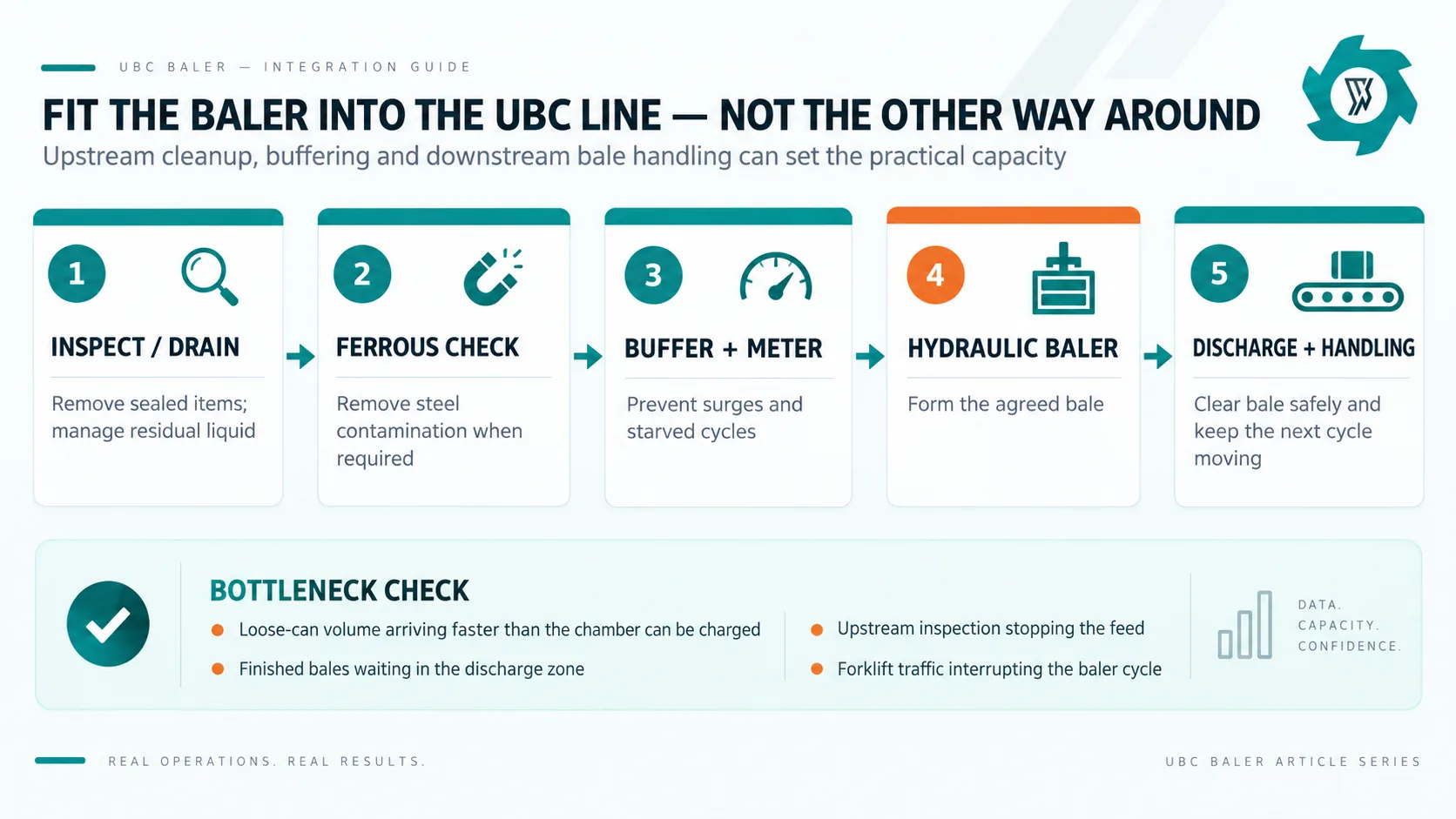
This guide focuses on baler selection. Receiving rules, bale-grade definitions and downstream UBC preparation are covered elsewhere. The broader UBC aluminum can recycling line shows where baling sits relative to inspection, ferrous removal, mixed-stream recovery and bale opening.
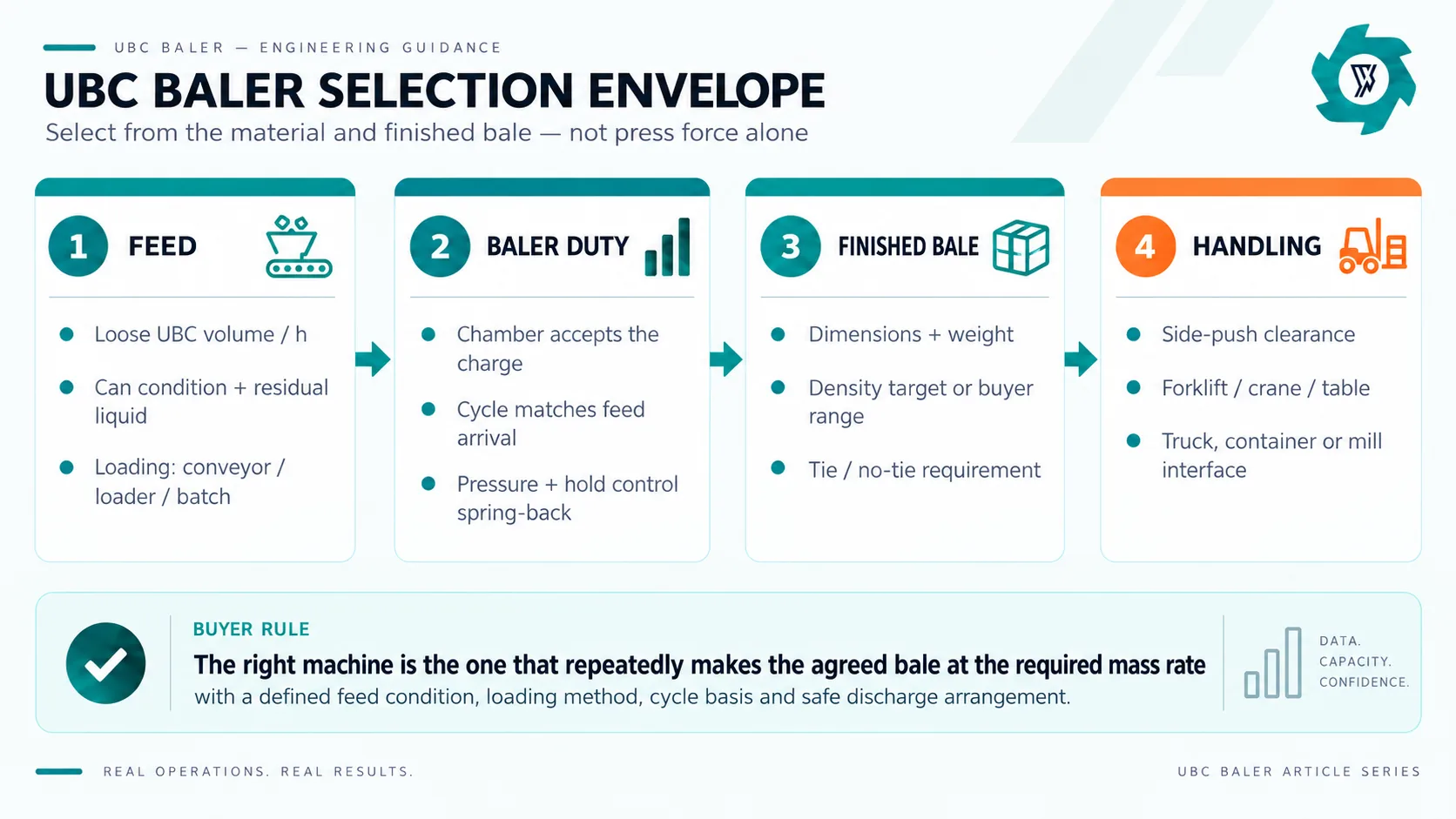
1. First Decide Whether Baling Is Actually the Next Process Step
That distinction matters because UBC projects arrive at the baler from different routes. A collection center may receive mostly clean loose cans and only need visual inspection, drainage and compression. A MRF may recover aluminum cans from a mixed dry stream and need magnetic and eddy-current separation before baling. A mill-preparation line may instead receive dense inbound bales and open them for cleaning, making the baler a possible final rebaling step rather than the first major machine.
In practice, the baler should be placed after the last quality-control step that must see loose material. Once the cans are compressed, inspection becomes less representative of the interior. Buyers should therefore define what contaminants are accepted before the baler and what must be removed upstream. That keeps the baler selection problem focused on densification.
2. Describe the UBC Feed in Two Units: Mass and Loose Volume
Loose used beverage cans are deceptive. The tonnage may look modest, while the physical volume arriving at the feed box is large. A specification written only as “2 t/h of aluminum cans” misses the question that often controls the layout: how much loose material has to enter the chamber every minute, and how consistently can the conveyor or loader place it there?
Record the required mass rate, but also record the loose feed condition. Are the cans intact, crushed, flattened or a mixture? Do they arrive from bags, cages, a sorting belt, a bunker or a loader bucket? Is there residual liquid that adds mass without contributing useful aluminum? Does the feed surge when a storage bunker discharges, or is it relatively steady? A machine that performs well with pre-flattened cans can need a different charging pattern when the same mass arrives as whole hollow containers.
For supplier comparisons, use a feed envelope rather than one average sample. Include a normal case and a difficult-but-normal case. The latter might contain more springy whole cans, a higher loose volume per tonne, or the upper end of normal moisture and contamination. This is more useful than showing one handpicked clean batch during a factory test.
Do not treat bulk density as a fixed universal number. It changes with can condition and handling. The useful engineering point is that lower loose density increases the chamber volume and charging work required per tonne. That can make the loading system, not hydraulic force, the limiting part of the baling cycle.
3. Define the Finished Bale Before Comparing Press Force
The finished bale is the real output specification. Write down the bale cross-section, acceptable length range, target weight, permitted variation, required integrity, tying method if used, and how the bale will be lifted and transported. If a buyer or mill uses a recognized commercial UBC specification, reference that agreement in the RFQ.
ReMA’s 2026 ISRI Specifications describe Taldon as baled aluminum used beverage can scrap and publish density limits that differ for flattened and unflattened UBC. Those values are commercial material definitions, not baler settings. The important procurement lesson is to translate the accepted bale condition into a machine test: make the bale from representative feed, weigh it, measure it, and calculate or otherwise verify the required bale condition using the agreed method.[1]
If your receiving or sales contract already defines density, dimensions, moisture and contamination, use the same language when writing the baler requirement. The separate guide to UBC bale specifications explains those receiving variables in detail. For baler selection, the key is simply to avoid a mismatch between the bale your customer accepts and the bale the press is designed to discharge.
Also check bale geometry against logistics. A dense bale that is awkward for the site forklift, does not stack safely in the planned storage pattern or wastes container space can create a handling problem even when the press itself works perfectly. Finished-bale design belongs in the same discussion as chamber size and force.
4. Chamber Size Determines How the Loose Stream Enters the Machine
The chamber has to accept the real charge without repeated unsafe poking, manual leveling or excessive waiting for material to settle. For light cans, a larger loading volume can reduce the number of charges needed to build one bale, but chamber size should not be viewed in isolation. Door or lid motion, feed opening, ram stroke, compression sequence and the available footprint all change with the machine design.
Ask the supplier to explain the complete loading cycle. Can a conveyor continue feeding while the previous bale is being discharged, or must it stop? Is a buffer hopper required? Does the chamber need a controlled batch weight? What prevents material from spilling into a door path or sensor area? If the plant uses a loader, can the bucket approach without placing people in the bale-discharge zone?
YUXI’s current hydraulic scrap metal baler range publishes chamber dimensions together with nominal force, bale cross-section, bale-weight ranges and reference capacity. That is the right way to read a model table: as a set of interacting variables, not as a force ranking. The published YXJD range covers 630–2000 kN nominal force and 0.4–5.0 t/h reference throughput, but the product page also notes that actual output changes with bulk density, feed preparation, loading speed and cycle consistency.
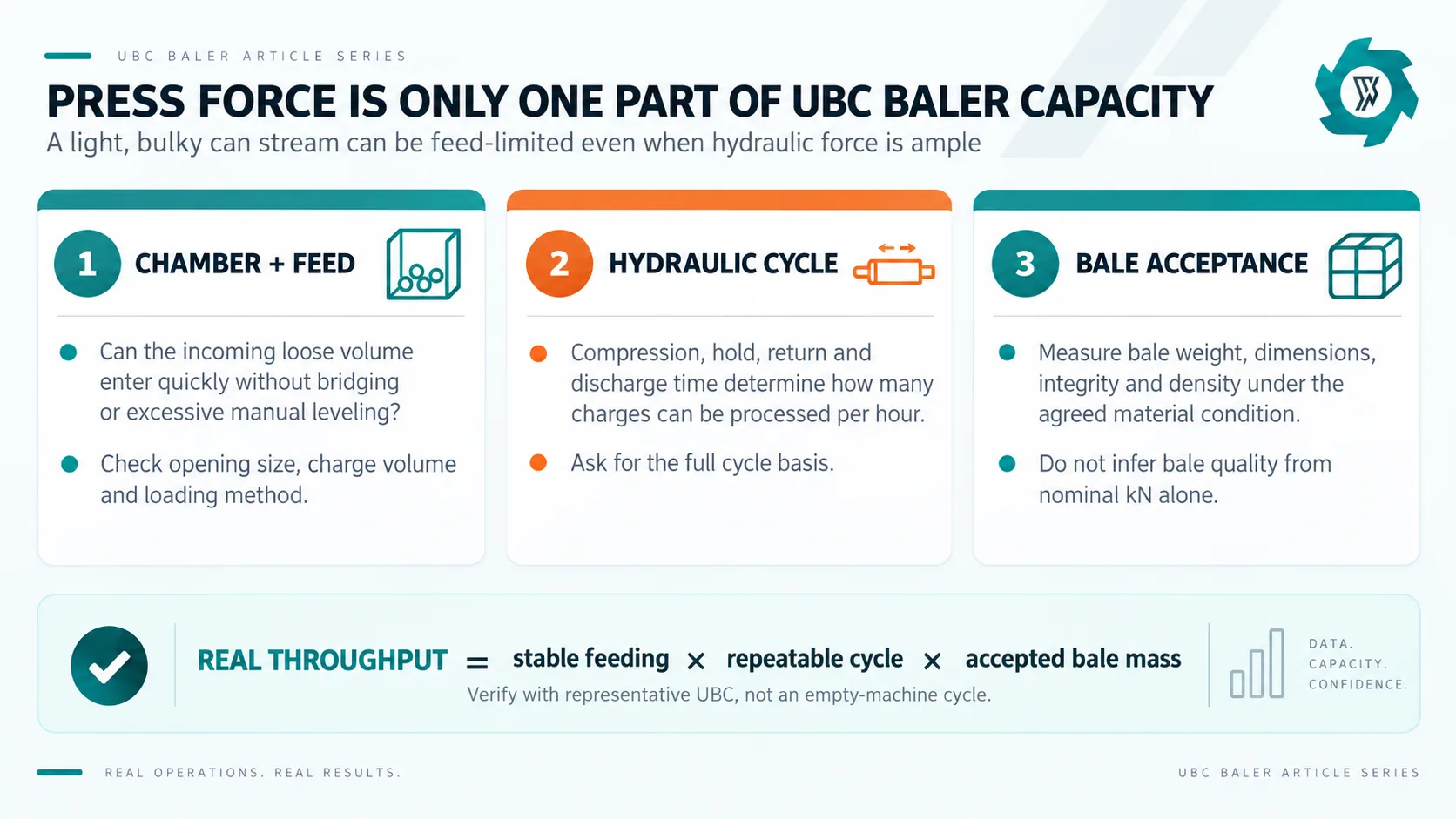
5. Do Not Use Hydraulic Force as a Substitute for Bale Performance
Nominal force tells you something important about the press, but not everything the buyer needs to know. The force is delivered through a specific platen area, stroke and compression sequence. Cans do not stay in one fixed shape while they are being pressed. They fold, slide past each other, and can open up slightly again when the ram moves back. This is why similar press force does not always give the same bale. Chamber shape and the way each pressing cycle is controlled can change the final result quite a lot.
For UBC, ask the practical questions. Does the machine reach the required bale weight without excessive cycle time? Does the bale hold its shape after discharge? Does it require a long hold time to control spring-back? Does material escape around the compression path? Is the same result achieved when the feed contains the more difficult end of the normal can mix?
A common purchasing mistake is to move to a larger press because the buyer wants more tonnes per hour. That can be unnecessary if the existing bottleneck is feeding. If the chamber sits empty while a small conveyor delivers cans, more hydraulic force will not solve the problem. Conversely, a fast loading system feeding a machine with a long compression and discharge cycle can create a full buffer and repeated upstream stops. Real production is the balance of feed, compression, hold, return, discharge and bale removal.
6. Compare the Full Cycle, Not the Fastest Stroke
Ask every supplier to define cycle time the same way. A useful basis starts when the chamber is ready to accept the next charge and ends when the finished bale has been discharged and the machine is ready again. If a bale is formed from several charges, record the number of charge cycles per bale. If tying is manual or automatic, include the tying time that affects production. If a forklift must remove the bale before the next discharge, include that operational dependency in the line study.
Empty-machine timing is not enough. Material changes cylinder loading, hold time, spring-back, door behavior and operator intervention. The test should use representative UBC and should record both running time and elapsed time. Running time helps show machine productivity while elapsed time exposes delays caused by loading, bale removal, alarms, manual clearing and other events.
For comparisons, request cycle logs. A supplier that states the number of bales, net accepted mass and elapsed test period gives the buyer something that can be checked. A supplier that states only “up to 3 t/h” without the can condition, bale target and time basis has not yet defined a comparable duty.
7. Choose the Loading Method as Part of the Baler
Manual feeding can work for small controlled operations, but it should not be assumed for an industrial line simply because cans are light. Operators should not have to reach into hazardous zones, climb onto the machine or repeatedly push bridging material by hand. As production rises, a receiving conveyor, bunker, metering conveyor or loader arrangement normally becomes part of the baler system.
Define the interface signal as well. Can the baler request feed, stop a conveyor when the chamber is full, and prevent restart during a protected part of the cycle? What happens after an alarm? The more tightly a baler is integrated into a line, the less acceptable it is to treat controls as an afterthought.
8. Plan Bale Discharge Before Freezing the Layout
Side-push discharge, tipping arrangements and other bale-release methods need clear space and a receiving plan. A machine may fit on the floor plan while the bale itself has nowhere safe to go. Check the full discharge envelope, maintenance access, forklift turning path, pedestrian separation and the temporary position of a bale if the next handling step is delayed.
The YXJD models currently shown by YUXI use side-push discharge, so the project layout must reserve space beside the baler and identify how the bale is received. For a forklift operation, the relevant question is not merely whether the truck can lift the nominal bale weight. The forks need a workable approach, the operator needs visibility, and the machine cycle should not depend on a forklift entering a hazardous moving-equipment zone at the wrong time.
9. Hydraulic System Questions That Matter to the Buyer
Hydraulic problems can stop a baler even when the main structure is still in good condition. A leaking hose, dirty oil, a worn seal, or a valve problem may be enough to interrupt production. The important thing for the buyer is not how the circuit was designed, but whether the parts that need attention can be reached easily, checked without difficulty, and replaced when necessary.
The supplier should provide the electrical requirements for the destination site, together with the main hydraulic service information. Before ordering, make sure the machine matches the power supply available at the site and that the hydraulic system can be maintained with locally available oil and filters. It is also useful to know the usual operating pressure and what happens if the oil gets too hot or the pressure rises too far. Wear items such as hoses, seals, and filters will need replacement sooner or later, so clear part numbers can save a lot of time when spares are needed.
10. Safety Must Cover Guarding and Stored Hydraulic Energy
A baler brings several hazards together in one machine, including the ram, access doors, bale discharge area, and stored hydraulic pressure. U.S. guarding requirements call for protection around operating points, pinch areas, and other moving parts.[2] In practice, the buyer should look closely at the actual guard layout, interlocks, emergency stops, and maintenance access instead of relying on a certification label alone.
Servicing creates another boundary. OSHA’s hazardous-energy rule covers maintenance where unexpected startup or the release of stored energy could injure employees and explicitly includes hydraulic energy among the energy sources that must be controlled.[3] A procurement review should therefore ask how electrical power is isolated, how hydraulic pressure is relieved or restrained, how raised or movable members are blocked where necessary, and how isolation is verified before maintenance or clearing.
Feed exclusions are equally important. Only emptied, non-pressurized cans inside the agreed UBC specification should enter a normal can-baling process. Aerosol containers, gas cylinders, batteries, unknown sealed packages and hazardous residues require separate handling. A baler increases pressure on whatever is inside the chamber; it does not make an unknown container safe.
11. Match the Baler to the Downstream Commercial Route
Some plants bale UBC as the final saleable form. Others bale mainly to reduce transport cost before the material reaches a mill that will reopen, clean or shred it. The downstream route changes how aggressively the shipping plant should optimize density, restraint and bale geometry.
If the next site will open the bales, make sure the finished package can be handled by the planned bale opener or shredder. An extremely dense package is not automatically better if it creates a difficult feed condition at the receiving plant. YUXI’s guide to choosing a UBC shredder for baled cans explains why bale dimensions, density, ties and contamination become feed variables once the bale reaches mill preparation.
For facilities handling more than beverage cans, avoid stretching a dedicated UBC baler specification across every aluminum scrap form. Profiles, sheet offcuts, wire and shavings behave differently in a chamber. The broader scrap aluminum recycling line separates these routes so the equipment can be matched to material form rather than metal name alone.
12. Common Purchasing Mistakes
Buying by kN only
Higher nominal force does not guarantee faster feeding, a shorter full cycle or a bale that matches the buyer’s geometry and density requirement.
Specifying only t/h
Loose UBC can be volume-limited. Give the supplier the can condition and loading method, not only mass flow.
Ignoring discharge
A fast press becomes a slow line when every bale waits for a forklift or blocks the next side-push cycle.
Testing with ideal cans
Use representative and difficult-but-normal feed. A clean flattened sample can hide problems caused by whole, springy cans or normal residual moisture.
Leaving bale acceptance vague
Write the dimensions, weight, density or commercial form, integrity and restraint requirement before comparing quotations.
Forgetting energy isolation
Hydraulic pressure and moving members matter during clearing and service. Maintenance access and isolation should be reviewed at procurement stage.
13. What to Put in the RFQ
A good RFQ should include the normal and difficult feed condition, loose UBC volume and mass rate, operating hours, current or planned loading system, residual-liquid condition, expected contamination, and any upstream magnetic or sorting step. For the finished product, include bale cross-section, length range, target weight, density or buyer specification, tying requirement, discharge direction and the handling equipment that will receive the bale.
Then request the proposed chamber dimensions, nominal force, hydraulic motor power, control sequence, charge method, expected number of charges per bale, cycle-time basis, reference capacity under the stated feed, bale discharge arrangement, utilities, service access, recommended spares and FAT method. If the supplier changes the assumed feed or bale target to reach a published capacity, that change should be visible in the quotation.
14. How to Run a Useful UBC Baler FAT
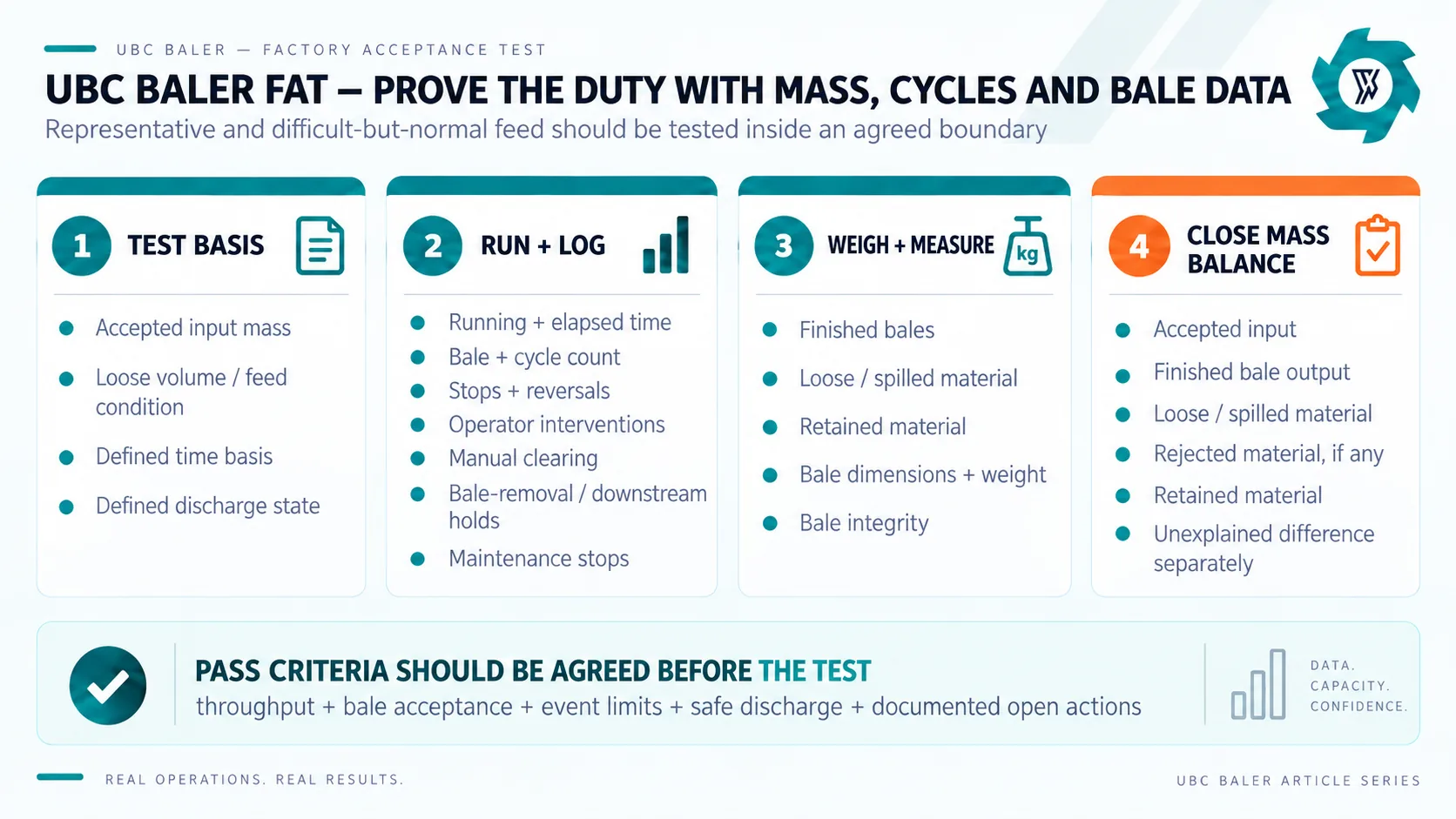
The factory acceptance test should prove the exact duty that justified the purchase. Agree the test feed, downstream or discharge state, and time basis before the run. Use enough representative material to reach stable operation. Include at least part of the difficult-but-normal feed condition if it is safe and inside the agreed machine duty.
Record accepted input mass and, where practical, the loose volume or batch count used to feed the machine. Log running time and elapsed time, bale count, cycle count, stops, reversals where applicable, operator interventions, manual clearing, bale-removal or downstream holds, and maintenance stops. If the machine has adjustable pressure, hold time or control parameters that materially affect the result, record the agreed settings so the test can be reproduced.
Weigh finished bales and record individual bale weight, dimensions and any agreed integrity checks. Keep loose or spilled material, rejected material if any, and material retained in the machine as separate categories. Do not hide the mass balance by combining retained material with an unexplained difference. The unexplained difference should be stated separately so both sides can decide whether it is within the agreed test tolerance or needs investigation.
Capacity should be reported on the agreed basis, with accepted input and finished-bale output visible. That prevents a test from appearing faster simply because material accumulated inside the machine or around the discharge area before the stopwatch stopped. A good FAT record is not a glossy production video; it is a reproducible set of mass, time, bale and event data.
15. A Practical Selection Sequence
- Confirm the process position. Bale only after the loose UBC has reached the quality condition you intend to sell or transport.
- Build the feed envelope. State mass rate, loose volume, can condition, moisture, contamination and how material arrives at the chamber.
- Write the bale specification. Define geometry, weight, density or commercial form, integrity, restraint and handling.
- Check chamber and charging. Make sure the machine can accept the real loose volume without unsafe manual intervention.
- Compare the complete cycle. Include loading, all compression stages, hold, return, tying if applicable, discharge and bale removal dependency.
- Review hydraulics, controls and safety. Confirm utilities, protection, stored-energy isolation, interlocks and service access.
- Freeze the layout last. Reserve feed, discharge, maintenance and forklift space after the machine and bale envelope are known.
- Prove it with representative material. Use an agreed FAT that reports mass, time, cycles, interventions and bale acceptance.
FAQ
What size aluminum can baler do I need for UBC?
Start with the required mass rate and loose-can volume, then define the target bale dimensions, weight and handling method. Chamber size, full cycle time, loading system and discharge arrangement must be checked together; nominal press force alone is not enough to select the machine.
Does a higher-force baler always make denser UBC bales?
No. Finished bale density also depends on can condition, chamber geometry, charge amount, compression sequence, hold time, spring-back and the target bale dimensions. Verify the finished bale with representative UBC rather than assuming density from nominal force.
Should whole and flattened aluminum cans use the same baler setting?
Flattened and whole cans can have different loose-volume, feeding and spring-back behavior. Treat can condition as part of the feed envelope and confirm settings during commissioning or FAT.
How should UBC baler capacity be tested?
Use representative and difficult-but-normal feed inside an agreed test boundary. Record accepted input mass, running time and elapsed time, bale and cycle counts, stops, reversals where applicable, operator interventions, manual clearing, bale-removal or downstream holds, and maintenance stops. Weigh finished bales, loose or spilled material, rejected material if any, and retained material separately, and state any unexplained mass difference separately.
What information should I send a baler supplier?
Send UBC photos or video, loose or flattened condition, hourly mass and loose volume, loading method, operating hours, contamination and moisture condition, target bale size and weight, density or buyer requirement, tying preference, discharge direction, handling equipment, power supply and available layout space.
Prepare a UBC Baler Proposal from the Real Feed and Bale Requirement
For model selection, provide representative UBC photos or video, loose-can condition, required mass rate and loose volume, loading method, target bale dimensions and weight, density or buyer requirement, tying preference, discharge handling, power supply and available floor space. The proposal should be built around the complete operating cycle and the bale your customer will actually accept.
References
- ReMA: UBC specs.
- OSHA: machine guarding.
- OSHA: lockout tagout.