




 Request Quote



Material coming off a UBC shredder is rarely consistent. Larger can sections may travel beside lids, tabs, thin flakes, fines, dirt, or bits of glass and aluminum. Looking only at the average size can hide that spread. What matters is whether the whole discharge works with the screen and sorting equipment that follow, and whether it still fits the buyer’s specification.
For a plant buyer, the useful question is therefore not “What shred size does the machine make?” It is: What particle-size distribution reaches each separation stage, how much aluminum moves into the fine fraction, and what measurable output window gives the best recovery without unnecessary over-shredding? The UBC aluminum can recycling line should be configured around that material behavior. Dense bales may need opening and controlled size reduction, but clean loose cans do not automatically benefit from being cut smaller.
Bale density, moisture and receiving inspection are covered separately in the UBC bale specifications guide. Machine torque, bite, drive configuration and bale handling belong in the UBC shredder selection guide. Here, the objective is to connect particle size with screening, separation, fines loss, sampling and acceptance testing.
1. Particle Size Is a Distribution, Not a Single Number
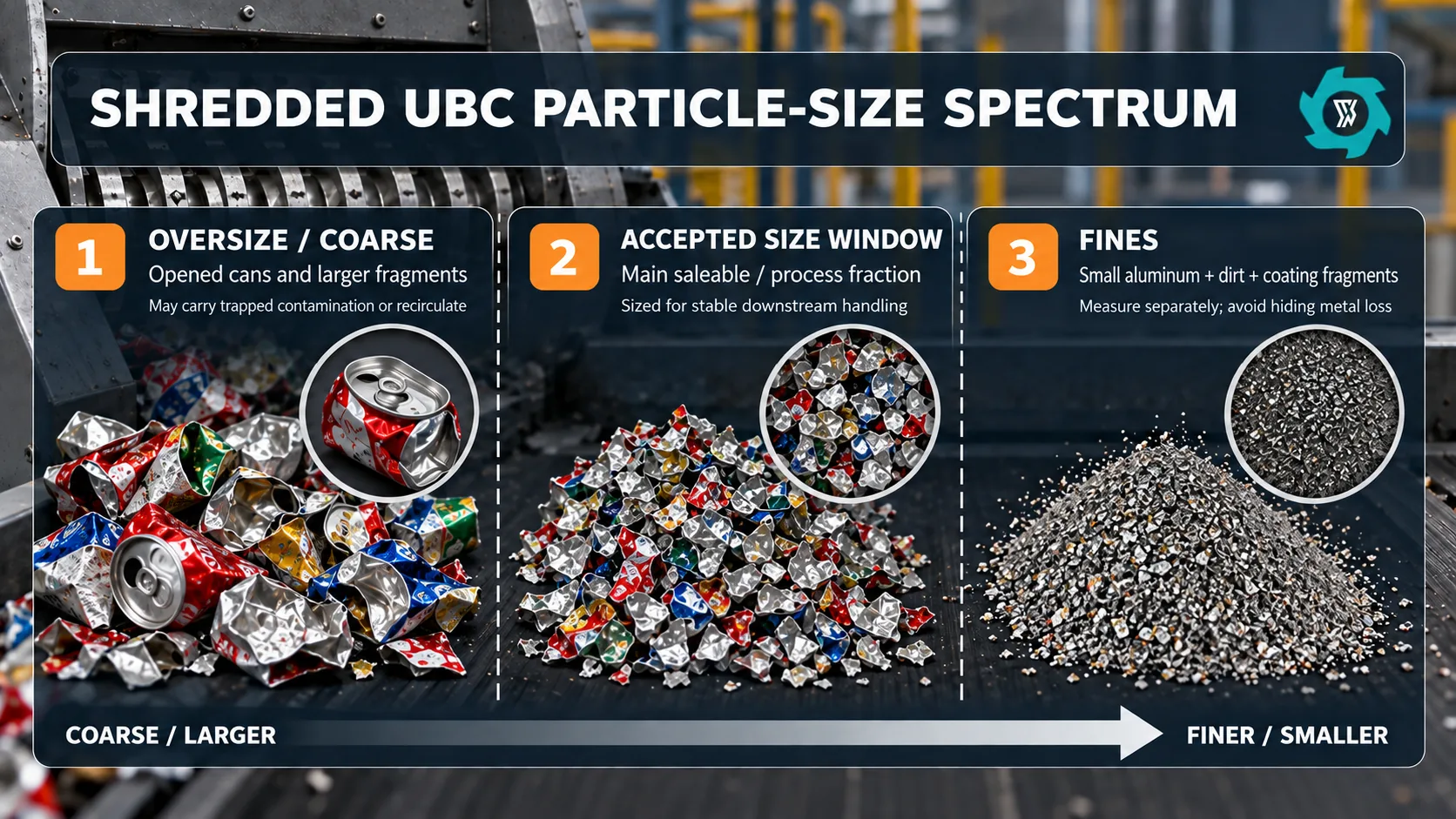
A shredder may be described with a nominal opening, blade spacing or target piece size, but none of those values means every can fragment leaves at the same dimension. Thin aluminum deforms, folds and tears. A long narrow strip can pass through an opening even though one dimension is much larger than the aperture. Nested cans may leave as partially opened groups. Brittle non-metal contamination may break much finer than the aluminum around it.
That is why a useful output specification separates at least three zones: oversize or coarse material, an accepted process window, and fines. The plant may also add intermediate sieve classes when downstream sorting is sensitive to size. The purpose is to show where metal value is physically reporting.
Two lines can have the same “average size” and behave very differently. One may have a narrow distribution around the target. Another may combine large unliberated clumps with a substantial fine tail. The second line can create more recirculation, more dust loading and more aluminum loss even when its arithmetic average looks similar. For purchasing and commissioning, percentile or sieve-fraction data are much more informative than one nominal size.
2. Talcred Makes Fines a Commercial Control Point
When shredded UBC is sold under the Talcred commercial description, particle size is not only a process variable. The current ISRI/ReMA specification states that Talcred should have a density of 12–17 lb/ft³ (193–273 kg/m³) and contain a maximum of 5% fines smaller than 4 mesh, listed as 6.35 mm. It also requires magnetic separation and excludes named foreign substances and non-UBC aluminum.[1]
That 5% figure should not be misused as a universal process target. A plant selling to a mill under a different contract may use another screen cut, another sampling plan or another maximum. Likewise, a plant may intentionally screen below 6.35 mm for internal process reasons without calling the resulting product Talcred. The important lesson is that the buyer and seller need the same definition of “fines.” A percentage without a screen size, sample method and lot basis is incomplete.
The separate UBC scrap specification comparison explains the commercial differences among Taldon, Talcred, Taldack and Taldork. For this discussion, Talcred matters because it shows how a size fraction can become part of the saleable product definition.
3. Why Too Much Coarse Material Can Reduce Effective Recovery
Large opened can pieces retain more metal mass per particle and are usually easier to handle than very light flakes or dust. The problem starts when “coarse” actually means insufficiently opened. A folded bale section can trap steel cans, straps, plastic or glass inside aluminum layers. A magnet can only remove ferrous material that is physically exposed to its field and able to separate from the surrounding mass.
Oversize can also create unstable screen loading. Large flat pieces may bridge across apertures, carry fines forward, or shield smaller particles. If the line sends oversize back for another pass, that recirculation should be measured. A machine can appear to have high first-pass throughput while the plant quietly processes the same aluminum several times.
The objective is therefore not maximum reduction. It is sufficient opening and liberation. In practice, the best coarse limit is the one that releases the contaminants and presents material consistently to the next machine without producing an unnecessary fine tail.
4. Screening Gives the Line a Measurable Size Boundary
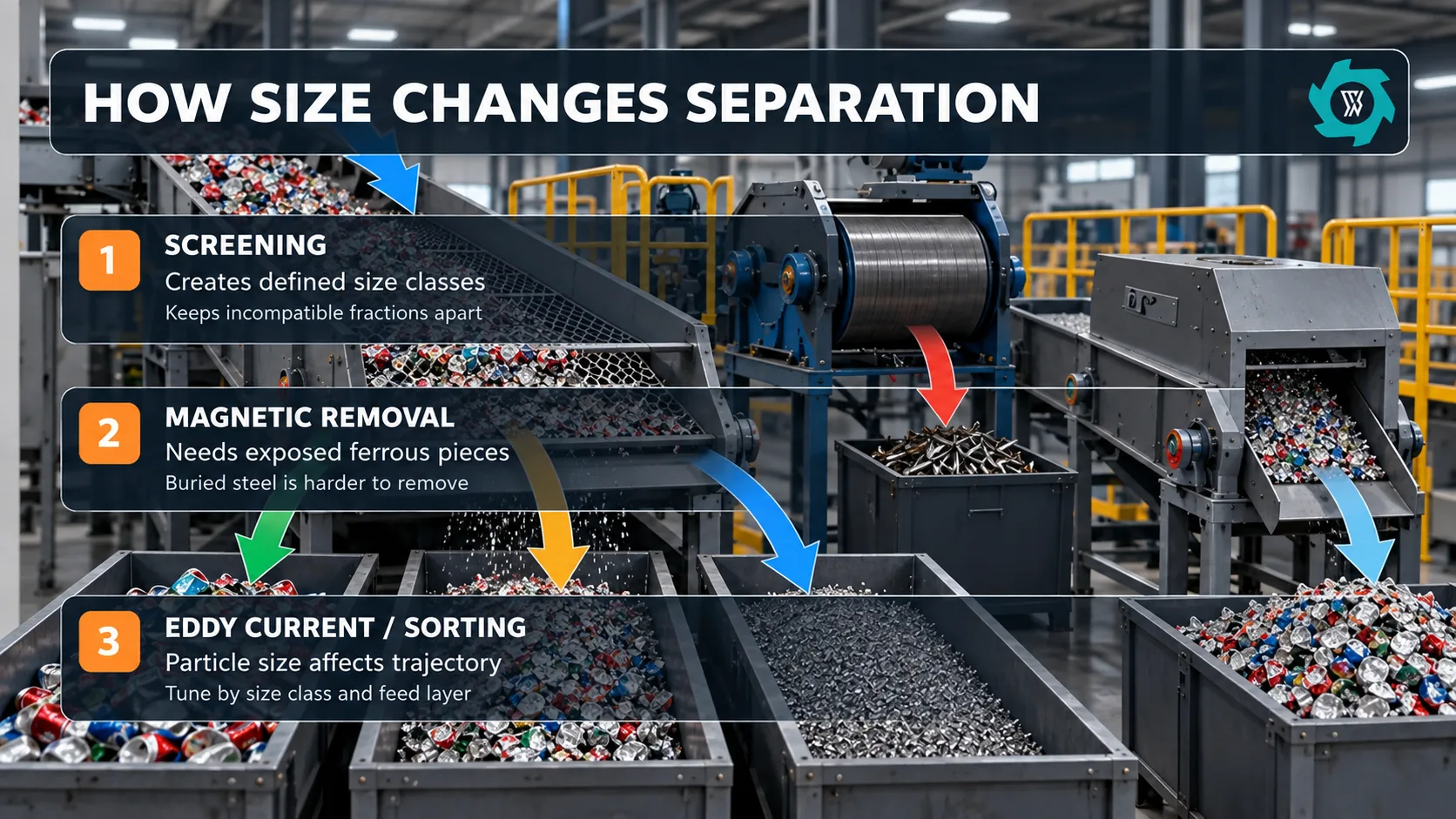
A screen does more than remove dirt. It converts a broad shredder discharge into defined size classes. That matters because different fractions can be handled with different separation settings. An undersize fraction may contain dirt, glass, coating debris and aluminum fines; a main fraction may be suitable for magnetic or eddy current separation; an oversize fraction may need inspection or controlled recirculation.
Screen performance depends on more than aperture. Bed depth, feed rate, particle shape, moisture, blinding and the tendency of flattened aluminum to cover openings all affect what actually passes. For a thin, irregular material such as UBC, a screen analysis should be verified with real product rather than predicted from the nominal hole size alone.
This is also where mass accountability becomes important. If 4% of the input reports to undersize, that does not mean aluminum loss is 4%. The undersize could be mostly dirt, or it could contain a high proportion of valuable aluminum. A buyer should ask for both the mass of the size fraction and a useful estimate or sample of its material composition.
5. Keep Eddy Current Separation as a Downstream Check, Not the Main Size Target
Particle size does affect eddy current separator behavior, but that subject is broad enough to deserve its own treatment. The separate aluminum eddy current particle-size guide covers rotor behavior, belt presentation, particle shape, splitter position and size-class testing in detail.
For UBC, use eddy current separation as a validation point. Published research confirms that particle size changes separation behavior and that the optimum depends on the separator and operating condition.[2] Other studies on shredded scrap show that very fine conductive particles can become difficult to recover and that screening can improve feed consistency.[3] Those studies explain the mechanism, but they do not establish a guaranteed UBC recovery curve.
If the UBC route includes eddy current separation, test the actual UBC size classes at the planned belt loading. Do not justify extra shredding only because a separator is present. If a cleaner, coarser can fraction already meets the product requirement, making it smaller can create more fines without creating more recoverable value.
6. Fines Are Not One Material
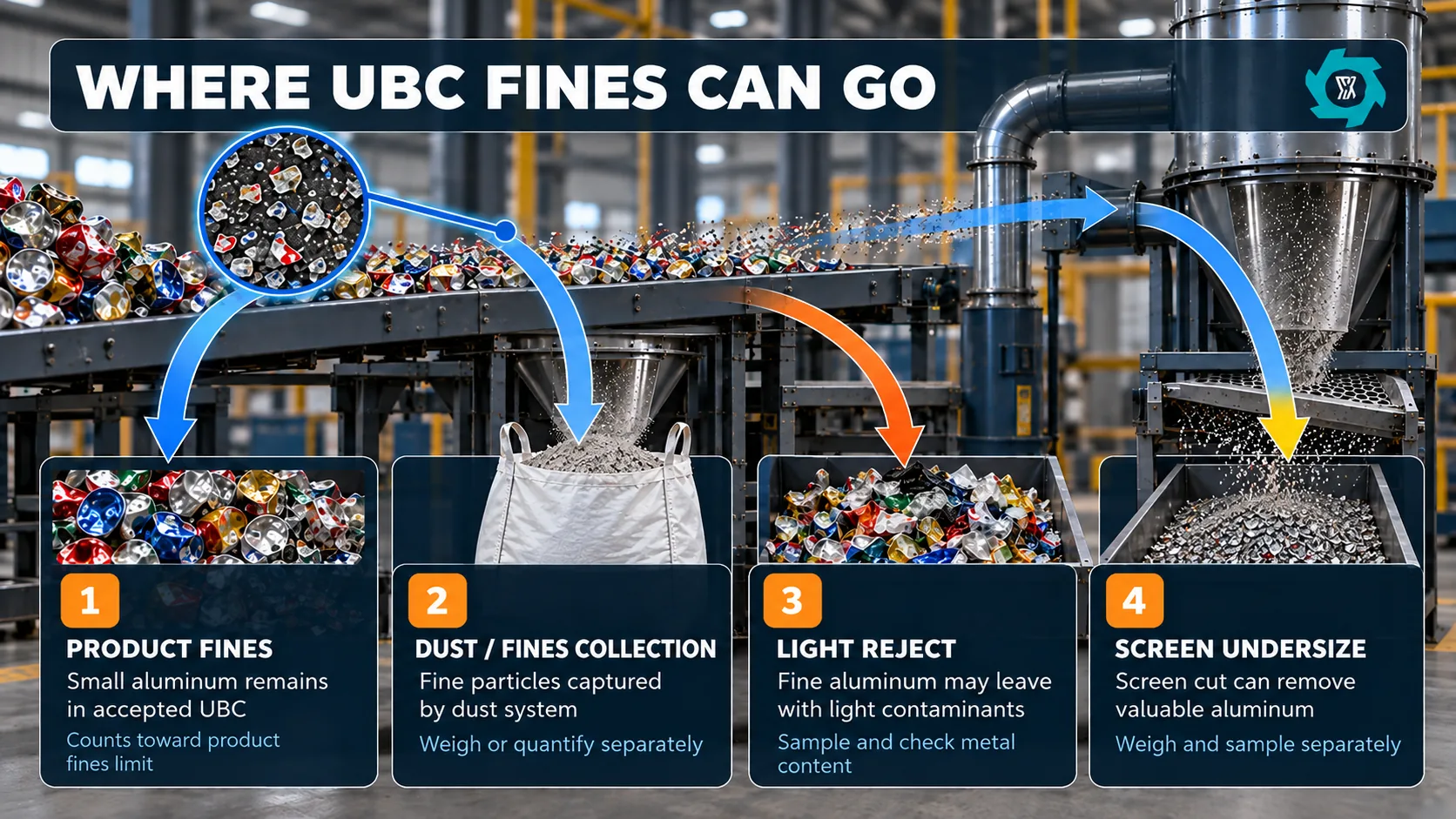
The word “fines” can hide several very different streams. Some fines are aluminum: torn can wall, lid fragments, tabs or small flakes. Some are non-metal: dirt, glass, label material, coating residue and dried contamination. Some become airborne dust; some stay on the belt; some fall through a screen; some report to an air-separation reject.
For that reason, a plant should avoid reporting only “fines = 3.8%” without saying where the fraction came from. Product fines inside accepted UBC are different from dust captured by a collector. Screen undersize is different from light reject. Each stream has a different commercial meaning and a different opportunity for metal loss.
Small aluminum pieces can be especially easy to lose because their value is hidden inside a low-mass reject stream. A dust or undersize bin may look visually dominated by dirt while still carrying enough aluminum to matter over thousands of operating hours. Periodic hand sorting, screening or laboratory characterization can show whether that stream is truly waste or whether the size-reduction step is creating avoidable loss.
7. What Creates Excessive UBC Fines?
Too many reduction passes. Reprocessing material that already meets the next-stage requirement converts acceptable pieces into smaller fragments without necessarily releasing more contamination. If oversize is recirculated, measure the recirculating mass and the number of passes.
Aggressive cutting or impact for the actual duty. A bale-opening job does not need the same reduction intensity as a line preparing a tightly controlled shredded product. Excessive speed, small clearances, repeated impacts or an unnecessarily fine downstream crusher can enlarge the fine tail.
Dry brittle contamination. Glass, dirt and dried residues can fracture into very small particles. This may raise total fines even when aluminum breakage is acceptable. That is why a simple fines percentage cannot diagnose the shredder by itself.
Worn or damaged cutting components. Wear can change bite, tearing pattern and recirculation behavior. A machine that once opened cans cleanly may begin folding, rubbing or repeatedly reworking material. Track particle-size distribution over maintenance cycles instead of waiting for a dramatic throughput failure.
Unstable feeding. Surges can overload a screen or downstream separator, while starvation can change how pieces are presented. A stable feed layer is part of size-control performance because it determines whether the separation equipment sees the distribution it was tuned for.
8. Define an Output Window from the Downstream Process Backward
A useful RFQ defines what the next operation needs and allows the equipment supplier to prove a distribution around that requirement. For example, the buyer may define a maximum oversize fraction, a principal accepted range, a fines cut at a named sieve, and a maximum fines percentage.
The window should also state what happens to material outside it. Oversize may be returned, manually inspected or accepted if it is already fully opened. Fines may remain in product up to the commercial limit, be separately collected, or be rejected. Without those dispositions, the supplier can meet a size table while sending too much metal to a non-product stream.
Do not choose the lower size bound from a catalog. Choose it from a material-balance and downstream-performance test. If making the product smaller does not improve contaminant release or separation, the extra breakage is hard to justify.
9. How to Sample and Measure Shredded UBC Size
Particle-size data are only as reliable as the sample. Shredder discharge can segregate during conveying: heavy or compact pieces may follow a different path from light flakes; fines can settle at transfer points; oversize can arrive in bursts after a dense bale section. A single scoop from the top of a bin is rarely representative.
For acceptance work, define the lot and sampling interval before the test. Collect increments across the operating run. Combine or analyze those increments under the agreed method. Record the total sample mass so the sieve fractions can be reconciled.
Use a sieve stack or defined screens appropriate to the commercial and process boundaries. If Talcred is the target, the 4-mesh/6.35-mm boundary must be represented because the commercial specification uses it.[1] The plant may add larger screens to measure the main product window and oversize. Report each fraction as mass and percentage of the test sample.
Thin UBC pieces create measurement complications. A long curled strip may pass one way and not another. A nested fragment can break apart during sample handling. For that reason, the agreed procedure should specify whether the sample is gently handled as received, whether clumps are manually opened, and how lodged particles are treated. The goal is repeatability between buyer and supplier, not laboratory theater.
10. Connect Particle Size to a Full Mass Balance
Size analysis alone cannot tell the buyer how much aluminum was recovered. The FAT should reconcile the whole test. Record accepted input mass and then weigh outputs separately: accepted product, ferrous output, other rejects, oversize or return material if present, fines or dust, and material retained in the line.
Then connect size classes to those streams. If a screen creates an undersize bin, weigh it and sample it. If dust collection removes a fine fraction, weigh or otherwise quantify the captured material where practical and inspect its aluminum content. If oversize recirculates, distinguish first-pass discharge from final accepted output.
This prevents a common reporting problem: a line shows a high gross throughput and a good-looking main product while valuable aluminum quietly accumulates in fines, return loops or housekeeping residue. Recovery should be discussed on an accepted-output basis, not only on material entering the shredder.
11. A Practical FAT for Size, Fines and Recovery
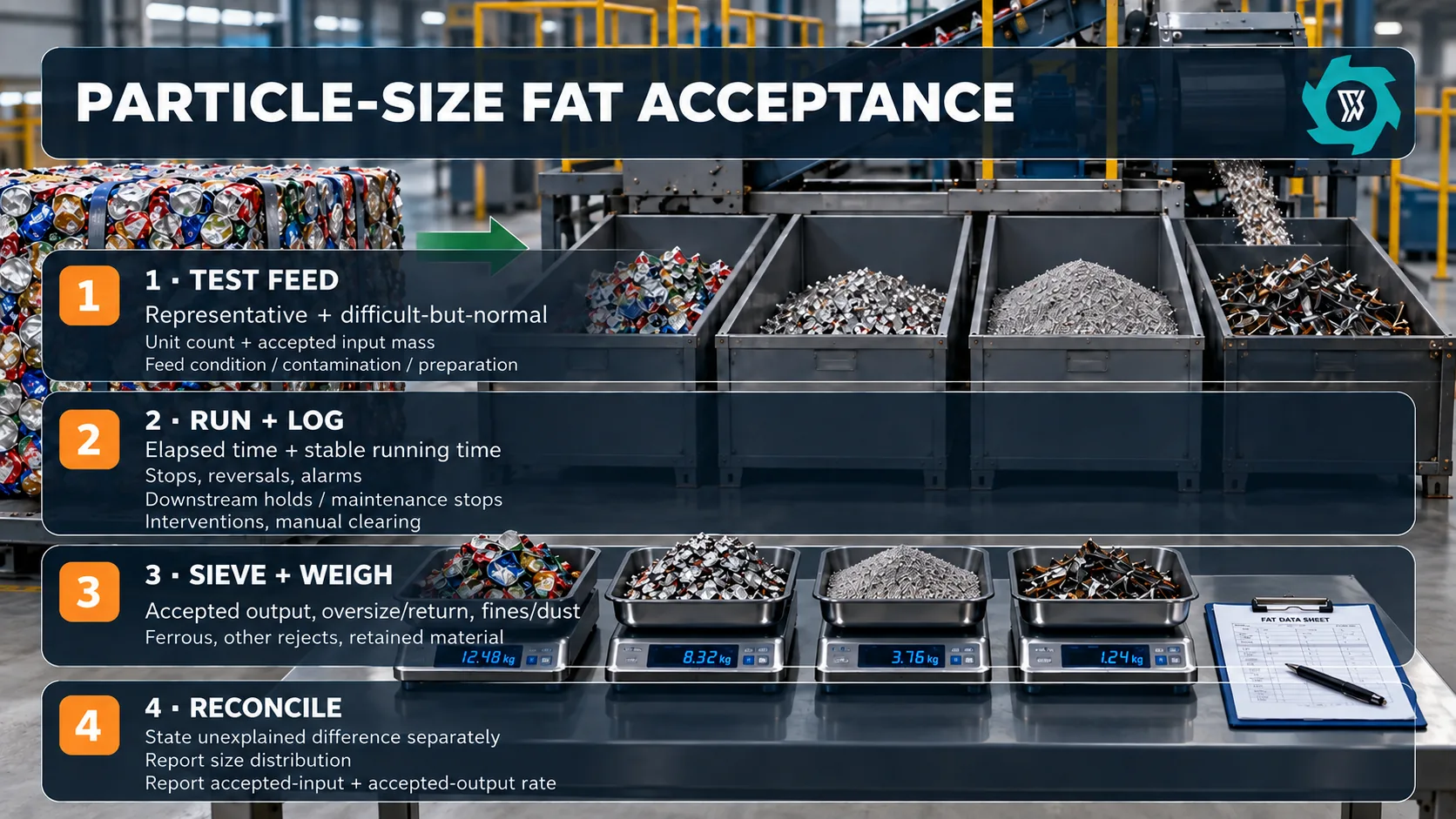
A useful factory acceptance test begins with representative UBC, including difficult-but-normal material inside the agreed feed boundary. Record unit count where it is meaningful, accepted input mass, bale or loose-feed condition, visible contamination and any preparation performed before feeding. The test should use the same screening and downstream state that the supplier claims will be used in production.
During the run, record elapsed time and stable running time separately. Log stops, automatic reversals, alarms, downstream holds, operator interventions and manual clearing. These events matter because a line can hit a short peak rate while repeatedly interrupting the material flow that the screen or separator needs for stable operation.
After the run, sample the accepted UBC across the test period and perform the agreed sieve analysis. Weigh accepted output, oversize/return, fines/dust, ferrous output, other rejects and retained material separately. State unexplained difference separately. If a downstream separator creates additional product and reject streams, weigh and sample those too.
Finally, report both accepted-input rate and accepted-output rate on the agreed time basis. The report should show the particle-size distribution, fines percentage at the contract screen cut, mass balance and any operating events that affected the result.
12. Troubleshooting the Particle-Size Distribution
| Observed result | Likely process question | What to verify |
|---|---|---|
| High oversize + low fines | Is the material sufficiently opened? | Contaminant exposure, screen carryover, recirculation load |
| Low oversize + high fines | Is reduction too aggressive? | Pass count, cutter condition, speed, downstream crusher duty |
| Fines rise over time | Has machine condition changed? | Wear, clearances, feed stability, screen condition |
| Good size curve + poor sorting | Is separator setup matched to the class? | Belt layer, rotor/splitter settings, orientation, contamination mix |
| Low reject mass + unexplained loss | Where is material accumulating? | Retained material, ducting, transfers, floor loss, scale reconciliation |
The same size curve can behave differently when can condition, moisture, contamination and separator design change. Use the data to identify the next test, not to force every plant into one nominal shred size.
13. What to Put in the RFQ
Ask the supplier to work from the feed and output evidence. The RFQ should identify the UBC form, expected contamination, whether the duty is bale opening or real size reduction, the required downstream equipment and the commercial product definition. Then request a particle-size window with named screen cuts, a maximum fines fraction where relevant, and a stated treatment of oversize.
Require the supplier to explain how the proposed shredder, screen and separator settings work together. If the proposal includes eddy current separation, ask what feed size range and bed condition the separator is designed around and how that claim will be proven with your material. If the proposal includes dust extraction or air separation, ask how aluminum reporting to those streams will be sampled during FAT.
Finally, make the acceptance plan part of the purchase order: representative material, test duration, time basis, operating-event log, sieve method, separately weighed outputs, mass-balance tolerance, pass/conditional/fail logic and retest responsibility.
FAQ
What particle size should shredded UBC be?
There is no universal best particle size for every UBC line. The accepted range should be chosen from the downstream separation requirement and the buyer’s product specification. The goal is sufficient opening and liberation with no more size reduction than the process needs.
What counts as fines in Talcred shredded UBC?
The current Talcred specification limits fines smaller than 4 mesh, listed as 6.35 mm, to a maximum of 5%. A contract should still define the sampling and test method used to verify that limit.
Do smaller aluminum pieces always reduce eddy current recovery?
Particle size strongly affects eddy current separator behavior, but performance also depends on particle shape, conductivity, rotor design, belt speed, feed layer and splitter settings. Published results from other scrap streams should be treated as mechanism evidence, not as a guaranteed UBC recovery curve.
How should UBC fines be measured during a FAT?
Use representative samples collected across the operating run, screen them at the agreed cut sizes, and report each fraction by mass. Weigh fines or dust separately from accepted product, oversize or return, ferrous output, other rejects and retained material, then state any unexplained difference separately.
Can a plant reduce fines simply by using a larger shred size?
Sometimes, but a coarser product can leave bales or nested cans insufficiently opened. The better approach is to find the least aggressive reduction that still exposes contamination and gives stable downstream separation, then verify it with size distribution and mass-balance data.
Define the Size Window Before You Buy the Line
Shredded UBC should be purchased as a measurable material condition, not a photograph of small aluminum pieces. Define the screen cuts, accepted range, fines limit, oversize treatment, downstream separation state and mass-balance method before equipment acceptance. Then test the actual cans under the actual line conditions.
If you are planning a new UBC opening, screening or separation project, send representative feed photos, bale data, contamination, required tons per hour, target product and any mill specification. YUXI can build the test and equipment proposal around the material you actually need to recover.
References
- ReMA: Talcred.
- Powder Tech: particle size.
- RCR: eddy current.