Henan University Science and Technology Park (Western) ,Zhengzhou, Henan ,China(Mainland)
Moisture in UBC bales changes both settlement and plant behavior. Water can raise as-received weight without adding aluminum value, while wet residue can also increase storage, housekeeping and processing problems.
The key issue is not simply the moisture limit itself. What matters is how the sample is collected, how the test result affects payable weight, and how a wet lot will be handled before it enters processing. ReMA’s Taldon description does not publish one universal moisture percentage for every baled UBC transaction.[1]
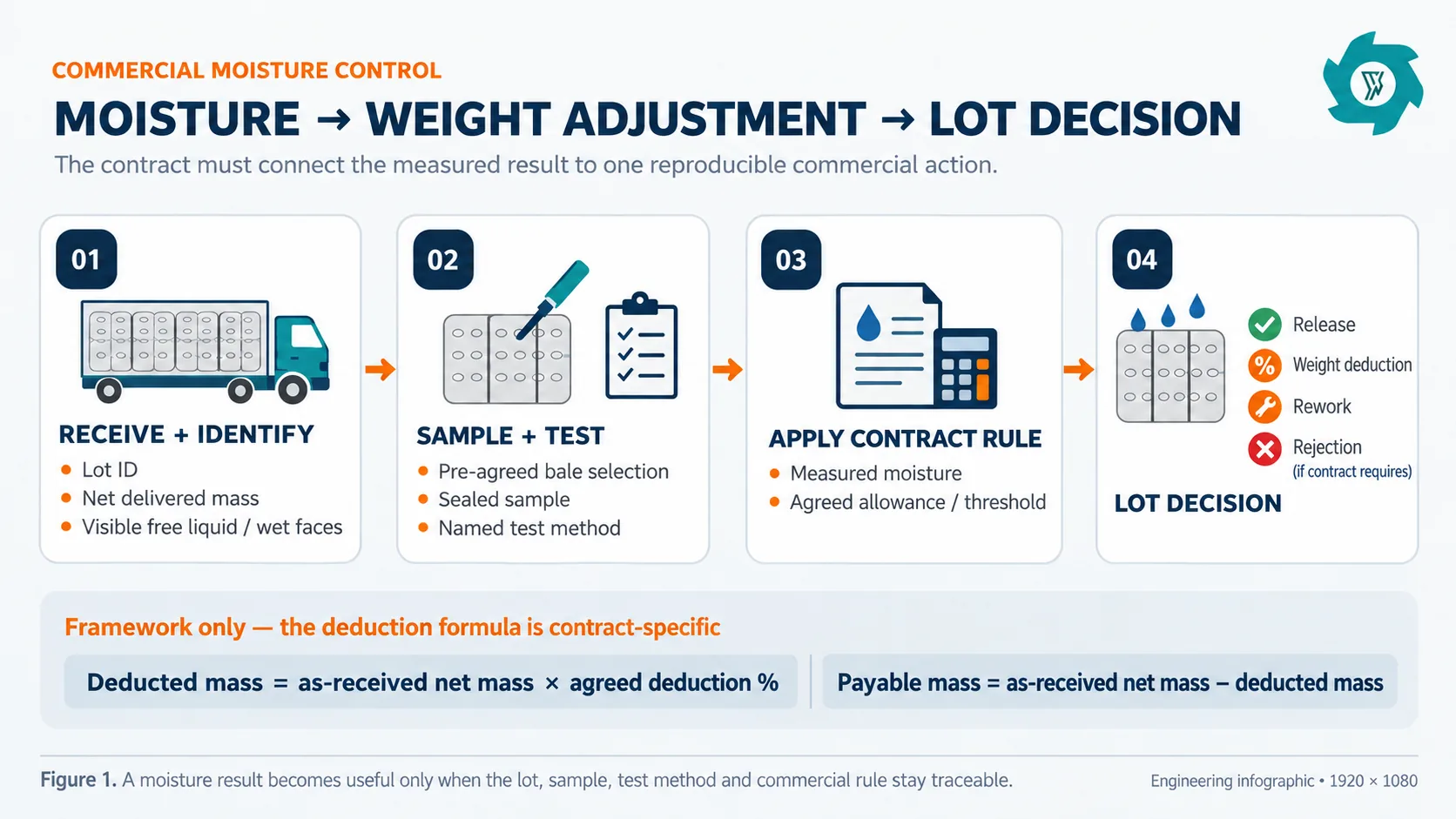
Write moisture as sample + test method + commercial threshold + action. Keep measured moisture separate from the deduction formula, prevent new water pickup in storage, and quarantine visibly wet lots until the agreed disposition is closed.
Figure 1. A moisture result becomes useful only when the lot, sample, test method and commercial rule stay traceable.
1. Keep Moisture Separate from the Broader Bale Specification
The UBC bale specifications guide already covers density, dimensions, tying and general receiving checks. This article goes narrower. It treats water as a variable that can change both settlement and process behavior. That separation matters because a bale can be inside the approved density envelope and still be wet, while a dry bale can fail for a completely different reason such as non-UBC aluminum or free lead.
For the same reason, do not mix the moisture result into one generic “contamination percentage.” The UBC contamination limits guide explains why different foreign materials have different consequences. Moisture needs its own line on the receiving record because the measurement method, commercial adjustment and downstream action may all differ from the rules used for steel, glass, dirt or other aluminum.
A practical receiving sheet therefore has separate fields for delivered net mass, bale count, visibly wet condition, free liquid, moisture sample identification, measured moisture, the applicable contract formula, any deducted mass, and the final disposition. That creates a clean audit trail when the quality team later compares suppliers or reviews a disputed load.
2. ReMA Does Not Create One Universal UBC Moisture Percentage
ReMA’s Taldon description for baled UBC requires magnetically separated material and restricts listed foreign substances, while variations to the specification are to be agreed between buyer and seller before shipment.[1] The related Taldack and Taldork descriptions are even more explicit: items not covered in those specifications, including moisture, should be agreed before shipment.[2][3]
For procurement, that means “dry UBC” is not a complete commercial clause. A buyer needs a reproducible basis. Write whether the result is on an as-received basis, how bales or increments are selected, how the sample is protected from evaporation or added water, which test method is used, the reporting precision, and what happens at or above the stated limit. Without those details, two laboratories can produce numbers that look precise but are not contractually comparable.
Do not copy a receiver-specific percentage from another contract and present it as an industry standard. One mill may be prepared to accept a wet lot with a deduction; another may hold it for retest; a third may require rework or reject it once a higher action threshold is reached. The correct rule is the one written into the transaction and connected to a named test procedure.
3. Weight Deduction Must Be a Formula, Not an Argument After Delivery
Moisture matters commercially because the truck scale sees water and aluminum together. The buyer, however, is purchasing metal under an agreed specification. A deduction mechanism converts the measured condition into a payable-weight decision without changing the test after the result is known.
Deducted mass = as-received net mass × agreed deduction percentage Payable mass = as-received net mass − deducted mass
The difficult part is not the arithmetic; it is defining the agreed deduction percentage. A contract might use the full measured moisture result, measured moisture above an agreed allowance, or another explicitly stated rule. None of those should be assumed to be universal.
A load has an agreed net delivered mass of 20.0 metric tonnes. The moisture test reports 6.0%, and the purchase contract—only for this example—states that the first 2.0 percentage points are an agreed allowance and the excess is deducted. The deduction percentage is therefore 4.0%, giving a deducted mass of 0.80 metric tonne and a payable mass of 19.20 metric tonnes. The lesson is not the 2% allowance. The lesson is that the buyer can reproduce the result from the written contract, raw test result and scale record.
Keep any material-contamination deductions separate. If the opened sample also contains dirt, plastic or glass, weighing those categories independently prevents the same non-metal mass from being deducted twice. A settlement sheet should show the moisture adjustment and each other quality adjustment as separate lines.
4. Build a Sampling Plan That Can Survive a Dispute
A wet outer face may not represent the whole load. Rain can wet the surface while the core stays drier; compact bales can also retain liquid internally after the outside looks dry. Define bale selection and sample location before delivery.
Record the lot, trailer, selected bale positions, collection time and sample ID. Seal the sample promptly when evaporation could change the result. If the contract uses a drying or mass-loss method, state the equipment, temperature, duration or end-point rule in the SOP.
If the commercial consequence is material, retain a duplicate or reserve sample for a defined period. The objective is simple: both parties should be able to reconstruct how the reported number was produced.
5. Separate Four Sources of Water Before You Blame the Supplier
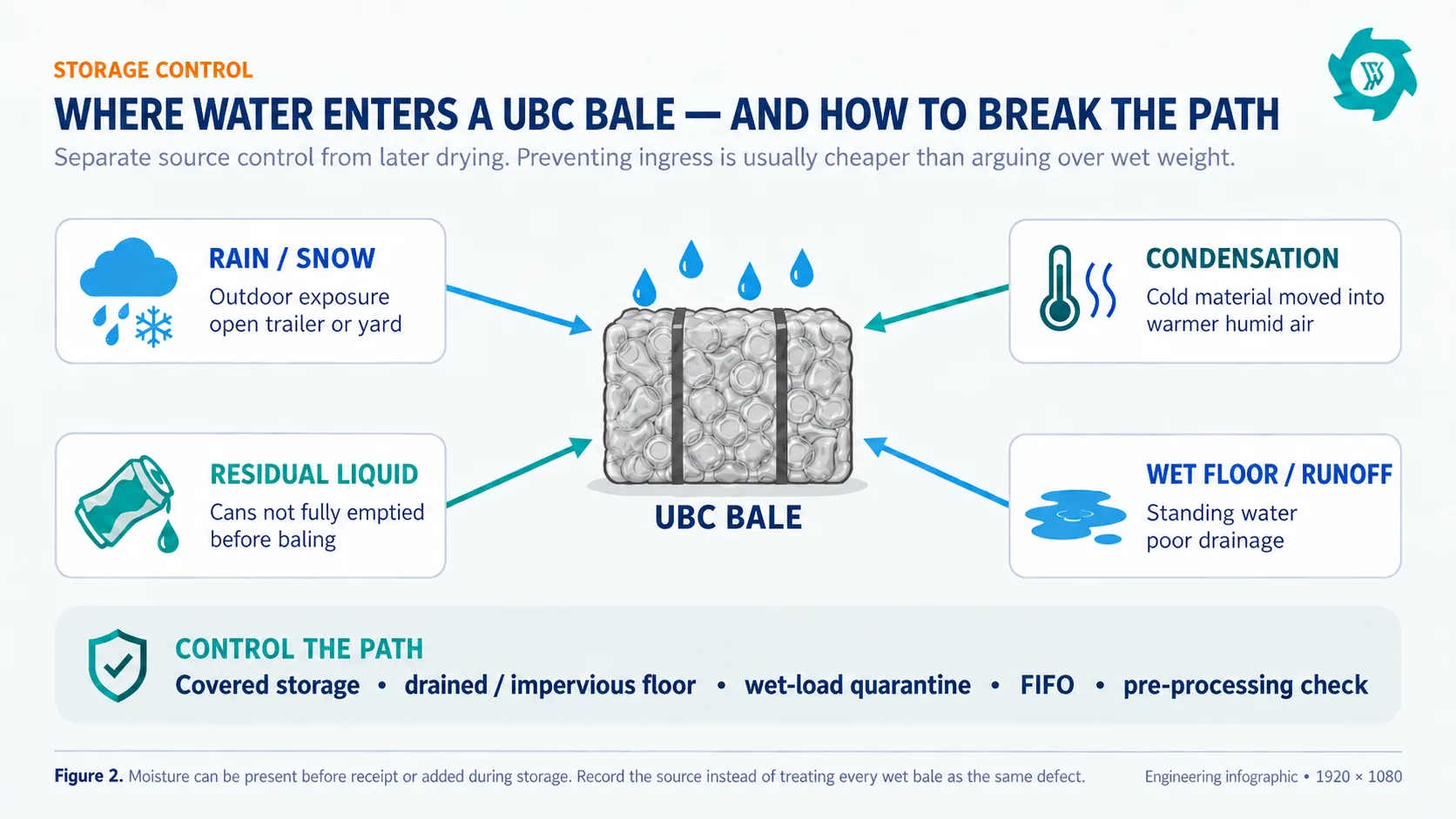
Moisture can enter the bale at different points, and the source changes the corrective action. Treating every wet load as the same defect hides useful process information.
Moisture source
What it looks like
Likely control
Residual beverage liquid
Localized wetness, odor, liquid released when cans open
Improve emptying, collection and pre-baling inspection
Rain or snow exposure
Wet outer faces, trailer or yard exposure, water on bale tops
Covered transport/storage, shorter exposure, quarantine on receipt
Wet floor or runoff
Bottom face wetting, dirty water, contact with standing water
Surface moisture after temperature/humidity change
Control transition into warmer humid areas and document conditions
The U.S. EPA’s Sector N guidance for scrap recycling facilities recommends minimizing exposure of materials to precipitation where feasible and gives examples such as roofs, buildings, sheds and temporary cover. It also emphasizes housekeeping, runoff control and designated storage practices.[4] Those measures are environmental controls, but they also improve commercial traceability because the plant is less likely to add new water after the receiving measurement.
Figure 2. Moisture can be present before receipt or added during storage. Record the source instead of treating every wet bale as the same defect.Record the source instead of treating every wet bale as the same defect.
6. Storage Design Should Prevent New Water from Entering the Claim
After sampling, storage becomes part of the evidence chain. If a buyer samples a truck and then leaves the bales uncovered through another rain event, a later retest may no longer describe the delivered condition. Use a marked quarantine area and record whether the lot was covered, drained or opened.
Covered storage, controlled drainage and an impervious floor reduce both water pickup and cross-contamination between lots. If the plant routinely drains wet UBC before processing, record that as a conditioning step. The receiving result and the later processing condition are different measurements.
The Aluminum Association’s public scrap-receiving guidance identifies moisture and contamination as safety concerns in purchased aluminum scrap.[5] Wet material should therefore remain visible in the receiving system.
7. Wet Bales Can Make Bale Opening and Shredding Less Repeatable
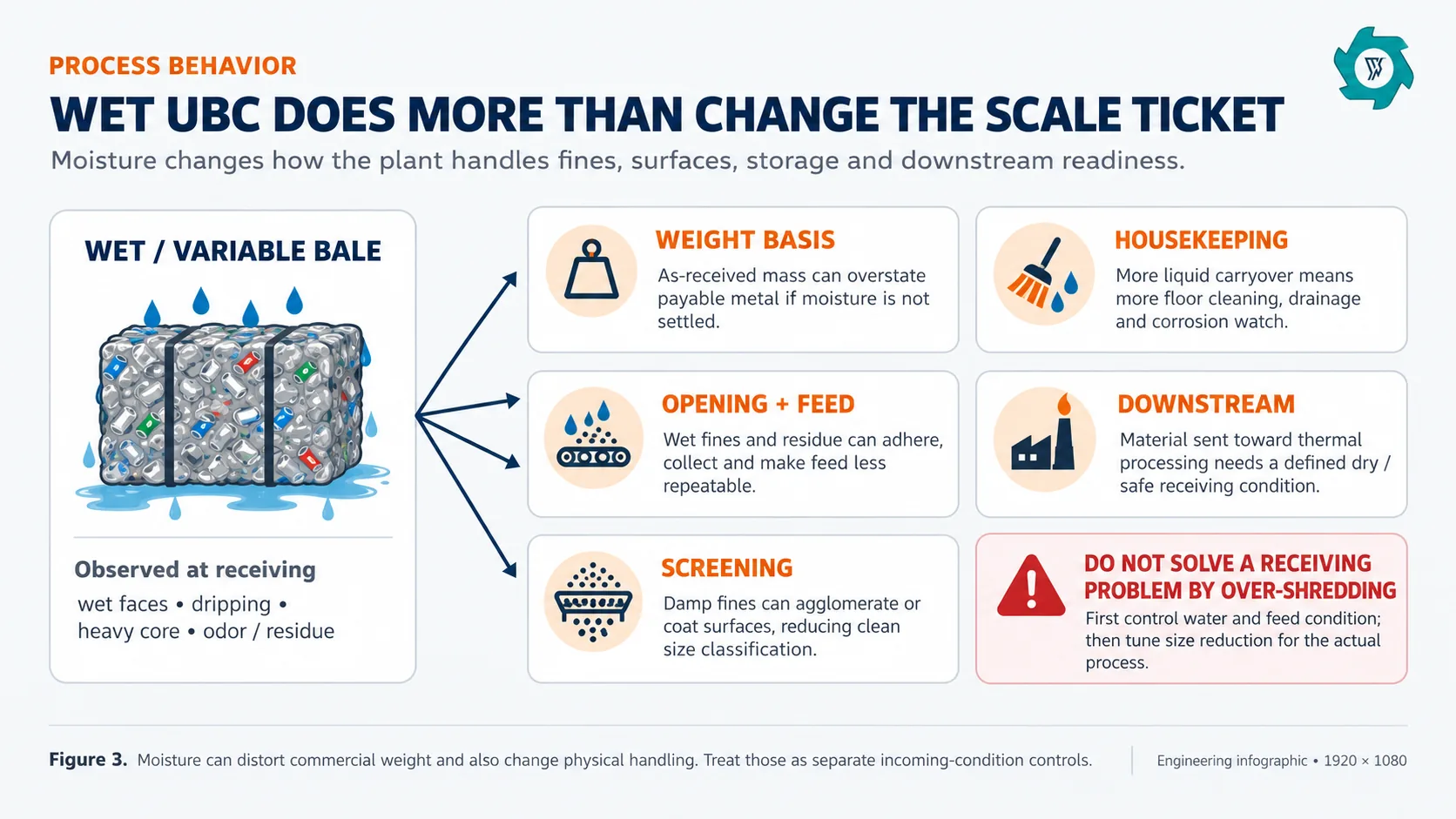
Moisture can change how residue behaves when a dense bale is opened. Wet dirt and fines may adhere to cans or the bale core instead of releasing cleanly, and pooled liquid may appear only after the first bite breaks the package.
For UBC shredder selection, define the accepted moisture condition before discussing machine size. Representative tests should record reversals, stops, operator interventions, manual clearing, downstream holds and maintenance stops when difficult-but-normal wet material is inside the accepted feed envelope.
Do not use aggressive size reduction as a moisture-control method. Over-shredding does not remove water by itself and can create more aluminum fines. Size reduction should still be driven by the required opening, liberation and downstream particle condition.
8. Screening and Separation Need a Stable Feed Condition
Screening works best when material can move and classify consistently. Damp fines may agglomerate, adhere to larger pieces or coat screen surfaces. That can make the measured size distribution less stable and can shift material between the accepted fraction and the reject or fines stream. If the project depends on tight classification, moisture condition belongs in the test record.
The shredded UBC size and fines guide treats particle size as a distribution and tracks where aluminum reports across oversize, accepted product and fines. Moisture adds a measurement complication because a wet fine fraction can be heavier than the same dry solids. When comparing tests, record whether fraction weights are as-received or conditioned to a defined moisture basis.
Magnetic separation is less directly sensitive to water than screening, but wet debris can still change how material spreads on a belt or releases at a transfer. Air-based separation is more obviously affected because wet paper, labels, dirt and fines may not behave like the same dry material. If a supplier test uses unusually dry, hand-spread cans while the plant normally receives damp compacted bales, the demonstration is not proving the normal operating condition.
Figure 3. Moisture can distort commercial weight and also change physical handling. Treat those as separate but connected controls.
9. Housekeeping, Corrosion and Odor Are Operating Costs, Not Just Cleanliness Issues
Residual beverage liquid and dirty water create work. Floors need cleaning, sumps and drains need attention, wet fines accumulate around transfer points, and odor can build when organic residue remains warm. None of those outcomes proves the aluminum itself is off-grade, but they can increase labor and complicate the clean separation of product and reject streams.
Corrosion risk also deserves a practical inspection routine. UBC lines contain structural steel, fasteners, bearings, sensors, motors and electrical enclosures around the aluminum stream. Water and sticky residue should not be allowed to sit on components or collect where inspection is difficult. The maintenance plan should identify drainage paths, cleanup frequency and areas where wet fines commonly accumulate.
EPA’s scrap-recycling stormwater guidance recommends regular cleanup of accumulated fluids and particulate residue around processing equipment, routine inspections and preventive maintenance.[4]
10. The Furnace Safety Boundary Is Different from the Receiving Deduction
A commercial moisture deduction is not a furnace-safety approval. HSE’s molten-metal guidance warns that water contamination of molten metal can cause explosions and identifies wet scrap as a common water-ingress route. It recommends storing scrap dry and covered where possible and drying and visually checking scrap when covered storage is not possible.[6]
The Aluminum Association identifies moisture and contamination as important safety concerns when aluminum scrap is received and handled.[5] Before any thermal processing, the downstream facility should separately define the dry-feed and charging conditions required for safe operation. For a recycling-line buyer, this creates a clear process boundary: the physical UBC preparation line may receive, open, sort and bale material, but the downstream mill must still define the condition required before thermal processing. A bale accepted commercially with a deduction may still need controlled drying or other preparation before it is safe for furnace charging.
Do not make the equipment supplier responsible for an undefined “furnace-ready” condition. Write the moisture or dry-feed requirement at the handoff between physical preparation and the downstream thermal system, and state who measures it.
11. Use a Lot-Disposition Matrix Instead of One Pass/Fail Number
Many receiving disputes become easier when the contract uses named actions. A buyer can define several zones, provided the limits and actions are written in advance.
Observed condition
Possible pre-agreed action
Evidence to keep
Within agreed moisture basis
Release lot
Scale ticket, sample result, lot ID
Above normal but inside deduction zone
Apply stated weight adjustment
Raw result, formula, deducted and payable mass
Visibly wet / free liquid
Hold and inspect; drain or rework if allowed
Photos, selected bale IDs, time record
Beyond contractual action threshold
Downgrade, reject or other agreed disposition
Retained evidence, authorization, supplier notice
Safety concern or unknown liquid
Isolate and escalate
Do not continue routine processing until assessed
This structure avoids pretending that every moisture issue has the same consequence. It also lets purchasing distinguish a supplier who consistently ships slightly damp but predictable material from one who occasionally sends bales with free liquid or unexplained wet cores.
12. Receiving Layout Can Reduce Both Claims and Process Variability
The front end of the aluminum UBC scrap recycling line should provide a place to inspect and isolate suspect material before it is mixed with accepted stock. A receiving zone, quarantine area, controlled drainage and safe bale-opening location are more useful than trying to manage a wet-load event in the main process aisle.
Ask one practical layout question: where does the water go? Check conveyor pits, sumps, traffic routes, sampling access and the storage position for held lots. These details are inexpensive to solve on a drawing and expensive to improvise after commissioning.
13. Put Moisture Terms into the RFQ and Purchase Order Before Equipment Testing
When the line supplier receives only a throughput target, moisture tends to appear late—usually when the test material behaves differently from production feed. Put it into the RFQ early. State the normal condition, difficult-but-normal condition and exclusion condition.
Named material form: baled UBC and any applicable commercial specification.
As-received moisture range observed historically, if known.
Presence or absence of free liquid; how often visibly wet loads occur.
Storage and transport exposure: covered trailer, outdoor yard, indoor stock, seasonal weather.
Receiving sample method and test basis.
Contractual deduction, hold, rework or rejection logic.
Whether bales are drained or conditioned before processing.
Downstream equipment sensitive to wet fines or sticky residue.
Required handoff condition before any thermal process.
Drainage, floor, sump and housekeeping scope included in the project.
Those fields also help suppliers interpret throughput. A machine processing clean, drained UBC should not be compared directly with a test using heavy wet contamination unless the operating basis is made explicit.
14. Acceptance Testing Should Record the Wet Condition, Not Average It Away
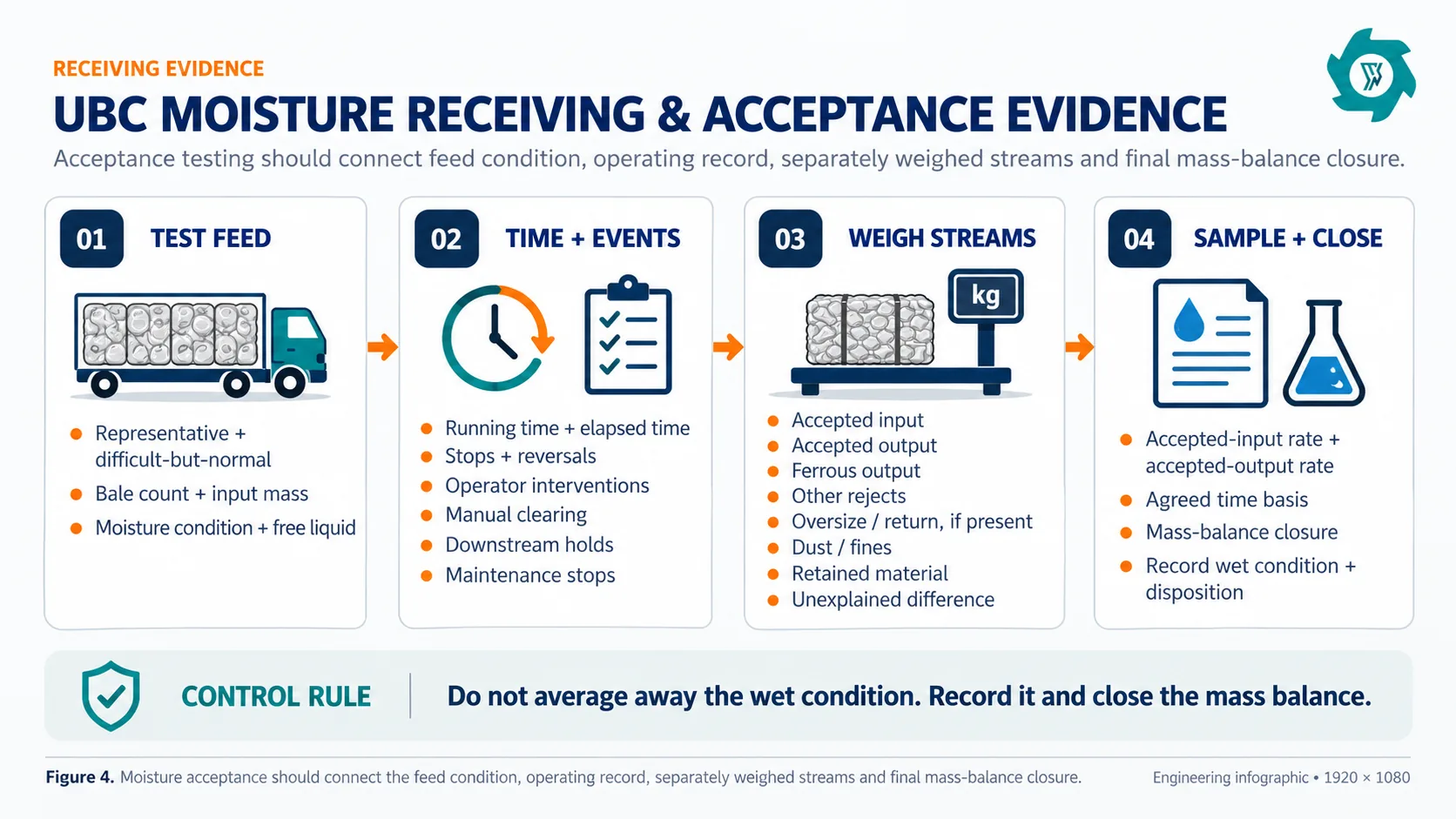
If moisture matters to the project, the factory or site acceptance record should identify the test-feed condition. Use representative material and include a difficult-but-normal wet condition only when it belongs inside the accepted feed envelope.
Record input mass, running and elapsed time, stops, reversals, operator interventions, manual clearing, downstream holds and maintenance stops. Weigh accepted output and relevant fines or reject streams separately, then report both accepted-input rate and accepted-output rate on the agreed time basis. A wet feed can make the input scale number look stronger without increasing accepted aluminum product.
Figure 4. Moisture acceptance should connect the feed condition, operating record, separately weighed streams and final mass-balance closure.
15. Common Moisture-Control Mistakes
Combining moisture and solid contamination. Keep water adjustments separate from dirt, plastic, glass or other reject weights.
Changing the sample rule after seeing the load. Targeted inspection can be valid, but it should be a pre-written escalation path.
Using outdoor exposure as the drying method. It may remove water, but it can also add rain, snow or runoff and destroy traceability.
Assuming a deduction solves the operating problem. Accounts may settle payable mass while production still handles wet fines and cleanup.
Quoting throughput on wet gross mass. Keep accepted input and accepted output visible on the same time basis.
Treating commercial acceptance as furnace approval. Downstream thermal processing needs its own dry/safe handoff requirement.
16. A Practical Moisture-Control Sequence for Buyers
Define the purchase rule first: material form, sampling, test basis, threshold or allowance, and commercial action. Then make sure the receiving area does not add new water and isolate visibly wet lots until disposition is closed.
Next define the processing condition. If wet bales will be drained or conditioned before opening, record that step. If difficult-but-normal damp feed is allowed, include it in representative testing. Keep the downstream furnace boundary separate: commercial acceptance, physical preparation and thermal charging are three different decisions.
Frequently Asked Questions
Is there one universal moisture limit for baled UBC?
No. ReMA’s public Taldon description does not publish one universal moisture percentage for every baled UBC transaction. The contract should name the test method, limit or allowance, and commercial action.
Should a buyer deduct the full measured moisture percentage from UBC weight?
The deduction is a commercial term. The purchase agreement should state whether all measured moisture, moisture above an allowance, or another formula controls settlement.
How should moisture samples be taken from UBC bales?
Use the agreed sampling plan. Record selected bales, sample location, sealing, collection time, test time and method so the result can be reproduced.
Can wet UBC bales be stored outdoors to drain?
Outdoor exposure can add new precipitation and weaken traceability. Covered storage with controlled drainage and a quarantine zone gives a cleaner receiving record.
Why can moisture cause processing problems before melting?
Wet residue and fines can adhere, complicate screening, increase housekeeping and make feed behavior less repeatable. Severity depends on water amount, contaminants and equipment.
What moisture information should be included in a UBC line RFQ?
Provide normal and worst moisture condition, free-liquid occurrence, storage exposure, test method, receiving rule, wet-load action and any downstream dry-feed requirement.
Define Moisture Before You Quote the UBC Line
Send representative bale photos or video, normal and worst moisture condition, bale dimensions and weight, contamination, target throughput, required output, storage exposure and downstream process. YUXI can use those inputs to review the receiving, opening, separation and drainage scope.
Daniel
Metal Recycling Equipment Specialist,YUXI Machinery
Daniel has over 7 years of experience serving the international recycling market.
He focuses on metal shredding and recycling systems,including feedstock evaluation,equipment selection,size reduction,separation,and complete line configuration.





 Request Quote