




 Request Quote



When a truckload of used beverage cans arrives at a mill, contamination cannot be judged by a single figure. A bale may look clean but still fail the agreed acceptance basis because it contains non-UBC aluminum, free lead, concealed steel, excessive undersize material, or moisture outside the contractual limit. Depending on the specification and purchase terms, the result may be a deduction, downgrade, hold for retesting, or rejection. Another load may contain a measurable amount of non-metal residue and still be accepted with a deduction, provided the buyer and seller have already agreed on how that residue will be sampled, measured, and settled.
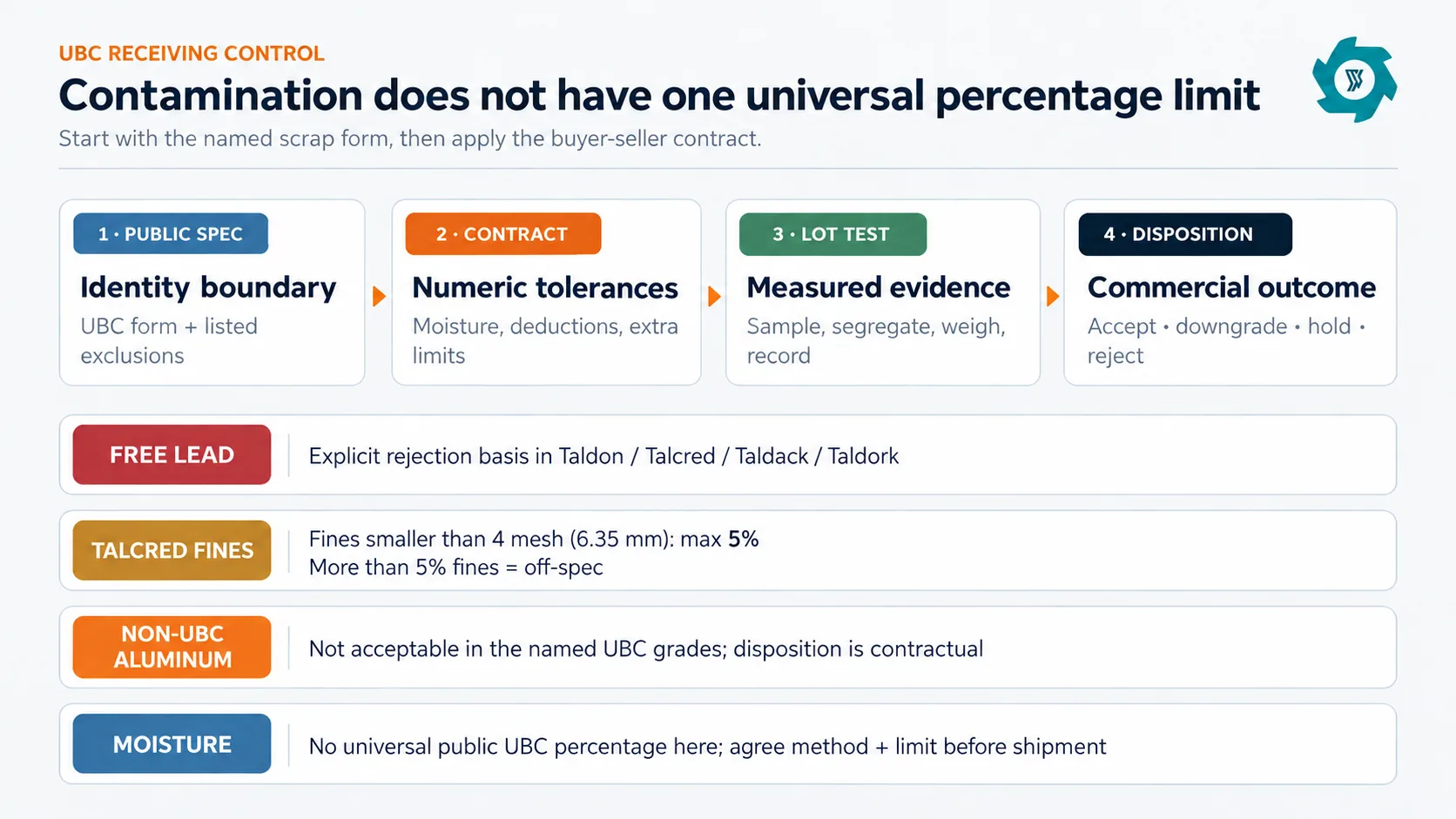
The practical question is therefore not “What contamination percentage is allowed in UBC?” It is “Which named scrap form is being sold, which public requirements apply to that form, what extra limits did the mill write into the purchase contract, and what evidence determines the lot disposition?” That distinction matters because the public UBC descriptions give several hard identity rules, but they do not publish one universal moisture or total-contamination percentage for every mill. The safest receiving system separates public specification requirements from buyer-specific tolerances.
Start with the Named UBC Grade, Not a Generic “Purity” Target
UBC can be traded in several physical forms. ReMA/ISRI’s public descriptions distinguish post-consumer can stock, shredded UBC, densified UBC, baled UBC and briqueted UBC. Those descriptions matter because the contamination language is attached to the named form. Taldon, for example, covers baled UBC; Talcred covers shredded UBC; Taldack covers densified UBC; and Taldork covers briqueted UBC. The separate UBC scrap specification comparison is useful when the commercial form itself is still being selected.
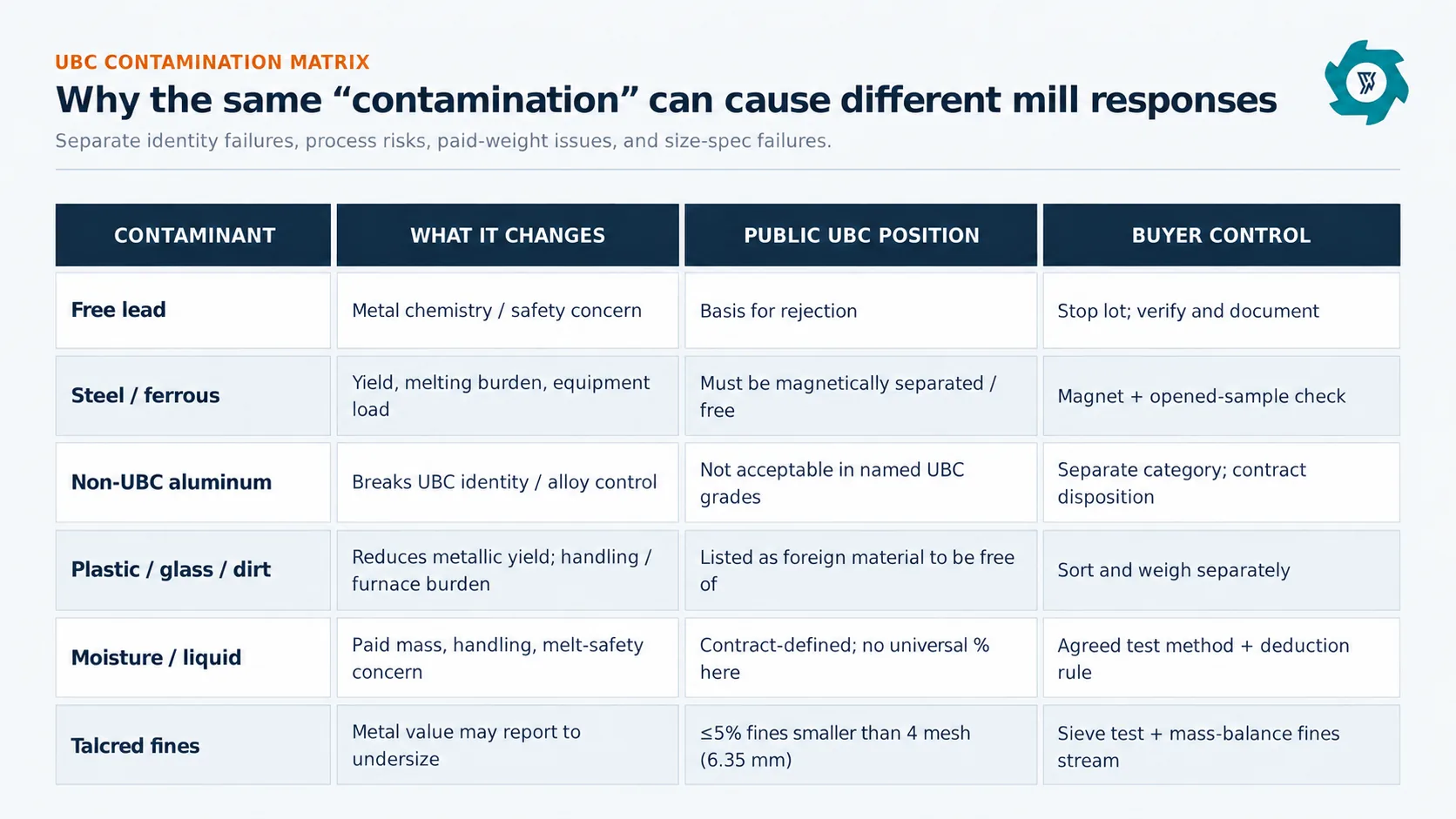
Across Taldon, Talcred and Taldack, the public descriptions require magnetically separated material and list steel, lead, bottle caps, plastics, glass, wood, dirt, grease, trash and other foreign substances as materials the UBC should be free from. Taldork similarly requires material free of steel, plastic, glass, dirt and other foreign substances. Those grades also state that aluminum items other than UBC are not acceptable. Most importantly, all four descriptions state that any free lead is a basis for rejection.[1][2][3][4]
That wording creates an identity boundary. A load can contain aluminum and still be wrong for the UBC grade if that aluminum is sheet, extrusion, foil, cast material or another non-UBC form. Likewise, a small but serious contaminant can matter more than a larger quantity of a relatively manageable residue.
Which Contaminant Has the Clearest Public Basis for Rejection?
Free lead is the clearest answer. Taldon, Talcred, Taldack and Taldork each say that any free lead is a basis for rejection.[1][2][3][4] A buyer does not need to turn that statement into a percentage to understand the commercial risk. If free lead is found in the lot, the public grade description already identifies rejection as an available response.
The receiving procedure still matters. Photograph the suspect item in the opened sample, identify the lot and selected bale, preserve the item when practical, record who witnessed the finding, and keep the rest of the lot segregated until the buyer decides disposition. This protects both sides. The supplier can see exactly what triggered the action, and the receiver avoids contaminating the evidence by mixing the load with other inventory.
Lead is also a good example of why average contamination percentages can mislead. A low overall foreign-material percentage does not cancel an explicit prohibited condition. Commercially, the correct sequence is to check for prohibited or rejection-triggering material first, then evaluate ordinary off-spec fractions and any deduction formula.
Steel and Ferrous Material: Usually an Off-Spec Identity Problem, Not Just Lost Yield
Public UBC descriptions require magnetic separation and freedom from steel or listed ferrous contamination.[1][2][3] A mill may be able to remove some residual ferrous material after receiving, but that does not make the supplier’s shipment conforming. Steel changes the metallic yield, increases burden on downstream separation, and can be hidden inside compacted cans where surface inspection cannot see it.
For dense bales, the receiving question is not simply whether a magnet finds something on the outer face. The buyer needs a sampling rule that exposes the interior. The UBC bale specifications guide covers bale dimensions, density, moisture and opening logic in more detail; here the key point is that the steel fraction should be separated and weighed as its own category. Do not merge “ferrous + glass + plastic” into one reject number when the contract treats those materials differently.
A useful mill receiving record therefore reports at least the opened sample mass, ferrous mass and ferrous percentage on the agreed basis. If the mill uses a commercial deduction for residual ferrous, write that formula in the purchase terms. If its contract treats any visible steel can or strap fragment as a hold condition, write that too. The public description tells you that the grade should be free of steel; the contract tells you how this buyer responds when the real load deviates.
Non-UBC Aluminum Can Cause a Downgrade Even Though It Is Still Aluminum
This is one of the most expensive misunderstandings in can scrap. Taldon, Talcred, Taldack and Taldork all state that aluminum items other than UBC are not acceptable in those named UBC grades.[1][2][3][4] The reason is commercial and metallurgical: the buyer is purchasing a defined can-scrap stream, not generic aluminum by weight.
Typical examples include pieces of siding, foil, extrusion, cast aluminum, household aluminum items or non-beverage packaging that entered the can stream. Some may look harmless because they respond like aluminum in an eddy current separator. That is precisely why a recovery machine alone cannot certify the grade. Eddy current separation distinguishes conductive non-ferrous pieces from a suitable non-metal stream; it does not prove that every aluminum piece is UBC. The aluminum-can eddy current separator guide explains that process boundary in equipment terms.
At receiving, non-UBC aluminum should be a separate measured category whenever it could affect settlement. If it is thrown into a combined “other rejects” bucket, the receiver loses the evidence needed to show whether the problem was non-metal dirt or an aluminum-identity failure. A supplier also loses the chance to trace the issue back to a sorting source.
Plastic, Glass, Dirt, Paper and Other Non-Metal Residue
The public UBC descriptions use “free of” language for multiple foreign materials. Talc, the post-consumer aluminum can stock description, calls for old aluminum food and/or beverage cans free of other scrap metals, foil, tin cans, plastic bottles, paper, glass and other non-metallic items.[5] The UBC-specific forms add or repeat plastics, glass, wood, dirt, grease, trash and related foreign substances.[1][2][3][4]
In actual commerce, mills may still use buyer-specific deductions, rework allowances or rejection thresholds for measured non-metal content. Those are contract terms, not universal percentages that should be copied from one buyer to another. The clean way to write a purchase specification is to state the allowed categories, test basis, limit for each category or combined group, and the exact consequence when the measured result crosses the limit.
Plastic deserves extra attention because all plastics are not operationally equivalent. The Aluminum Association notes that plastic contamination can dilute recycling value and create operational, compliance and safety issues, and its container design guidance specifically warns against PVC and chlorine-based plastics in aluminum container recycling.[6] A mill that places a tighter limit on certain plastic types therefore may be responding to its process and environmental controls.
Glass and dirt are different again. They add non-metal mass, may break into fine fractions, and can increase wear and housekeeping burden. A mixed “non-metal” percentage may be acceptable for a quick internal trend, but a disputed commercial lot benefits from separated weights: plastic, glass, dirt/fines and other residue. That detail makes corrective action possible.
Moisture: Do Not Invent a Universal UBC Limit
Moisture is where copied specifications often go wrong. Taldack and Taldork explicitly say that items not covered in the specification, including moisture, and any variations should be agreed between buyer and seller before shipment.[3][4] Taldon and Talcred likewise require buyer–seller agreement for variations to the public description.[1][2] That is not a public license to use any moisture level; it is a signal that the commercial limit and test method belong in the contract.
A useful moisture clause should state how the sample is selected, whether the result is measured on an as-received basis, the test method, sample handling, timing, rounding rule and what happens above the limit. A buyer may deduct excess moisture from payable weight, downgrade the lot, request rework, hold for a confirmatory test or reject beyond a higher threshold. The correct response is whatever the signed purchase terms say.
Moisture also has a safety dimension. The Aluminum Association’s scrap receiving and inspection guidance is explicitly aimed at helping recyclers and suppliers prevent accidents associated with moisture or contamination in purchased scrap.[7] At the same time, the U.S. EPA describes secondary aluminum preprocessing as including size reduction and removal of oils, coatings and other contaminants before furnace operations.[8] Those sources reinforce the practical point: moisture and contaminants are not only accounting variables; they affect downstream handling and melting conditions.
Talcred Adds a Numeric Fines Limit That Other UBC Forms Do Not
Shredded UBC has one particularly useful public number. Talcred states that material should contain a maximum of 5% fines smaller than 4 mesh, identified in the description as 6.35 mm.[2] That is a product-form limit, not a general contamination limit for every bale or briquette. Applying it to Taldon or Taldork without a contract basis would be mixing specifications.
For a Talcred lot, the mill should define how the sieve sample is taken and how the undersize mass is calculated. A result above 5% indicates that the material does not meet that public Talcred condition. Whether the commercial outcome is a downgrade, rework request or rejection should then follow the contract. The separate shredded UBC size and fines guide goes deeper into why over-shredding can push valuable aluminum into the fine fraction; here the important receiving point is to keep the measured fines result distinct from dirt or dust contamination.
If the undersize stream contains both aluminum fines and foreign dirt, weigh and inspect it in a way that preserves that distinction. Otherwise the mill cannot tell whether the supplier has a shredding-control problem, a source-contamination problem, or both.
Downgrade, Deduction, Hold and Rejection Are Different Decisions
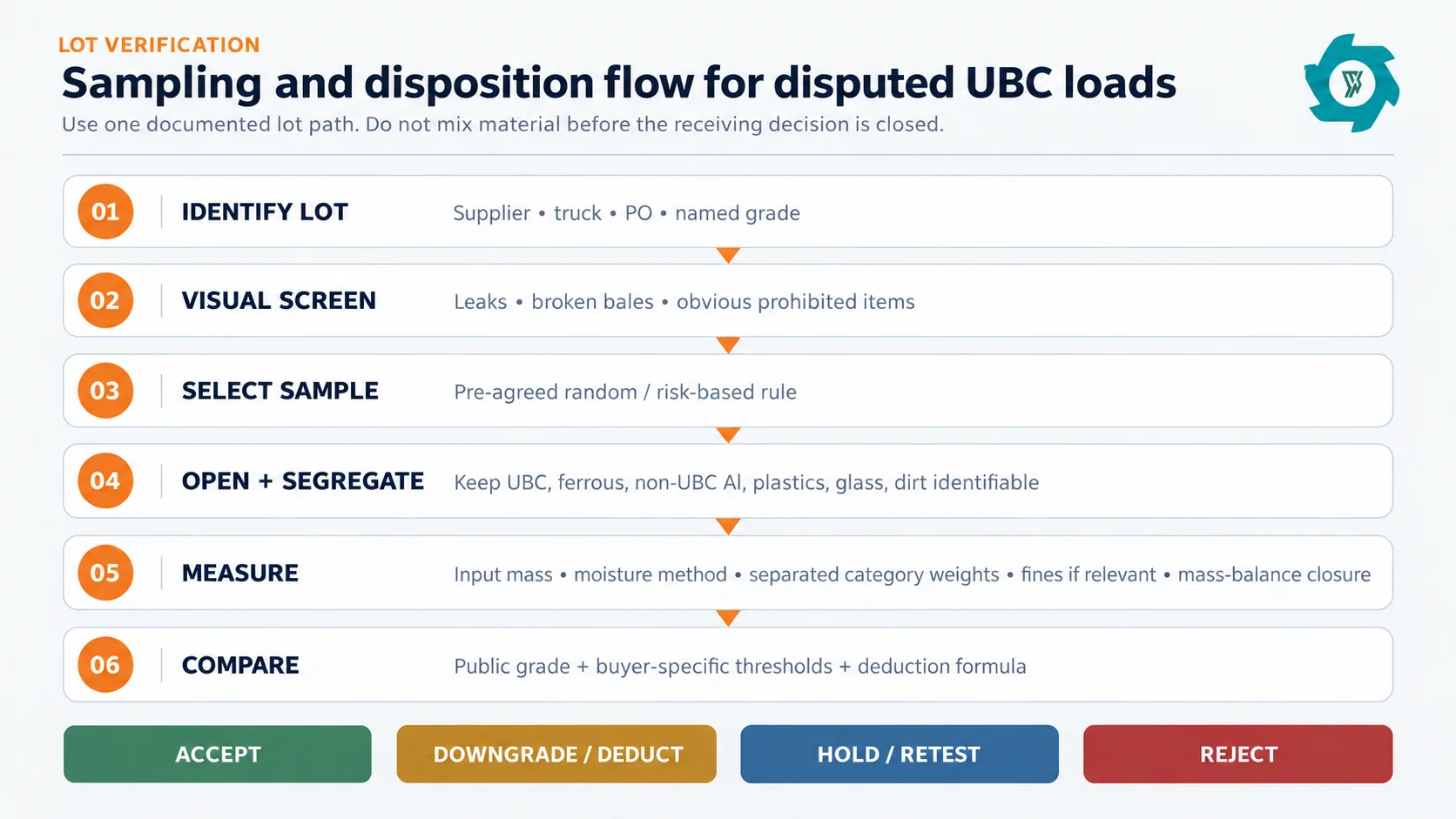
Accept means the lot meets the agreed basis. Downgrade or deduction means the lot can still be used but the measured deviation changes price or grade under the contract. Hold or retest means the evidence is incomplete, disputed or close enough to a decision boundary that a second test is required. Reject means the lot hits an explicit rejection condition, prohibited material rule or contractual threshold that the buyer will not accept.
This vocabulary improves supplier relationships because it prevents an operator from making a commercial decision based only on appearance. A wet-looking bale may need a moisture test. A few pieces of plastic may trigger a measured deduction if that is the signed rule. Free lead is different because the public UBC descriptions themselves identify it as a rejection basis. The decision tree should preserve those differences.
For equipment planning, the same logic supports the UBC aluminum can recycling line: opening, magnetic separation, screening and quality control should be selected around the contaminants that must actually be removed, separated and measured. A plant does not become more compliant simply by installing more machines. It becomes more controllable when each process stage is linked to a defined incoming problem and a measurable outgoing requirement.
Build the Sampling Rule Before the Truck Arrives
A contamination limit without a sampling rule is not an enforceable engineering control. Dense UBC bales hide their interior, while loose cans can segregate by size and density during transport. The contract should therefore state how many bales or increments are selected, how selection is randomized or risk-weighted, what constitutes the test mass, and who can witness the procedure.
For a new supplier or a source with unstable quality, the buyer may choose a more intensive rule. For an established source with stable records, the contract may permit reduced sampling. What matters is that the decision is made before the result is known. Selecting only the dirtiest visible bale after unloading may be useful for troubleshooting, but it is not the same as a pre-agreed commercial sample.
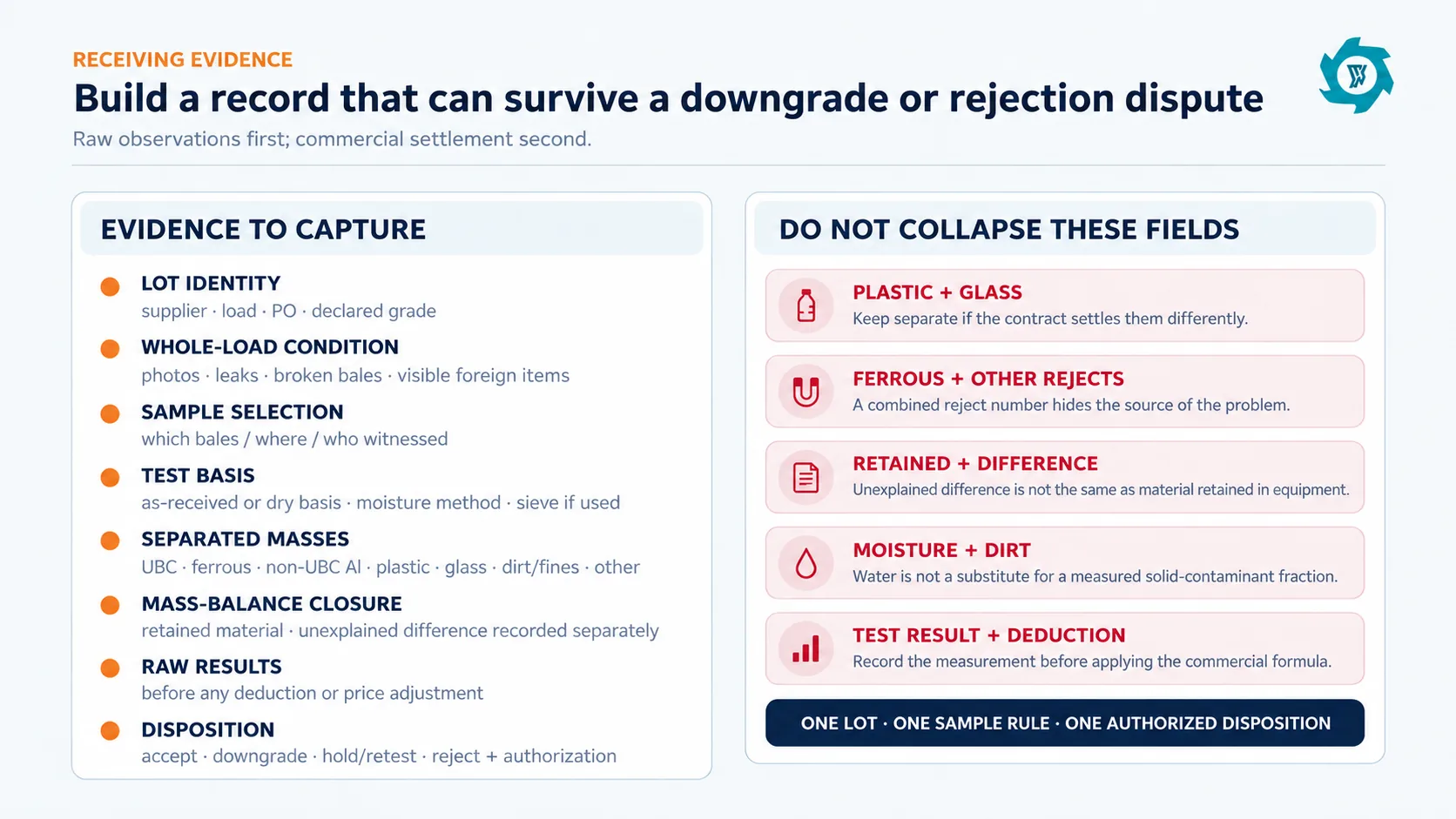
Once selected, preserve the opened sample as a mass balance. Record the accepted UBC portion and each contaminant category separately. For a practical receiving test, useful categories can include ferrous, non-UBC aluminum, plastics, glass, dirt/fines, other rejects, moisture result, and an oversize or special fraction if the contract calls for one. If Talcred is being verified, the fines sieve result needs its own line.
Do not silently discard material that sticks in equipment or falls outside a collection bin. Retained material should be measured or estimated under the agreed method, and any unexplained difference should remain a separate line. Combining “retained + difference” hides measurement quality. The same principle applies to “ferrous + other rejects”: combined numbers are easier to type but much harder to defend.
Use Raw Results Before Commercial Deductions
The receiving sheet should show what was measured before it shows what was charged. Suppose an opened sample contains a known mass of ferrous, non-UBC aluminum, plastic and dirt, plus a measured moisture result. Those are test results. The price deduction is a second calculation based on contract terms. Keeping the two steps separate lets both parties audit the settlement later.
This is especially important when the buyer uses a sliding deduction rather than a hard pass/fail limit. If the formula changes next quarter, the historical raw measurements are still useful. If only the final “2.4% deduction” was stored, the plant cannot reconstruct whether the problem was moisture, foreign solids or a particular source stream.
Trend data can also prevent rejection. A supplier that sees plastic increasing from one lot to the next can adjust sorting before the buyer reaches the contractual action limit. A mill that sees repeated ferrous excursions from one collection route can ask for stronger magnetic cleanup at the source. The purpose of quality data is not only to settle disputes; it is to stop the next one.
What a Mill Should Put in the Purchase Specification
Start with the named material form and reference description. Then add the buyer’s project-specific requirements rather than rewriting the public grade in vague language. The document should state the sample-selection method, moisture method and limit, any numeric limits for ferrous or non-metal fractions, the treatment of non-UBC aluminum, the Talcred fines test if applicable, prohibited materials, deduction formulas, retest rights and rejection conditions.
It should also define the calculation basis. “Contamination below 2%” is incomplete. Is that 2% of gross sample mass, dry sample mass, net UBC mass, or another basis? Does moisture come out before the solid-contaminant percentage is calculated? Are ties and packaging included? The math should be written so that two people using the same raw data obtain the same result.
Finally, define authority. Who can place a truck on hold? Who approves a downgrade? Who can reject a load? What evidence must be sent to the supplier, and how long does the supplier have to request a retest? These are commercial controls, but they directly affect plant flow because disputed material occupies floor space and can contaminate other inventory if segregation is poor.
How Suppliers Can Reduce Downgrades Before Shipping
Suppliers should work backward from the buyer’s failure modes. Remove steel cans, loose strapping and accessible ferrous before final baling. Keep non-UBC aluminum from entering the can stream. Drain residual liquid and protect stored material from rain or standing water. Control plastics, glass and dirt at the sorting stage instead of expecting the mill to clean them out later. Where shredded UBC is sold as Talcred, control the undersize fraction.
Quality control is most effective before densification. Once loose cans are compressed into a dense bale, the clean-looking exterior can hide contamination in the center. That is why the last inspection point should be placed before the material becomes difficult to see. If the process route includes recovery from mixed dry recyclables, stabilize feed presentation and remove ferrous before the aluminum fraction is baled.
Keep internal records by source. If one MRF, collection route or shift repeatedly produces more glass or plastic, that information is more actionable than a monthly average. When a mill issues a downgrade, the supplier can trace the lot back to the most likely cause and show what changed.
Buyer Checklist: Decide the Rule Before You Need It
- Name the form: Talc, Taldon, Talcred, Taldack, Taldork or a buyer-specific description.
- List prohibited conditions first: especially free lead and any site-specific hazardous or unacceptable items.
- Separate identity from percentage: non-UBC aluminum can fail the grade even though it is aluminum.
- Write numeric limits only where they actually exist: for example, Talcred’s maximum 5% fines smaller than 4 mesh (6.35 mm), plus any buyer-specific limits.
- Define moisture by contract: method, basis, limit and disposition.
- Pre-agree sampling: bale or increment selection, test mass, witnessing and retest rule.
- Weigh categories separately: ferrous, non-UBC aluminum, plastics, glass, dirt/fines and other rejects as needed.
- Preserve raw results: calculate deductions only after measurements are recorded.
- Use named outcomes: accept, downgrade/deduct, hold/retest or reject.
- Keep disputed lots segregated: do not mix them into accepted inventory before closure.
FAQ
Which UBC contaminant is explicitly identified as a basis for rejection?
Public ReMA/ISRI descriptions for Taldon, Talcred, Taldack and Taldork state that any free lead is a basis for rejection. Other contaminants should not be described as universal automatic-reject conditions unless the buyer’s contract says so; they can make the material off-spec and subject to the agreed disposition.
Does ReMA/ISRI set one universal moisture limit for UBC?
Taldack and Taldork explicitly identify moisture as an item to be agreed between buyer and seller, while the other UBC descriptions require agreement on variations. A mill should write its moisture test method, limit and commercial consequence into the purchase contract.
What is the Talcred fines limit?
Talcred states that shredded UBC should contain a maximum of 5% fines smaller than 4 mesh, identified in the public description as 6.35 mm. The sampling and sieve procedure should still be agreed so both sides calculate the result the same way.
Is non-UBC aluminum acceptable in UBC scrap?
The public Taldon, Talcred, Taldack and Taldork descriptions state that aluminum items other than used beverage cans are not acceptable in those named UBC grades. The buyer’s contract should define how a measured deviation is handled commercially.
What is the difference between a downgrade and a rejection?
A downgrade or deduction means the buyer can still use the lot but applies the contract’s price or grade adjustment. Rejection means the lot hits an explicit rejection condition, prohibited-material rule or contractual threshold that the buyer will not accept.
Define the feed, contamination rule and acceptance test before selecting the line.
Send representative UBC photos, bale condition, known contaminants, required output form, throughput and the mill acceptance basis. The process can then be configured around the actual material instead of a generic can-scrap assumption.
References
- ReMA: Taldon.
- ReMA: Talcred.
- ReMA: Taldack.
- ReMA: Taldork.
- ReMA: Talc.
- Aluminum Association: can design.
- Aluminum Association: scrap receiving.
- U.S. EPA: secondary aluminum.