Henan University Science and Technology Park (Western) ,Zhengzhou, Henan ,China(Mainland)
The word “recovery” can refer to different measurements in a UBC line. It may describe how much of the incoming weight ends up as saleable material, how much of the aluminum in the feed is captured in the accepted product, or how much aluminum is lost with the reject streams. Those are not the same calculation. Before comparing results, the test boundary, sampling method, and weight basis need to be clear. Otherwise, the same feed can produce more than one recovery figure, depending on what was counted and where the measurement was taken.
This guide focuses on measurement rather than separator settings or particle-size selection. The wider UBC aluminum can recycling line can use different routes for clean loose cans, mixed dry recyclables and dense UBC bales. Whatever route is selected, a defensible recovery test needs the same foundation: define what crosses the boundary, weigh every material stream, sample the streams that may contain aluminum, keep retained material separate from unexplained difference, and report product grade beside aluminum recovery.
UBC aluminum recovery should be calculated from aluminum mass. Measure or estimate the aluminum in the accepted input, measure the aluminum in the accepted product, and sample aluminum-bearing reject streams so the missing metal has a destination. Separately close the total mass balance. A good FAT therefore reports at least four things: accepted-product mass yield, aluminum recovery, product grade and aluminum loss by reject stream.
1. Define the Recovery Boundary Before You Calculate Anything
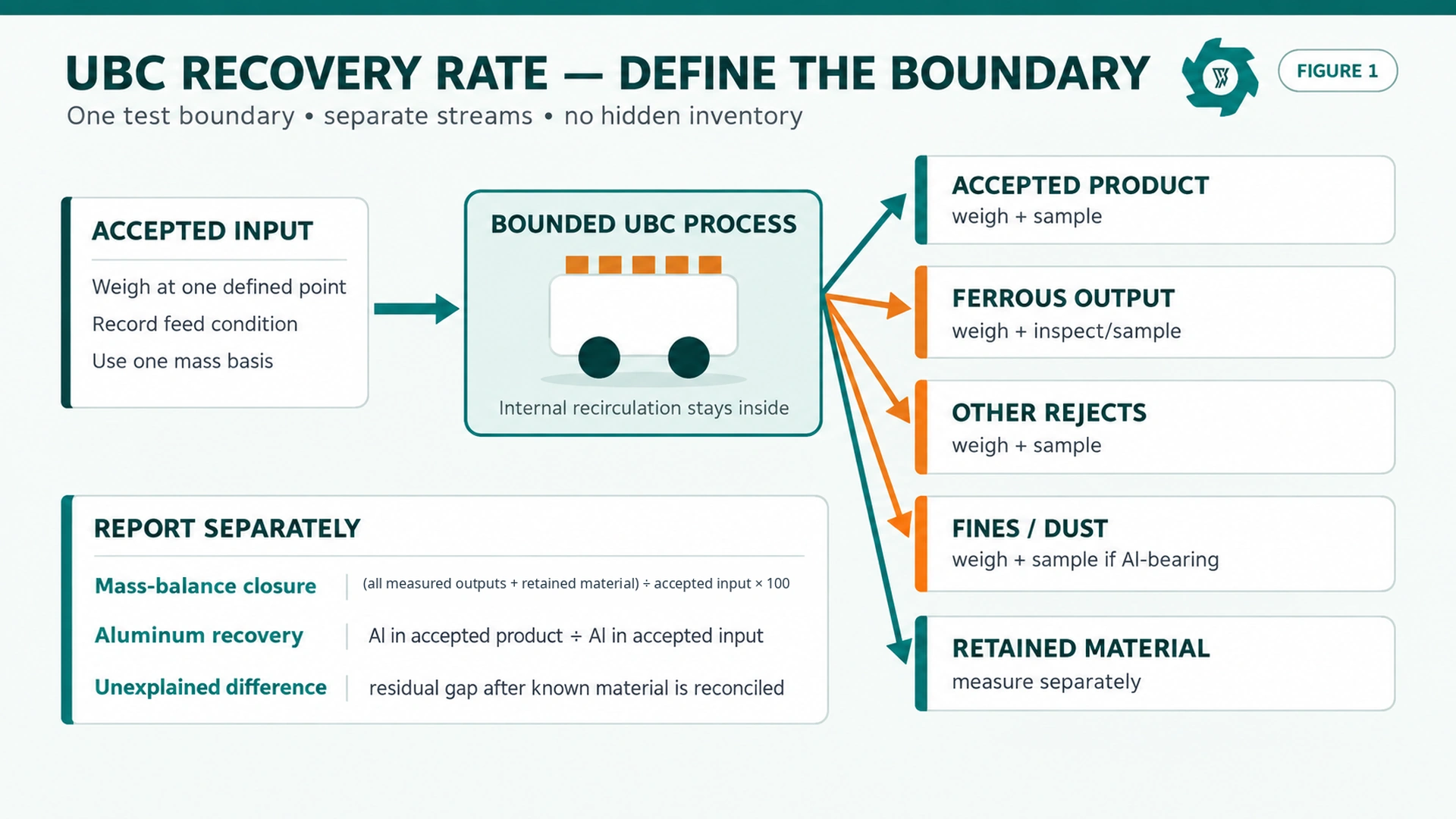
For a complete preparation line, that boundary may start at the accepted-input weighing point and end at the accepted UBC product plus every reject, return and retained-material location. For one separator, it may start at the separator feed and end at the two or three streams leaving that machine. Do not compare those two percentages as if they describe the same duty.
The Aluminum Association’s KPI methodology measures consumer or industry recycling over a much broader market boundary and, for its consumer rate, uses quantities of processed UBC entering melting operations as part of the numerator definition.[1] That is useful for national recycling statistics, but it is not a factory acceptance formula for a shredding or sorting line. A plant test should define its own physical start point, end point and streams.
Write the boundary in the FAT before the test begins. Mark the actual scale or collection point used for accepted input. Identify where accepted product is collected. List every side stream. State whether an internal return conveyor remains inside the boundary. Define what happens to material still sitting in a hopper, chute, magnet box or conveyor at the end of the run.
2. Do Not Use One Percentage for Three Different Questions
The most common reporting mistake is to call product yield, aluminum recovery and product grade by the same name.
Accepted-product mass yieldaccepted product mass ÷ accepted input mass × 100Shows how much total mass became accepted product. It does not prove how much aluminum was recovered.
Aluminum recoveryaluminum mass in accepted product ÷ aluminum mass in accepted input × 100Shows how much of the available aluminum reached the accepted product.
Product gradeconforming UBC or agreed aluminum mass ÷ total accepted product mass × 100Shows product quality under the agreed classification method.
Reject metal lossaluminum mass in a reject stream ÷ aluminum mass in accepted input × 100Shows where recoverable metal is leaving the intended product path.
Consider a separator adjusted to throw more material into the product bin. The total product mass can rise even if extra plastic or glass is carried with it. Mass yield improves, but grade can fall. The opposite can also happen: a narrow splitter setting may produce a very clean fraction while sacrificing aluminum into residue. Recovery and grade therefore belong on the same report.
The existing guide to eddy current separator feed preparation and recovery covers that recovery-versus-grade tradeoff at the separator. This article focuses on applying the same accounting logic across the full bounded UBC process, including magnetic rejects, fines, non-metal residue and retained inventory.
Figure 1. Recovery starts with a boundary. Product, rejects, fines and retained material must all belong to the same test before the percentages are compared.
3. Use One Mass Basis Across Input and Outputs
Choose the basis before testing. For a receiving or dry-preparation FAT, the most practical approach is often to record as-received masses and separately document moisture or free-liquid condition. If a contract requires a dry or corrected basis, define the correction method, sampling point and laboratory or field procedure. Do not correct only the input while leaving outputs on an as-received basis. The related guide on moisture in UBC bales covers receiving deductions and moisture-related handling in more detail.
Scale performance matters as well. NIST Handbook 44 is written for commercial weighing and measuring equipment and emphasizes accurate, repeatable measurement under applicable requirements.[2] A recovery test does not become defensible merely because masses were written to the nearest kilogram. Record the scale identity, its usable range, the tare method, resolution and the verification or calibration status required by the project.
4. Weigh Every Stream, Not Only the Product
Accepted input: the material that actually enters the agreed test boundary after any excluded feed is removed.
Accepted output: the product that meets the agreed acceptance definition.
Ferrous output: steel cans, straps, fasteners and magnetic material, weighed independently because attached or trapped aluminum can leave with it.
Other rejects: plastic, paper, glass, dirt and other rejected material not assigned to another named stream.
Oversize or return: material routed to a return loop or held for reprocessing, where present.
Dust/fines: material removed by screening, dust collection or housekeeping points that are inside the test boundary.
Retained material: known inventory remaining in equipment at the defined end condition.
Unexplained difference: the residual mass-balance gap after all measured streams and retained material have been reconciled.
Do not merge retained material with unexplained difference. One is known material physically present in the system; the other is evidence that the measurement system has not fully reconciled the run. EPA’s description of secondary-aluminum pretreatment also shows why side streams matter: scrap preparation can include physical separation, size reduction, magnetic removal, screening and classification rather than one single “aluminum output.”[3]
5. Product Weight Is Not the Same as Recovered Aluminum
For a buyer who purchases UBC as a commodity, “conforming product” may be more important than elemental aluminum purity. The classification method should follow the commercial specification actually used for the transaction. The separate guide on UBC contamination limits and mill rejection addresses acceptance limits.
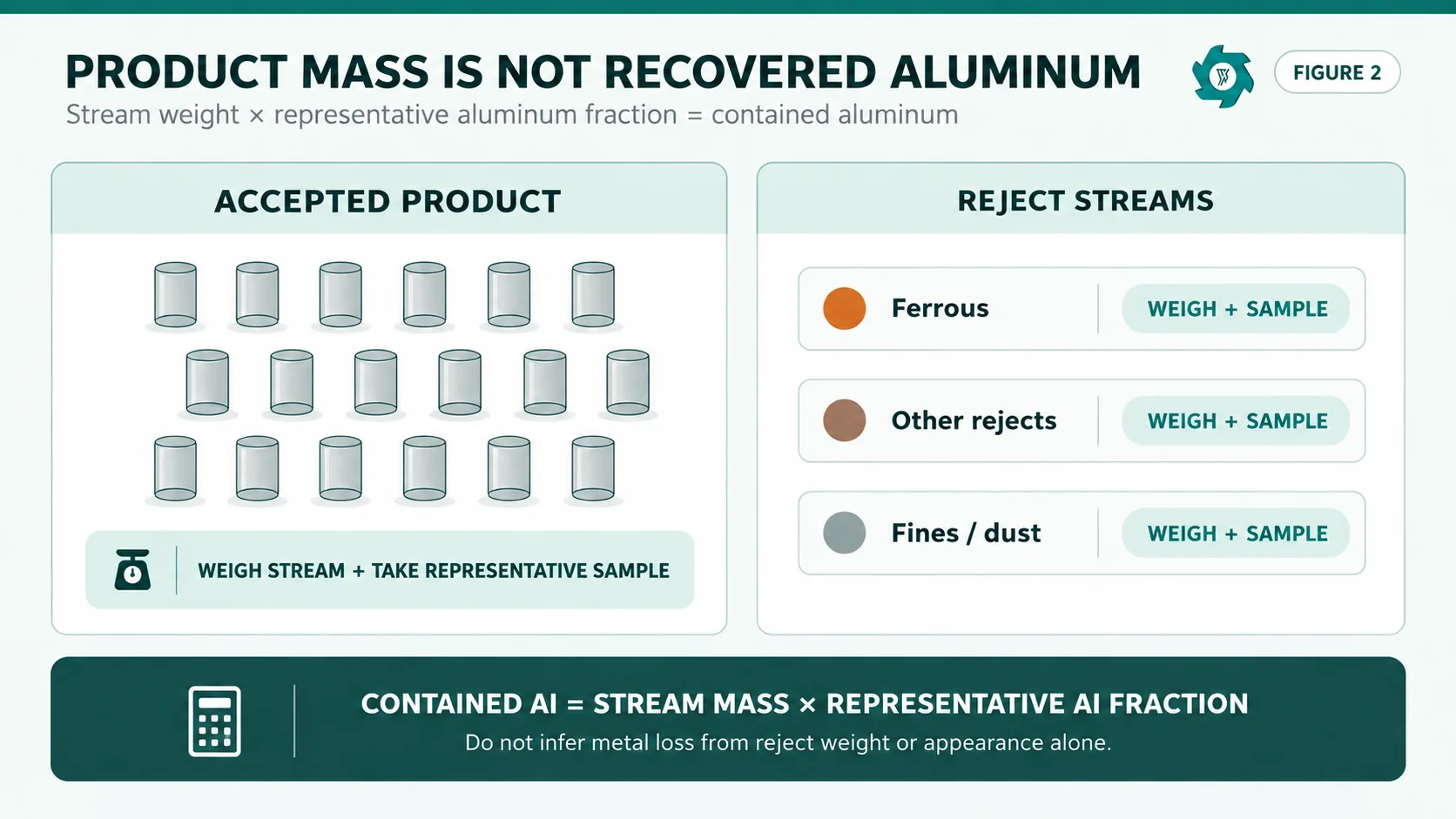
When the contract uses aluminum mass, calculate the aluminum contained in each stream from the stream mass and its representative aluminum fraction. The test method may be hand sorting into agreed categories, controlled physical separation, laboratory analysis, or another buyer-approved method suitable for the material. The method is project-specific; the important point is that product and reject estimates are based on the same written classification logic.
Figure 2. A reject bin’s total weight is not its aluminum loss. Weigh the stream and determine a representative aluminum fraction before converting it into metal mass.
6. Measure Aluminum in Rejects to Find the Real Loss
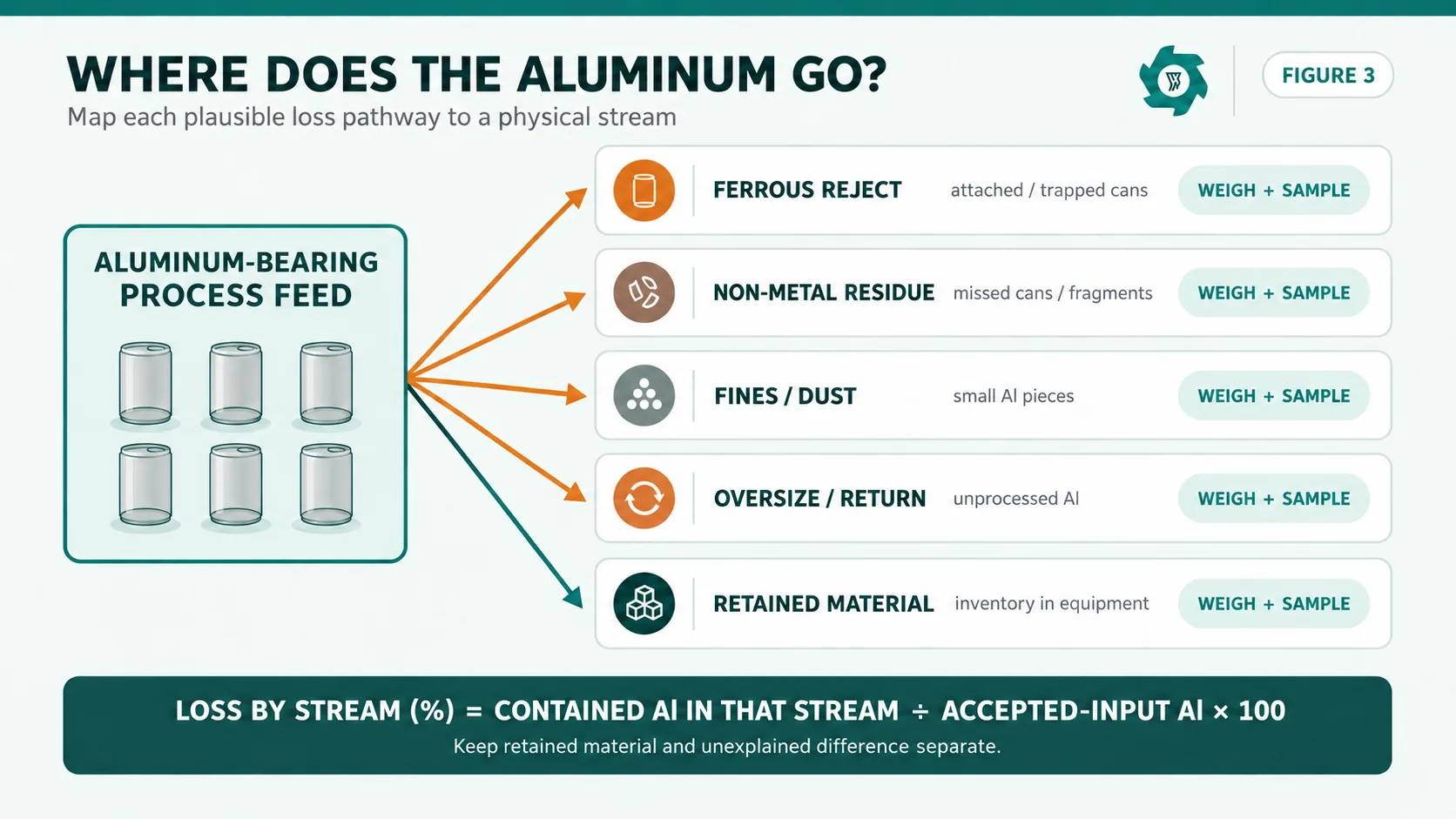
Metal loss is often hidden in a stream that looks mostly non-metallic. A magnetic fraction can carry cans trapped in steel. A light-reject stream can contain thin aluminum pieces. Fines can contain shredded can fragments. An oversize return can hold valuable material that has not yet completed the process. Total reject weight alone cannot tell you which stream deserves corrective work.
For each reject stream that can reasonably contain aluminum, calculate contained aluminum mass:
Contained aluminum mass = measured stream mass × representative aluminum fraction
Then express that contained aluminum as a share of the accepted-input aluminum. Reporting the losses separately is far more diagnostic than publishing one combined loss number. If most loss is in the magnetic reject, inspect liberation and attached metal. If it is in fines, investigate how the feed is opened, transferred and screened. If it is in a final residue, inspect separator presentation and the accepted operating window. The test tells the engineering team where to look without assuming in advance that one machine is at fault.
7. Sampling Is the Weak Link in Many Recovery Claims
EPA sampling guidance makes the general quality point clearly: data cannot be made representative later by more precise analysis if the sampling design itself was not representative of the population being studied.[4] Applied to UBC recovery, that means the sampling plan should be written before the run. Identify the stream, sampling location, increment frequency, sample size, reduction method, classification procedure and the time window represented by each composite sample.
Where loss is expected to vary over time, take increments across the run rather than one end sample. Where a line has distinctly different streams—ferrous, light residue and fines—treat them as separate populations instead of mixing them into one bucket. Stratifying the samples by stream also makes corrective action easier because the resulting loss is tied to a physical exit point.
8. Keep Fines and Dust Separate from General Rejects
Fines deserve their own line item because their composition and handling can differ sharply from bulky residue. The total fines mass may be mostly dirt, glass or coatings, yet a small aluminum fraction can still represent meaningful metal value. The opposite can also occur: a visually metallic fines stream may be small enough that its total metal loss is modest. Weigh first, sample second, then calculate.
Particle-size effects, accepted windows and fines generation are already treated in the shredded UBC size and fines guide. Avoid duplicating those decisions inside a recovery test. Here, fines are simply one measured destination in the metal account. If the process has no fines discharge, do not invent one. If dust is captured separately and can contain measurable aluminum, keep that stream visible.
9. Do Not Count Recirculation Twice
Return conveyors can make throughput and recovery look better than they are if the same material crosses a scale more than once. Suppose an oversize fraction is screened out, returned to the shredder and later reaches accepted product. Its second pass is process activity, not new accepted input.
The clean method is to choose an external boundary around the recirculation loop. Material entering the loop remains inside inventory until it exits as product, reject or retained material. If an oversize stream leaves the boundary for later off-line reprocessing, then weigh it as a separate output and state that it was not accepted product during the test. The report should make that decision obvious.
Figure 3. “Metal loss” is a map, not one bin. Measure the aluminum content of each plausible exit so optimization targets the real loss mechanism.
10. Mass-Balance Closure Is a QA Check, Not the Recovery Rate
Total mass closure asks whether the measured material account balances. It does not tell you whether the valuable aluminum reached the product. A perfectly closed mass balance could still describe a poor separation if much of the aluminum is sitting in a reject bin.
List the unexplained difference separately. A small gap can result from scale resolution, adhering moisture, uncollected dust, material left outside the defined retained-material check, or sampling and handling losses. A large gap should stop the team from over-interpreting a precise-looking recovery percentage. The unresolved mass could contain aluminum; assigning it automatically to either product or reject would hide uncertainty.
A second check is aluminum closure. Compare the estimated aluminum in the accepted input with the summed aluminum across accepted product, sampled rejects and retained material. Because composition estimates have sampling uncertainty, do not expect false mathematical perfection. Use the discrepancy as a diagnostic: if the metal balance refuses to reconcile while the total mass balance closes, the problem is more likely in composition sampling or classification than in the scales.
11. When Input Composition Is Difficult, Reconstruct Carefully from Outputs
Reconstructing input aluminum from bounded output streams can help when direct input sampling is unreliable, but it still has limits. It fails if an unmeasured dust stream leaves the boundary, if retained inventory is ignored, if reject samples are not representative, or if product and reject classification methods differ. State clearly whether input aluminum was measured directly, reconstructed from outputs, or estimated by a hybrid method. Never present the method as a universal industry standard when it was chosen for one test.
12. An Illustrative Recovery Calculation
Stream
Measured mass
Illustrative Al fraction
Contained Al
Accepted input
10,000 kg
90.30%
9,030 kg
Accepted product
9,100 kg
97.50%
8,872.5 kg
Ferrous output
300 kg
2.00%
6 kg
Other rejects
450 kg
15.00%
67.5 kg
Fines/dust
100 kg
40.00%
40 kg
Retained material
50 kg
60.00%
30 kg
The total measured mass closes at 10,000 kg. Accepted-product mass yield is 91.0%. Aluminum recovery is 8,872.5 ÷ 9,030 = 98.26%. Measured aluminum in the three reject streams is 113.5 kg, or 1.26% of accepted-input aluminum. Retained aluminum is estimated at 30 kg, or 0.33%. The aluminum account sums to 9,016 kg, leaving a 14 kg composition difference, about 0.16% of the estimated input aluminum.
The useful part is not the high or low value of any one example percentage. It is the structure of the report. An engineer can see the product, each loss point, retained inventory and the remaining metal-account uncertainty. If the other-reject loss doubled on the next run while fines loss fell, that change would be visible even if the gross product weight remained similar.
13. Build the FAT Around Evidence, Not a Demonstration
A supplier demo answers “can the equipment run?” A recovery FAT should answer “under the agreed feed and operating state, where did the mass and aluminum go?” The test plan should be signed or otherwise agreed before the trial so the calculation cannot be redesigned after the result is known.
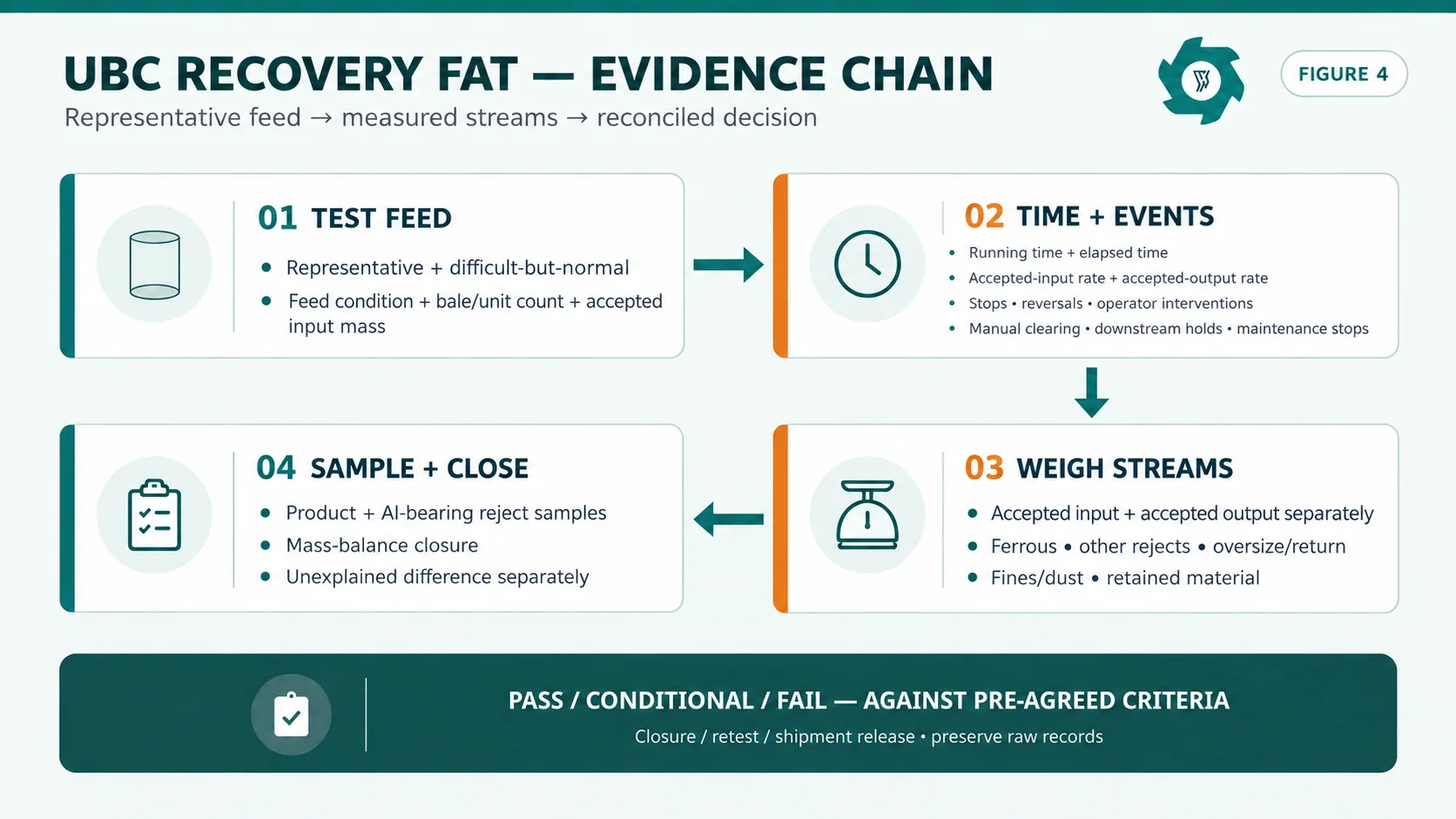
Use representative material and include difficult-but-normal feed that the plant is expected to receive. Record unit or bale count where relevant, accepted input mass, feed condition and any moisture or free-liquid observations. Define the downstream state and the test time basis. Record running time and elapsed time separately so feed starvation, stops and downstream holds are not hidden inside a production-rate claim.
Report accepted-input rate and accepted-output rate on the same stated time basis. Do not substitute gross conveyor throughput for either figure.
During the run, log stops, reversals, operator interventions, manual clearing, downstream holds and maintenance stops. Freeze the agreed operating settings during a measurement period. If a material or machine setting is changed, mark the change and either analyze that period separately or reset the test.
At the end, weigh accepted input and accepted output separately, then ferrous output, other rejects, oversize/return if present, dust/fines and retained material. State unexplained difference separately. Take planned product and reject samples across the agreed time window, not only after the most stable period has ended. If an output stream may contain aluminum, include it in the metal account or explain why it was excluded.
Figure 4. A repeatable recovery FAT connects one representative feed lot to time records, separate stream weights, representative samples and a reconciled close-out.
14. What the Recovery Report Should Contain
A buyer should be able to hand the report to an engineer who did not attend the test and still reproduce the calculation. At minimum, include the boundary drawing, material description, feed lot identity, scale records, time basis, accepted-input rate, accepted-output rate, operating settings, event log, stream masses, sampling plan, composition results, formulas, raw calculations and the final acceptance decision.
Any guaranteed recovery value should state exactly which formula and feed envelope it uses. A percentage without feed condition, boundary, product definition and test method is not a useful contract term.
15. Common Recovery-Measurement Errors
Error
Why it misleads
Better practice
Using accepted product mass as recovered aluminum
Product can contain non-aluminum material.
Measure product mass and a representative aluminum or conforming-UBC fraction separately.
Weighing product but not rejects
There is no evidence showing where missing aluminum went.
Weigh each physical output stream and sample aluminum-bearing rejects.
Combining all rejects
The loss mechanism cannot be located.
Keep ferrous, other rejects, fines and oversize/return distinct.
Hiding retained material in “difference”
Known inventory is confused with measurement error.
Measure retained material, then report unexplained difference separately.
Sampling only the cleanest period
The sample no longer represents the complete tested material.
Take scheduled increments over the defined run or stable test window.
Counting recirculated material as new input
Throughput and denominators can be inflated.
Put return loops inside one external boundary or report them as a separate output.
Changing settings during the run without resetting
The final result represents several configurations at once.
Freeze settings or segment and repeat the measurement after a change.
16. Put the Measurement Method in the RFQ
Recovery should not first appear as a question after the machine has been built. In the RFQ, describe the incoming UBC condition, contamination types, moisture or residual-liquid condition, target accepted-input rate, required product, known reject streams, downstream process and the commercial product specification. Ask the supplier to identify the proposed process boundary and where each output will be collected and weighed.
Then state the evidence requirement. Specify whether aluminum recovery will be based on direct input composition, output reconstruction or another agreed method. Define how product grade will be classified. Name the reject streams that must be weighed and sampled. Require retained material and unexplained difference to remain separate. State the acceptable test material, minimum stable period or test quantity, and how changes to operating settings will be handled.
Frequently Asked Questions
What is the correct formula for UBC aluminum recovery?
Use aluminum mass in the accepted product divided by aluminum mass in the accepted input, multiplied by 100. The input and product must use the same test boundary and mass basis, and the aluminum content must come from an agreed representative sampling or reconstruction method.
Is product mass yield the same as aluminum recovery?
No. Product mass yield compares total accepted product mass with total accepted input mass. Aluminum recovery tracks the aluminum itself. A heavy product can still contain non-aluminum contamination, so the two metrics should be reported separately.
How should aluminum loss in rejects be measured?
Weigh each relevant reject stream separately, take representative samples, determine the aluminum fraction by the agreed method, and multiply stream mass by aluminum fraction. Express each reject’s contained aluminum as a share of accepted-input aluminum.
Should retained material be included in unexplained difference?
No. Retained material is known inventory remaining inside the test boundary at the defined end condition. Weigh or estimate it separately. Unexplained difference is the residual gap after measured outputs and retained material have been reconciled.
What should a UBC recovery FAT record besides recovery percentage?
Record representative test feed, accepted input and output masses, accepted-input rate and accepted-output rate, running and elapsed time, stops, reversals, operator interventions, manual clearing, downstream holds, maintenance stops, all reject-stream weights, sampling records, retained material, mass-balance closure, product grade and the unexplained difference.
Define the Test Before You Ask for a Recovery Number
Send representative UBC photos or video, loose or baled condition, contamination and moisture observations, target accepted-input rate, required product, downstream process and the streams you want measured during FAT. The line configuration and recovery test can then be matched to one agreed material boundary.
Daniel
Metal Recycling Equipment Specialist,YUXI Machinery
Daniel has over 7 years of experience serving the international recycling market.
He focuses on metal shredding and recycling systems,including feedstock evaluation,equipment selection,size reduction,separation,and complete line configuration.





 Request Quote