




 Request Quote



A credible refrigerator recycling equipment manufacturer does more than send an attractive machine list. It shows where its responsibility begins and ends, proves that the proposed route matches the buyer’s appliances, and accepts measurable obligations for the equipment it supplies. The evaluation should therefore be built around evidence, not catalog size, factory appearance or the confidence of a sales presentation.

Why This Evaluation Is Different From Choosing a Line
Line selection asks what process fits the feed and required products. Manufacturer evaluation asks whether a particular supplier can design, build, document, test and support that process.
This distinction matters because the YUXI waste refrigerator recycling line can be configured either as a mechanical section for prepared cabinets or as a broader integrated project. A manufacturer should be judged against the exact boundary requested. Evidence for a cabinet shredder does not, by itself, prove refrigerant recovery, oil handling, foam-gas control or complete-plant integration. There is already a separate guide on how to choose a refrigerator recycling line.
Use an Eight-Part Scorecard
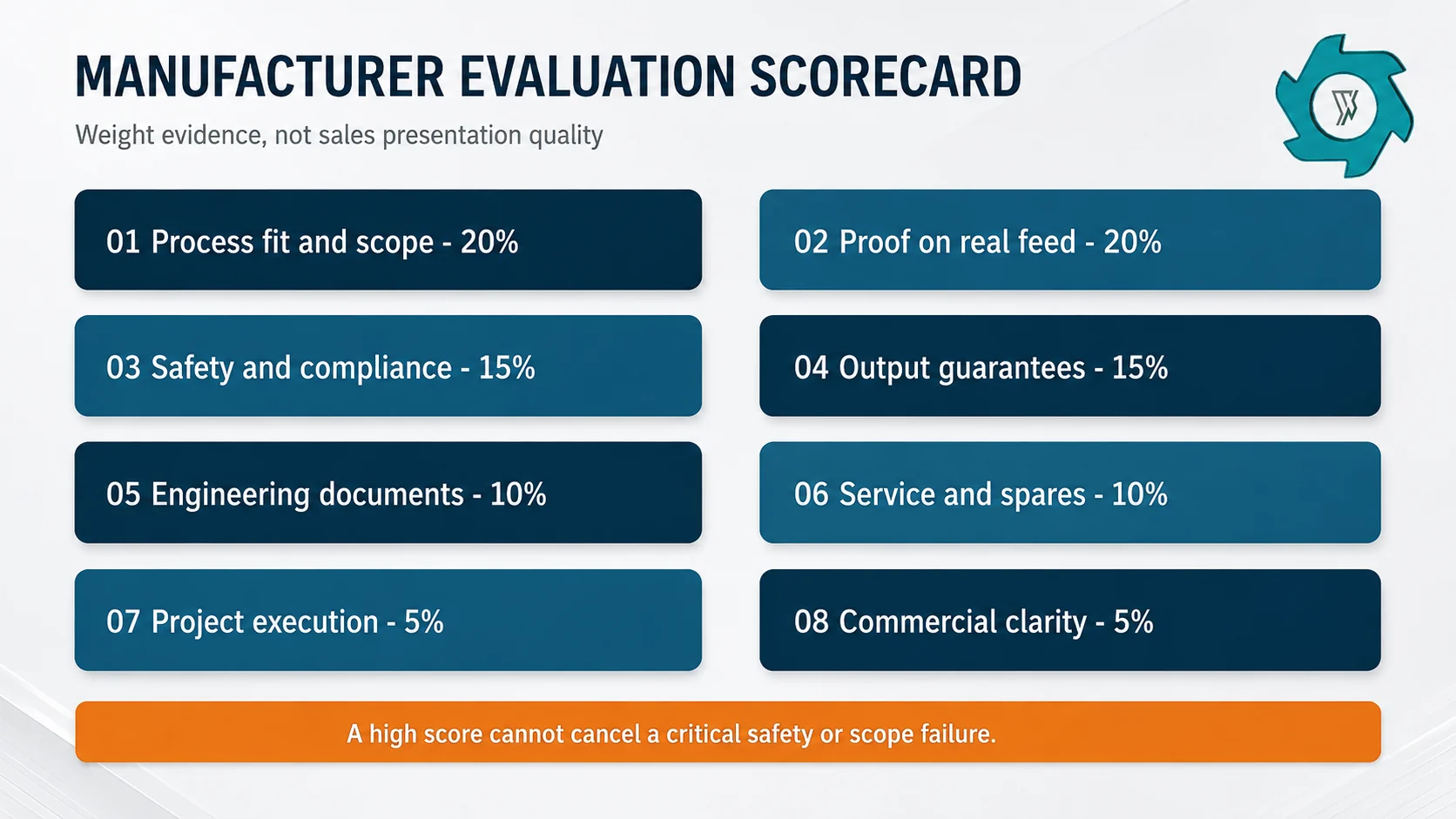
| Criterion | Weight | Evidence to request | Reason to hold or reject |
|---|---|---|---|
| Process fit and scope | 20% | Process flow, boundary matrix, equipment list, interface schedule | Incoming feed or excluded stages remain ambiguous |
| Proof on real feed | 20% | Comparable references, test video with context, witnessed trial data | Only clean or unrelated material is shown |
| Safety and compliance engineering | 15% | Hazard review, interlock philosophy, gas/dust controls, guarding plan | Supplier treats intact appliances as unrestricted shredder feed |
| Output guarantees | 15% | Mass balance, sampling method, purity and recovery definitions | “High purity” appears without a test method |
| Engineering documents | 10% | GA drawings, load list, P&ID where applicable, I/O and manual index | Documents are promised only after final payment |
| Service and spares | 10% | Response route, commissioning plan, critical-spares list, lead times | No named service responsibility in the destination market |
| Project execution | 5% | Schedule, milestones, sub-supplier control, change procedure | No revision control or accountable project lead |
| Commercial clarity | 5% | Inclusions, exclusions, payment gates, warranty and acceptance terms | Price cannot be reconciled with the technical scope |
Score each item from 0 to 5, multiply by its weight and record the evidence reference beside the score. Do not allow averaging to hide a critical failure. Refrigerant handling, combustible vapor control, emergency stops, guarding and a defined feed boundary are gate items, not bonus points.
1. Freeze the Process Boundary Before Scoring the Manufacturer
Ask one direct question: What condition enters the first powered machine in your quotation? The answer should identify whether the supplier receives complete appliances, evacuated appliances, compressor-free cabinets or already reduced material.
For U.S. projects, EPA states that the final disposer is responsible for refrigerant recovery and describes the documentation needed when recovery is performed earlier in the chain.1 A proposal that silently assumes “customer-prepared feed” can therefore shift more than labor to the buyer; it may shift a compliance-critical interface. Use the separate refrigerator depollution guide when checking what must happen before cabinet processing.
2. Grade the Manufacturer’s Evidence, Not Its Claims
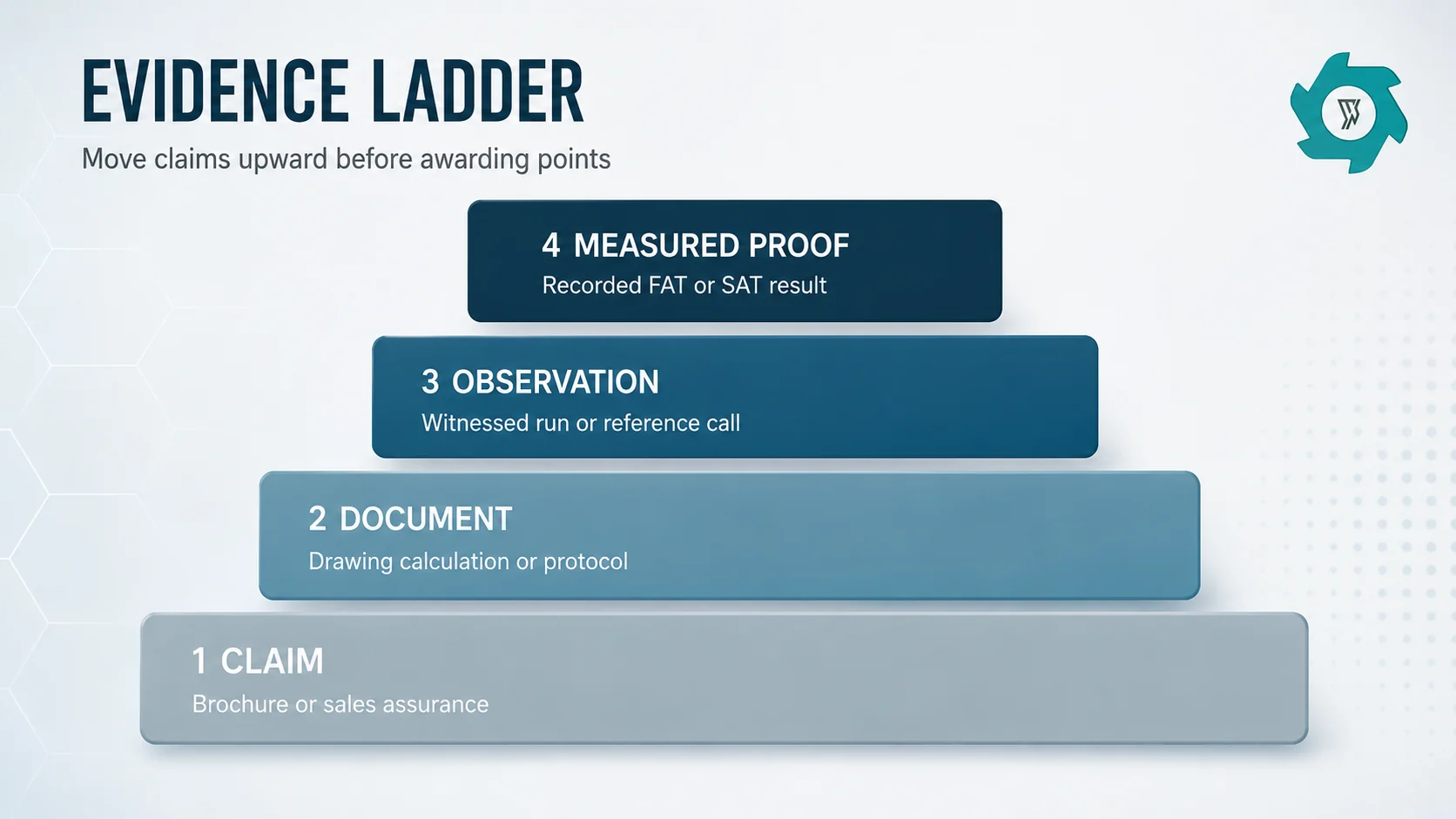
A brochure statement belongs at the bottom of the evidence ladder. A drawing or calculation is stronger because it can be checked. A witnessed build, customer reference or live trial adds context. The strongest proof is a recorded result obtained under the agreed feed and measurement rules.
Ask what appliances entered, which stages were supplied, how long the plant has operated, what output was contracted and who maintains the system. A high-capacity WEEE installation may tell you little about foam management in a dedicated refrigerator plant. With the reference owner’s permission, speak to operations or maintenance staff rather than relying only on a prepared testimonial.
3. Audit Engineering Depth at the Interfaces
Manufacturers often describe their own machines clearly while leaving the handoffs vague. Those handoffs are where projects fail. Check the transfer from depollution to cabinet feeding, the balance between primary size reduction and secondary liberation, the connection between foam classification and dust collection, and the loading presented to magnetic and non-ferrous separators.
A useful proposal states normal and maximum feed dimensions, expected bulk flow, surge capacity, recirculation, motor and utility loads, access space and the design basis for extraction. The site layout should also show traffic, clear height, platforms and maintenance removal paths. These checks are covered in more physical detail in the refrigerator recycling plant layout guide.
4. Make Every Performance Claim Testable
Capacity needs both units per hour and tonnes per hour, together with average appliance weight and preparation condition. Output quality needs named fractions, contamination definitions and a sampling method. Recovery requires an estimate of target material entering the lot; it cannot be proved from product purity alone.
Ask the manufacturer to state how stops, manual interventions, oversize return and start-up material are treated in the calculation.
5. Review Safety and Compliance as a Design Discipline
Look for a hazard review that matches the appliance mix. Refrigerants and blowing agents are not interchangeable process streams. Hydrocarbon-bearing units can change ventilation, gas detection, ignition control and emergency response. Foam dust affects housekeeping, extraction and fire protection. The proposal should show who designs each control and which site or local approvals remain outside the manufacturer’s scope.
EPA requires applicable refrigerant recovery and recycling equipment to be tested to confirm that it meets the relevant equipment standards.2 This does not make the recycling-line manufacturer the local compliance authority. It does mean the manufacturer should disclose the equipment basis, interfaces and limitations clearly enough for the buyer’s qualified team to complete the review.
6. Inspect Manufacturing Capability Without Overvaluing the Factory Tour
During the visit, match serial numbers, drawings and component lists to the project. Review weld quality, machining records, gearbox and bearing installation, cable identification, guarding, coating, panel construction and change control. Ask which assemblies are built in-house and which come from sub-suppliers.
A large workshop is not proof of refrigerator experience. Conversely, a specialist integrator may outsource fabrication while retaining strong process control. The main question is whether the supplier can trace design, procurement, assembly, testing and deviations through one controlled project record.
7. Separate FAT, Handover and SAT
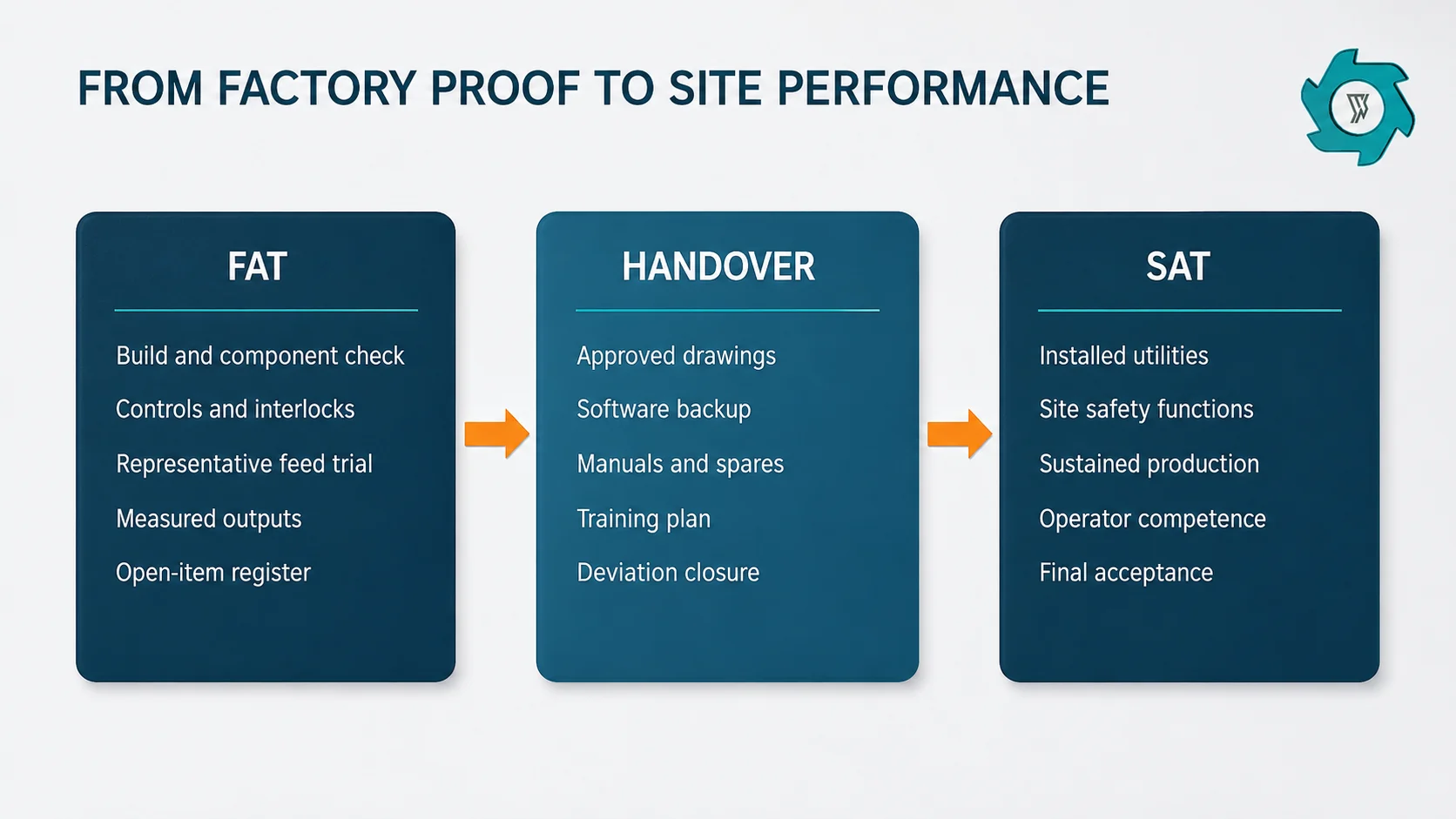
The FAT should verify the build, controls, factory-testable safety functions and any loaded performance that the temporary setup can reproduce. Use representative material, weigh the test lot and record every deviation. The test protocol should define the requirements, measurement methods, pass/fail criteria and corrective-action process before the FAT begins.
The handover should include approved drawings, software backups, manuals, spares, open-item status and a site test plan. SAT then checks installed utilities, interfaces, operator training and sustained performance under site conditions. Do not defer every hard measure to SAT; once equipment has shipped, the buyer’s leverage and the cost of correction both change.
8. Normalize Service, Warranty and Commercial Risk
Ask who answers the first call, expected response channels, remote access conditions, technician travel basis and critical-spares lead times. Request a recommended two-year spare-parts list separated into commissioning spares, wear parts and long-lead failures. The supplier should also explain which failure evidence is needed for warranty review.
Finally, build a normalized price sheet. Include freight, foundations, platforms, ducts, extraction, utilities, installation, commissioning, training, taxes, initial spares and excluded upstream or downstream systems.
Red Flags That Should Stop the Evaluation
- The quotation never defines the feed condition.
- Complete refrigerators are shown entering a shredder with no depollution boundary.
- Capacity is offered without appliance mix, weight, test duration or uptime basis.
- Purity and recovery are used as interchangeable terms.
- Gas, foam or dust controls are described only as optional accessories.
- The proposed reference plant cannot be matched to a comparable scope.
- Drawings, manuals, software or component lists have no delivery milestone.
- Warranty, commissioning and acceptance responsibilities contradict one another.
Documents to Request Before Final Award
| Stage | Minimum package |
|---|---|
| Shortlist | Process description, scope matrix, preliminary flow, references and exclusions |
| Technical clarification | Equipment list, utility schedule, GA layout, mass-balance basis, control philosophy and safety assumptions |
| Contract | Approved specification, responsibility matrix, document schedule, FAT/SAT protocol, guarantees and deviation rules |
| Pre-shipment | FAT report, open-item register, as-built drawings, manuals, spares and software backup |
Frequently Asked Questions
What should I verify first when evaluating a refrigerator recycling equipment manufacturer?
Verify the process boundary and incoming feed condition first. A proposal for pre-treated cabinets is not equivalent to a plant that receives complete appliances and includes refrigerant, oil and compressor handling.
Is a factory visit enough to prove manufacturer capability?
No. A tidy factory is useful evidence of build capability, but it does not prove performance on refrigerator feed. Combine the visit with document review, reference checks and a witnessed test under agreed conditions.
How should refrigerator recycling performance guarantees be written?
Tie each guarantee to a defined feed, process boundary, test duration, measurement method and treatment of stops, recirculation and rejects.
What is the difference between FAT and SAT?
FAT verifies the agreed build and factory-testable functions before shipment. SAT verifies the installed line, site interfaces and sustained performance after commissioning.
Should the lowest-priced manufacturer receive the highest score?
No. Compare normalized installed scope and risk-adjusted project cost. A low equipment price can exclude gas handling, extraction, platforms, controls, commissioning or downstream equipment that another supplier includes.
Evaluate YUXI Against a Defined Project Scope
Send representative appliance data, feed condition, required capacity, output specifications, site drawings and destination country. Ask for a boundary matrix, process proposal and test basis that your team can compare with other bids.
Engineering References
- EPA Appliances — disposal guidance.
- EPA Certification — recovery equipment.