




 Request Quote



Summary
Loose UBC is not automatically the low-cost feed, and baled UBC is not automatically the high-cost feed. The cost difference comes from the equipment required to move each feed condition to the same accepted output. Loose cans avoid de-baling, but their low bulk density can enlarge receiving, storage, conveying and final baling duties. Baled UBC reduces volume before it reaches the plant, but a project that must reopen and clean those bales can add bale handling, tie management, controlled opening, buffering, ferrous removal, screening and extra controls.
The most useful comparison is therefore not “price of a loose-can line versus price of a baled-can line.” It is: what equipment is added or avoided when both routes are asked to make the same product from a defined feed envelope?
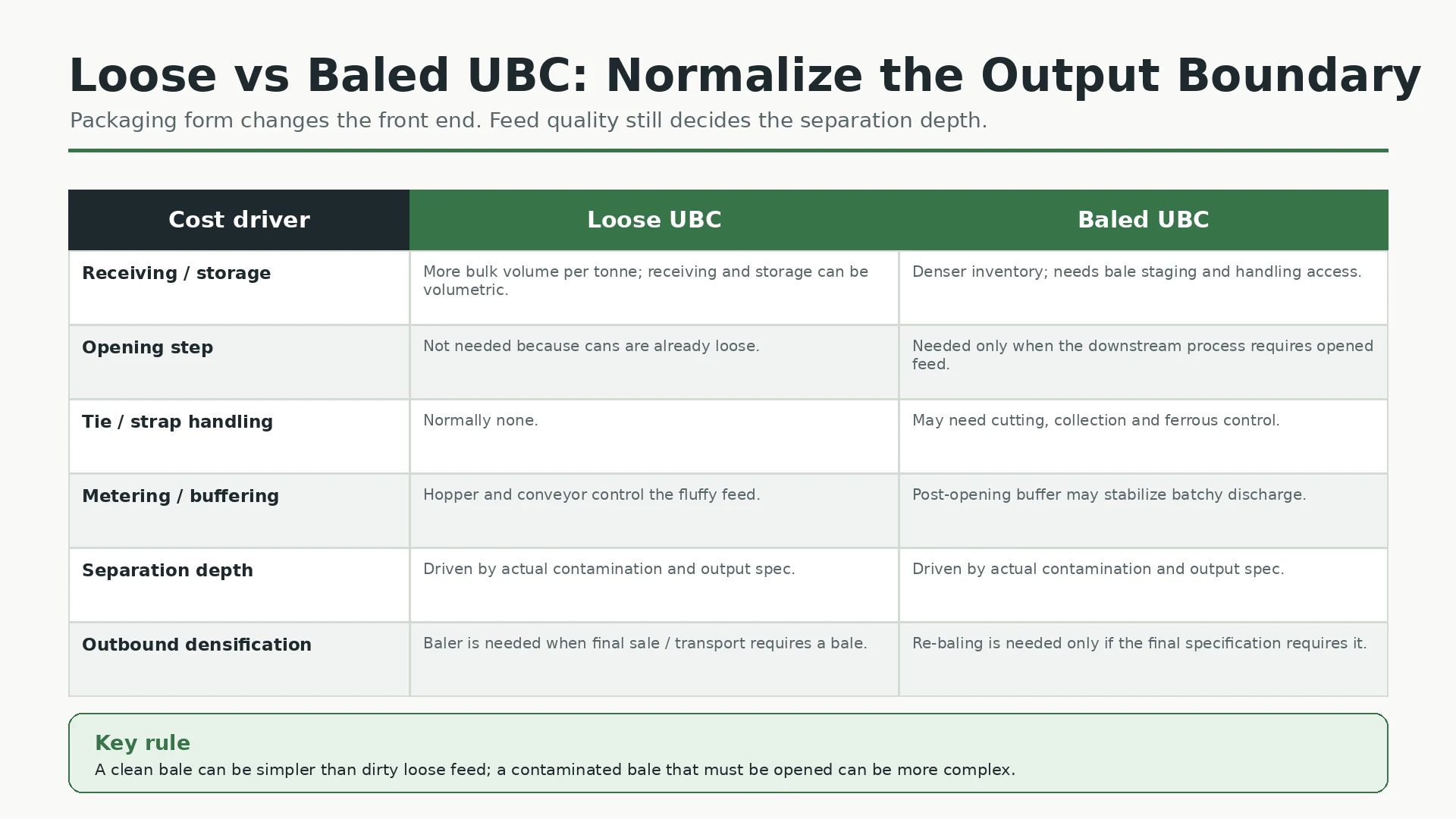
1. Compare the Same Output Before Comparing Cost
A cost comparison becomes misleading as soon as the two quotations end at different points. One supplier may quote loose cans through inspection and a baler. Another may quote dense bales through opening, magnetic separation, screening and a clean loose discharge. The second line has more equipment, but it is also doing more work.
The public UBC recycling line is intentionally configured by feed condition and required output rather than one fixed machine sequence. Use the same rule for cost comparison. Define whether the accepted product is a transport-ready bale, a cleaned loose UBC fraction, a controlled opened fraction for a downstream mill process, or another agreed state.
If any one of those changes, the quoted project cost may change for reasons that have nothing to do with whether the cans arrived loose or baled.
2. Why a Bale Changes the Front End
A commercial UBC bale is not just “loose cans with less air.” It is a handled unit with a defined geometry, density range and tying system. ReMA’s Taldon specification, for example, defines baled UBC density ranges and allows specified steel bands or wires as tying methods.[1] Those details matter because the receiving system must handle the bale as a load, and the processing line must deal with the ties if the bale is opened.
For engineering, record the actual bale dimensions, mass, density range and tie type rather than assuming one market specification covers every supplier. The separate guide to UBC bale specifications covers that feed envelope in more detail. This article stays focused on what that envelope does to equipment scope and cost.
The Can Manufacturers Institute illustrates a common can-to-can route in which UBC is sorted and baled at a material recovery facility, then the bale is opened or shredded at the aluminum mill so non-aluminum components can be removed before later thermal and melting steps.[2] That does not mean every bale must be shredded. It does show an important cost principle: densification can save logistics work upstream while transferring opening and cleaning work downstream.
3. The Loose-UBC Cost Stack Is Often About Volume
Loose aluminum cans occupy a large volume for their mass. A plant that receives them directly can therefore spend money on space and material flow even when the mechanical process is simple. Common scope includes a tipping or receiving area, a hopper or live-bottom feeder, metering conveyors, an inspection point, optional magnetic removal and a final baler when the buyer requires dense transport units.
The low-density feed can make conveyor width, hopper volume, buffer storage and baler charging rate more important than a simple tonnes-per-hour target. The separate UBC capacity guide explains why volume flow and the slowest sustainable stage can control line output. For cost work, the important point is narrower: a “simple” loose-can route may still need substantial handling equipment because air occupies so much of the feed volume.
If the required final product is a dense bale, the baler is part of the loose-feed processing cost rather than an optional logistics accessory. Chamber size, cycle behavior, feeding method and required finished bale should be defined before the press is priced. The dedicated UBC baler guide covers that machine decision.
4. Where Baled UBC Can Add Equipment
When the incoming bale must be opened and cleaned before it reaches the accepted output, the front end usually becomes more layered. The extra equipment is not there because “bales are difficult” in the abstract. Each item solves a specific duty created by receiving a dense unit and then converting it back into a controlled material stream.
| Possible added scope | Why it appears | When it may be omitted |
|---|---|---|
| Bale receiving and staging | Forklift, crane or loader access is needed to unload, store and position dense units safely and repeatably. | If an upstream system delivers opened material directly into the line. |
| Tie / strap handling | Steel wire, steel band or other approved tying material must be cut, collected and prevented from entering unsuitable downstream equipment. | If the supply form is tie-free or the opening equipment and contract explicitly handle it. |
| Bale opener or controlled shredder | Releases compacted cans and exposes hidden non-UBC material for later separation. | If the bale already meets the next process or buyer specification and does not need to be reopened. |
| Surge buffer and metering | Opening a bale can create batchy discharge. A buffer converts that release into a steadier feed for separators or inspection. | If the opening stage already provides sufficiently stable continuous discharge. |
| Magnetic separation | Removes ferrous contamination and can capture steel tie fragments after opening. | If the feed is demonstrated to be effectively free of ferrous material and the downstream process allows omission. |
| Screening or light-fraction removal | Removes fines, dirt, glass fragments, labels, paper or other material only when the required product makes that cleanup necessary. | For clean feed where the accepted output is met without the stage. |
| Guarding, controls and dust scope | Each connected machine adds interlocks, access control, electrical loads, housekeeping points and maintenance space. | Never omitted where required for installed equipment; the amount changes with the final line. |
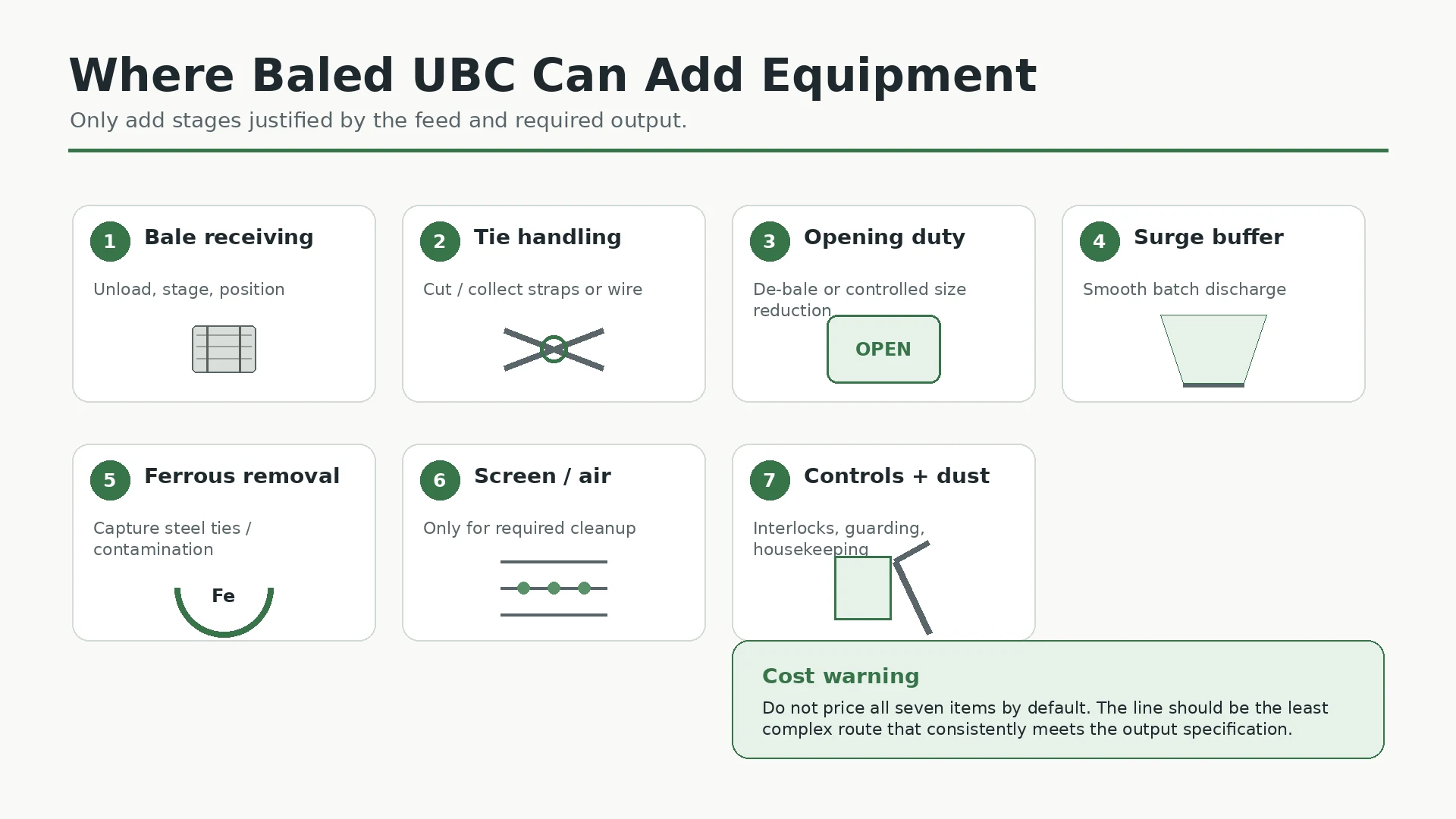
The machine used to open a bale is a separate engineering choice. It may be a bale breaker, low-speed shredder or another controlled opening stage depending on bale geometry, density, contamination, desired discharge and downstream process. The baled UBC shredder guide deals with that selection so this cost article does not duplicate it.
5. Treat Baling as a Cost Shift, Not a Universal Cost Penalty
Baling can reduce transport and storage volume before the material reaches the processor. That benefit can be substantial in a supply chain built around long-distance movement or limited yard space. But if the downstream plant needs the cans loose and exposed again, part of the saved logistics work reappears as de-baling, opening, tie handling and cleaning equipment.
A useful total-cost view is:
This is why a fixed claim such as “baled UBC costs more to process” is incomplete. It may cost more inside the processing hall while costing less to transport into that hall. Conversely, loose cans can be cheap to process when they are clean and local, but expensive to move long distances because so much of the load is volume.
Industrial practice also shows why bale quality matters. Novelis described a dedicated UBC cleaning line installed to remove residual plastic and paper from contaminated beverage-can bales before melting.[3] The Aluminum Association likewise notes that non-aluminum contamination, especially plastic, can create operational and safety problems in aluminum recycling.[4] The cost driver is therefore not the bale alone; it is the work required to convert the actual bale into the product the next process accepts.
6. Four Scenarios Show Why Feed Form Alone Does Not Decide the Budget
Scenario A: Clean loose UBC to transport-ready bales
This can be a relatively simple processing route: controlled receiving, inspection, optional ferrous removal and baling. The hidden expense is usually volume handling—space, conveyors, buffering and the baler duty required to keep up with fluffy feed.
Scenario B: Clean baled UBC accepted without further cleaning
If the incoming bale already satisfies the next buyer or process specification, the plant may only need receiving, storage and transfer. In this case, baled feed can be simpler than a loose-feed plant that must create bales before shipment. This is the main reason not to write “baled is always more expensive.”
Scenario C: Baled UBC must be opened and cleaned
Now the cost stack expands. The line may need bale staging, tie management, opening, metering, ferrous removal, screening, light-fraction cleanup, reject handling and extra controls. If the final product must be baled again, a second densification step can appear after cleaning.
Scenario D: Loose UBC is actually a mixed can-rich fraction
Loose material is not automatically clean material. A can-rich fraction containing steel containers, plastic, paper, glass or dirt can require screening, magnetic separation, eddy-current recovery or optical/manual quality control. A clean bale may need less separation than this dirty loose stream. Feed quality can outweigh packaging form.
7. Installed Cost Includes More Than the Main Machine
Equipment lists often hide the pieces that make one quotation look cheaper than another. A bale opener without the upstream loading arrangement, downstream conveyor, electrical controls or guarding is not the same scope as an integrated opening module. The same applies to a baler quoted without its infeed, discharge route or bale-handling area.
| Scope item | Loose UBC cost effect | Baled UBC cost effect |
|---|---|---|
| Receiving civil area | May need more floor volume for a low-density stream. | Needs bale staging, stacking limits and handling aisles. |
| Material handling | Hoppers and conveyors move a bulky feed continuously. | Forklift/crane handling plus post-opening conveyors may both be required. |
| Electrical / PLC | Depends on conveyor, baler and separation scope. | Additional opener, buffer and separators add drives and interlocks. |
| Guarding / access | Required around conveyors, baler and any separators. | Opening and tie-management areas can add guarded access and service zones. |
| Dust / housekeeping | Driven by dirt, fines, paper and transfer points. | Opening can release material previously trapped inside a dense bale. |
| Reject handling | Containers are needed if incoming loose feed contains rejects. | Opened bales may expose concentrated side streams that need dedicated bins. |
| Wear / spares | Often concentrated in baler and conveyor components. | Opening or shredding adds wear components and maintenance tasks. |
When normalizing vendor quotes, mark every one of these as included, excluded, optional or by buyer. That simple exercise often explains more of the price gap than the headline machine model.
8. Operating Cost Moves with the Same Duties
Operating cost follows the installed process. Loose feed can require more loader travel, conveyor run time and housekeeping per tonne simply because the volume is large. If the final output is a dense bale, the press cycles and the finished-bale handling are recurring operating duties.
Baled feed can reduce inbound material volume, but reopening adds different recurring costs: tie removal, opener or shredder wear, reversing or clearing difficult bales, post-opening conveyors, separation equipment, dust cleanup and maintenance access. Whether that operating cost is higher or lower than the loose route depends on the actual feed, the required output and the logistics avoided upstream.
Do not convert a nominal machine motor rating into a project energy cost. The line may not run every drive at full load, and different configurations may use different productive time. Compare measured or contractually defined line energy only after the process boundary is fixed.
9. Product Recovery Can Change the Economic Result
The cheapest equipment list is not necessarily the lowest-cost route if it sends saleable aluminum into rejects or leaves too much contamination in the product. A more complete cleaning stage can add capital and operating cost while also changing accepted product mass, reject mass and product value.
That tradeoff should be measured rather than assumed. The UBC recovery measurement explains how to separate accepted product, rejects, side streams and unexplained mass difference. For a cost comparison, use the same material boundary so one supplier is not rewarded for calling rejected or recirculated material “throughput.”
10. Normalize Quotes Before Looking at the Price
A procurement table should force every supplier onto the same definition. The more different the feed forms are, the more important this becomes.
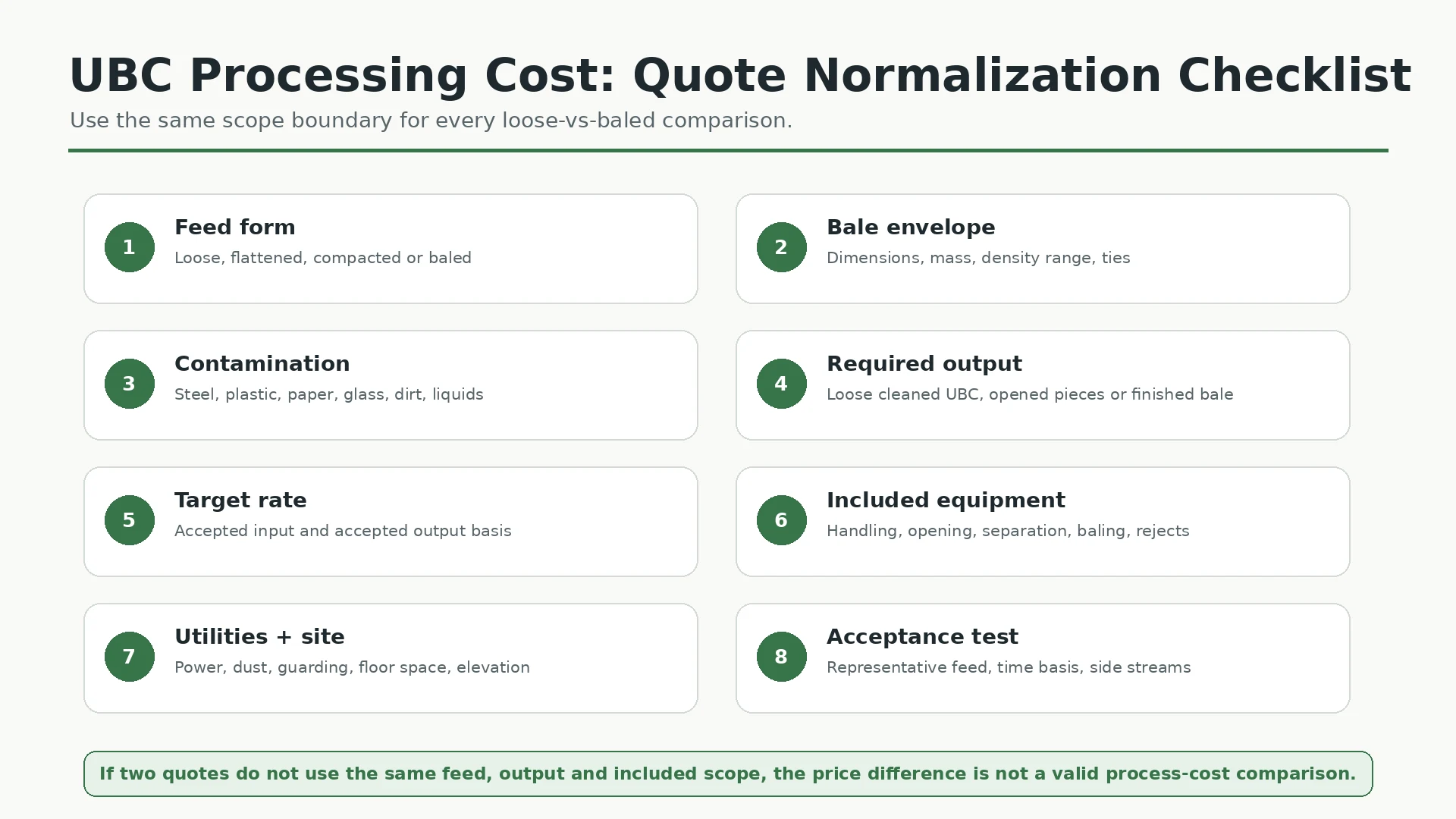
| Question | Why it changes the comparison |
|---|---|
| What exactly enters the first machine? | Loose cans, flattened cans and dense bales create different receiving and feeding duties. |
| What exactly counts as accepted output? | A loose cleaned fraction and a transport-ready bale are not the same deliverable. |
| Are bale handling and tie removal included? | These can be real labor and equipment items that disappear from a simplified machine quote. |
| Is opening separate from size reduction? | The project may need only de-baling, or it may need controlled shredding to meet downstream size or separation requirements. |
| Which separation stages are included? | Magnet, screen, air separation, eddy current or optical inspection should be tied to actual contamination and product requirements. |
| Who supplies conveyors, buffers and reject bins? | Connecting equipment can represent substantial installed scope. |
| Are controls, guarding and dust measures included? | These are required by the installed process even when they are absent from a short equipment list. |
| What is the FAT boundary? | The test should prove the same feed-to-output duty used for the commercial comparison. |
11. Common Cost-Comparison Mistakes
Comparing one machine to a complete line
A shredder price cannot be compared with a quotation that also includes conveyors, separation, controls and baling.
Assuming every bale needs the same process
Bale density, ties, contamination and final product decide whether opening, screening and other stages are required.
Ignoring equipment that the buyer must supply
Forklifts, cranes, civil works, power distribution, platforms, reject bins and dust ducting can move cost outside the vendor quote.
Using feed tonnes as finished tonnes
Rejects, ferrous output, fines and retained material make the accepted product rate different from gross feed rate.
Ignoring logistics outside the plant
Loose feed may avoid de-baling but increase transport and storage volume. Baled feed can move the cost in the opposite direction.
Buying unnecessary complexity
Every added machine creates power, wear, guarding, controls and maintenance. The simplest route that meets the product rule is usually the better engineering target.
12. RFQ Data Needed for a Real Loose-vs-Baled Cost Comparison
| RFQ field | What to provide | What it controls |
|---|---|---|
| Feed form | Loose, flattened, compacted, baled or mixed dry-recyclable fraction | Receiving, storage, metering and opening duty |
| Bale envelope | Dimensions, mass, density range and tying method | Handling, opener size, tie management |
| Contamination | Steel, plastic, paper, glass, dirt, fines and other non-UBC material | Required separation depth and reject handling |
| Moisture / liquid | Normal condition and any free-liquid issue | Housekeeping, weight basis and process stability |
| Required product | Loose cleaned UBC, opened pieces, size range or finished bale | Defines the line boundary and equipment endpoint |
| Target rate | Accepted-input and accepted-output target on a stated time basis | Equipment sizing and FAT method |
| Operating pattern | Hours/shift, shifts/day, loader or conveyor feeding | Daily production and labor requirement |
| Site / utilities | Power standard, floor space, height, access and dust-control boundary | Installed scope, civil and electrical work |
Send Both Feed Scenarios for a Comparable Line Proposal
Provide loose and/or baled UBC photos or video, bale dimensions and mass, tie type, contamination, moisture, target accepted-output rate, required final product, power supply, working hours and workshop layout. The comparison should identify which equipment is common, which equipment is added for each feed form, and which stages can be omitted.
Frequently Asked Questions
Is baled UBC always more expensive to process?
No. Baled feed can reduce inbound transport and storage volume. It becomes more equipment-intensive when the project must reopen the bale, manage ties, stabilize the opened flow and remove contamination before the required output is reached.
Does every baled UBC line need a shredder?
No. A shredder or bale opener is justified when the bale must be opened or downsized for cleaning, sorting or downstream preparation. If the incoming bale already meets the next buyer or process specification, mechanical opening may be unnecessary.
Why can loose UBC still need expensive equipment?
Loose cans are bulky for their mass. Receiving, storage, metering conveyors and the final baler can be sized by volume rather than by weight alone. Dirty loose material can also require more separation than clean baled UBC.
Should loose and baled UBC quotes use the same tonnes-per-hour number?
They should use the same defined mass boundary and accepted output condition. A feed-rate number is not comparable with a cleaned-product or finished-bale rate.
What is the biggest hidden cost with baled UBC?
There is no universal single biggest cost. Common additions include bale handling, tie or strap management, bale opening, buffering, ferrous control, screening, guarding, dust housekeeping and the civil or electrical work needed to connect those stages.
What information should be sent for a cost comparison?
Provide loose or baled condition, bale dimensions and mass where relevant, ties, contamination, moisture, target input and output rates, required final product, operating hours, power standard, loading method and available layout.
References
- Recycled Materials Association (ReMA), Taldon — baled aluminum UBC specification, including density and tying requirements. ReMA Taldon.
- Can Manufacturers Institute, Aluminum Beverage Can Recycling Primer & Roadmap — illustrates MRF baling followed by mill shredding and separation of non-aluminum components. CMI roadmap.
- Novelis, Warrington UBC cleaning-line investment — describes removal of residual plastic and paper from contaminated beverage-can bales before melting. Novelis cleaning line.
- The Aluminum Association, Four Keys to Circular Recycling — notes operational and safety problems that non-aluminum contamination, including plastics, can create in aluminum recycling. Aluminum Association.