




 Request Quote



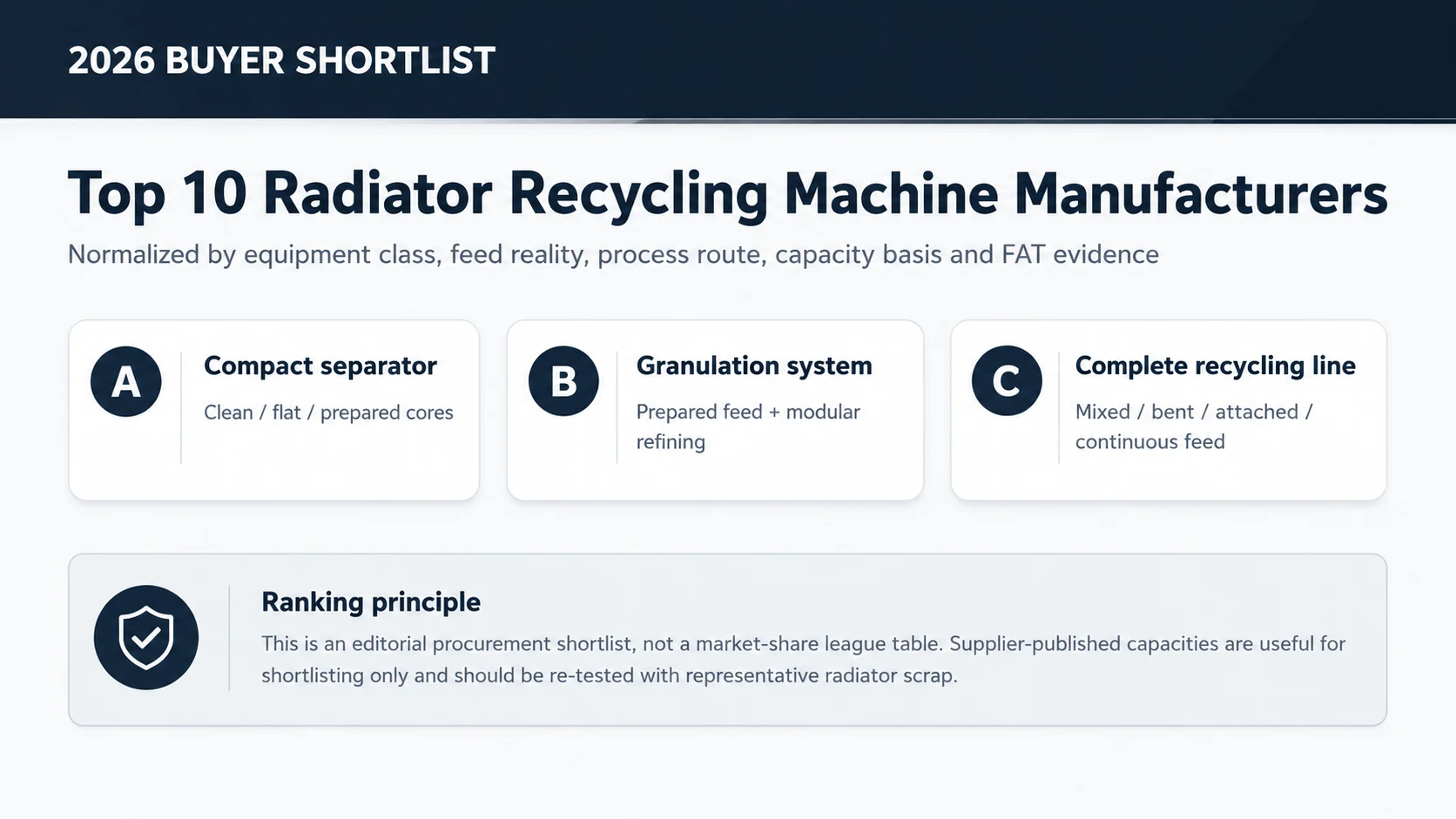
A search for a radiator recycling machine manufacturer can lead to three very different types of equipment: a compact stripping machine for clean, flat coils; a granulation system adapted from cable and non-ferrous recycling; or a complete line that shreds, liberates and separates mixed radiator scrap. A supplier can be strong in one class and a poor fit in another.
This 2026 shortlist compares ten manufacturers with current, radiator-specific product evidence. We ranked direct radiator relevance, feed flexibility, process completeness, technical disclosure, commissioning/test evidence and project fit. Supplier-published capacities are shown only as a shortlisting reference; they are not treated as independently audited performance.
First Define What “Radiator Recycling Machine” Means
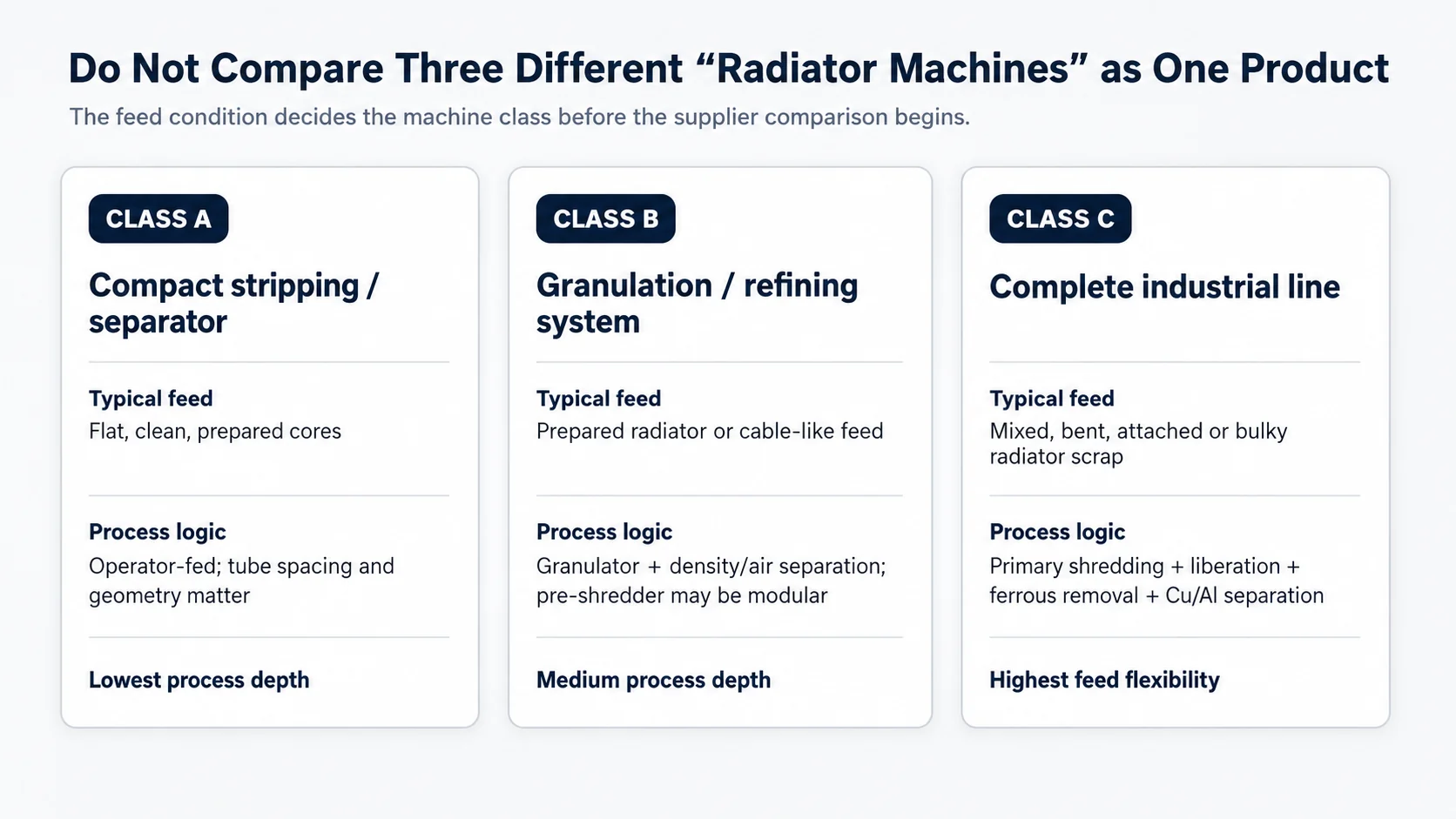
Not all radiator recycling machines are designed for the same feed or process duty, so the equipment class should be identified before suppliers are compared. The YUXI copper aluminum radiator recycling line makes the boundary clear: a small stripping machine can suit flat, clean and dimensionally consistent cores, while a complete line is intended for a broader feed such as bent, mixed or attachment-heavy radiator scrap.
Class A: compact stripping or separator machine
This route depends heavily on geometry. The operator normally presents a relatively clean coil or a prepared section to a roller, cutter or stripping mechanism. Tube spacing, coil thickness and the number of tube layers can determine whether the material can be processed at all. It can be a sensible low-capital option for a dismantler with a narrow, predictable feed stream. It is not a substitute for a line that must accept deformed mixed radiators with steel frames, plastic tanks and variable construction.
Class B: granulation and refining system
Some established cable and non-ferrous recycling manufacturers also process radiators through granulation, refining and dry density separation. The route can be compact and modular. A pre-shredder may be added when the incoming material is too bulky for direct granulation.
Class C: complete shredding, liberation and separation line
This is the industrial route for a wider feed envelope. Primary shredding opens bulky material. Secondary crushing creates liberation. Magnetic separation removes ferrous attachments, while airflow, vibration or specific-gravity equipment separates copper-rich and aluminum-rich fractions. Conveyors, dust collection and PLC coordination become part of the line rather than optional accessories.
How We Built This 2026 Manufacturer Shortlist
We started with a broader candidate pool than the final ten. A company stayed on the list only when a current official website provided direct evidence of a radiator-specific machine, plant or process. Generic metal shredders were not enough. Refrigerator lines that happened to contain copper and aluminum separation were not enough either.
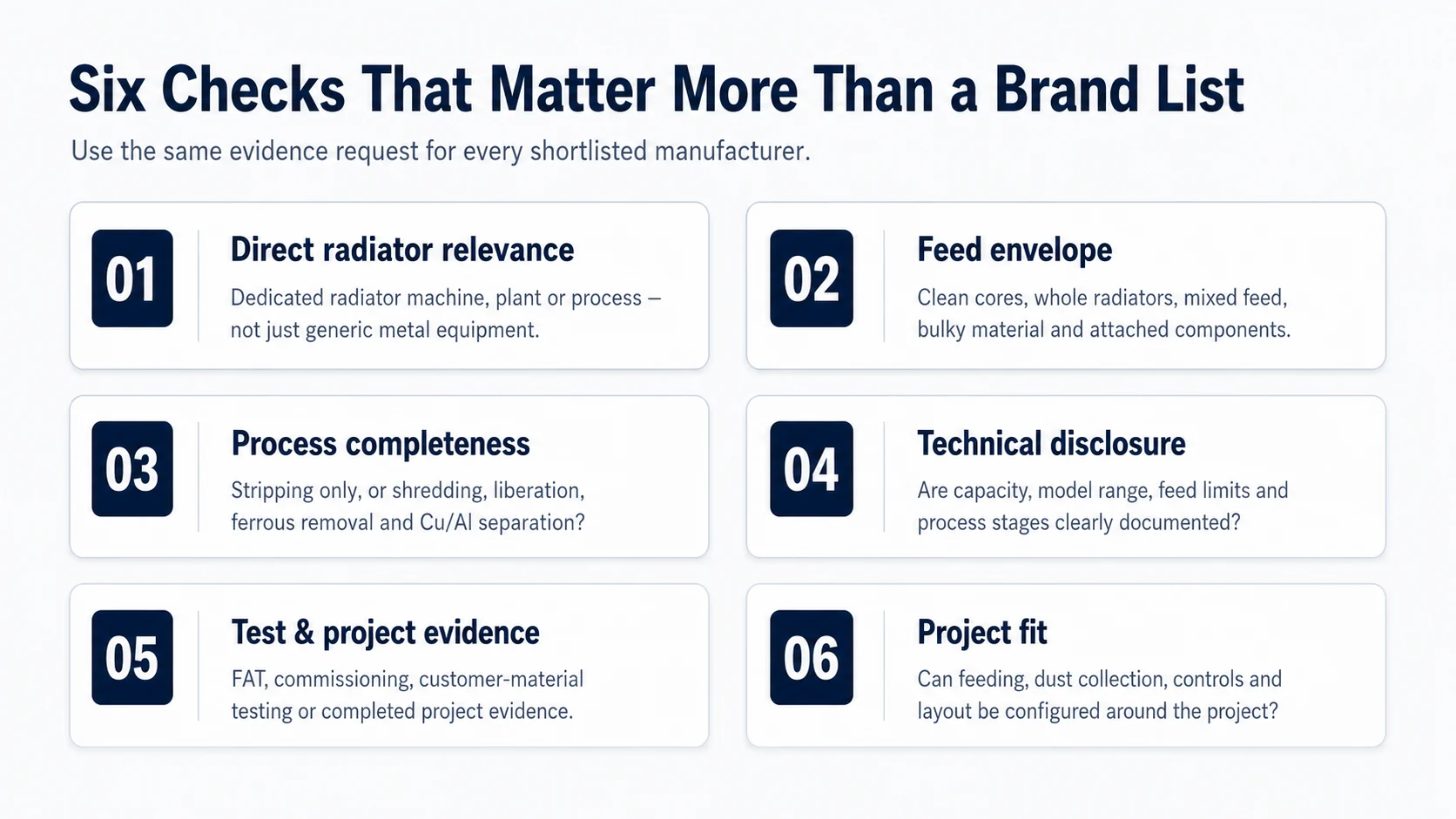
The ranking then considered six buyer-facing questions:
- Direct radiator relevance: does the supplier show a dedicated radiator product or process rather than only a generic shredder?
- Feed envelope: does the published scope explain whether the equipment accepts clean cores, whole radiators, mixed car/AC feed, large blocks or attached components?
- Process completeness: is the route limited to stripping, or does it include primary size reduction, liberation, ferrous removal and copper/aluminum separation?
- Technical disclosure: are capacities, model ranges, feed limits or process stages described clearly enough to form an RFQ?
- Test and project evidence: does the supplier show FAT, commissioning, customer-material testing or a completed line rather than only marketing renderings?
- Project fit: can the supplier configure feeding, dust collection, controls, layout and downstream separation around a real plant requirement?
Top 10 Radiator Recycling Machine Manufacturers: Comparison Table
| Rank | Manufacturer | Primary equipment class | Published capacity basis | Buyer fit |
|---|---|---|---|---|
| 1 | Stokkermill | Granulation + complete industrial systems | Multiple configured systems; radiator-specific hammermill and separation routes published | Buyers wanting an established modular route from pre-shredding through refining and advanced sorting |
| 2 | Guidetti Recycling Systems | Compact/modular granulation systems | SINCRO EKO family marketed from roughly 50 to 1,000 kg/h | Small-to-medium non-ferrous plants that value compact systems and modular pre-shredding |
| 3 | YUXI Machinery | Complete industrial radiator recycling line | Project-specific capacity based on feed condition and line configuration. | Mixed car/AC/heat-exchanger feed needing shredding, liberation, magnetic and gravity separation |
| 4 | SUNY GROUP | Complete industrial line | Supplier-published 400–500, 800–1,000 and 1,500–2,000 kg/h capacity classes | Buyers comparing standardized high-throughput full-line configurations |
| 5 | Henan DOING | Complete industrial line | Supplier-published 500 / 1,000 / 2,000 kg/h classes | Projects needing shredding, hammer crushing, magnetic and air separation with plant integration |
| 6 | WANROOETECH | Complete line + compact separator options | Complete-line models published at 1,000–5,000 kg/h; separate compact machines also offered | Buyers who want to compare manual/compact and automatic line routes from one supplier |
| 7 | BSGH Granulator | Heavy-duty complete line | Supplier-published ACP1000 at about 2–3 t/h and ACP1200 up to 5 t/h | High-volume AC-radiator projects that can validate large published capacities with their own feed |
| 8 | Gomine Recycling Machinery | Complete dry physical line | Supplier-published model ranges around 800–1,500 kg/h | Buyers looking for a clearly described shred–crush–magnetic–airflow route |
| 9 | WANREES | Complete industrial line | No capacity table on the reviewed radiator page | Buyers prioritizing a transparent six-stage process description over catalog headline numbers |
| 10 | VANER Machinery | Compact radiator stripping/separator machines | Model-dependent daily/hourly figures; geometry-specific prepared feed | Small dismantlers with clean, regular AC/car radiator cores rather than mixed industrial feed |
Capacity figures above are supplier-published references from current official pages checked on 26 August 2026. They are not independent test results and are not directly comparable until feed, runtime, process boundary and output specification are normalized.
Manufacturer Profiles and Where Each One Fits
1. Stokkermill — Strongest Overall Technical Breadth
Stokkermill publishes radiator-specific applications for automotive radiators and heat exchangers rather than treating them as a footnote under generic metal shredding. Its official material describes a process in which an HM refiner mill reduces the radiator, an over-belt magnetic system removes ferrous material, and gravimetric or dry densiometric separation handles the non-ferrous fractions. A D-series twin-shaft shredder can be installed upstream when primary volume reduction is needed.
That breadth is the reason Stokkermill takes the first position here. The company also publishes current complete-plant and sorting capabilities, including optical or sensor-based upgrades where the feed warrants them.
Best fit: recyclers that want a mature European supplier with multiple size-reduction and dry-separation building blocks. Confirm before order: which exact line configuration was used for the quoted capacity, what upstream preparation is required, and what output sampling method will define acceptance.
2. Guidetti Recycling Systems — Compact Modular Non-Ferrous Processing
Guidetti’s current SINCRO EKO series is explicitly marketed for copper and aluminum recovery from electrical cables and radiators. The family covers compact production classes and can be paired with PMG pre-shredders. That makes it a useful option where radiator processing is part of a broader non-ferrous recycling business rather than a stand-alone high-volume radiator plant.
Its strength is compact modularity. A small or medium recycler may not need a large primary shredder and long conveyor line if the feed is already prepared and consistent.
Best fit: prepared radiator feed, cable/radiator mixed businesses and plants with limited floor area. Confirm before order: actual radiator preparation, allowable piece size, continuous radiator-only capacity and whether the pre-shredder is included in the quoted scope.
3. YUXI Machinery — Complete Line for Mixed Radiator Feed
YUXI’s current radiator pillar is built around a complete mechanical route: feeding, double-shaft shredding, vertical crushing and screening, magnetic separation, specific-gravity separation, conveyors, PLC coordination and centralized dust collection. The published feed scope includes car radiators, AC condensers, copper-aluminum radiators, all-aluminum radiators, heat exchangers and mixed radiator scrap.
In practice, radiator line capacity has to be matched to the actual feed. Material density, size, deformation, steel or plastic attachments and the required output size can all change the sustainable throughput. The page says real capacity depends on feed density, size, deformation, iron/plastic content, target particle size, crusher load and separator stability. That is a better starting point for a project with variable feed.
If your project needs broader copper/aluminum liberation logic, the copper and aluminum separation guide explains why primary opening, secondary liberation, ferrous removal and controlled density separation must work together.
Best fit: industrial buyers with mixed or changing radiator streams who want a complete line rather than a geometry-dependent stripping machine. Confirm before order: representative feed envelope, sustained throughput target, final fraction specification, layout, power standard, dust-control boundary and FAT criteria.
4. SUNY GROUP — Broad Published Full-Line Capacity Range
SUNY GROUP publishes a dedicated scrap radiator recycling plant with double-shaft shredding, hammer crushing, gravity separation, airflow separation and pulse dust collection. Its current official product page lists capacity classes of 400–500, 800–1,000 and 1,500–2,000 kg/h.
That explicit model range is useful for early budgeting and plant-size screening.
Best fit: buyers who prefer a standardized complete-line starting point and want several published capacity classes. Confirm before order: model-specific feed condition, whether stated rate is gross inlet or stable complete-line throughput, and how product quality changes at the top end of the range.
5. Henan DOING — Project-Oriented Large-Scale Crushing and Separation
DOING’s official radiator page describes a large-scale line for air-conditioning radiators, car water tanks, condensers and other radiator-like feed. The published route includes shredding, hammer crushing, negative-pressure baffling, magnetic separation, air separation, cyclone/pulse dust collection and turnkey project services.
The current site shows 500, 1,000 and 2,000 kg/h equipment classes. As with every supplier in this roundup, those are useful shortlisting numbers rather than independent performance certificates. DOING’s inclusion is based mainly on the direct radiator scope and the clearly described process chain.
Best fit: buyers seeking a complete line with plant-design and installation support. Confirm before order: model basis, exact input dimensions, how the negative-pressure pre-separation interacts with downstream air separation, and the sampling procedure used for output claims.
6. WANROOETECH — Both Compact and Automatic Radiator Routes
WANROOETECH is useful because its current radiator solution explicitly distinguishes manual/compact copper-aluminum separation from an automatic crushing and separation line. That mirrors the most important decision in this market. The automatic plant page shows radiator processing with multiple model capacities, while separate stripping machines target prepared coils.
This makes WANROOETECH a comparison supplier when a recycler has not yet decided whether it needs a compact workstation or a full industrial line. The risk is assuming that numbers from those two equipment classes can be compared directly. They cannot.
Best fit: projects evaluating both low-capital prepared-core processing and automated mixed-feed processing. Confirm before order: which route the quotation covers, feed preparation before each route, labor requirement and whether dust/control auxiliaries are included.
7. BSGH Granulator — High-Throughput Radiator Line Claims Worth Testing
BSGH publishes two current radiator line families: the BS-ACP1000, described at about 2–3 t/h, and the BS-ACP1200, marketed up to 5 t/h. The ACP1000 page describes twin-shaft pre-shredding, secondary crushing, air/vibrating separation, magnetic separation and dust collection. The ACP1200 uses a different first crushing arrangement and is positioned as the higher-capacity option.
The published capacity is unusually high for this shortlist, which makes representative testing more important. Feed dimensions, radiator construction, attached material, productive runtime and output quality can move the real sustainable rate substantially.
Best fit: high-volume radiator projects willing to run a disciplined FAT before committing to headline capacity. Confirm before order: exact representative feed, measured sustained rate, downtime during the run, output mass balance and how the quoted separation result is sampled.
8. Gomine Recycling Machinery — Clear Dry-Process Line Architecture
Gomine’s current radiator production-line page describes a dry physical process for automobile radiators, AC radiators, water-tank radiators, condensers and heat exchangers. The published process includes primary shredding, hammer crushing, magnetic separation, airflow sorting, optional electrostatic separation and pulse dust collection.
The company currently lists model ranges around 800–1,500 kg/h. Optional electrostatic separation may be relevant to certain fine fractions, but it should not be added automatically without confirming particle size and the actual separation problem.
Best fit: buyers who want a conventional dry shred–crush–magnetic–air route with optional upgrading. Confirm before order: when electrostatic separation is justified, the target particle-size window and how much recirculation is expected.
9. WANREES — Transparent Six-Stage Process Description
WANREES publishes a recent copper-aluminum radiator line with six named stages: double-shaft shredding, hammer crushing, magnetic separation, airflow sorting, specific-gravity sorting and pulse dust collection. Its reviewed page does not provide a model capacity table, so there is less catalog data to normalize at the first pass.
That does not make it a weak candidate. For an engineering buyer, a clear process boundary can be more useful than an isolated capacity label. The next step is simply to force the quotation to become specific: feed dimensions, feed composition, sustained rate, final fractions, power, footprint, maintenance access and test plan.
Best fit: buyers who want a complete dry line and are prepared to develop the technical specification through RFQ. Confirm before order: model range, proven feed envelope, capacity basis and project references for material similar to yours.
10. VANER Machinery — Compact Prepared-Core Specialist
VANER is intentionally kept in the shortlist even though it is not a like-for-like competitor to the complete lines above. Its V-1200P and V-1100S products are compact radiator recycling/stripping machines. The V-1200P page, for example, states that clean radiators are cut to a width that fits the inlet and that single- or double-layer material can be processed directly, while thicker material may need pre-cutting.
For a dismantler with a steady supply of clean AC coils, a small separator can make more sense than a multi-stage plant. For mixed automotive and HVAC scrap, it may create too much manual preparation and too narrow a feed window.
Best fit: low-to-moderate volume prepared radiator cores with consistent geometry. Confirm before order: tube spacing, number of layers, required pre-cutting, operator rate and the percentage of your normal feed that falls outside the machine’s accepted geometry.
How to Compare Radiator Recycling Capacity Without Being Misled
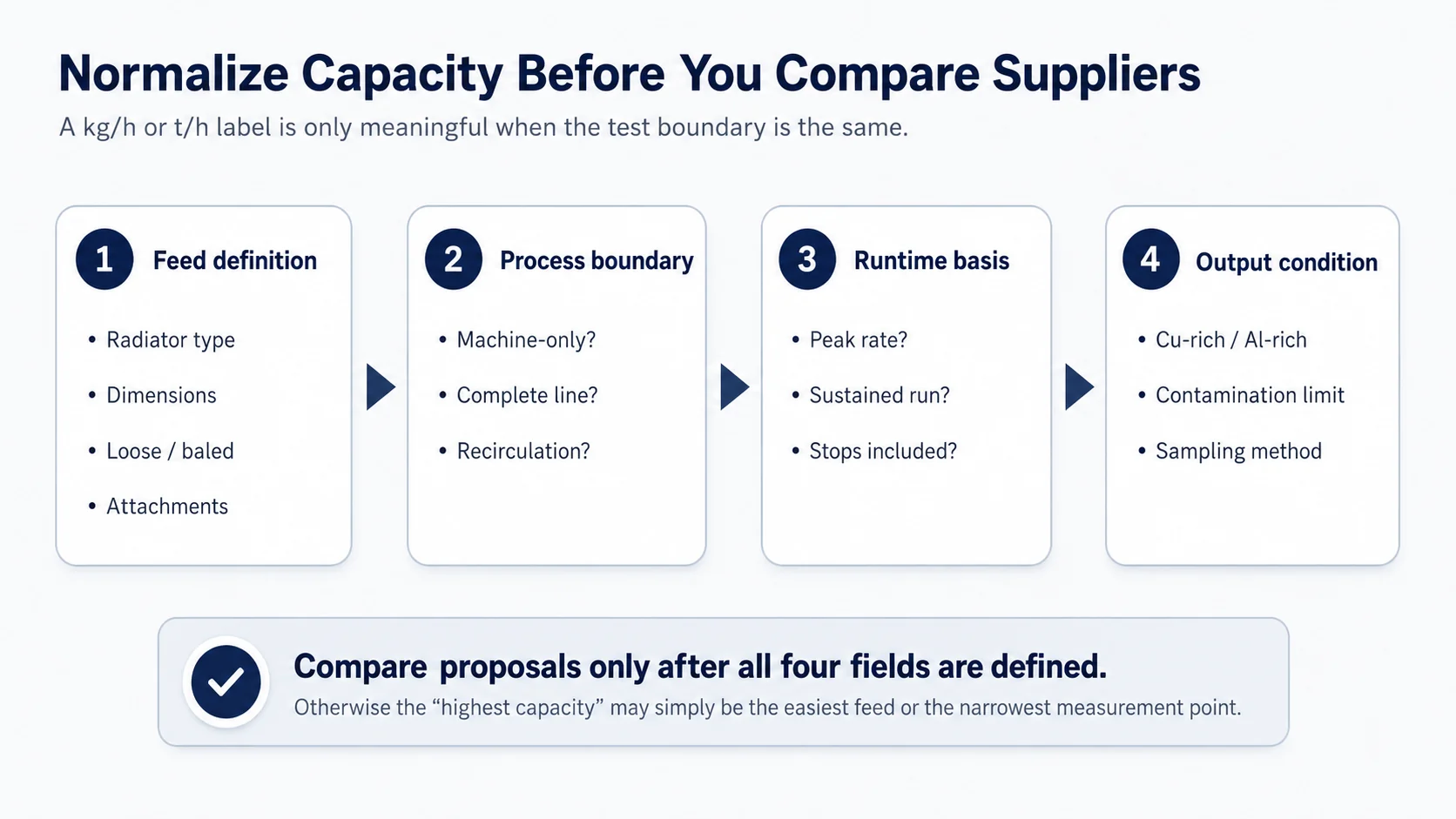
Capacity is the easiest number to copy into a spreadsheet and one of the easiest to misread. The existing radiator recycling line capacity guide explains the full sizing method. For manufacturer comparison, four fields are enough to expose most false equivalence.
1. Feed definition
Write the radiator family, percentage mix, average and maximum dimensions, loose or compacted condition, steel/plastic attachments and residual liquids. A stack of clean AC coils is not the same duty as crushed car radiators with side tanks and heavy brackets.
2. Process boundary
Ask where the tonnes are measured. At the first feeder? At the primary shredder discharge? Or after the final separator? A complete-line rate is more useful for plant design than the maximum rate of one machine, but only if the same boundary is used in every proposal.
3. Runtime basis
A five-minute burst is not a shift rate. Ask for sustained productive runtime and record every bridge, overload, screen clean, manual intervention and recirculation event. The data does not need to hide normal stops; it needs to show them.
4. Output condition
The line is not useful if the copper-rich and aluminum-rich products fall outside your buyer’s contamination limits at the quoted rate. Capacity and output quality must be tested together. That is also why the phrase “99% purity” is incomplete without the fraction, sample location, sample method and denominator.
What to Ask Before You Choose a Manufacturer
The machine list matters, but the engineering conversation around it is more revealing. A serious supplier should be able to explain the causal link between your material and each process stage.
Ask what the primary shredder is expected to accomplish
Primary shredding should open bulky material and make feeding into the next stage controllable. It should not be credited with copper/aluminum separation if the metals are still mechanically bonded. If the supplier proposes no primary stage, ask what feed dimensions and preparation allow the next machine to accept the material safely and continuously.
Ask how liberation is verified
The secondary crusher or granulator has to break enough copper-aluminum connections for the separator to work. Too little liberation leaves composite particles. Excessive size reduction can create fines, dust and additional wear. Ask for representative output samples at the proposed screen or size setting.
Ask where ferrous material leaves the line
Steel frames, screws and brackets should not be treated as invisible contamination. Ask where they are removed, what maximum steel attachment is acceptable at the inlet and how magnetic loading affects the rest of the process.
Ask how dust, access and maintenance are designed
Dust collection is not a decorative accessory. It affects housekeeping, visibility, filter maintenance and process stability. Machine guarding also matters around shredders, belts, rotating equipment and nip points. In the United States, OSHA 29 CFR 1910.212 requires machine guarding against hazards such as points of operation, ingoing nip points, rotating parts, flying chips and sparks.[1]
Safe jam clearing is another design question. OSHA 29 CFR 1910.147 addresses hazardous-energy control during servicing and maintenance, including cleaning and unjamming when unexpected startup or stored energy could injure workers.[2] Regulations differ by country, so the final machine and plant safety design must be checked against the rules that apply at the installation site.
Ask for a quotation boundary, not just a machine price
Compare whether each proposal includes feeding, conveyors, primary and secondary size reduction, screens, magnetic separation, copper/aluminum separation, dust collection, PLC, electrical cabinet, platforms, spares, freight packaging, installation supervision and commissioning. The radiator recycling machine price guide separates machine price from the wider installed project cost.
Factory Acceptance Testing: The Best Way to Compare the Final Two Suppliers
Once the shortlist is down to two or three suppliers, another table of marketing claims adds little value. A representative factory acceptance test is more useful.
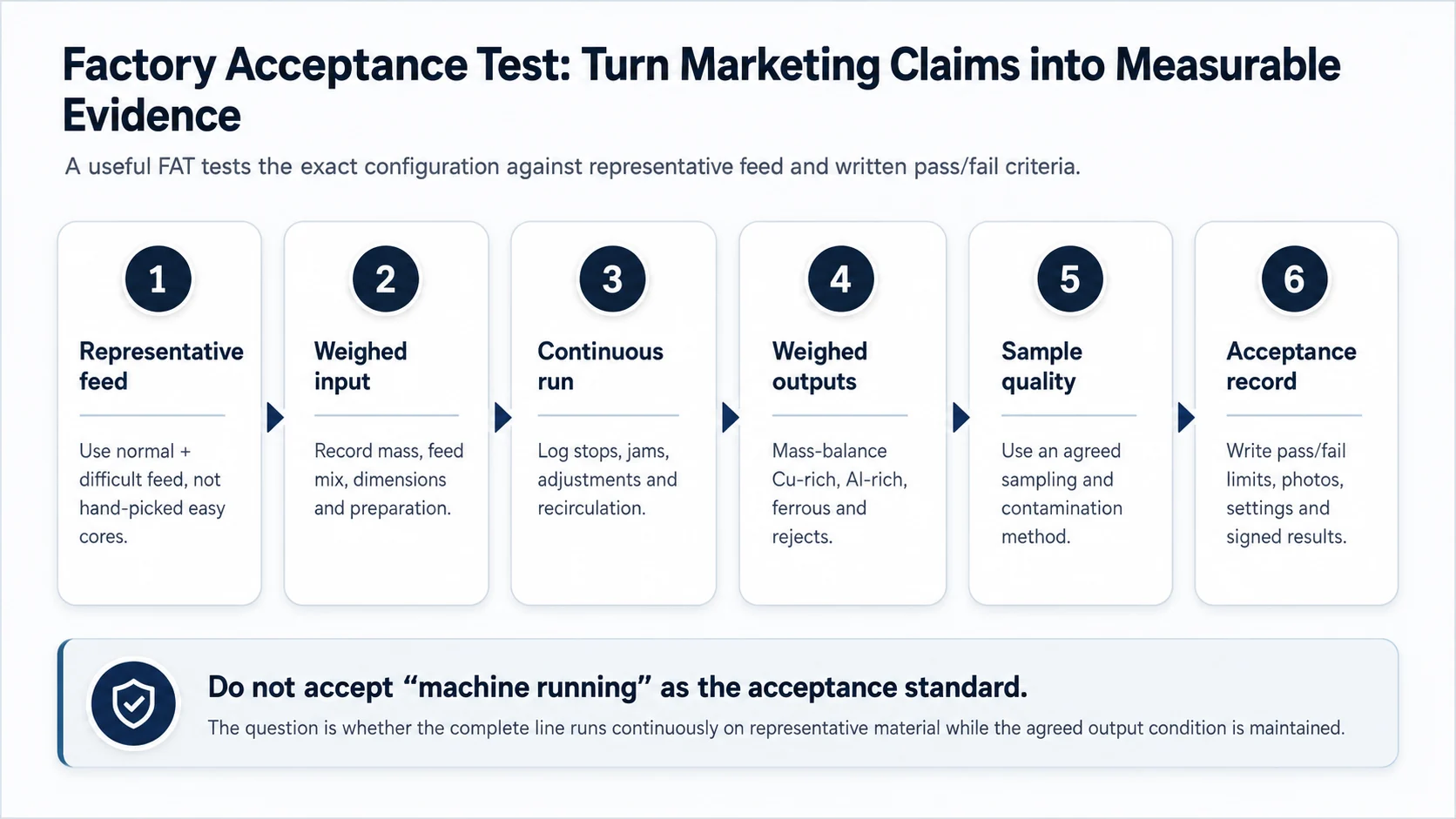
A strong FAT should include:
- representative feed from the buyer, including normal variability rather than only easy flat cores;
- weighed input and a written description of feed composition and preparation;
- a long enough continuous run to expose bridging, overload, separator surging and cleaning needs;
- a downtime log that records jams, adjustments, recirculation and manual intervention;
- weighed copper-rich, aluminum-rich, ferrous, light/non-metal and reject streams;
- an agreed sampling method for contamination or purity checks;
- machine settings, screen configuration and feed rate recorded with the result;
- written pass/fail limits tied to the exact configuration being purchased.
Common Mistakes When Comparing Radiator Recycling Machine Suppliers
- Comparing a stripping machine with a complete line. The feed preparation and process depth are fundamentally different.
- Choosing the highest catalog t/h. Capacity without a feed and output boundary is not a common test standard.
- Using purity as a standalone ranking metric. Purity needs a defined product fraction and sampling method.
- Ignoring attachments and bad-day feed. Steel frames, plastic tanks, bent sections and compacted scrap often determine the real bottleneck.
- Assuming more crushing is always better. Unnecessary fine crushing adds wear, dust and fines without automatically improving saleable product.
- Ignoring wear parts and maintenance access. Screens, hammers, cutters, bearings and separation decks need inspection and service room.
- Buying a machine instead of a process boundary. Missing conveyors, dust collection, controls or platforms can move cost and responsibility back to the buyer.
- Skipping representative testing. A polished demonstration with easy feed tells less than a controlled run with the buyer’s own material.
RFQ Checklist for the Final Manufacturer Shortlist
Send the same information to every supplier. It makes quotations easier to compare and reduces the chance that one company assumes clean AC coils while another designs for mixed automotive radiators.
Need a Radiator Line Configuration Review?
Send representative material photos or video, maximum dimensions, the approximate car/AC radiator mix, attached steel/plastic condition, target continuous throughput and the final fractions you want to sell.
FAQ: Radiator Recycling Machine Manufacturers
Who is the best radiator recycling machine manufacturer?
There is no single best supplier for every feed. Stokkermill ranks first in this editorial shortlist for technical breadth, while Guidetti is strong in compact modular non-ferrous systems and YUXI is positioned for complete mixed-feed industrial lines. The right choice depends on your radiator construction, preparation, throughput, output specification and site requirements.
Is a radiator separator the same as a radiator recycling line?
No. A compact separator usually depends on clean, regular radiator geometry and manual or semi-manual feeding. A complete line accepts a wider feed envelope and adds shredding, liberation, ferrous removal, copper/aluminum separation, conveying, controls and dust collection.
How should I compare kg/h or t/h between suppliers?
Make every supplier use the same feed definition, process measurement point, test duration and output-quality requirement. Ask whether the number is a peak, machine-only rate or sustained complete-line throughput, and record downtime and recirculation during testing.
Should I choose a supplier that publishes the highest purity?
Not from the percentage alone. Ask which product fraction was sampled, where the sample was taken, how large it was, what counted as contamination and whether the result was maintained during a sustained run on representative material.
Can one line process both car and AC radiators?
A properly configured complete line can be designed for a mixed feed, but the percentage of car versus AC radiators, plastic tanks, steel brackets, deformation and residual liquids must be defined. Those variables can change feeding, wear, liberation and separator loading.
What should I send a manufacturer before asking for a quotation?
Send photos or video, radiator types and percentages, maximum dimensions, loose or baled condition, attached steel and plastic, pre-treatment, desired sustained throughput, final product specification, power standard, layout limits and destination country.
What should a radiator recycling line FAT include?
Use representative feed, weighed input and outputs, a continuous runtime, downtime and jam records, recirculation, agreed sampling of final fractions, machine settings and written pass/fail criteria tied to the exact configuration being purchased.
Safety References
- OSHA 29 CFR 1910.212 — machine guarding.
- OSHA 29 CFR 1910.147 — lockout/tagout.